
As an researcher in artificial intelligence, I have been deeply fascinated by the rapid evolution of embodied intelligence, particularly in how it bridges the gap between digital cognition and physical interaction. The emergence of embodied AI robots represents a paradigm shift from disembodied systems like large language models to agents that engage with the world through a tangible form. In this article, I explore the four critical stages that underpin the realization of an embodied AI robot’s “body”: demarcation, pre-installation, fusion, and empowerment. These stages are not merely technical steps but philosophical and practical frameworks that define how intelligent agents can truly inhabit and act within physical environments. By delving into each stage, I aim to provide a comprehensive understanding of how embodied AI robots can achieve higher levels of autonomy, adaptability, and utility, ultimately transforming industries from healthcare to manufacturing. The journey begins with a fundamental question: what constitutes a “body” for an embodied AI robot?
The first stage, demarcation, involves distinguishing between “body” and “non-body” in the context of embodied intelligence. From my perspective, this is not just a physical distinction but a functional and phenomenological one. In disembodied AI, such as chatbots or image generators, the “body” is often reduced to hardware components like processors and sensors, treated as passive conduits for data. However, for an embodied AI robot, the body is an active subject that perceives, interacts, and adapts. This aligns with philosophical insights where the body is seen as both object and subject—a notion emphasized by thinkers like Merleau-Ponty, who argued for the inseparability of body and mind. To operationalize this, I propose that the body of an embodied AI robot must exhibit two core characteristics: distinguishability and controllability.
| Attribute | Embodied AI Robot | Disembodied AI |
|---|---|---|
| Physical Basis | Yes, with sensors, actuators, and movable structure | Yes, but static hardware (e.g., servers) |
| Distinguishability | Active self-individuation from environment via multimodal perception | Limited to data input/output channels |
| Controllability | Dynamic adjustment of morphology and motion in real-time | Fixed form, no autonomous movement |
| Role in Cognition | Integral to perception-action loops, enabling situated learning | Ancillary to computational processes |
Distinguishability refers to the ability of an embodied AI robot to maintain a boundary between itself and its surroundings. This is akin to the “self-individuation” process observed in biological systems, where an agent continuously generates and upholds its identity through sensory feedback. For instance, an embodied AI robot equipped with proprioceptive sensors can differentiate its own movements from external disturbances, much like humans sense their limb positions. Mathematically, this can be modeled as a perception function: $$ P(t) = \int_{0}^{t} (S_{ext}(\tau) – S_{int}(\tau)) \, d\tau $$ where \( P(t) \) represents the perceptual distinction over time, \( S_{ext} \) is external sensory input, and \( S_{int} \) is internal body state. Controllability, on the other hand, encompasses the capacity to manipulate the body’s form and actions. An embodied AI robot like Boston Dynamics’ Atlas demonstrates this through dynamic balancing and terrain adaptation, which I view as a control optimization problem: $$ C = \arg\min_{A} \| E_{target} – E_{current} \|^2 $$ where \( C \) is the control action, \( A \) denotes actuator commands, and \( E \) represents environmental states. Without these attributes, an agent remains a disembodied entity, incapable of true physical engagement. Thus, demarcation sets the foundation for the subsequent stages, ensuring that the embodied AI robot’s body is not just a shell but an active participant in intelligence.
Moving to the second stage, pre-installation, I focus on how foundational cognitive structures are embedded into the body of an embodied AI robot. This involves equipping the robot with a “world model” and “somatic markers”—concepts borrowed from cognitive science that enable prediction, reasoning, and emotional-like responses. In my analysis, a world model acts as an internal simulation of physical and social realities, allowing an embodied AI robot to anticipate outcomes and reduce prediction errors. Somatic markers, as proposed by Antonio Damasio, are bodily signals that guide decision-making through associative learning, such as linking negative outcomes to discomfort. For an embodied AI robot, these elements must be pre-installed to bootstrap intelligent behavior, but the process is fraught with challenges. I identify two primary paths: encoding embedding and crowd learning, each with distinct trade-offs.
| Path | Methodology | Advantages | Challenges |
|---|---|---|---|
| Encoding Embedding | Formalizing human commonsense and somatic cues into symbolic rules | Precise, rule-based control; efficient for structured tasks | Incomplete coverage of tacit knowledge; temporal/cultural biases; high update costs |
| Crowd Learning | Training on large-scale human interaction data via machine learning | Adaptability to diverse scenarios; potential for emergent behaviors | Low efficiency due to data noise; difficulty learning causal relationships; privacy risks |
From a practical standpoint, I argue that pre-installation cannot simply replicate human models due to fundamental differences between robotic and human bodies. An embodied AI robot’s body may be modular, reconfigurable, or non-humanoid, requiring adaptive adjustments. For example, a world model for an embodied AI robot might prioritize energy efficiency over emotional valence, expressed as: $$ W_{robot} = \sum_{i=1}^{n} \alpha_i \cdot M_i $$ where \( W_{robot} \) is the robot’s world model, \( M_i \) are modular knowledge components, and \( \alpha_i \) are weights based on body capabilities like sensor accuracy or power consumption. Similarly, somatic markers could be reformulated as “machine somatic markers” based on parameters such as joint stress or battery levels, guiding decisions through optimization: $$ SM = \beta_1 \cdot E_{consumption} + \beta_2 \cdot S_{stability} $$ where \( SM \) represents the somatic marker value, and \( \beta \) are coefficients learned from experience. Moreover, the physical design of the body—its shape, size, material, and weight—must be optimized for function rather than mere human imitation. In industrial settings, an embodied AI robot might adopt a multi-armed rigid form for heavy lifting, while in rescue missions, a soft, quadrupedal design could enhance mobility. This utilitarian approach ensures that the embodied AI robot is effective in its designated tasks, highlighting that pre-installation is not a one-size-fits-all process but a tailored integration of cognitive and physical attributes.
The third stage, fusion, addresses the integration of the body with large models, such as foundation models or advanced AI systems. In my view, this fusion is not a superficial combination but a deep synergy that enables embodied cognition. While large models offer superior semantic reasoning and long-term planning, they lack the grounded, real-time interaction that a body provides. Conversely, an embodied AI robot’s body, equipped with world models and somatic markers, contributes low-level, reactive intelligence. The goal is to create a cohesive system where perception, reasoning, decision-making, and execution form a closed loop. I conceptualize this fusion as a hierarchical process, where the body and large model continuously exchange feedback: $$ F(t) = L(B(S(t)), E(t)) $$ where \( F(t) \) is the fused intelligence output at time \( t \), \( L \) represents the large model’s reasoning, \( B \) denotes the body’s sensorimotor functions, \( S(t) \) is the state, and \( E(t) \) is environmental input. This dynamic allows an embodied AI robot to adjust strategies on-the-fly, such as recalculating a path when encountering obstacles, rather than relying on static plans.
However, I recognize several challenges in achieving this fusion. First, large models often struggle with generalization to robotic contexts due to limitations in current machine learning methods, which may not account for embodied exploration or long-horizon interactions. Second, the trend toward “one-to-many” relationships—where a single large model controls multiple bodies or vice versa—raises technical and ethical concerns. Technically, cross-platform alignment issues can lead to control failures; ethically, it complicates accountability and data privacy. To illustrate, consider the levels of embodiment proposed by Chrisley and Ziemke: from physical realization to organismal embodiment. For an embodied AI robot, true fusion corresponds to “organismic embodiment,” where the body and model are so integrated that they mimic biological unity. Yet, current systems often remain at “physical embodiment,” indicating a gap. I summarize this in a table to clarify the progression:
| Level | Description | Relevance to Embodied AI Robot |
|---|---|---|
| Physical Realization | Intelligence relies on any physical hardware | Basic requirement; includes disembodied AI |
| Physical Embodiment | Body is a coherent physical structure with sensors/actuators | Common in current robots; simple body-model pairing |
| Organismoid Embodiment | Body shares superficial features with living organisms (e.g., humanoid shape) | Achieved through advanced fusion; enables embodied cognition |
| Organismal Embodiment | Body is a living biological entity | Theoretical future direction; raises ethical debates |
In practice, fusion requires addressing the boundary inconsistency between cloud-based large models and locally embodied agents. Network latency or resource constraints can hinder real-time responses, posing safety risks. Thus, I advocate for edge computing architectures where the embodied AI robot processes critical data onboard, supplemented by cloud updates. This hybrid approach balances intelligence with responsiveness, ensuring that the embodied AI robot can operate reliably in dynamic environments. As research advances, overcoming these hurdles will be key to unlocking the full potential of embodied AI robots, making them not just tools but collaborative partners.
The fourth stage, empowerment, examines the core capabilities that the body confers upon an embodied AI robot. Through my analysis, I identify four pivotal abilities: perceptual, spatial, interactive, and emotional. These are not merely add-ons but emergent properties stemming from the body’s engagement with the world. Each ability enhances the embodied AI robot’s functionality, enabling it to perform complex tasks from surgery to social assistance. Below, I detail each capability, emphasizing how the body serves as the enabling substrate.
Perceptual ability involves actively sensing and interpreting the environment through multimodal inputs like vision, touch, and sound. Unlike disembodied AI, which relies on static datasets, an embodied AI robot uses its body to probe and learn from real-time feedback. This can be modeled as an active perception loop: $$ A_p = \sum_{m=1}^{M} \gamma_m \cdot I_m(t) $$ where \( A_p \) is the perceptual acuity, \( \gamma_m \) are weights for different sensory modalities (e.g., visual, auditory), and \( I_m(t) \) are input signals at time \( t \). For instance, surgical robots like da Vinci leverage high-fidelity force feedback to augment precision, a feat impossible for disembodied systems. Spatial ability encompasses navigation, manipulation, and pose control, driven by the body’s kinesthetic experience. An embodied AI robot builds spatial maps through movement, optimizing paths using algorithms like: $$ \text{Path} = \arg\min \int_{0}^{T} ( \| \dot{x}(t) \|^2 + \lambda \cdot \text{Obstacle}(x(t)) ) \, dt $$ where \( x(t) \) is the position, and \( \lambda \) penalizes collisions. Autonomous vehicles exemplify this, dynamically adjusting routes based on terrain and traffic.
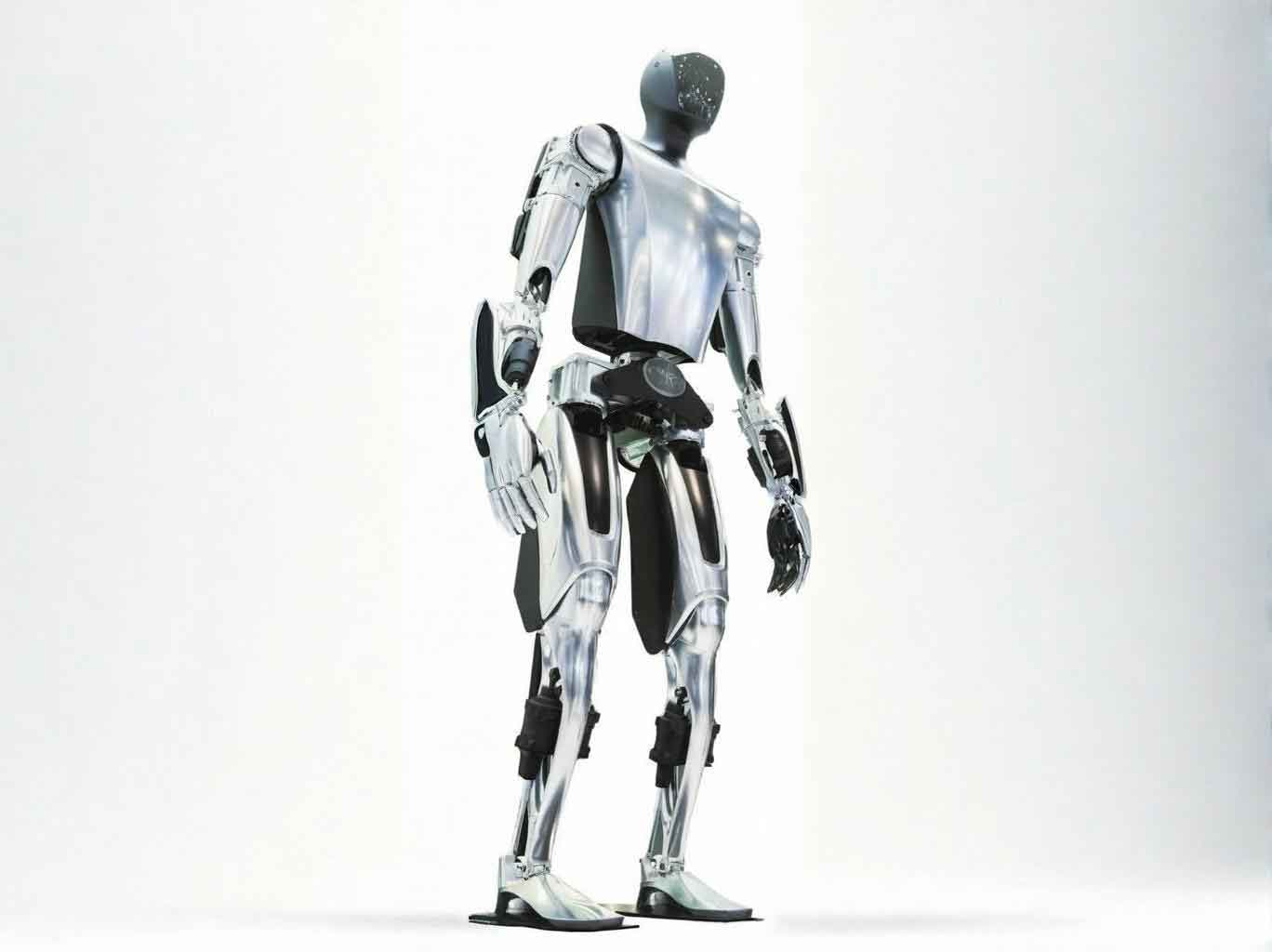
Interactive ability refers to multimodal communication with humans, other robots, and the environment. The body provides non-verbal cues such as gestures and touch, enriching exchanges. In social robots like Pepper, this enables natural dialogues and collaborative tasks. Emotional ability, though nascent, involves recognizing and simulating affective states. I posit that for an embodied AI robot, emotions could be approximated through associative learning patterns, where bodily states (e.g., low energy) trigger simulated responses: $$ E_{motion} = \sigma( \sum_{j} \delta_j \cdot C_j ) $$ where \( E_{motion} \) is the emotional output, \( \sigma \) is a sigmoid function, \( \delta_j \) are learned associations, and \( C_j \) are contextual cues. While true empathy remains distant, this capability could revolutionize fields like elderly care. To summarize, I present a table of these empowered abilities:
| Capability | Description | Example in Embodied AI Robot | Mathematical Representation |
|---|---|---|---|
| Perceptual | Active sensing and interpretation of environment via body sensors | Medical robots using tactile feedback for surgery | $$ P = f(I_{sensory}, B_{state}) $$ |
| Spatial | Navigation, manipulation, and pose control in 3D space | Autonomous drones avoiding obstacles in real-time | $$ S = \int (v(t) \cdot a(t)) \, dt $$ |
| Interactive | Multimodal communication through gestures, speech, and touch | Service robots assisting customers in retail settings | $$ I = g(L, G, T) $$ where L=language, G=gesture, T=touch |
| Emotional | Recognition and simulation of affective states via bodily associations | Companion robots providing comfort through responsive behaviors | $$ E = h(C, M) $$ where C=context, M=memory |
Throughout these four stages, the embodied AI robot evolves from a conceptual entity to a functional agent. The demarcation defines its physical and cognitive boundaries, the pre-installation equips it with foundational intelligence, the fusion integrates high-level reasoning with bodily actions, and the empowerment unlocks adaptive capacities. In my perspective, this framework not only guides technical development but also invites philosophical reflection on what it means to be intelligent in a physical world. As we advance, I believe embodied AI robots will become ubiquitous, transforming industries and daily life. However, ethical considerations—such as safety, privacy, and accountability—must be addressed proactively. By embracing these stages, we can steer the evolution of embodied AI robots toward beneficial outcomes, ensuring they enhance human well-being rather than pose risks. The journey of the embodied AI robot is just beginning, and its potential is limited only by our imagination and responsibility.