
The field of robotics is undergoing a profound transformation, moving beyond specialized, single-task machines towards versatile, intelligent agents that can operate fluidly within human-centric environments. At the forefront of this revolution is the embodied AI robot, particularly in its humanoid form. An embodied AI robot is defined by its physical instantiation and its capacity to acquire intelligence and skills through direct interaction with the physical world. This concept of “embodiment” is crucial, as it posits that intelligence emerges not just from computation, but from the dynamic coupling between an agent’s body, its sensors and actuators, and its environment. The humanoid morphology represents the ideal vessel for this embodied AI, as its anthropomorphic design grants it an innate compatibility with environments built for humans—navigating stairs, using tools, and interacting with people in an intuitive manner. This review aims to dissect the technological landscape of humanoid robots, tracing their evolution, analyzing their core subsystems, examining applications, confronting existing challenges, and forecasting future trends centered on the development of truly capable embodied AI robots.
Evolution and Current State of Humanoid Robotics
The journey of humanoid robots from mechanical curiosities to platforms for advanced embodied AI can be segmented into distinct phases, each marked by technological breakthroughs and shifting paradigms.
| Phase | Timeframe | Key Characteristics & Technologies | Limitations |
|---|---|---|---|
| Early Mechanical | 1970s-1990s | Focus on basic bipedal locomotion using simple control systems and rigid mechanics. Research prototypes demonstrated fundamental walking. | Extremely limited autonomy, no real-time sensing, pre-programmed movements, high energy consumption. |
| Integrated Sensing & Static Control | 2000-2015 | Integration of basic sensor suites (cameras, IMUs). Development of Zero Moment Point (ZMP)-based walking for stable, albeit slow, locomotion. Increased degrees of freedom (DoF). | Movement was static or quasi-static. Limited environmental understanding. High-level intelligence and adaptive control were minimal. |
| High-Dynamic Motion & Early AI | 2015-2022 | Breakthroughs in dynamic balancing and whole-body control enabled running, jumping, and acrobatics. Early application of deep reinforcement learning (DRL) for locomotion and simple manipulation in simulation. | AI was largely separate from the core real-time control stack. Perception-action loops were narrow. Skills were not generalizable. |
| Embodied AI Integration | 2022-Present | Convergence of large AI models (LLMs, VLMs) with robotic control. Shift towards end-to-end learning, where perception, planning, and control are jointly optimized. Emergence of “foundation models” for robotics. | Bridging the simulation-to-reality gap. Managing computational latency for real-time control. Achieving robust and safe generalization in the physical world. |
Globally, the development landscape features established leaders and agile newcomers. In the United States, companies like Boston Dynamics have set the benchmark for dynamic athleticism with their Atlas robot, now transitioning to an all-electric platform. Tesla’s Optimus project emphasizes vertical integration and scalability for manufacturing applications. Startups like Figure AI and 1X Technologies are pursuing data-driven approaches, leveraging partnerships with AI leaders like OpenAI to imbue their robots with advanced reasoning and natural language capabilities. Japan retains deep expertise in precise mechanics and human-robot interaction, with a long history of research and development. In Europe, academic institutions like ETH Zurich and commercial entities focus on robust locomotion and advanced control theory.
The domestic landscape in China is characterized by remarkable dynamism and rapid iteration. Companies such as Fourier Intelligence, Unitree Robotics, and Ubtech are producing capable humanoid platforms at competitive costs, often with a strong focus on industrial and service applications. A key differentiator is the trend towards greater openness in development frameworks and modular designs, fostering a collaborative ecosystem. The establishment of national and regional innovation centers (e.g., the Beijing Embodied Intelligent Robot Innovation Center) signifies a concerted, policy-backed effort to build a holistic industrial chain. While certain high-performance components and foundational AI models may still rely on international sources, the pace of innovation, market responsiveness, and systemic support position the domestic industry for significant global impact.
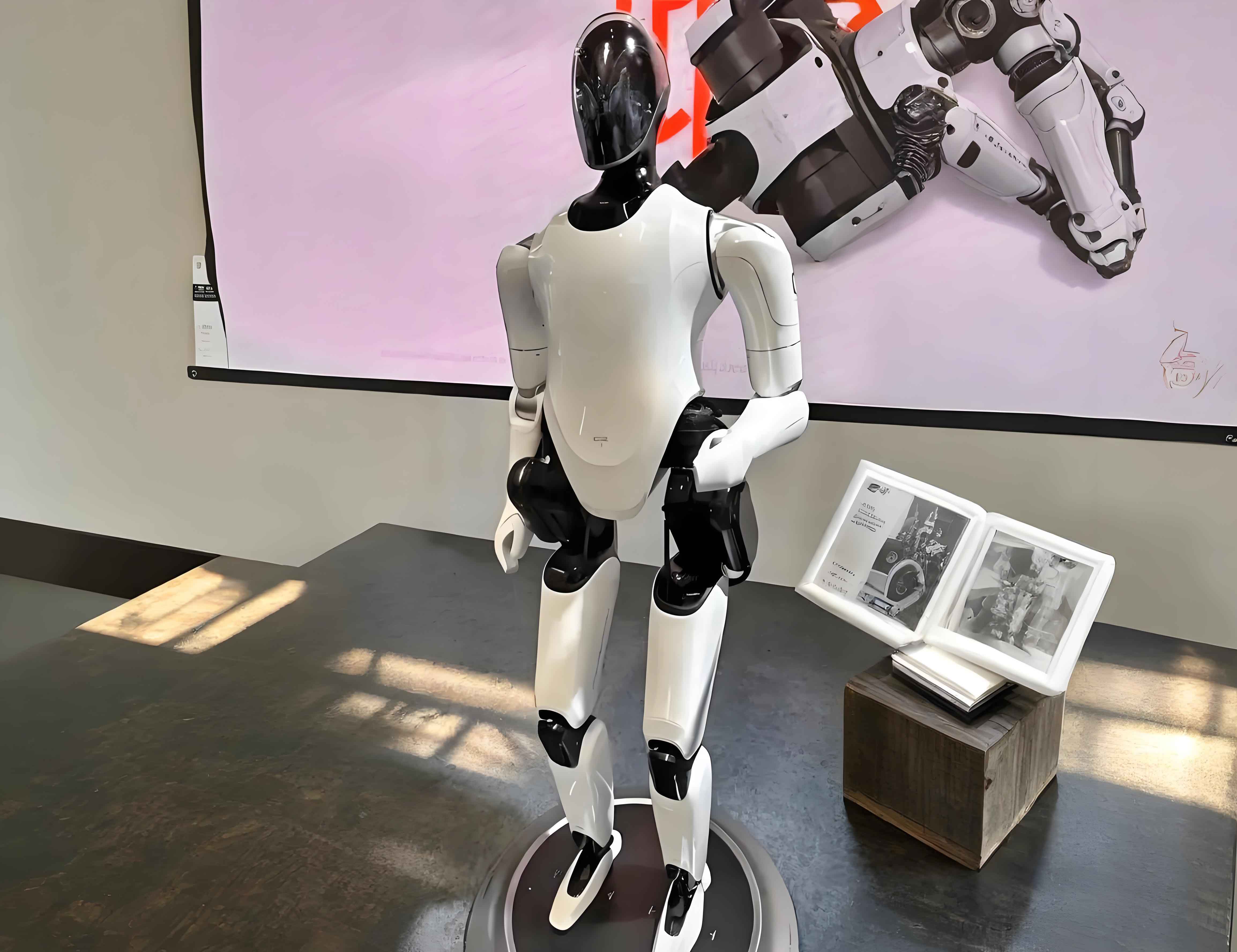
Deconstructing the Core Technologies of an Embodied AI Robot
A modern humanoid embodied AI robot is a symphony of interdependent subsystems. Its capabilities are defined by the performance and integration of its hardware and the sophistication of its software intelligence.
1. Hardware Platform: The Physical Body
The mechanical body must balance strength, weight, and flexibility. Advanced alloys, composites, and topology-optimized structures are used to achieve a high strength-to-weight ratio. The actuator is the fundamental unit of motion. The prevailing trend is toward high-torque density, backdrivable electric joint modules, often integrating a frameless motor, a harmonic drive reducer, and a high-resolution encoder into a single compact unit. The performance of these actuators directly limits the robot’s speed, force, and efficiency.
A critical component for dexterous interaction is the end-effector. Anthropomorphic hands with multiple degrees of freedom (often 5-6 active DoF per hand) and integrated tactile sensors are essential for complex, in-hand manipulation. The choice between rigid, tendon-driven hands and softer, underactuated designs involves trade-offs between precision, robustness, and cost. Key hardware components are summarized below:
| Component Category | Key Function & Challenge | Technological Trends |
|---|---|---|
| Joint Actuator | Provides torque for movement. Must be powerful, efficient, backdrivable, and compact. | High-torque density permanent magnet synchronous motors (PMSM). Advanced harmonic drives. Integrated torque sensing via current measurement or strain gauges. |
| Tactile Sensor | Provides contact force, pressure, and slip information for manipulation. | High-density flexible sensor arrays. Vision-based tactile sensors (e.g., GelSight). Multi-modal sensing (force, vibration, temperature). |
| Central Compute Unit | Runs perception, AI, and control algorithms in real-time. | Heterogeneous SoCs combining multi-core CPUs, GPUs, and NPUs. Edge-AI processing to reduce latency and reliance on cloud. |
| Power System | Provides energy for mobility and computation. Limits operational duration. | High-energy-density battery cells (e.g., Lithium-based). Advanced Battery Management Systems (BMS). Research into fuel cells and hybrid systems. |
2. Perception and Scene Understanding: The Robot’s Senses
An embodied AI robot relies on a multi-modal sensor suite to build a coherent model of its world. This typically includes:
- Vision: Stereo cameras and depth sensors (RGB-D) for 3D reconstruction, object recognition, and semantic segmentation. Event-based cameras are being explored for low-latency, high-dynamic-range perception.
- Proprioception: Encoders, inertial measurement units (IMUs), and joint torque sensors provide continuous feedback on the robot’s own state (posture, velocity, internal forces).
- Force/Torque Sensing: Six-axis force/torque sensors at the ankles and wrists are critical for measuring interaction forces with the ground and objects, enabling impedance and force control.
- Tactile Sensing: As mentioned, skin-like sensors provide detailed contact information essential for fine manipulation, grasp stability, and safe human contact.
The fusion of these streams into a unified, actionable representation—a process known as sensor fusion—is a core challenge. Modern approaches use deep neural networks and probabilistic filters (e.g., Kalman Filters, Particle Filters) to estimate the state of the robot and its environment robustly.
3. Locomotion and Manipulation: The Art of Movement
Bipedal locomotion is inherently unstable. Modern control strategies have evolved from purely model-based to hybrid and learning-based approaches.
Model-Based Control: Relies on simplified mathematical models of the robot’s dynamics. The Linear Inverted Pendulum (LIP) and Spring-Loaded Inverted Pendulum (SLIP) models are common templates. Model Predictive Control (MPC) solves a finite-horizon optimization problem in real-time to generate optimal footholds and center-of-mass trajectories.
$$ \min_{\mathbf{u}} \sum_{k=0}^{N-1} ( \mathbf{x}_k^T Q \mathbf{x}_k + \mathbf{u}_k^T R \mathbf{u}_k ) + \mathbf{x}_N^T P \mathbf{x}_N $$
$$ \text{s.t. } \mathbf{x}_{k+1} = f(\mathbf{x}_k, \mathbf{u}_k), \quad g(\mathbf{x}_k, \mathbf{u}_k) \leq 0 $$
where $\mathbf{x}$ is the state, $\mathbf{u}$ is the control input, and $f$ describes the system dynamics under constraints $g$.
Learning-Based Control: Deep Reinforcement Learning (DRL) trains control policies in simulation that can handle complex terrains and recover from pushes. The policy $\pi_\theta(\mathbf{a}_t | \mathbf{o}_t)$ maps observations $\mathbf{o}_t$ to actions $\mathbf{a}_t$, parameterized by $\theta$, and is optimized to maximize expected cumulative reward. This paradigm is powerful for developing dynamic and adaptive gaits but requires massive amounts of simulation data and careful sim-to-real transfer.
Whole-Body Control (WBC): This framework coordinates all joints of the robot to execute locomotion and manipulation simultaneously. It formulates a hierarchy of tasks (e.g., maintain balance, track hand trajectory, avoid collisions) as a sequence of constrained optimization problems, often using Quadratic Programming (QP).
Manipulation extends beyond simple pick-and-place. It involves motion planning for arms in cluttered spaces, grasp planning based on object geometry and intended use, and fine manipulation using tactile feedback. The integration of vision-language models now allows for manipulation based on high-level instructions like “hand me the blue screwdriver.”
4. The Cognitive Core: Embodied AI and Foundational Models
This is the transformative layer turning a mechanically sophisticated machine into an intelligent embodied AI robot. The goal is to create a system that can understand open-ended instructions, reason about its environment, plan long-horizon tasks, and learn from interaction.
- Large Language Models (LLMs) as Task Planners: LLMs like GPT-4 can decompose a natural language command (“Make me a cup of coffee”) into a sequence of executable sub-tasks (find kitchen, locate mug, operate machine, etc.). They act as high-level reasoners and interface translators.
- Vision-Language-Action (VLA) Models: These are multimodal foundation models trained on vast datasets of images, text, and robot action trajectories. Examples include RT-2 and GR-1. A VLA model can directly map visual observations and a text prompt to low-level robot actions (e.g., joint velocities or end-effector poses), enabling emergent capabilities and zero-shot generalization to new objects and scenes.
- Learning from Demonstration (LfD) & Offline Reinforcement Learning: By learning from datasets of human demonstrations or previously collected robot experience, these methods allow the robot to acquire complex manipulation skills without explicit programming.
The architecture of an embodied AI system often involves a hierarchical structure: a high-level LLM/VLM for task planning and reasoning, a mid-level module for symbolic action planning and scene graph management, and a low-level module comprising learned skills or traditional controllers for execution.
5. Human-Robot Interaction (HRI) and Safety
For an embodied AI robot to collaborate with people, safe and intuitive interaction is non-negotiable. Key aspects include:
- Physical Safety: Achieved through compliant control (impedance/admittance control), soft coverings, collision detection, and emergency stop mechanisms. The control law for impedance control is given by:
$$ \tau = J^T ( K_p (x_d – x) + K_d (\dot{x}_d – \dot{x}) ) + \text{gravity compensation} $$
where $\tau$ is joint torque, $J$ is the Jacobian, $x$ is the end-effector pose, and $K_p$, $K_d$ are stiffness and damping matrices. - Social Intelligence: The robot should understand social cues (gestures, gaze, tone of voice) and exhibit appropriate behaviors. This involves affective computing and multi-modal dialog systems.
- Explainability & Transparency: The robot should be able to explain its intentions, decisions, and failures in a way understandable to humans, fostering trust.
6. The Development Stack: Simulation, Tools, and OS
Rapid development and safe training of embodied AI policies are impossible solely in the physical world. High-fidelity simulation platforms are indispensable.
- Physics Simulators: Tools like NVIDIA Isaac Sim, MuJoCo, and RaiSim provide accurate, parallelizable simulation environments. They are used for:
- Controller design and testing.
- Massively parallel reinforcement learning (e.g., training 10,000 robot instances simultaneously).
- Generating synthetic data for perception model training.
- Sim-to-Real Transfer: Techniques like domain randomization (varying physics parameters, visuals, and lighting in simulation) and adaptive dynamics are critical to bridge the “reality gap” and deploy sim-trained policies on real hardware.
- Robot Operating Systems (ROS): Frameworks like ROS 2 provide the middleware for communication between sensors, actuators, and algorithms, facilitating modular and reusable software development.
Application Domains: From Factories to Homes
The versatility of the humanoid form factor enables applications across diverse sectors, though maturity levels vary.
| Domain | Potential Applications | Key Value Proposition | Current Readiness |
|---|---|---|---|
| Industrial Automation | Parts handling, machine tending, assembly, quality inspection, logistics in non-standardized or legacy lines. | Flexibility to perform multiple, non-repetitive tasks without re-tooling; operates in human-designed spaces. | Early pilot stages. Demonstrating single tasks (e.g., moving boxes, inspecting parts). Cost and reliability are key hurdles. |
| Logistics & Warehousing | Picking and placing irregular items, palletizing/de-palletizing, inventory management. | Dexterity to handle a vast array of object shapes and sizes compared to traditional grippers. | Concept demonstrations. Speed and efficiency need to surpass specialized automated systems. |
| Healthcare & Elderly Care | Physical assistance (lifting, mobility support), medication reminders, companionship, remote monitoring. | Socially acceptable form factor for close human interaction; can perform physical assistive tasks. | Research and very early trials. Extreme safety, reliability, and ethical considerations are paramount. |
| Domestic Service | Household chores (cleaning, laundry, cooking), pet care, security patrol. | Ultimate general-purpose assistant for the human environment. | Long-term vision. Requires extreme robustness, low cost, and advanced common-sense reasoning. |
| Hazardous Environments | Disaster response, nuclear facility inspection, search and rescue, space exploration. | Can traverse rough terrain and use human tools to perform critical tasks in places too dangerous for people. | Advanced research prototypes (e.g., DRC). Ruggedization, communication, and full autonomy are major challenges. |
Critical Challenges on the Path to Ubiquity
Despite rapid progress, significant hurdles remain before humanoid embodied AI robots become commonplace.
- Technological Bottlenecks:
- Hardware Cost & Reliability: High-performance actuators, sensors, and compute are expensive. Mean Time Between Failures (MTBF) for continuous operation in unstructured settings is unproven.
- Power Density & Endurance: Current battery technology limits operational time to a few hours for high-activity tasks, necessitating frequent recharging.
- Real-Time AI Inference: Running large VLA models with low latency (<100ms) on embedded hardware is a severe computational challenge.
- Robust Generalization: An embodied AI robot trained in one environment often fails in another with slight variations. Achieving true robustness to the “long tail” of real-world scenarios is unsolved.
- System Integration Complexity: Seamlessly integrating perception, AI reasoning, planning, and low-level control into a reliable, real-time system is a monumental systems engineering challenge.
- The Simulation-to-Reality Gap: While simulators are excellent, policies often degrade in the real world due to unmodeled physics, sensor noise, and wear-and-tear.
- Safety & Ethical Frameworks: Comprehensive safety standards, certification processes, and ethical guidelines for autonomous humanoid robots operating near people are still in their infancy. Issues of liability, privacy, and societal impact require urgent attention.
Future Trajectories and Concluding Outlook
The future development of humanoid embodied AI robots will be shaped by several converging trends:
- Vertical Specialization of AI Models: While general-purpose “robot foundation models” will continue to evolve, we will see a proliferation of smaller, more efficient, and task-specific models fine-tuned for particular skills (e.g., “knob-turning model,” “cloth-folding model”) that can run efficiently on edge hardware.
- Ubiquitous Simulation and Digital Twins: Simulation platforms will become more photorealistic and physically accurate. The concept of a “digital twin”—a continuously updated virtual replica of a specific physical robot and its environment—will be central for monitoring, predictive maintenance, and safe policy updates.
- Neuromorphic and Edge Computing: Hardware inspired by biological neural systems (neuromorphic chips) and specialized AI accelerators will enable more efficient, low-power, and high-speed processing of sensor data and AI models directly on the robot.
- Material Science and Soft Robotics: Advances in artificial muscles (e.g., shape memory alloys, pneumatic actuators), soft skins, and flexible electronics will lead to safer, more efficient, and more robust robotic bodies.
- Ecosystem and Standardization: The growth of open-source software stacks, modular hardware interfaces, and shared datasets will accelerate innovation. Simultaneously, international efforts will establish critical safety and interoperability standards.
In conclusion, the humanoid robot represents the most ambitious pursuit in the field of embodied AI. It is no longer merely a challenge in mechanical engineering or control theory, but a grand integration problem spanning advanced hardware, perception, and cognitive AI. The trajectory is clear: from mechanically impressive automatons to context-aware assistants, and eventually to truly adaptive and general-purpose embodied AI robots. While formidable challenges in robustness, cost, and safety lie ahead, the relentless pace of innovation in AI, computing, and material science suggests that these machines will transition from laboratory prototypes and niche applications to become transformative partners in our workplaces, homes, and society at large, fundamentally redefining our relationship with technology.