
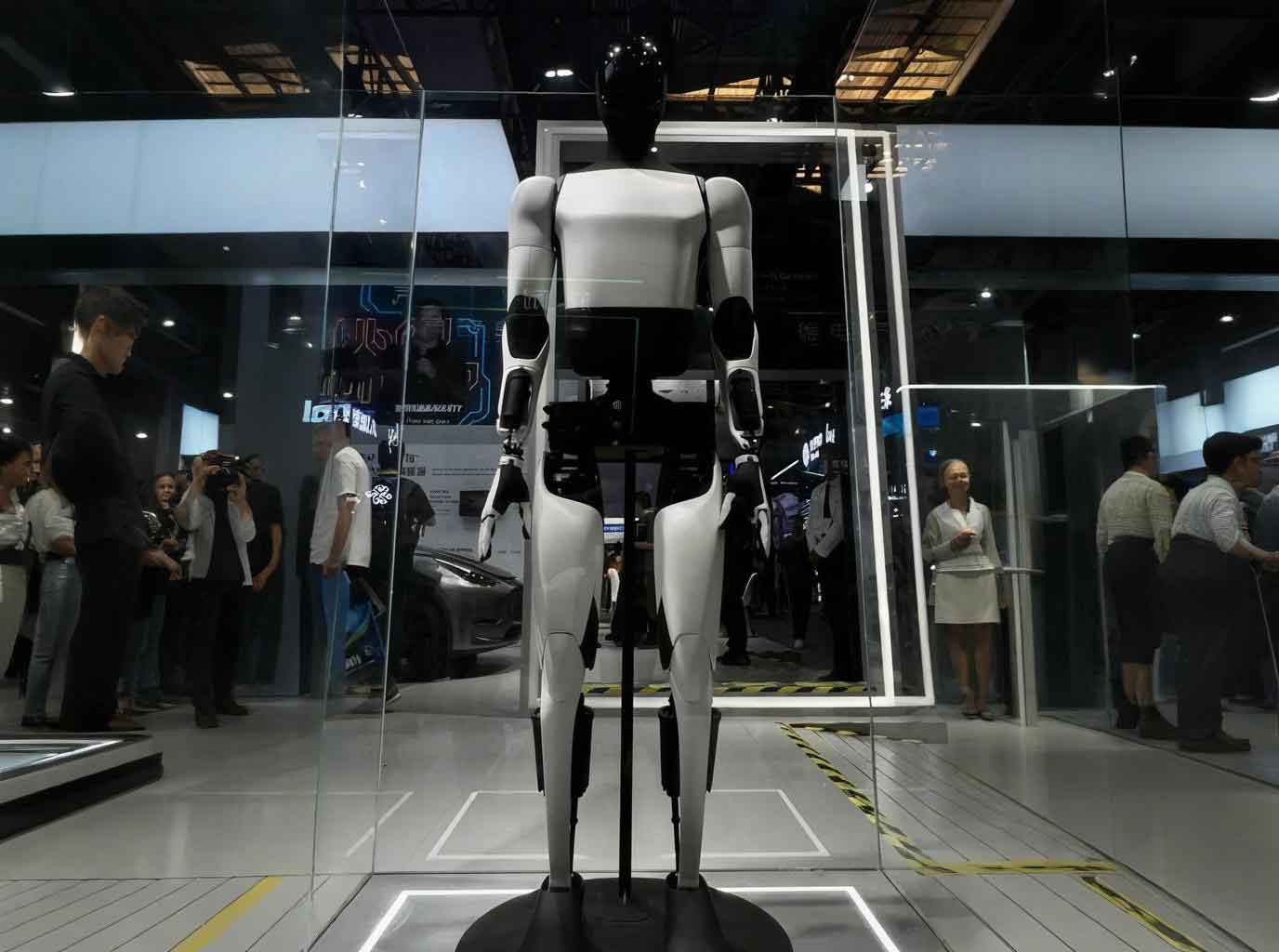
The evolution of artificial intelligence is undergoing a profound shift, moving from abstract computation within digital confines to intelligent interaction within the physical world. This paradigm, known as Embodied Intelligence, represents the frontier where AI gains a physical form—an embodied AI robot—enabling it to perceive, reason, decide, and act through continuous interplay with its environment. Unlike traditional AI, which processes symbols and data in isolation, an embodied AI robot constructs its intelligence from the ground up through sensorimotor experiences. This transition from virtual validation to physical application heralds a new era of human-machine synergy, promising disruptive transformations across industries and society. This article delves into the core concepts, technical architecture, application landscapes, persistent challenges, and future trajectories of embodied intelligence, arguing that the embodied AI robot is not merely a technological trend but a foundational force for global intelligent transformation.
Core Conceptual Foundations: Embodiment as a Prerequisite for Intelligence
The central thesis of embodied intelligence challenges the classical “disembodied” view of cognition. It posits that true intelligence cannot be divorced from a physical entity’s dynamic interactions with its surroundings. An embodied AI robot is an agent that utilizes its physical body (with actuators and effectors) and a suite of sensors to engage with the real world. Its cognitive processes—understanding, planning, and learning—are fundamentally shaped and constrained by this embodiment. This creates a perception-cognition-action loop that is closed in the real world, as opposed to being closed merely in a software simulation.
The distinction from traditional robotics and industrial automation is crucial. For decades, industrial robots have excelled in highly structured environments, performing repetitive tasks with precision. However, their operation is fundamentally based on pre-programmed rules and trajectories. They lack the capacity for autonomous perception, contextual decision-making, and adaptation to unforeseen changes. Changing their task often requires significant manual re-programming by engineers. Similarly, many contemporary service robots (e.g., delivery robots) often operate on a hybrid model of “local intelligence with local rules,” such as using AI for vision-based navigation but relying on scripted protocols for interaction.
The contemporary wave of embodied intelligence, significantly accelerated by advances in large-scale models and reinforcement learning, aims for a more holistic, end-to-end intelligence. The goal is to develop an embodied AI robot capable of generalizable learning, autonomous task execution based on high-level goals (e.g., natural language commands), and continuous self-correction in dynamic settings. The ultimate vision is a system that learns complex skills not through explicit programming but through interaction and experience, much like humans do.
Technical Architecture of an Embodied AI Robot
The operational intelligence of an embodied AI robot arises from a sophisticated, layered architecture integrating hardware with advanced software algorithms. The following table summarizes the core technological pillars:
| Pillar | Core Function | Key Technologies & Components |
|---|---|---|
| Multimodal Perception | To construct a comprehensive and actionable model of the environment and the robot’s own state. | Cameras (RGB, Depth), LiDAR, RADAR, Tactile/Pressure Sensors, Inertial Measurement Units (IMUs), Microphones, Force-Torque Sensors. |
| Computational & Cognitive Core | To process perceptual data, maintain world models, reason, plan, and generate action policies. | Embodied AI Foundation Models (VLA models), World Models, Task Planners, Symbolic Reasoners (hybrid systems). |
| Learning & Adaptation Framework | To acquire and optimize skills through interaction, both in simulation and reality. | Deep Reinforcement Learning (RL), Imitation Learning, Meta-Learning, Sim-to-Real Transfer techniques. |
| Control & Actuation Layer | To translate high-level action policies into stable, precise, and safe physical movements. | Model Predictive Control (MPC), Whole-Body Control (WBC), Adaptive/Impedance Control, High-precision Actuators. |
| Simulation & Training Infrastructure | To provide a scalable, safe, and parallelizable environment for training and validating policies. | Physics Engines (e.g., NVIDIA Isaac Sim, MuJoCo, PyBullet), Photorealistic Renderers, Domain Randomization tools. |
Multimodal Perception and Sensor Fusion form the foundational layer. An embodied AI robot must fuse asynchronous, heterogeneous data streams into a coherent state estimate. This involves algorithms for sensor calibration, noise filtering, and fusion (e.g., Kalman Filters, Bayesian networks). For instance, combining LiDAR’s precise geometry with camera-derived semantic labels enables an embodied AI robot to not only detect an object but also identify it and understand its potential function.
The Cognitive Core: Embodied Foundation Models. The advent of Vision-Language-Action (VLA) models represents a quantum leap. These large-scale models, pre-trained on vast datasets of internet text, images, and robotics trajectories, provide a form of “common sense” and semantic grounding. They allow an embodied AI robot to interpret natural language instructions like “tidy the desk by placing the blue block inside the red box” and decompose this into a sequence of actionable steps. The model’s internal representations bridge the gap between pixels, words, and feasible motor commands.
Learning Through Interaction: Reinforcement Learning. RL provides the mathematical framework for trial-and-error learning. The embodied AI robot (agent) interacts with an environment, receiving observations $$s_t$$ and rewards $$r_t$$, and takes actions $$a_t$$. The goal is to learn a policy $$\pi(a_t | s_t)$$ that maximizes the cumulative expected return $$R_t = \sum_{k=0}^{\infty} \gamma^k r_{t+k}$$, where $$\gamma$$ is a discount factor. Deep RL uses neural networks to represent this policy or the associated value function $$Q(s, a)$$ (estimating the expected return of taking action $$a$$ in state $$s$$).
$$Q^{\pi}(s, a) = \mathbb{E}_{\pi}[R_t | s_t=s, a_t=a]$$
Policy gradients and actor-critic methods are central to training complex motor skills. However, training solely in the real world is prohibitively slow and risky. This leads to the critical role of Simulation and Sim-to-Real Transfer. Millions of trials can be run in parallel in photorealistic, physics-based simulators. Techniques like Domain Randomization (varying textures, lighting, physics parameters) and Domain Adaptation train policies that are robust to the “reality gap,” enabling an embodied AI robot to transfer its simulated experience to the physical world.
Distributed Coordination. For applications requiring multiple agents, distributed coordination frameworks enable embodied AI robot collectives to work cohesively. This involves algorithms for multi-agent reinforcement learning (MARL), communication protocols, and decentralized task allocation, allowing swarms of robots to achieve complex objectives like coordinated search and rescue or warehouse logistics.
Application Landscapes and Emerging Use Cases
The practical deployment of embodied AI robot systems is expanding from controlled labs to real-world scenarios, though largely in pilot or specialized forms.
1. Industrial Manufacturing and Logistics. This is a primary testing ground. Applications move beyond fixed automation to flexible, cognitive tasks.
- Adaptive Assembly & Kitting: An embodied AI robot with vision and dexterous manipulation can identify parts from unstructured bins, perform delicate assembly, and adapt to component variations.
- Quality Inspection and Maintenance: Mobile robots equipped with advanced sensors can autonomously patrol facilities, using thermal and visual inspection to identify equipment anomalies or defects on production lines.
- Intelligent Logistics: Beyond following magnetic tapes, next-generation Autonomous Mobile Robots (AMRs) use embodied AI for dynamic path planning in crowded spaces, intelligent picking from shelves, and handling irregular parcels.
2. Healthcare and Assistive Technologies. The potential here is transformative, focusing on augmentation and care.
- Surgical Assistance: While fully autonomous surgery is distant, embodied AI robot systems are advancing tele-operative surgery with enhanced precision and haptic feedback, and can assist with repetitive pre-operative tasks.
- Rehabilitation and Physical Therapy: Exoskeletons and robotic limbs with adaptive control can provide personalized, data-driven therapy, adjusting support in real-time based on patient effort and progress.
- Elderly Care and Assistance: Robots can help with mobility support, fetching objects, medication reminders, and monitoring daily activities, promoting independence and safety.
3. Domestic and Service Environments. The long-envisioned personal robot helper is incrementally becoming plausible.
- Home Assistant Robots: Tasks like loading/unloading dishwashers, sorting laundry, preparing simple meals, and general tidying require immense perception, planning, and dexterity—the core challenges for domestic embodied AI robot platforms.
- Interactive Companionship: For social interaction, robots can engage in conversation, play games, or provide cognitive stimulation, leveraging their physical presence for more natural engagement than a voice-only assistant.
Critical Challenges on the Path to Scalability
Despite exciting progress, the widespread deployment of robust embodied AI robot systems faces significant hurdles.
The Simulation-to-Reality (Sim2Real) Gap. While simulation is indispensable, no simulator perfectly replicates reality. Inaccuracies in physics modeling (friction, material deformation), sensor simulation (noise, latency), and the sheer complexity of open-world interactions mean policies often degrade upon deployment. Bridging this gap remains an open research problem, requiring advances in system identification, meta-learning, and real-world fine-tuning with minimal data.
Hardware Limitations: The Cost-Performance Trade-off. The “body” for embodied intelligence is expensive and fragile. Key issues include:
- Dexterous Manipulation: Creating a robotic hand with human-like dexterity, tactile sensitivity, and robustness at a reasonable cost is extraordinarily difficult.
- Power Density and Efficiency: Mobile embodied AI robot platforms require compact, high-capacity power sources. Current battery technology limits operational duration for high-torque tasks.
- Computational Edge Processing: Running large foundation models and complex control algorithms requires substantial compute, which must be packaged into a mobile platform without excessive weight or heat generation.
Data Scarcity and Compositional Generalization. While internet-scale data trains language and vision models, comparable datasets of physical interaction are scarce and expensive to collect. An embodied AI robot must learn compositional skills—combining known primitives (grasp, push, place) in novel ways to solve unseen tasks. Achieving this level of generalization from limited interaction data is a fundamental challenge.
Safety, Verification, and Ethical Governance. As robots operate closer to humans, ensuring safe failure modes is paramount. Unlike software, a physical robot’s failure can cause harm. Formal verification of AI control policies in complex environments is exceptionally hard. Furthermore, ethical questions about job displacement, privacy (constant environmental sensing), and the appropriate level of robot autonomy in social settings require proactive societal dialogue and policy frameworks.
Future Trajectories and Concluding Perspective
The trajectory for embodied intelligence points toward greater autonomy, generality, and integration. Key future trends include:
1. Self-Evolving and Lifelong Learning Systems. Future embodied AI robot platforms will not be statically deployed. They will employ lifelong learning algorithms to continuously adapt to environmental drift, new objects, and updated tasks without catastrophic forgetting, learning from every interaction throughout their operational life.
2. Foundation Models for Embodiment. Research will focus on training even larger “embodiment-aware” foundation models on massive datasets of video, physics simulations, and robot trajectories. These models will serve as universal priors for physical reasoning, dramatically accelerating the learning of new skills (few-shot or zero-shot learning).
3. Material and Hardware Innovations. Breakthroughs in soft robotics, artificial muscles (e.g., dielectric elastomers), high-energy-density solid-state batteries, and neuromorphic computing chips (for low-power, sensorimotor processing) will revolutionize the physical capabilities and efficiency of the embodied AI robot.
4. Cross-Domain Fusion with Digital Twins and the Metaverse. The integration will deepen. A highly accurate digital twin of a factory or city, constantly updated with real-world data, will be the ultimate training and testing ground for embodied AI. Robots will practice in these synchronized virtual worlds, and their proposed actions in the real world will be first validated in the twin, creating a seamless testing-deployment loop.
5. Standardization and Modular Software Ecosystems. For industry adoption, open standards for robot middleware, communication interfaces, and software modules (perception, planning, control) will emerge. This will lower the barrier to entry, allowing developers to build on common platforms and focus on high-level application logic.
In conclusion, the journey of embodied intelligence from a theoretical concept to a tangible, world-interacting embodied AI robot is well underway. It represents a paradigm shift in our pursuit of artificial general intelligence, insisting that true understanding is inextricably linked to the capacity to act and experience consequences in a shared physical reality. While formidable challenges in robustness, generalization, and safety persist, the convergence of advancements in AI algorithms, computing power, and hardware design is creating an irreversible momentum. The embodied AI robot is poised to become a catalytic force, not just automating tasks but collaborating as an intelligent partner, ultimately driving a new wave of technological revolution and economic growth across the globe.