
The landscape of modern conflict is undergoing a profound transformation, driven by the pervasive integration of unmanned systems. From intelligence, surveillance, and reconnaissance (ISR) to direct kinetic engagement, these platforms have evolved from simple remote-controlled tools to central pillars of contemporary military strategy. However, as battlefields grow more complex—encompassing dense urban environments, denied electromagnetic spectra, and multi-domain operations—the limitations of traditional, pre-programmed or teleoperated unmanned combat systems become starkly apparent. Their brittleness in dynamic scenarios, difficulty in complex task decomposition, and vulnerability to electronic warfare highlight an urgent need for a fundamental leap in autonomy. This leap, I argue, is being catalyzed by the emergence of a new paradigm in artificial intelligence: embodied artificial intelligence. This article explores how embodied AI robot technology is poised to redefine the capabilities and operational concepts of future unmanned combat systems.
The core thesis of embodied intelligence is that true cognition and adaptive behavior cannot arise from disembodied algorithms processing abstract data alone. Instead, intelligence is fundamentally grounded in, and shaped by, having a physical form that interacts with the environment. An embodied AI robot learns and makes decisions not just from prior datasets, but from the continuous, real-time loop of perception, action, and consequence within a physical or simulated world. This paradigm shift moves us from systems that “think” in isolation to agents that “think” through doing. For unmanned combat systems, which are intrinsically physical entities operating in the ultimate dynamic environment—the battlefield—the implications are revolutionary. It promises a transition from scripted automatons to adaptive, resilient, and intelligently cooperative combatants.
The Core Tenets of Embodied AI: Beyond Disembodied Algorithms
To understand the transformative potential for military systems, we must first delineate the defining characteristics of embodied AI, which stand in clear contrast to traditional, disembodied AI approaches often used in limited autonomy functions today. These characteristics are deeply interwoven, each enabling and reinforcing the others to create a cohesive intelligent agent.
1. Embodiment: The Foundation of Situated Intelligence
Embodiment is the cardinal principle. It posits that the physical structure, sensors, and actuators of an agent are not merely peripherals to a central “brain,” but are constitutive of its intelligence. The morphology of an embodied AI robot—whether a legged, wheeled, winged, or aquatic platform—directly constraints and enables its possible interactions with the world. Knowledge is not just statistically inferred from data; it is acquired through sensorimotor experience. For instance, an embodied AI robot learns the affordances of terrain (what slopes it can traverse, what gaps it can jump) not from a database, but from the physics of its own body interacting with that terrain. This leads to a form of common-sense reasoning about physics and space that is notoriously difficult to encode in purely symbolic systems.
| Conceptual Dimension | Embodied Intelligence | Disembodied Intelligence |
|---|---|---|
| Physical Form | Essential; intelligence is shaped by and dependent on the physical body. | Irrelevant; cognition is abstract symbol manipulation or data processing. |
| Source of Knowledge | Emerges from real-time, situated interaction and sensorimotor experience. | Derived from pre-existing knowledge bases or training on large, static datasets. |
| Perception-Action Coupling | Tightly coupled; perception is for action, and action informs perception. | Largely decoupled; perception modules feed data to separate decision modules. |
| Environmental Adaptation | Dynamically adapts to specific, novel situations through interaction. | Relies on pre-programmed rules or broad statistical generalization, often brittle to novelty. |
| Military Analogy | A soldier learning tactics through field training and combat experience. | An expert system running predetermined contingency plans based on intelligence reports. |
2. Multimodality: Fusing the Senses for Robust Perception
An embodied AI robot operating in the chaotic real world cannot rely on a single sensory stream. Multimodality refers to the integration of data from diverse sensors—visual (RGB, thermal, LiDAR), auditory, tactile, proprioceptive, and radio-frequency—into a coherent, holistic understanding of the environment. This fusion is not mere data concatenation; it involves learning the correlations and complementarities between modalities. In a battlefield context, vision might be obscured by smoke, but acoustic signatures could reveal enemy vehicle movement. LiDAR might fail to distinguish a camouflaged net, but a millimeter-wave radar could detect it. A multimodal embodied AI robot can maintain situational awareness and complete its mission even when individual sensory channels are degraded or spoofed, providing a significant advantage in electronic warfare environments.
3. Interactivity: The Perception-Action-Improvement Loop
This is the dynamic engine of embodied intelligence. Unlike a static AI model that processes an input to produce an output, an embodied AI robot is engaged in a continuous, closed-loop process with its environment. It perceives the world, makes a decision to act (e.g., move, manipulate, communicate), executes that action, and then perceives the consequences of its action. This new perceptual state is then fed back into the decision-making process. This loop, formalized in concepts like reinforcement learning, allows the agent to learn from trial and error, to refine its models of the world, and to adapt its behavior in real time. The fundamental equation governing this adaptive loop can be conceptualized as a policy optimization problem, where the agent seeks to maximize its cumulative reward $R$ over time:
$$
\pi^* = \arg\max_{\pi} \mathbb{E}_{\tau \sim \pi} \left[ \sum_{t=0}^{T} \gamma^t r(s_t, a_t) \right]
$$
Here, $\pi$ is the policy (the agent’s strategy), $\tau$ is a trajectory of states $s_t$ and actions $a_t$, $r$ is the reward received, and $\gamma$ is a discount factor. For an embodied AI robot, the state $s_t$ is a multimodal representation of its environment and self, and the action $a_t$ is a physical movement or effector command. The policy $\pi$ is continually updated based on the outcomes of this interactive loop.
Critical Enabling Technologies for the Embodied AI Robot
The realization of capable embodied AI robots for demanding environments like the battlefield rests on advancements in several interlocking technological domains.
1. Embodied Perception & Multimodal Fusion
This involves not just advanced sensors, but algorithms that can interpret and fuse their signals in real-time. Techniques range from early fusion (combining raw data) to late fusion (combining high-level features). A key challenge is cross-modal alignment—ensuring that what is “seen” by a camera corresponds spatially and temporally with what is “felt” by a LiDAR or “heard” by a microphone. Deep learning architectures, particularly vision-language-action models, are making significant strides here. They allow an embodied AI robot to associate visual scenes with linguistic commands (“find the concealed bunker near the burnt-out truck”) and appropriate action sequences.
| Perception Modality | Key Sensors | Military-Relevant Capabilities | Fusion Challenges |
|---|---|---|---|
| Visual | EO/IR Cameras, LiDAR, SWaP-constrained SAR | 3D Mapping, Target ID (day/night), Change Detection, SLAM in GPS-denied areas. | Aligning 2D pixels with 3D point clouds; handling varying lighting/weather. |
| Acoustic | Acoustic Arrays, Seismic Sensors | Shot Detection/Localization, Vehicle Classification, Personnel Tracking. | Separating signals from noise (wind, battle sounds); fusing with non-coherent spatial data. |
| Radio Frequency (RF) | SDRs, Direction-Finding Antennas | Comm Signal Detection/Classification, Electronic Support Measures (ESM), Emitter Mapping. | Correlating RF emitters with physical entities in visual/geospatial context. |
| Tactile/Proprioceptive | Force-Torque Sensors, Flexible Skin Sensors, Motor Encoders | Deft Manipulation (e.g., opening doors, handling ordnance), Terrain Stability Assessment, Damage Detection. | Integrating high-bandwidth contact data with exteroceptive senses for reactive control. |
2. Embodied Reasoning and Decision-Making
This is where large foundation models (LMs) and world models converge with physical constraints. The goal is to translate high-level mission commands (“secure the crossroads”) into a sequence of feasible physical actions for a specific embodied AI robot platform. Key capabilities include:
- Natural Language Instruction Anchoring: Grounding abstract commands into actionable affordances in the current environment. For example, the command “block that road” must be parsed into specific actions like “navigate to coordinates X,Y,” “identify large debris,” and “push debris into the roadway.”
- Zero/Few-Shot Reasoning: The ability to perform novel tasks without explicit pre-training, by decomposing them into known sub-skills or by leveraging commonsense knowledge encoded in the LM.
- Constrained Planning: Integrating the physical limits of the platform (kinematics, dynamics, fuel) and tactical constraints (rules of engagement, exposure risk) into the planning process. This often involves hierarchical planning, where an LM handles the high-level task logic, and lower-level controllers handle the motion primitives.
3. Embodied Execution and Control
This domain translates decisions into robust, precise physical motion. It must handle the full complexity of dynamics, uncertainty, and potential hardware failure. Primary strategies include:
- Model Predictive Control (MPC): An online optimization technique that uses a model of the system dynamics to predict future states and computes optimal control inputs over a receding horizon. It is highly effective for dynamic balancing and locomotion in complex terrain. The core optimization can be expressed as:
$$
\min_{u_{t}, …, u_{t+N-1}} \sum_{k=0}^{N-1} \left( \| x_{t+k} – x_{ref} \|^2_Q + \| u_{t+k} \|^2_R \right)
$$
subject to: $x_{t+k+1} = f(x_{t+k}, u_{t+k}), \quad u_{min} \leq u \leq u_{max}$
where $x$ is the state, $u$ is the control input, $f$ is the dynamics model, and $Q, R$ are weighting matrices.
- Reinforcement Learning (RL) & Imitation Learning (IL): RL agents learn control policies through trial-and-error to maximize a reward signal, making them suitable for complex, non-linear tasks where analytic models are hard to derive. IL leverages demonstrations from experts (human or algorithmic) to bootstrap learning, crucial for acquiring delicate skills like manipulation.
4. World Models and Simulation: The Crucible for Training
Given the cost, danger, and scarcity of real-world military training data, high-fidelity simulation is indispensable. World models are learned or programmed representations that allow an embodied AI robot to predict the outcomes of its actions. Training in simulation allows for:
- Massive Scale: Millions of trials can be run in parallel, exploring edge cases and failure modes.
- Safe Exploration: Agents can learn from catastrophic mistakes in simulation without physical damage.
- Rapid Iteration: New algorithms, sensors, or platform designs can be tested virtually.
Advanced simulators like NVIDIA Isaac Sim or physics engines like MuJoCo are creating increasingly realistic digital twins of robots and combat environments, facilitating the transfer of skills from simulation to reality (Sim2Real).
| Simulation Platform | Core Focus & Fidelity | Relevant Military Training Scenarios |
|---|---|---|
| High-Fidelity Physics Sims (e.g., MuJoCo, Drake) | Precive rigid/soft-body dynamics, contact mechanics. | Legged locomotion on rubble, vehicle mobility on soft soil, manipulator contact tasks. |
| Photo-realistic & Sensor Sims (e.g., Isaac Sim, CARLA) | Visual realism, camera/LiDAR/radar sensor modeling, lighting/weather. | Autonomous navigation in urban canyons, target recognition under adversarial conditions, multi-sensor fusion testing. |
| Large-Scale Strategic Sims (e.g., SEAS, MANA) | Multi-agent behavior, command and control logic, terrain and logistics. | Testing swarm tactics, evaluating human-robot teaming protocols, mission-level planning and rehearsal. |
The Battlefield Imperative: Why Unmanned Systems Need Embodied AI
The evolution toward multi-domain operations (MDO) presents challenges that legacy unmanned systems are ill-equipped to handle, creating a powerful demand signal for embodied intelligence.
1. Conquering Environmental Complexity: Future battlefields will not be open deserts or seas. They will be mega-cities, dense forests, subterranean networks, and cluttered littoral zones. These are unstructured, dynamically changing, and perceptually degraded environments. A wheeled robot cannot climb stairs; a drone with a pre-planned flight path cannot navigate a collapsed building. An embodied AI robot with multimodal perception and adaptive control can dynamically map, interpret, and traverse such terrain, selecting gaits or maneuvers in real-time based on its physical interaction with the world.
2. Managing Mission Complexity: The “find, fix, track, target, engage, assess” (F2T2EA) kill chain is becoming compressed and requires autonomous decision-making under extreme time pressure. Missions may involve combined arms coordination, dynamic targeting, and battle damage assessment—all while adhering to rules of engagement. An embodied AI robot with advanced reasoning can decompose a commander’s intent, dynamically re-prioritize tasks based on unfolding events, and execute complex action sequences (e.g., “breach the wall, clear the room, identify high-value equipment, and mark it for recovery”) with minimal human supervision.
3. Enabling Resilient Swarm Cohesion: The future of unmanned warfare lies in heterogeneous swarms—mixes of small drones, unmanned ground vehicles (UGVs), and unmanned surface/subsurface vessels (USVs/UUVs) operating collaboratively. Current swarms often rely on centralized control or fragile communication links. An embodied AI robot swarm, however, can exhibit emergent, decentralized intelligence. Each agent, understanding its own capabilities and perceiving its local environment, can collaborate through implicit communication (observing each other’s actions) and explicit but robust protocols, enabling self-organization, adaptive re-tasking, and graceful degradation when members are lost or communications jammed.
Future Forms: The Embodied AI Robot in the Battle Space
The integration of embodied AI will manifest across a spectrum of unmanned platforms, evolving their roles from tools to teammates.
1. Advanced Biomimetic Machines: Legged “robodogs” are already in use for reconnaissance and logistics. With embodied AI, their mobility in complex terrain will become truly robust and autonomous. Beyond canines, we will see:
- Avian-inspired Micro-UAVs: Flapping-wing or gliding drones that can perch, hover silently, and blend into urban wildlife for persistent, covert surveillance.
- Serpentine or Insectoid Platforms: For intrusion into deeply confined spaces—ventilation shafts, sewer lines, or wreckage—to deploy sensors or conduct interdiction.
- Piscine or Marine-mammal inspired UUVs: Using bio-mimetic propulsion for stealthy, efficient, and agile underwater reconnaissance near shores or around infrastructure.
These platforms will not just mimic shape, but the effective locomotion and behavioral strategies of their biological counterparts, learned and optimized through embodied interaction.
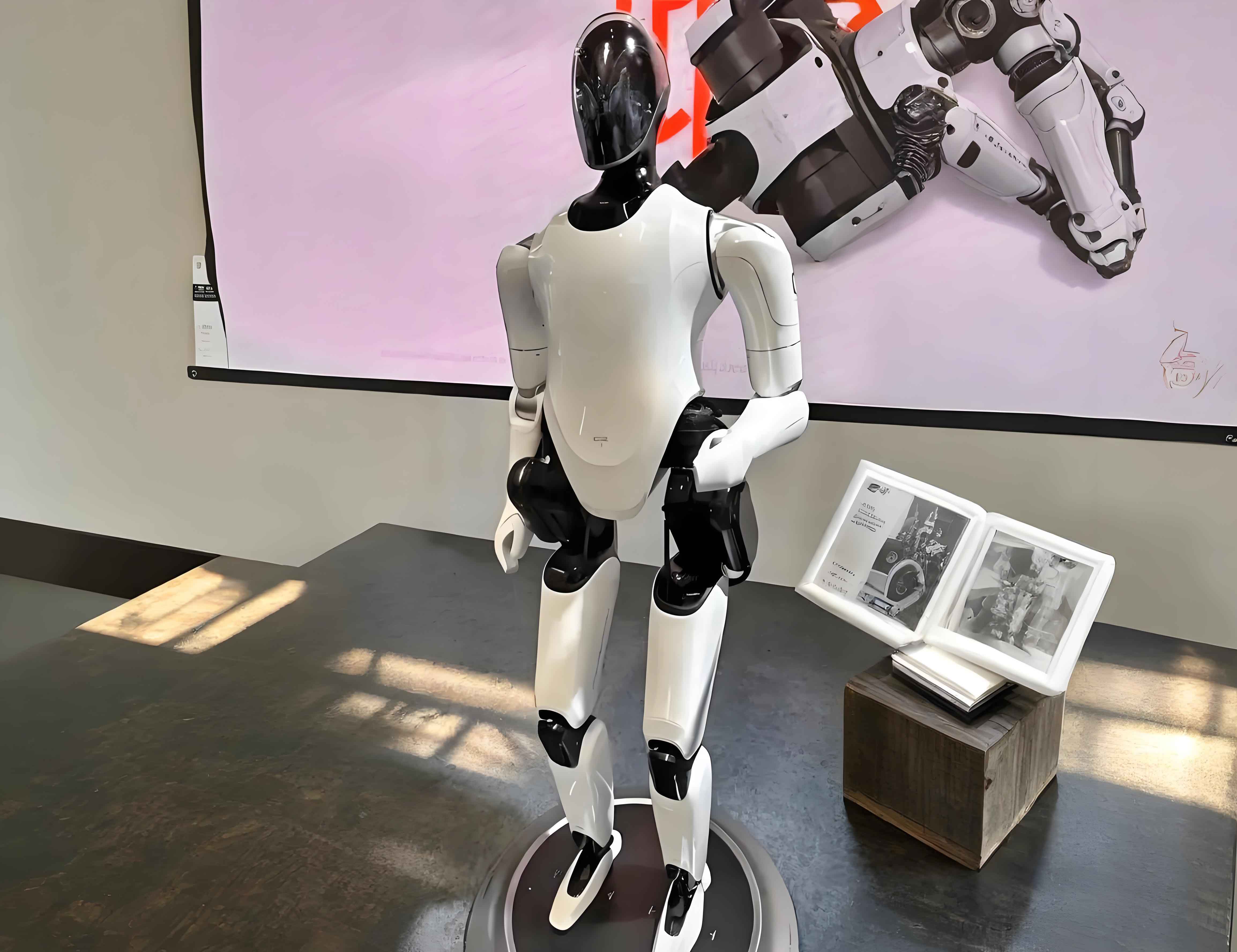
2. The Robotic Infantryman (Mech-soldier): Humanoid or anthropomorphic embodied AI robots represent the ultimate challenge and opportunity. Their value lies in:
- Seamless Infrastructure Integration: They can operate in environments built for humans—use stairs, doors, vehicles, and tools without modification.
- Direct Human Teaming: They can work alongside soldiers, understanding gestures and verbal commands, and performing tasks like casualty extraction, ammunition resupply, or operating complex weapon stations.
- Tactical Versatility: A single platform could sequentially perform reconnaissance, breach a door, secure a room, and manipulate battlefield objects.
While immense technical hurdles in power, dexterity, and reliability remain, progress in full-body dynamics control and bimanual manipulation driven by embodied AI is accelerating.
3. The Hyper-Intelligent Singular Platform: Even traditional forms—unmanned tanks, fighter drones, or patrol boats—will be transformed. An embodied AI robot fighter jet would not just follow a flight plan; it would perceive an adversary’s maneuvers, predict intent, and execute complex dogfighting tactics autonomously, exploiting its full flight envelope in ways that may exceed human physiological limits. An unmanned tank would understand terrain masking, hull-down positions, and opportunistic engagements, coordinating with infantry and other assets as an intelligent node in the network.
Formidable Challenges on the Road to Deployment
The path to fielding operational embodied AI robot systems is fraught with significant technical, operational, and ethical obstacles.
| Challenge Category | Specific Issues | Potential Mitigation Pathways |
|---|---|---|
| Technical & Computational |
|
|
| Operational & Security |
|
|
| Ethical & Legal |
|
|
Conclusion: The Dawn of a New Era in Warfare
The convergence of robotics, artificial intelligence, and military necessity is ushering in a transformative era. Embodied artificial intelligence represents more than an incremental upgrade; it is a fundamental re-conception of what an unmanned system can be. By grounding intelligence in physical interaction, the embodied AI robot transcends the limitations of its pre-programmed ancestors. It gains the capacity to perceive, understand, and adapt to the chaos of the battlefield in real-time, to collaborate intelligently with its peers, and to execute complex missions with a degree of autonomy and resilience previously unimaginable.
The journey from laboratory and simulation to the operational theatre will be long and paved with daunting challenges—technical, ethical, and strategic. It will require sustained investment in core AI and robotics research, the development of new testing and evaluation methodologies for adaptive systems, and serious international dialogue on governance. However, the trajectory is clear. The nation or coalition that most effectively masters and integrates embodied intelligence into its unmanned combat forces will gain a decisive advantage in the character of future conflict. They will possess not just an army of machines, but an army of adaptable, intelligent, and cooperative embodied agents, fundamentally altering the calculus of power on the future battlefield.