
The landscape of public library services is undergoing a seismic shift. For decades, our mission has centered on providing access to information. Yet, the very nature of “access” and “information” is being redefined by the accelerating convergence of artificial intelligence, robotics, and sensor technologies. Traditional service models, often constrained by static physical interfaces and one-size-fits-all digital portals, are revealing their limitations in addressing the nuanced, dynamic, and deeply personal needs of our diverse communities. My experience and observation point towards a fundamental evolution: from libraries as repositories to libraries as intelligent, interactive, and adaptive knowledge ecosystems. At the heart of this transformation lies a powerful paradigm—Embodied Artificial Intelligence.
Embodied AI represents a profound departure from conventional, software-only intelligence. It posits that true intelligence cannot be disembodied; it emerges from the continuous sensorimotor interaction between an agent and its physical environment. An embodied AI robot is not merely a computer that moves. It is a unified system that perceives the world through multimodal sensors (cameras, microphones, LiDAR, tactile sensors), reasons about it using advanced machine learning models, and takes physical action to effect change. This creates a “perception-decision-action” loop, allowing the agent to learn from and adapt to the real world’s complexities. The formula for this core loop can be expressed as a continuous cycle:
$$ \text{Intelligence}(t) = \Phi( \text{Perception}(S_t), \text{Policy}(\pi_{\theta}), \text{Action}(A_t), \text{Environment}(E) ) $$
where at time \( t \), the agent’s intelligent behavior is a function \( \Phi \) of its sensory input \( S_t \), its learned decision-making policy \( \pi_{\theta} \) with parameters \( \theta \), its executed action \( A_t \), and the resulting state change in the environment \( E \). It is this capacity for situated, physical interaction that makes embodied AI robot technology uniquely suited to bridge the gap between the digital wealth of our collections and the tangible, human-scale experience of our patrons.
Foundational Pillars of Embodied AI for Library Integration
To understand how an embodied AI robot can transform library services, we must deconstruct its core technological pillars. These are not isolated components but interdependent layers that create a cohesive intelligent entity.
1. Multimodal Perception and Scene Understanding: An embodied AI robot perceives the library not as a collection of shelves and chairs, but as a rich, dynamic semantic scene. Computer vision identifies patrons, recognizes gestures and facial expressions, reads book spines, and monitors space occupancy. Simultaneously, audio processing captures speech queries, identifies ambient noise levels, and locates sound sources. LiDAR and depth sensors construct precise 3D maps in real-time. The fusion of these streams creates a comprehensive world model, allowing the system to understand that a patron waving near the history section while looking confused likely needs navigational assistance. This perception capability is foundational for any subsequent intelligent action.
2. Physical Embodiment and Actuation: The “body” of the system is what enables service interventions in the physical world. This can range from a mobile robotic platform that navigates aisles to deliver books, to a stationary but articulate robotic arm that retrieves items from high shelves, or even to a network of smart, reconfigurable furniture. The key is that intelligence has a physical expression. For instance, a patron’s request for a specific journal issue can culminate in an embodied AI robot physically locating, grasping, and transporting that item to a designated pickup station. The dynamics of such an action involve complex control:
$$ \tau = M(q)\ddot{q} + C(q, \dot{q})\dot{q} + g(q) $$
Where \( \tau \) is the vector of joint torques for the robot manipulator, \( M \) is the inertia matrix, \( C \) accounts for Coriolis and centrifugal forces, \( g \) is gravity, and \( q, \dot{q}, \ddot{q} \) are the joint positions, velocities, and accelerations respectively. Safe and smooth operation in human spaces requires precise control of these physical parameters.
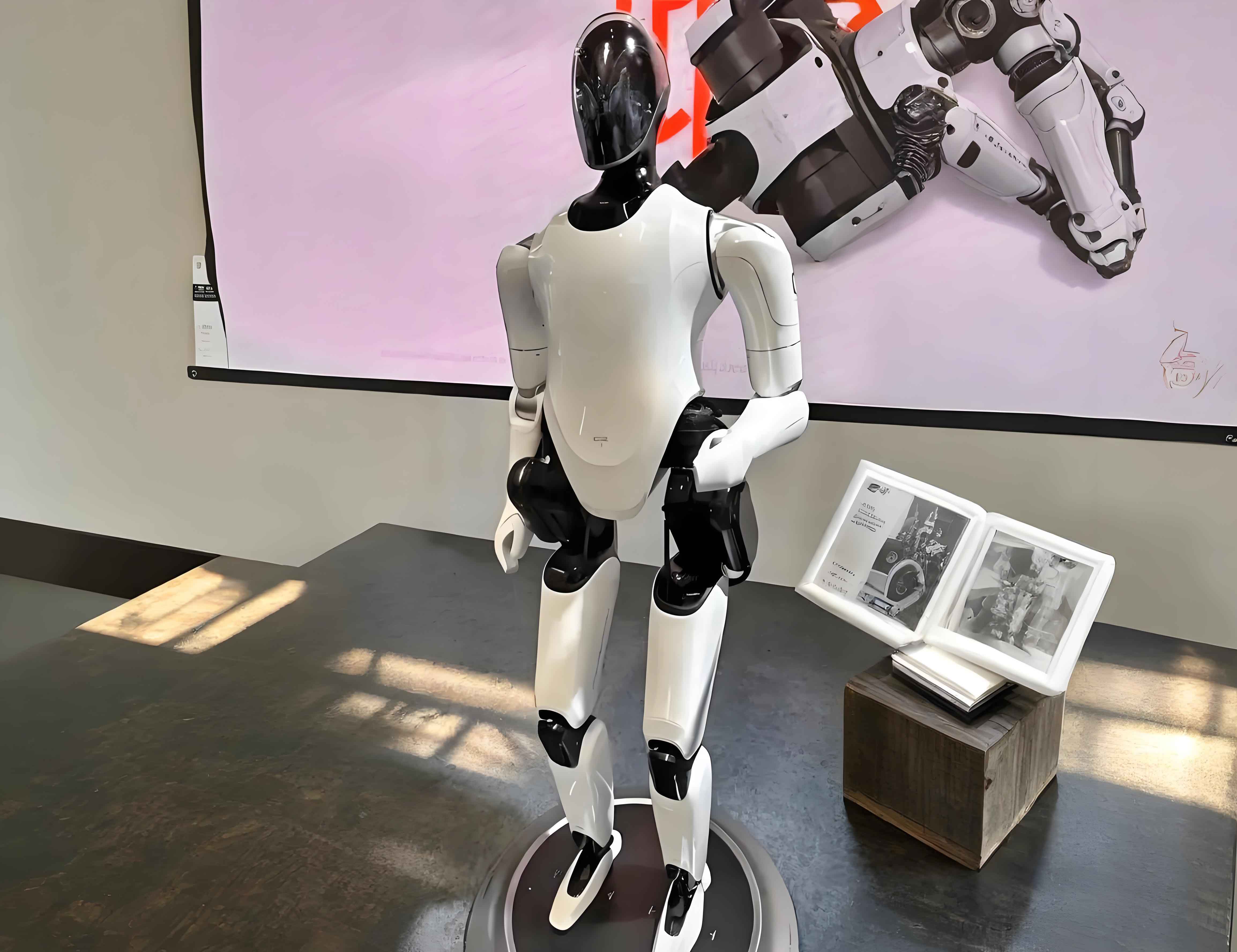
3. Embodied Learning and Adaptive Interaction: The most powerful embodied AI robot systems learn from interaction. Through techniques like reinforcement learning, they optimize their service policies based on feedback. For example, a robot guiding visitors learns which pathways are most efficient and least disruptive. A virtual assistant with a physical presence (like a hologram or screen-based avatar) learns to adapt its communication style—verbal cues, tone, gesture—based on patron responses. This learning is often framed as maximizing a cumulative reward \( R \):
$$ \pi^* = \arg\max_{\pi} \mathbb{E}_{\pi}\left[ \sum_{t=0}^{T} \gamma^t r(s_t, a_t) \right] $$
where \( \pi^* \) is the optimal policy, \( \gamma \) is a discount factor, and \( r(s_t, a_t) \) is the reward received for taking action \( a_t \) in state \( s_t \). The “reward” in a library context could be successful task completion, measured patron satisfaction, or increased engagement.
The following table summarizes the transition from traditional library systems to an embodied AI-enhanced framework:
| Aspect | Traditional Library System | Embodied AI-Driven System |
|---|---|---|
| Perception | Limited to manual observation, basic electronic access logs. | Multimodal, real-time sensing of space, objects, and patron states (behavior, affect). |
| Interaction | Screen/keyboard/mouse, human-to-human at service desks. | Natural, multimodal interaction (speech, gesture, touch) with both physical robots and ambient intelligent environments. |
| Service Delivery | Static pathways; patron must adapt to system. | Dynamic, proactive, and physically enacted. The system adapts to the patron’s context. |
| Learning & Adaptation | Slow, based on surveys and aggregate statistics. | Continuous, individualized learning from each interaction loop. |
| Spatial Intelligence | Fixed map, passive navigation signs. | Active, context-aware navigation and spatial resource management. |
Redefining Core Library Service Domains with Embodied AI
The integration of embodied AI robot systems catalyzes a fundamental re-imagination of our core service domains: collection development, environmental accessibility, and personalized information literacy.
1. Dynamic, Patron-Informed Collection Development and Management
Traditionally, collection decisions rely on circulation statistics, publisher catalogs, and librarian expertise—valuable but distal metrics. An embodied AI robot network provides a proximal, real-time lens into how collections are actually used. Imagine sensors and robots that don’t just track which book is checked out, but observe how it is used: which sections are browsed most frequently, where patrons pause and for how long, which books are often pulled out and compared side-by-side. This behavioral data, anonymized and aggregated, generates a living demand map.
This enables two transformative strategies. First, just-in-time collection augmentation. If the system detects repeated, unfruitful searches for resources on a specific emerging technology, it can flag this gap and even initiate automated acquisition processes or provide instant access to relevant digital materials on nearby displays. Second, adaptive resource representation. The physical collection itself can become interactive. A patron pondering a complex historical timeline could, with a gesture, prompt a nearby embodied AI robot or smart shelf to project a dynamic, annotated visualization onto a table surface, transforming the static book content into an immersive learning experience. The collection is no longer a static asset but an interactive partner in knowledge discovery.
2. Creating Universally Accessible and Responsive Environments
True accessibility moves beyond ramps and Braille signage—it demands environmental intelligence that adapts to individual needs in real time. This is where the physical agency of an embodied AI robot becomes paramount.
- Navigational Autonomy: For a patron with visual impairment, the service begins at the entrance. A personal guiding embodied AI robot can approach, provide an audible greeting, and offer tailored navigation. Using its precise SLAM (Simultaneous Localization and Mapping) and obstacle avoidance systems, it can safely guide the patron to a specific shelf, study carrel, or meeting room, describing the environment along the way. The path planning algorithm ensures efficiency and safety:
$$ A^*: f(n) = g(n) + h(n) $$
where the robot finds the optimal path by minimizing the cost \( g(n) \) from start to node \( n \), plus a heuristic estimate \( h(n) \) of the cost from \( n \) to the goal, all while updating for dynamic obstacles. - Adaptive Physical Interfaces: Retrieval becomes effortless. A patron in a wheelchair need not struggle to reach a high shelf. A simple voice command to a stationed embodied AI robot or a gesture towards a smart shelf can result in the item being gently fetched and placed within easy reach. The environment itself responds.
- Ambient Intelligence for Cognitive Accessibility: For neurodiverse patrons or those experiencing cognitive overload, the library environment can modulate itself. If sensors indicate signs of agitation or confusion, lighting can soften, ambient noise can be dampened by directional sound control, and a low-stress, simplified navigation route can be suggested via a calm, discreet interface. The embodied AI robot acts as a subtle mediator of environmental stimuli.
3. Hyper-Personalized Information Discovery and Literacy Facilitation
Personalization today often means a recommendation list on a website. Embodied AI personalizes the entire process of discovery and learning. An embodied AI robot companion can engage in a natural dialogue to understand a patron’s research goal, not just their keywords. It can then physically lead them to the most relevant physical and digital resources, synthesizing information across formats.
More powerfully, it can facilitate embodied information literacy training. Consider a student learning about architectural styles. Instead of just showing pictures, an embodied AI robot could project a 3D model of a Gothic cathedral into a shared space, allow the student to “walk” through it using gesture control, highlight structural elements with augmented reality overlays, and relate them back to books on medieval engineering. The learning is kinesthetic, spatial, and deeply engaging. The robot becomes a co-learner and facilitator, its actions directly tied to constructing understanding. The system personalizes the learning trajectory \( L \) based on continuous assessment of patron engagement \( E \) and comprehension \( C \):
$$ L_{t+1} = L_t + \alpha \cdot \nabla_{L} (E_t \cdot C_t) $$
where the learning path is iteratively adjusted by a factor \( \alpha \) based on the gradient of observed engagement and comprehension.
The following table outlines specific service transformations across key patron interactions:
| Patron Need / Interaction | Traditional Service Model | Embodied AI Robot-Driven Model |
|---|---|---|
| Finding a Book/Resource | Use OPAC terminal, note call number, navigate manually. | Verbally ask a robot; it guides you directly to the spot or fetches it for you. |
| Research Assistance | Scheduled appointment with librarian, desk-based consultation. | Continuous, contextual assistance from an AI agent that can pull and cross-reference physical and digital materials in real-time during your exploration. |
| Attending a Workshop | Sit in a room, watch a presenter. | Interactive, hands-on session where robotic tools and augmented reality displays allow you to manipulate data models, practice skills, or explore historical artifacts virtually. |
| Accessibility Support | Static tools (screen readers, magnifiers), reliance on staff. | Proactive, autonomous robotic assistant for navigation, retrieval, and customized environmental control. |
| Children’s Story Time | Librarian reads aloud with a book. | Immersive experience where the story environment is projected, characters are animated, and children interact with the narrative through movement and sound, guided by an engaging robotic facilitator. |
Strategic Implementation Framework and Future Trajectory
The journey toward an embodied AI-integrated library is iterative and strategic. It begins with focused pilot deployments, such as a shelf-scanning and inventory embodied AI robot or a stationary navigation kiosk with a physically present interactive avatar. These projects build internal expertise, test public acceptance, and generate tangible data on efficiency gains and patron satisfaction, measured by metrics like task completion time \( T_{complete} \) and patron-reported satisfaction scores \( S \):
$$ \text{ROI} = \frac{\sum ( \beta_1 \cdot \Delta T_{complete} + \beta_2 \cdot \Delta S)}{\text{Cost of Implementation}} $$
where \( \beta_1 \) and \( \beta_2 \) are weights assigned to efficiency and qualitative improvement.
Concurrently, a robust data governance framework is non-negotiable. All perception data must be anonymized, encrypted, and processed with clear policies that prioritize patron privacy and autonomy. Transparency about what data is collected and how it is used is critical for maintaining public trust.
The role of library staff evolves magnificently in this new paradigm. Librarians are not replaced by embodied AI robot systems; they are elevated. Their expertise shifts from transactional tasks (finding call numbers, basic reference) to high-level curation, complex problem-solving, community engagement, and overseeing the ethical development of the library’s AI ecosystem. They become the humanistic guides and interpreters in a technologically rich environment.
Looking forward, the trajectory points toward the fully integrated “phygital” library—a seamless blend of physical and digital where intelligent environments and robotic agents work in concert. The library becomes a platform for experiential learning and community co-creation. An embodied AI robot might help a local historian digitize and annotate a fragile archive, then later guide a school group through an interactive exhibit built from that archive. The boundary between consuming information and creating knowledge dissolves.
In conclusion, the imperative for public libraries is clear. To remain vital, inclusive centers of knowledge and community in the 21st century, we must embrace the transformative potential of embodied intelligence. By deploying embodied AI robot systems thoughtfully and ethically, we can build libraries that are not just accessible, but proactively supportive; not just informative, but experientially immersive; not just repositories of past knowledge, but active partners in shaping future understanding. This is not merely a technological upgrade—it is a fundamental reaffirmation of our mission to serve every patron with greater empathy, efficiency, and empowerment than ever before.