
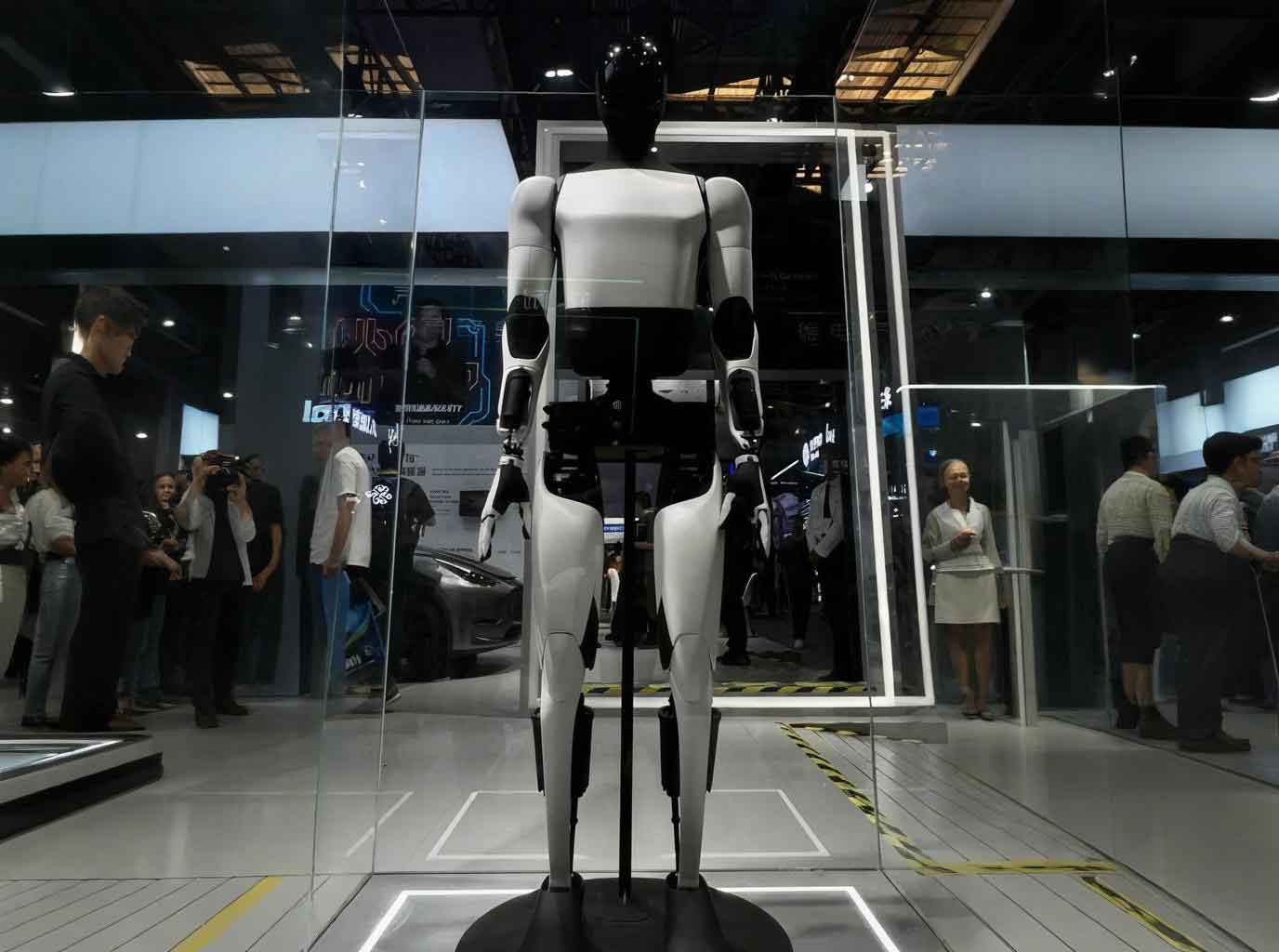
The transition towards intelligent agriculture is accelerating globally, driven by the need to address labor shortages, enhance productivity, and ensure sustainable resource use. Within this transformation, the embodied AI robot represents a paradigm shift from traditional automated machinery. An embodied AI robot is an intelligent system with a physical form that integrates perception, cognition, decision-making, and action into a closed-loop framework, enabling dynamic interaction with and adaptation to complex, unstructured environments. Unlike disembodied AI, which processes symbols or images in isolation, the intelligence of an embodied AI robot is grounded in and emerges from its continuous sensory-motor interaction with the real world. This article, from my perspective as a researcher in the field, systematically explores the key technologies, application frameworks, challenges, and future prospects of embodied AI robots in agriculture.
Core Technological Pillars of Embodied AI Agricultural Robots
The realization of a fully functional embodied AI robot in agriculture rests upon the seamless integration of several advanced technological pillars. These technologies enable the robot to perceive its surroundings, understand tasks, plan and execute actions, and continuously learn from experience.
1. Multimodal Fusion Perception
As the “perceptual center” of an embodied AI robot, multimodal fusion perception is fundamental. Agricultural environments are characterized by variability in lighting, occlusion by foliage, dynamic obstacles, and diverse textures. Relying on a single sensor modality is insufficient. Therefore, an embodied AI robot must fuse data from complementary sensors—such as RGB-D cameras, LiDAR, spectral imagers, millimeter-wave radar, and inertial measurement units (IMUs)—to build a robust and comprehensive understanding of its operational context. The core challenge lies in aligning heterogeneous data that differ in format, timing, and noise characteristics to achieve a unified semantic representation.
The evolution of this technology has moved from modular AI architectures to foundation model-driven approaches. Table 1 summarizes representative works and their characteristics across different technical directions within multimodal perception.
| Technical Direction | Methods/Examples | Core Principle & Advantages | Limitations & Challenges |
|---|---|---|---|
| Modular AI Fusion | Linear Weighted Fusion, Multi-stream Networks, Multi-stage Progressive Fusion | Clear structure, good performance in stable scenarios; allows for task-specific optimization of individual modules (e.g., YOLO for detection, LOAM for SLAM). | Poor generalization to novel scenes; high integration complexity; performance degrades with environmental dynamics like sudden illumination changes. |
| Foundation Model-Driven Perception | Vision Foundation Models (e.g., SAM), Vision-Language Models (e.g., CLIP, GPT-4V), Embodied Multisensory Models (e.g., MultiPLY) | Strong zero-shot and few-shot generalization; enables semantic understanding and cross-modal alignment (e.g., linking “ripe tomato” to visual features); supports learning from web-scale data. | High computational cost for training and inference; requires careful adaptation to the agricultural domain; simulation-to-reality gap for physical interaction data. |
| 3D Dynamic Scene Understanding | LiDAR-based SLAM, Visual-LiDAR Fusion, Neural Radiance Fields (NeRF) | Provides precise geometric and volumetric understanding of the environment; essential for navigation, manipulation, and reasoning about object affordances in 3D space. | Processing sparse/irregular point clouds is computationally intensive; real-time performance for dense reconstruction is challenging on edge devices. |
| Domain Adaptation for Perception | Unsupervised Domain Adaptation (UDA), Semi-supervised Domain Adaptation (SSDA) | Mitigates the performance drop when a perception model trained in one environment (e.g., simulation, a specific farm) is deployed in another; reduces need for extensive new labeled data. | Risk of negative transfer if domain shift is too large; alignment of high-level semantic features remains difficult. |
A key mathematical formulation in domain adaptation, which is crucial for an embodied AI robot to adapt its perception across different farms or growing seasons, involves minimizing the divergence between the feature distributions of the source domain (e.g., labeled data from a research greenhouse) and the target domain (e.g., unlabeled data from a new field). A common measure is the Maximum Mean Discrepancy (MMD):
$$ MMD^2(X_s, X_t) = \left\| \frac{1}{n_s} \sum_{i=1}^{n_s} \phi(x_s^i) – \frac{1}{n_t} \sum_{j=1}^{n_t} \phi(x_t^j) \right\|_{\mathcal{H}}^2 $$
where \(X_s\) and \(X_t\) are samples from the source and target domains, \(n_s\) and \(n_t\) are their sample sizes, \(\phi(\cdot)\) is a feature mapping to a Reproducing Kernel Hilbert Space \(\mathcal{H}\), and \(\|\cdot\|_{\mathcal{H}}\) is the norm in that space. The learning objective for the perception model \(f_\theta\) then becomes:
$$ \min_{\theta} \mathcal{L}_{task}(f_\theta(X_s), Y_s) + \lambda \cdot MMD^2(f_\theta(X_s), f_\theta(X_t)) $$
where \(\mathcal{L}_{task}\) is the supervised loss on the source domain and \(\lambda\) is a trade-off parameter.
2. Intelligent Autonomous Decision-Making
This component acts as the “command center” of the embodied AI robot. It translates perceived environmental states and high-level mission objectives (e.g., “harvest ripe strawberries in row 3”) into actionable plans. The decision-making pipeline involves task decomposition, reasoning about constraints (e.g., robot kinematics, obstacle avoidance), and generating a sequence of executable sub-tasks.
The evolution here has been from rigid, scripted logic to flexible, learning-based, and now large-model-driven planners. Table 2 contrasts these paradigms.
| Paradigm | Basis | Typical Methods | Suitability for Agricultural Embodied AI Robot |
|---|---|---|---|
| Rule-Based & Classical Planning | Pre-programmed scripts, Finite State Machines, Geometric planners (e.g., A*, RRT) | Deterministic, verifiable. Good for structured tasks like following a pre-mapped path in a controlled greenhouse. | Low. Fails in dynamic, uncertain environments (e.g., navigating around moving animals or dealing with fallen branches). |
| Learning-Based Planning | Reinforcement Learning (RL), Imitation Learning (IL) | Deep RL (e.g., PPO, DQN) can learn complex policies through trial-and-error in simulation. IL can clone expert human demonstrations. | Medium-High. Can handle dynamics but requires vast amounts of training data/interaction. Sample inefficient for real-world training. |
| Large Model-Driven Planning | Large Language Models (LLMs), Vision-Language-Action (VLA) Models | Models like GPT-4V or embodied variants (PaLM-E, Vima) can interpret natural language instructions, reason about commonsense, and generate step-by-step plans by leveraging world knowledge. | Very High for high-level planning. Excels at task decomposition and semantic reasoning (e.g., understanding “weed” vs. “crop”). Must be coupled with low-level controllers for safe execution. |
A large model-driven planner in an embodied AI robot often works by conditioning a pre-trained LLM or VLM on the current environmental context \(C\) (e.g., a textual description of sensor readings or embedded visual features) and the user instruction \(I\). The model then generates a plan \(P\) as a sequence of sub-tasks:
$$ P = [p_1, p_2, …, p_n] \sim \text{LLM}(I, C) $$
where each \(p_i\) is a natural language or code-like command (e.g., “navigate_to(gps_coordinate)”, “detect_and_grasp(ripe_tomato)”). This plan must then be validated and translated into low-level robot commands by a separate, reliable system.
3. Autonomous Action Control and Execution
This is the “execution unit” that physically carries out the planned actions. For an embodied AI robot, control is not merely about following a trajectory; it involves compliant, adaptive interaction with objects whose properties (size, firmness, weight) may be uncertain. Key tasks include dexterous manipulation (e.g., picking a fragile fruit), robust navigation on uneven terrain, and forceful interaction (e.g., pushing a gate open).
Recent breakthroughs combine the reasoning power of large models with the precision of traditional and learning-based control. A promising architecture is the “high-level planner (LLM) + low-level controller (RL/Traditional)” hybrid. The LLM handles semantic reasoning and task sequencing, while a trained reinforcement learning policy or an impedance controller handles the low-level dynamics and contact forces.
For instance, a manipulation policy for a harvesting embodied AI robot can be trained using Deep Reinforcement Learning, where the goal is to maximize a reward function \(R\) that encourages success and minimizes damage:
$$ \max_{\pi_\theta} \mathbb{E}_{\tau \sim \pi_\theta} \left[ \sum_{t=0}^{T} \gamma^t R(s_t, a_t) \right] $$
where \(\pi_\theta\) is the policy parameterized by \(\theta\), \(\tau = (s_0, a_0, s_1, a_1, …)\) is a trajectory of states and actions, and \(\gamma\) is a discount factor. The reward \(R(s_t, a_t)\) could be:
$$ R(s_t, a_t) = R_{\text{success}} + R_{\text{grasp\_quality}} – \lambda_{\text{damage}} \cdot \text{DamageIndicator} – \lambda_{\text{time}} \cdot t $$
Training such a policy from scratch in the real world is prohibitively expensive. Therefore, training is primarily done in high-fidelity simulators, and the policy is transferred to the physical embodied AI robot using techniques like domain randomization.
4. Feedback-Driven Autonomous Learning
This is the “self-optimizer” that closes the loop for the embodied AI robot. It enables the system to improve its perception, decision-making, and control policies based on experience. Unlike offline training, this learning happens continuously during operation, allowing the robot to adapt to novel situations, recover from failures, and optimize its behavior over time.
Key methodologies here include:
- Online Reinforcement Learning: The robot updates its policy based on real-world interaction rewards. This is data-inefficient and risky for complex tasks but can be guided by pre-trained models or human feedback.
- Large Model-Assisted Feedback: Techniques like VoxPoser use LLMs and VLMs to generate corrective feedback or new skill representations from natural language corrections or visual demonstrations. For example, if a farmer says, “You’re squeezing the tomato too hard,” the system can translate this into a parameter adjustment for the gripper force controller.
- Continual/Lifelong Learning: The embodied AI robot must learn new tasks (e.g., a new crop variety) without catastrophically forgetting previous skills. This is an open research challenge. Strategies include elastic weight consolidation, which adds a regularization term to protect important parameters for old tasks:
$$ \mathcal{L}_{\text{total}}(\theta) = \mathcal{L}_{\text{new}}(\theta) + \lambda \sum_i F_i (\theta_i – \theta^*_i)^2 $$
where \(\mathcal{L}_{\text{new}}\) is the loss for the new task, \(\theta^*\) are the parameters after learning previous tasks, and \(F_i\) is the Fisher information matrix diagonal element for parameter \(i\), indicating its importance.
Application Framework and Analysis for Embodied AI Robots
The integration of the aforementioned technologies materializes through a coherent application framework. For an agricultural embodied AI robot, this framework can be conceptualized as four iterative and interconnected stages: Embodied Perception, Embodied Cognition, Embodied Execution, and Embodied Evolution.
Embodied Perception in the Field
An embodied AI robot does not just “see” passively; it perceives actively through interaction. A weeding robot, for instance, might use a gentle tactile probe to distinguish a shallow-rooted weed from a crop stem, fusing this haptic feedback with visual data. The perceptual model is inherently multimodal and state-dependent. The robot’s own motion (e.g., vibration from driving over rough terrain) becomes part of the sensory input that must be filtered or utilized for state estimation.
Embodied Cognition for Agricultural Tasks
Cognition here is grounded in physical possibility. When an embodied AI robot is instructed to “prune the lower leaves of the tomato plant,” it doesn’t just recognize leaves in an image. It builds a 3D spatial model, reasons about which leaves are “lower” and accessible to its end-effector, understands the physical action of “pruning” (involving a cutting motion with specified force), and plans a sequence that avoids damaging the stem or fruits. This is a stark contrast to a disembodied AI that might only classify images as “needs pruning” or “does not need pruning.”
Embodied Execution Under Uncertainty
Execution is where the embodied AI robot confronts the real world’s unpredictability. A fruit-picking trajectory planned in a static simulation may fail if the branch sways in the wind. Therefore, execution must be adaptive, often relying on real-time sensor feedback (e.g., visual servoing, force-torque sensing) to modify actions on the fly. The control policy must be robust to perturbations and capable of managing contact forces delicately.
Embodied Evolution Through Lifelong Learning
The ultimate goal for a mature embodied AI robot is to evolve over its operational lifetime. After harvesting thousands of tomatoes, its perception model should become more accurate for that specific greenhouse’s lighting and plant varieties. Its grasping policy should become more efficient, reducing average cycle time. This evolution is enabled by the continuous logging of success/failure data and the periodic retraining or fine-tuning of models, perhaps during offline periods like nighttime.
Critical Challenges Facing Embodied AI Agricultural Robots
Despite significant progress, the widespread deployment of capable embodied AI robots in agriculture faces steep hurdles. From my analysis, these challenges are both technical and practical in nature.
| Challenge Category | Specific Issues | Impact on Embodied AI Robot Development |
|---|---|---|
| Technical & Algorithmic |
|
Increases development time and cost; limits robustness and reliability; hinders commercialization. |
| System & Hardware |
|
Limits the range of feasible tasks (e.g., fine pruning); reduces practicality and economic viability; increases maintenance needs. |
| Practical & Adoption |
|
Slows user acceptance; creates regulatory barriers; risks suboptimal agronomic outcomes; increases total cost of ownership. |
Mathematically, the Sim2Real challenge can be framed as a domain adaptation problem where the simulation domain \(S\) and real-world domain \(R\) have different joint distributions \(P_S(x, y)\) and \(P_R(x, y)\) over observations \(x\) and outcomes \(y\). The goal is to learn a policy \(\pi\) in simulation that minimizes the real-world expected cost \(J_R(\pi)\):
$$ \pi^* = \arg\min_{\pi \in \Pi} J_R(\pi) = \arg\min_{\pi \in \Pi} \mathbb{E}_{(x,y) \sim P_R}[C(\pi(x), y)] $$
when we only have abundant data from \(P_S\). Domain randomization, which varies simulation parameters (e.g., textures, lighting, friction) widely during training, aims to make the learned policy \(\pi\) invariant to these parameters, effectively making \(P_S\) cover \(P_R\):
$$ \pi^* = \arg\min_{\pi} \mathbb{E}_{p \sim \mathcal{P}} [ \mathbb{E}_{(x,y) \sim P_S(p)}[C(\pi(x), y)] ] $$
where \(p\) are simulation parameters drawn from a distribution \(\mathcal{P}\).
Future Prospects and Concluding Remarks
The future of embodied AI robots in agriculture is inextricably linked to advancements in AI, robotics, and their thoughtful application to biological systems. Based on current trends, I foresee several key directions:
- Foundation Models for Agriculture: The development of agricultural-domain foundation models (akin to “AgriGPT” or specialized vision models pre-trained on millions of farm images) will dramatically lower the barrier to implementing advanced perception and planning for embodied AI robots. These models would encapsulate agronomic knowledge, pest and disease identification, and growth stage recognition.
- Large-Scale Simulation and Digital Twins: The creation of ultra-realistic, physics-based agricultural simulators will become the primary training ground for embodied AI robots. These digital twins of farms will allow for safe, scalable, and accelerated training of complex behaviors before any real-world deployment.
- Hierarchical AI Architecture: The dominant architecture will be hierarchical: a slow-thinking, large-model-based “brain” for strategic task planning and context understanding, coupled with fast-reacting, specialized “sub-brains” (e.g., for visual servoing, collision avoidance) that ensure safe and responsive execution on the embodied AI robot.
- Multi-Robot Embodied Intelligence: Farms will be managed by heterogeneous swarms of embodied AI robots—aerial, ground-based, and perhaps even in-soil—that collaborate. Research into multi-agent embodied AI, where robots share perceptions and coordinate actions to achieve collective goals (e.g., one robot scouting for ripe fruit, another harvesting), will be crucial.
- Embodied Intelligence-as-a-Service (EIaaS): Given the complexity and cost, smaller farms may access embodied intelligence through a service model. They might lease robots whose “intelligence” is continuously updated via cloud-based models that learn from aggregated, anonymized data across thousands of farms, making each individual embodied AI robot smarter over time.
In conclusion, the embodied AI robot is not merely an incremental improvement over existing agricultural automation; it represents a fundamental shift towards creating machines that can see, reason, act, and adapt within the intricate and dynamic world of agriculture. The path forward requires concerted efforts in fundamental AI research, robust robotic engineering, and deep collaboration with agronomists and farmers. The potential payoff—in terms of resilience, sustainability, and productivity for our food systems—makes this one of the most compelling and important frontiers in robotics and AI today.