
As a researcher in the field of artificial intelligence, I have witnessed the rapid evolution of embodied intelligence, which represents a new paradigm where intelligent agents learn through physical interaction with their environment. This concept is particularly transformative for autonomous unmanned systems, such as drones, ground vehicles, and robots, which serve as natural carriers for AI. In this article, I will explore the foundations of embodied intelligence, its key technologies, applications in autonomous systems, and future directions, with a focus on how embodied AI robots are reshaping industries and everyday life.
Embodied intelligence emphasizes that intelligence arises from the interaction between an agent’s body and its environment. Unlike traditional AI, which often relies on pre-defined datasets, embodied AI robots actively perceive, reason, and act in dynamic settings, enabling continuous learning and adaptation. This aligns with the vision of autonomous unmanned systems that can operate independently in complex scenarios, from military missions to civilian tasks like logistics and surveillance. The core idea is that an embodied AI robot must integrate perception, cognition, decision-making, and control into a cohesive system, much like humans do.
To achieve this, two primary technological pathways have emerged: large foundation models and reinforcement learning. These approaches empower embodied AI robots with advanced capabilities in perception, planning, and action. I will delve into each, using formulas and tables to summarize their contributions.
Key Technologies for Embodied Intelligence
The development of embodied AI robots hinges on sophisticated algorithms that enable them to understand and interact with the world. Large models, trained on vast amounts of data, provide a foundation for generalizable knowledge, while reinforcement learning allows for adaptive behavior through trial and error.
Large Foundation Models
Large models, including large language models (LLMs), large vision models (LVMs), and vision-language models (VLMs), have revolutionized AI by offering robust perception and reasoning abilities. For an embodied AI robot, these models serve as the brain, processing multimodal inputs like text, images, and sensor data to make informed decisions.
For instance, LLMs can generate action plans from natural language instructions. Consider a scenario where an embodied AI robot is tasked with “fetch the red object from the table.” The LLM can decompose this into sub-tasks: perceive the environment, identify red objects, plan a path, and execute the grasp. This can be modeled as a sequence generation problem, where the probability of an action sequence $A = \{a_1, a_2, …, a_n\}$ given an instruction $I$ is maximized:
$$ P(A | I) = \prod_{t=1}^{n} P(a_t | a_{<t}, $$=""
Here, $a_t$ represents an action at time $t$, and the model learns from contextual data. In practice, LLMs like GPT or LLaMA are fine-tuned on embodied tasks to enhance their planning accuracy.
Similarly, LVMs enable fine-grained visual understanding, which is crucial for an embodied AI robot to navigate cluttered spaces. A common formula for object detection involves minimizing a loss function that combines classification and localization errors:
$$ \mathcal{L} = \lambda_{cls} \cdot \mathcal{L}_{cls} + \lambda_{reg} \cdot \mathcal{L}_{reg} $$
where $\mathcal{L}_{cls}$ is the cross-entropy loss for object categories, and $\mathcal{L}_{reg}$ is a regression loss for bounding boxes. Advanced models, such as those based on Vision Transformers, improve performance by capturing global dependencies in images.
VLMs bridge vision and language, allowing an embodied AI robot to answer queries about its surroundings. For example, a robot might use a VLM to interpret “what is left of the blue door?” by jointly encoding visual and textual inputs. The embedding process can be represented as:
$$ E = f_{\theta}(V, T) $$
where $V$ is the visual input, $T$ is the text, and $f_{\theta}$ is a multimodal encoder. This facilitates tasks like visual question answering, essential for human-robot interaction.
To summarize the roles of these models, I present Table 1, which compares their applications in embodied AI robots.
| Model Type | Key Function | Example Application in Embodied AI Robot |
|---|---|---|
| Large Language Model (LLM) | Natural language understanding and task decomposition | Generating step-by-step plans for manipulation tasks |
| Large Vision Model (LVM) | High-resolution visual perception | Detecting small objects in real-time for navigation |
| Vision-Language Model (VLM) | Multimodal reasoning and dialogue | Answering questions about the environment during exploration |
Reinforcement Learning
Reinforcement learning (RL) complements large models by enabling an embodied AI robot to learn optimal behaviors through environmental interaction. In RL, the robot, as an agent, takes actions in a state space to maximize cumulative rewards. This is formalized as a Markov Decision Process (MDP) with states $s \in S$, actions $a \in A$, a reward function $R(s, a)$, and a transition probability $P(s’ | s, a)$. The goal is to learn a policy $\pi(a | s)$ that maximizes the expected return:
$$ J(\pi) = \mathbb{E}_{\pi} \left[ \sum_{t=0}^{\infty} \gamma^t R(s_t, a_t) \right] $$
where $\gamma \in [0,1]$ is a discount factor. Deep reinforcement learning techniques, such as Deep Q-Networks (DQN) or Proximal Policy Optimization (PPO), have been successfully applied to control embodied AI robots in tasks like locomotion and manipulation.
For example, in training a quadruped embodied AI robot to walk, RL algorithms can optimize gait parameters by simulating various terrains. The reward function might include terms for energy efficiency and stability:
$$ R = w_1 \cdot \text{velocity} – w_2 \cdot \text{energy\_consumption} – w_3 \cdot \text{fall\_penalty} $$
with weights $w_1, w_2, w_3$ tuned for balance. Through iterative trial and error, the embodied AI robot learns adaptive strategies without human intervention.
Moreover, RL can be combined with large models to form a hybrid approach. For instance, an LLM might provide high-level instructions, while RL fine-tunes low-level motor controls. This synergy enhances the robustness of embodied AI robots in unpredictable environments.
Applications in Autonomous Unmanned Systems
Embodied intelligence is driving significant advancements in autonomous unmanned systems, where embodied AI robots perform complex tasks across diverse domains. From industrial automation to search and rescue, these systems leverage the technologies discussed above to achieve autonomy.
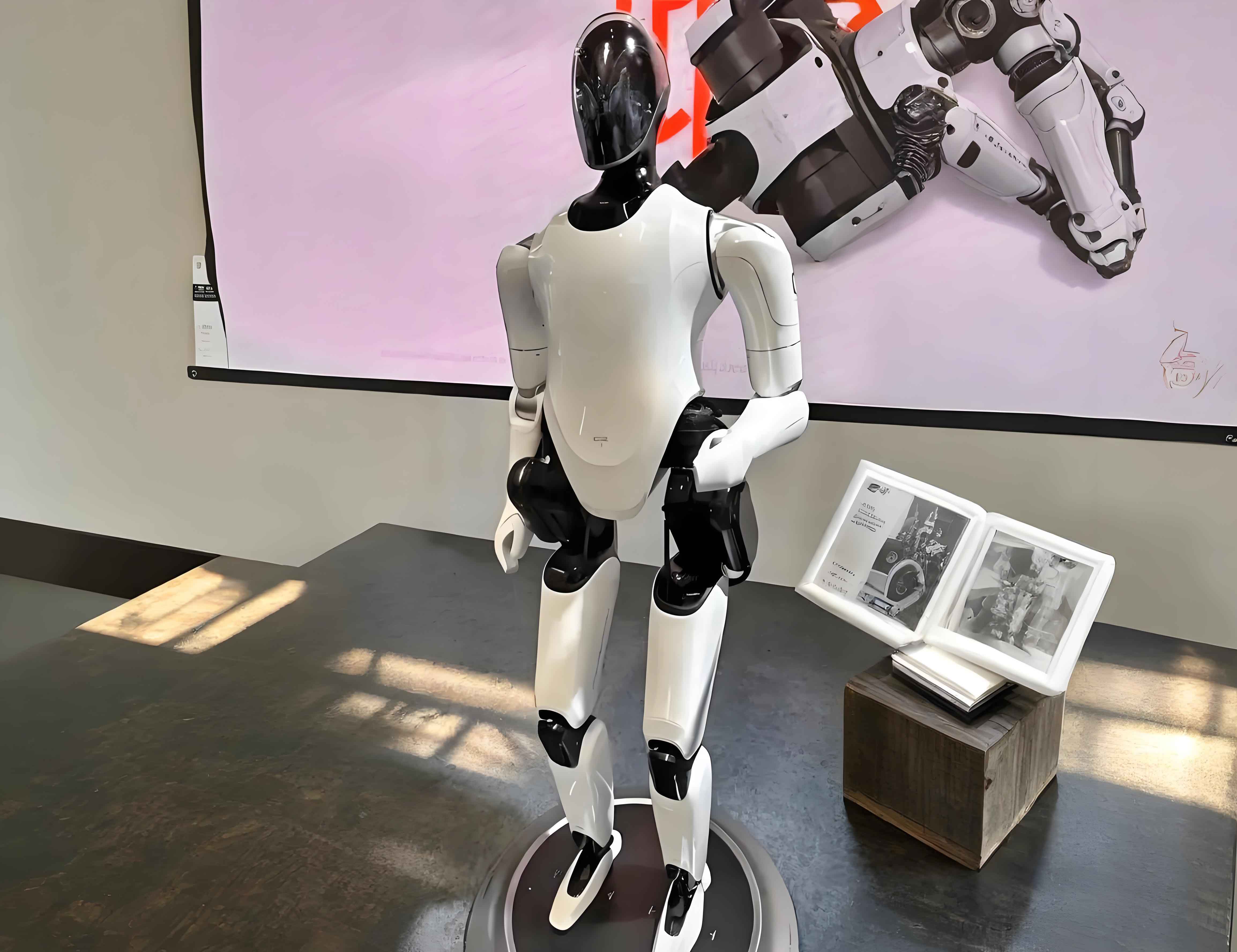
In manufacturing, embodied AI robots are revolutionizing production lines. They can perceive their surroundings via LVMs, interpret verbal commands using LLMs, and execute precise actions through RL-trained policies. For instance, a robotic arm might assemble components by following natural language instructions, adapting to variations in part placement. The integration of embodied AI robots in such settings reduces human labor and increases efficiency.
In the realm of autonomous vehicles, embodied AI robots enable self-driving cars to navigate dynamic traffic. These systems use VLMs to understand road signs and pedestrian gestures, while RL algorithms optimize driving policies for safety and comfort. The decision-making process can be modeled as a partially observable MDP, where the embodied AI robot must account for uncertainties in sensor data.
For aerial systems, drones equipped with embodied intelligence can conduct surveillance or delivery missions. An embodied AI robot drone might use an LLM to parse mission objectives like “monitor the perimeter for intrusions,” then employ RL to plan energy-efficient flight paths. Table 2 outlines some key applications and their technological requirements.
| Domain | Embodied AI Robot Example | Key Technologies Used | Challenges Addressed |
|---|---|---|---|
| Industrial Automation | Mobile manipulator for assembly | LLM for planning, LVM for object detection, RL for control | Precision in cluttered environments |
| Autonomous Driving | Self-driving car | VLM for scene understanding, RL for navigation | Real-time decision-making in traffic |
| Aerial Surveillance | Autonomous drone | LLM for task interpretation, RL for path planning | Battery life and obstacle avoidance |
| Healthcare | Assistive robot for patient care | VLM for human-robot interaction, RL for gentle manipulation | Safety and adaptability to human behaviors |
Another promising area is swarm robotics, where multiple embodied AI robots collaborate to achieve common goals. For example, in disaster response, a team of embodied AI robots can search for survivors by sharing perceptual data via VLMs and coordinating actions through distributed RL. The collective behavior emerges from local interactions, much like in biological systems.
Furthermore, embodied AI robots are enhancing human-robot collaboration. In homes or offices, they can serve as companions or assistants, using embodied intelligence to understand context and anticipate needs. This requires advanced fusion of large models for natural communication and RL for adaptive behavior.
Mathematical Frameworks for Embodied Learning
To deeper understand how embodied AI robots learn, we can formalize their learning processes using mathematical models. These frameworks combine perception, cognition, and action into unified formulations.
One common approach is the world model, where an embodied AI robot learns a simulator of its environment. Let $o_t$ be an observation at time $t$, and $a_t$ be an action. The world model predicts the next observation and reward:
$$ \hat{o}_{t+1}, \hat{r}_t = g_{\phi}(o_t, a_t) $$
where $g_{\phi}$ is a neural network parameterized by $\phi$. The embodied AI robot can then plan actions by simulating futures within this model, reducing the need for expensive real-world trials. This is particularly useful for training embodied AI robots in safe virtual environments before deployment.
Another framework is hierarchical reinforcement learning, which aligns with how humans break down complex tasks. An embodied AI robot might use a high-level policy $\pi_{\text{high}}$ to set sub-goals, and a low-level policy $\pi_{\text{low}}$ to execute primitive actions. The overall objective becomes:
$$ \max_{\pi_{\text{high}}, \pi_{\text{low}}} \mathbb{E} \left[ \sum_{k} R_{\text{high}}(s_k, g_k) + \sum_{t} R_{\text{low}}(s_t, a_t) \right] $$
where $g_k$ are sub-goals. This decomposition allows an embodied AI robot to tackle long-horizon tasks, such as “clean the room,” by first planning to “pick up trash” then “vacuum the floor.”
Additionally, we can model the perception-action cycle of an embodied AI robot as a Bayesian inference problem. Given sensory data $D$, the robot infers the state of the world $W$ and chooses actions to maximize utility $U$:
$$ a^* = \arg\max_a \mathbb{E}_{P(W|D)} [U(W, a)] $$
This probabilistic approach enables robust decision-making under uncertainty, crucial for embodied AI robots operating in noisy environments.
Future Research Directions
Looking ahead, the development of embodied AI robots faces several challenges and opportunities. As a researcher, I believe that focusing on the following areas will be pivotal for achieving fully autonomous unmanned systems.
First, lightweight embodied intelligence is essential for deployment on resource-constrained platforms. Current large models demand significant computational power, which may not be feasible for small embodied AI robots like micro-drones. Techniques such as model pruning, quantization, and edge computing can help compress algorithms without sacrificing performance. For example, a lightweight LLM for an embodied AI robot could be distilled from a larger model using knowledge distillation:
$$ \mathcal{L}_{\text{distill}} = \alpha \cdot \mathcal{L}_{\text{task}} + (1-\alpha) \cdot \text{KL}(p_{\text{teacher}} || p_{\text{student}}) $$
where $p_{\text{teacher}}$ and $p_{\text{student}}$ are output distributions, and $\alpha$ balances task loss and distillation loss.
Second, group coordination for embodied AI robots in swarms will enable complex collective tasks. This involves developing communication protocols and distributed learning algorithms. A multi-agent RL framework can be used, where each embodied AI robot learns a policy that considers others’ actions. The global reward might be shared to promote cooperation:
$$ R_{\text{global}} = \sum_{i=1}^{N} R_i(s, a_i) $$
with $N$ robots. Research in this area will allow embodied AI robot teams to perform synchronized operations, such as construction or environmental monitoring.
Third, full autonomy for embodied AI robots requires moving beyond human supervision. This means enabling self-directed learning, where an embodied AI robot can set its own goals and explore novel environments. Intrinsic motivation methods, such as curiosity-driven exploration, can be incorporated by adding an exploration bonus to the reward:
$$ R_{\text{total}} = R_{\text{extrinsic}} + \beta \cdot I(s_t; s_{t+1}) $$
where $I$ represents information gain about the environment. This encourages an embodied AI robot to seek out new experiences, accelerating its learning.
Fourth, human-robot integration for embodied AI robots will foster seamless collaboration. Future systems should understand human intentions and emotions, possibly using affective computing alongside embodied intelligence. For instance, an embodied AI robot could adapt its behavior based on verbal cues or facial expressions, creating a symbiotic relationship.
To illustrate these directions, Table 3 summarizes the key focus areas and potential solutions for advancing embodied AI robots.
| Research Direction | Challenge | Proposed Solutions for Embodied AI Robots | Expected Impact |
|---|---|---|---|
| Lightweight Embodied Intelligence | High computational demands on small platforms | Model compression, efficient architectures, edge AI | Deployment in portable and low-power systems |
| Group Coordination | Scalable communication and decision-making in swarms | Multi-agent RL, emergent behavior algorithms | Large-scale collaborative tasks without central control |
| Full Autonomy | Dependence on human input for goal setting | Intrinsic motivation, self-supervised learning | Embodied AI robots that learn and adapt independently |
| Human-Robot Integration | Understanding and responding to human social cues | Multimodal emotion recognition, adaptive dialogue systems | Natural and trustworthy partnerships in daily life |
Conclusion
In conclusion, embodied intelligence is transforming autonomous unmanned systems into sophisticated embodied AI robots capable of perception, reasoning, and action. Through the integration of large foundation models and reinforcement learning, these systems are overcoming traditional limitations and achieving new levels of autonomy. From industrial automation to personal assistance, embodied AI robots are poised to revolutionize various sectors by interacting with the world in human-like ways.
As research progresses, addressing challenges like lightweight design, swarm coordination, full autonomy, and human integration will be crucial. By leveraging mathematical frameworks and continuous innovation, we can envision a future where embodied AI robots operate seamlessly alongside humans, enhancing productivity and quality of life. The journey toward truly intelligent embodied AI robots is ongoing, but the advancements so far promise a transformative impact on technology and society.