
The pursuit of artificial intelligence has long been captivated by the challenge of abstract reasoning and data manipulation. Yet, a profound shift is underway, moving intelligence from the disembodied realm of pure data into the physical world. This paradigm, which I consider the next evolutionary step, is embodied AI. At its core, embodied AI posits that true intelligence is not merely about processing symbols or recognizing patterns in static datasets, but about the emergence of cognitive abilities through an agent’s continuous sensorimotor interaction with a dynamic, physical environment. An embodied AI robot is the quintessential manifestation of this principle—a system that perceives, reasons, plans, and acts upon the world to accomplish tasks, thereby grounding its intelligence in physical experience.
The recent and explosive advancement of large-scale foundation models, particularly large language models (LLMs) and vision-language models (VLMs), has served as a powerful catalyst for this field. These models, trained on vast corpora of internet-scale text and image data, have internalized a remarkable amount of commonsense knowledge and semantic understanding. My research, along with that of the broader community, focuses on harnessing these capabilities and grounding them into the physical substrate of an embodied AI robot. The central challenge and opportunity lie in the symbiotic relationship: the robot provides the “body” for the model’s intelligence to act, while the model provides the “mind” that enables the robot to understand, reason, and generalize in open-ended environments. This transition signifies a move from systems designed for specific, closed-world tasks to generalist embodied AI robots capable of operating in unstructured, dynamic, and interactive settings.
Catalysts and Architectural Evolution
The development of the embodied AI robot is driven by two intertwined forces: the need for more capable autonomous systems and the enabling technology of foundation models. Traditional robotic pipelines were modular, with distinct components for perception, state estimation, planning, and control. This architecture, while reliable for well-defined tasks, struggled with generalization and required extensive engineering for each new environment or objective.
The Transformer architecture revolutionized this landscape. Models like CLIP demonstrated that visual and linguistic concepts could be aligned in a shared semantic space, enabling open-vocabulary recognition. LLMs like GPT-3 and its successors showed unprecedented prowess in language understanding, generation, and even rudimentary reasoning. The key insight was to leverage these models not as isolated tools but as the central “brain” of the robotic system. This has led to an architectural convergence, where the boundaries between perception, decision-making, and control are becoming increasingly blurred, moving towards end-to-end trainable policies or tightly integrated frameworks powered by large models. The trajectory is clear: from single-task specialists to multi-task generalists, from scripted behaviors to adaptive, instruction-following agents.
| Model/Approach | Core Innovation | Key Contribution to Embodied AI |
|---|---|---|
| SayCan | LLM + Affordance Scoring | Grounded high-level language instructions into feasible robotic skills by combining LLM value proposals with learned affordance functions. |
| RT-1 (Robotics Transformer) | Transformer for Action Chunks | Scaled imitation learning by treating robot actions as tokens, learning a policy from large-scale demonstration data for diverse manipulation tasks. |
| PaLM-E | Multimodal Embodied LLM | Created a single, large model that ingests continuous sensor data (images, states) as language tokens, enabling embodied reasoning, VQA, and manipulation planning in one model. |
| RT-2 (VLA Model) | Vision-Language-Action Translation | Co-trained on web-scale vision-language data and robot data, enabling the transfer of semantic knowledge from the web to direct robot control, facilitating novel generalization. |
| VoxPoser | LLM-as-Scene-Planner | Used LLMs to generate code that constructs 3D value maps and constraints from language, enabling zero-shot synthesis of complex manipulation trajectories. |
Foundational Technical Pillars
Building a competent embodied AI robot rests on several interconnected technical pillars. My work synthesizes advances from robotics, computer vision, and machine learning to address these core challenges.
1. Large-Model-Driven Multimodal Perception
An embodied AI robot must make sense of a rich, multi-sensory world. While traditional perception pipelines relied on models trained for specific object categories, the goal now is open-world understanding. This is where foundation models become indispensable.
- Vision-Language Models (VLMs): Models like CLIP, OWL-ViT, and Grounding DINO provide the fundamental capability of linking pixels to words. They allow a robot to detect and segment objects based on free-form textual descriptions (e.g., “the red mug next to the laptop”), breaking the dependency on a pre-defined list of classes. The core learning objective often involves contrastive loss, aligning image and text embeddings:
$$ \mathcal{L}_{contrastive} = -\log \frac{\exp(\text{sim}(I_i, T_i) / \tau)}{\sum_{j=1}^{N} \exp(\text{sim}(I_i, T_j) / \tau)} $$
where $I_i$ and $T_i$ are the embeddings of a matching image-text pair, and $\tau$ is a temperature parameter. - Multimodal Large Models: The PaLM-E architecture represents a significant leap. It treats multimodal inputs—images, sensor readings, proprioception—as sequential tokens that are fed into a large language model backbone. By training on mixed datasets of internet language/image data and robot trajectory data, the model learns a unified representation where the robot’s sensory state is as interpretable as text. This enables the model to answer questions about scenes (“Is the drawer open?”) and directly output action plans or low-level controls, effectively fusing perception and cognition.
| Modality | Representation Method | Role in Embodied AI Robot |
|---|---|---|
| RGB Vision | VLM embeddings (CLIP, DINO), Neural Descriptors | Object recognition, scene understanding, affordance prediction. |
| Depth / 3D Point Cloud | PointNet++ features, Projection to VLM space (PointCLIP), Tri-plane features | Geometric reasoning, grasp pose estimation, 3D navigation. |
| Proprioception / State | Tokenization into LLM vocabulary (PaLM-E) | Provides self-awareness (joint angles, battery level) for context-aware planning. |
| Language (Instruction) | LLM token embeddings | High-level task specification, interactive feedback, commonsense reasoning. |
| Tactile / Force-Torque | Time-series feature encoders | Fine-grained manipulation control, slip detection, material property estimation. |
2. Scene Representation and Understanding for Open Environments
For an embodied AI robot to act intelligently, it needs more than 2D snapshots; it requires a persistent, spatially-grounded understanding of its environment. Recent advances in neural scene representations are pivotal.
- Neural Radiance Fields (NeRF) & Semantic Extensions: While NeRF originally synthesized novel views, extensions like LERF (Language Embedded Radiance Fields) distill dense, language-aligned semantic features into a 3D volume. This allows a robot to query a reconstructed 3D scene with language (e.g., “where are the cleaning supplies?”) and receive a 3D spatial region, enabling semantically-aware navigation and manipulation.
- 3D Feature Fields & Maps: Works like F3RM and VLMaps create 3D spatial memories that combine geometry with visual-language features. A robot can build a map where each location is tagged with its semantic meaning. This map can then be used for long-horizon task planning expressed in natural language, such as “Go to the living room, find the blue book on the coffee table, and bring it to me.” The representation bridges the gap between the abstract reasoning of LLMs and the metric space the robot operates in.
3. Reasoning and Decision-Making for Embodied Tasks
This is the domain where LLMs truly shine. The challenge is to transform their abstract knowledge into concrete, executable plans for an embodied AI robot.
- High-Level Planning with LLMs: Frameworks like Code as Policies (CaP) prompt LLMs to generate executable code (e.g., in Python) that calls parameterized perception and control primitives. For example, given the instruction “Make me a cup of coffee,” the LLM might generate code that first calls a `find_object(“kettle”)` function, then a `navigate_to(kettle_location)` function, followed by a `grasp(kettle)` function. This treats the LLM as a high-level planner that understands task structure and common sense (the kettle needs water, the water needs heating).
- Closed-Loop Reasoning: Inner Monologue and similar frameworks incorporate real-time feedback (e.g., “I failed to grasp the spoon,” “The drawer is stuck”) back into the LLM’s context window. This allows the embodied AI robot to dynamically re-plan, recover from failures, and adjust its strategy based on actual world feedback, moving towards robust closed-loop task execution.
- Value-Driven Synthesis: VoxPoser represents a powerful approach where the LLM is used to generate not a plan of actions, but a program that creates a 3D value function over the workspace. This function scores states based on task goals (“be near the cup”) and constraints (“avoid spilling”). A model-predictive controller then optimizes the robot’s trajectory to maximize this value, leading to precise and complex manipulation behaviors specified purely in language.
A general formulation for this embodied decision-making can be expressed as finding an action sequence $a_{1:T}$ that maximizes the expected success of a task $\mathcal{T}$ described by language $L$, given the robot’s history of observations $o_{1:t}$:
$$ a_{1:T}^* = \arg\max_{a_{1:T}} \mathbb{E}[ \mathcal{R}(\mathcal{T}) \;|\; \pi_\theta(a_{1:T} \;|\; o_{1:t}, L, \mathcal{M}) ] $$
where $\pi_\theta$ is the policy (often an LLM/VLM-augmented model) and $\mathcal{M}$ represents the internal world model or scene representation.
4. Interactive Robot Learning and Control
Pre-trained models provide a strong prior, but an embodied AI robot must also learn from its own interactions to adapt and refine its skills.
- Learning from Language Feedback: Systems like DROC (Distillation and Retrieval of Online Corrections) allow humans to teach robots using natural language (“No, move your gripper further to the left”). The robot distills these corrections into a retrievable knowledge base, improving its performance on future, similar tasks without re-learning from scratch. LMPC (Language Model Predictive Control) frames human feedback as part of a sequence modeling problem, using the LLM to predict human preferences and optimize actions accordingly.
- Visual Affordance Learning: This line of research focuses on learning what actions are possible and where they can be applied from visual data. Models like Where2Act and O2O-Afford train neural networks to predict interaction hotspots and success probabilities for actions like pushing, pulling, or opening directly from point clouds or images. This provides a fundamental layer of physical understanding that complements the semantic knowledge of LLMs, guiding the embodied AI robot towards mechanically plausible behaviors.
The control problem for an embodied AI robot leveraging these learned affordances and high-level plans can be framed as a constrained optimization, minimizing the discrepancy between the current state and a goal state derived from the plan, while respecting physical dynamics $f$ and constraints $C$:
$$ \min_{u_{t:t+H}} \sum_{k=t}^{t+H} ||x_k – x_k^{goal}||^2_Q + ||u_k||^2_R $$
$$ \text{s.t. } x_{k+1} = f(x_k, u_k), \; C(x_k, u_k) \leq 0 $$
where $x^{goal}$ is informed by the high-level planner or affordance model.
5. Embodied AI Simulators
Collecting vast amounts of real-world robot interaction data is costly and slow. High-fidelity simulators are essential for training, testing, and benchmarking embodied AI robot algorithms at scale.
- Platforms: Simulators like Habitat, iGibson, and AI2-THOR provide photorealistic 3D environments with physically plausible interaction models. They support complex tasks like navigation in scanned real-world apartments (Matterport3D in Habitat) or interactive object manipulation (AI2-THOR).
- Role: They enable (1) Large-scale data generation for training perception and policy models, (2) Safe and rapid prototyping of algorithms, (3) Standardized benchmarking of tasks like Embodied Question Answering (EQA) or Vision-and-Language Navigation (VLN), and (4) Sim-to-real transfer research, where policies trained in simulation are adapted to work on physical robots.
Exemplar Tasks and Applications
The integration of these technologies is best illustrated through concrete tasks that challenge an embodied AI robot‘s integrated capabilities.
1. Vision-and-Language Navigation (VLN): The robot must follow natural language instructions (e.g., “Go down the hall, turn left at the painting, and wait in the kitchen near the fridge”) to navigate in an unseen, complex environment. This requires continuous visual perception, spatial reasoning, grounding language to landmarks, and long-horizon planning. Modern approaches use VLMs to match observations to instruction steps and LLMs to track progress and make strategic decisions.
2. Language-Driven Mobile Manipulation: This is the holistic test of an embodied AI robot. Commands like “Tidy up the living room by putting the toys in the green bin” require: segmenting “toys” and “green bin” (VLM), navigating to the living room and searching (VLN), planning a sequence of pick-and-place operations (LLM planning), and executing precise grasps and movements (affordance learning & control). End-to-end models like RT-2 and PaLM-E aim to solve such tasks by translating language and vision directly into action sequences, demonstrating emergent capabilities like reasoning about object categories not explicitly seen during robot training.
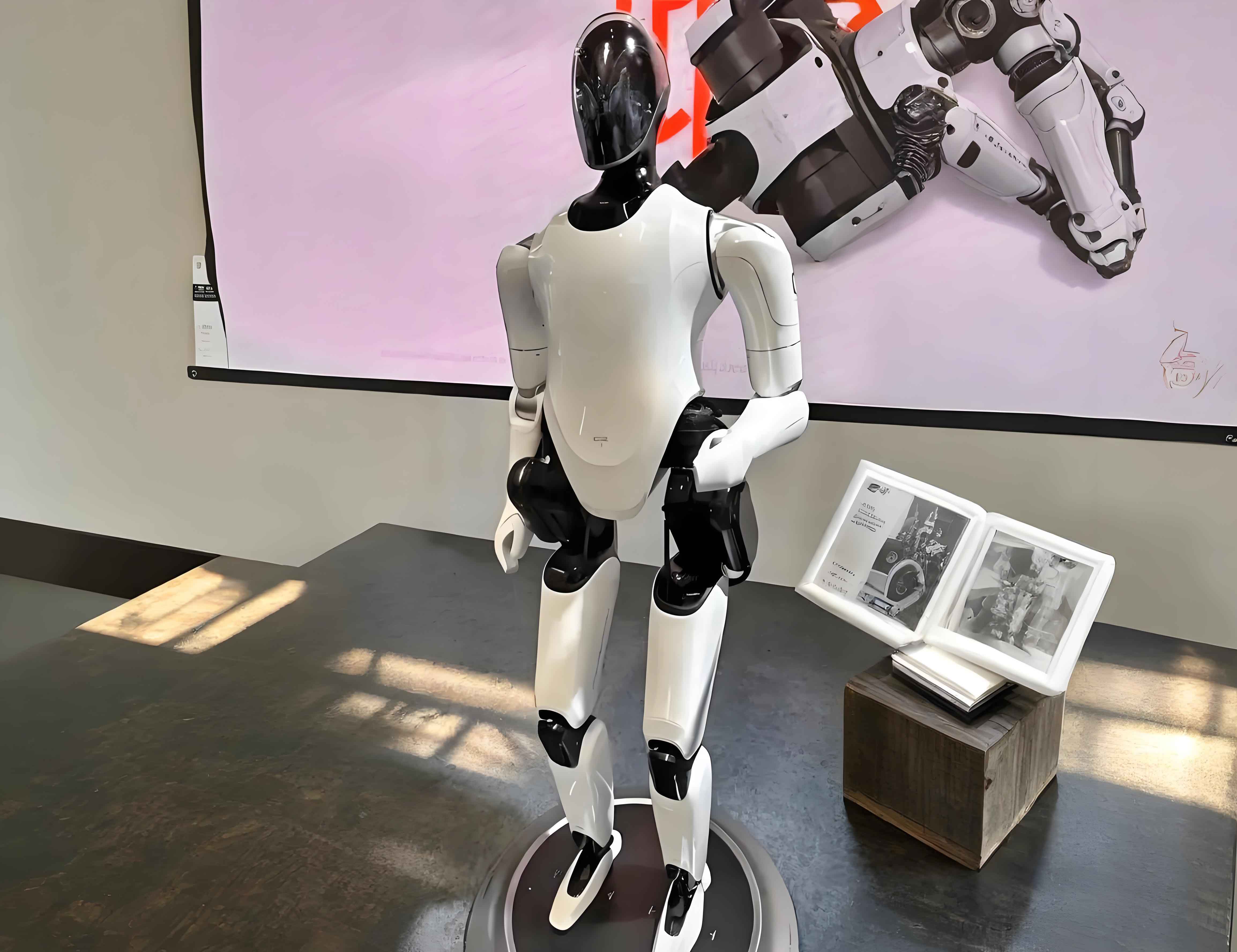
Challenges and Future Research Directions
Despite remarkable progress, the path towards a truly robust and general embodied AI robot is fraught with open challenges. My perspective on the critical frontiers includes:
- Seamless Sim-to-Real Transfer: The “reality gap” remains significant, especially for contact-rich manipulation involving deformable objects, friction, and complex physics. Future work must develop more accurate physical simulators, better domain randomization techniques, and more sophisticated adaptation algorithms that allow policies and representations learned in simulation to deploy effectively on real hardware.
- Model Efficiency and Scalability: The largest embodied models have hundreds of billions of parameters, making them impractical for real-time deployment on mobile platforms. Research into model compression (pruning, distillation, quantization), efficient architectures (mixture-of-experts), and the development of smaller, yet capable “embodied-specific” foundation models is crucial.
- Safety, Reliability, and Mitigating “Hallucination”: LLMs can generate plausible but incorrect or unsafe plans—a critical failure mode for a physical robot. Developing rigorous frameworks for verification, constraint satisfaction (e.g., through symbolic grounding or learned safety critics), and uncertainty quantification in embodied decision pipelines is paramount. We must ensure the embodied AI robot knows when it doesn’t know.
- Multi-Agent Embodied Systems: The real world requires collaboration. Scaling embodied AI to teams of robots introduces challenges in decentralized communication, coordinated planning under uncertainty, and emergent cooperative strategies. This direction extends the embodied AI robot paradigm to collective intelligence.
- Lifelong Learning and Adaptation: An embodied AI robot should not be static. It must continuously learn from its successes and failures, assimilate new knowledge from interactions or human instruction, and adapt its models to environmental changes without catastrophic forgetting. This points towards the need for efficient continual learning algorithms within the embodied context.
- Integration with Digital Twins: A promising direction is tightly coupling the embodied AI robot with a high-fidelity digital twin of its operating environment. The twin provides a perfect world model for planning and “what-if” simulation, while the robot’s real-world data keeps the twin updated. This symbiotic loop could dramatically enhance planning robustness and enable pre-execution verification of complex actions.
In conclusion, the field of embodied intelligence represents a fundamental convergence of robotics, computer vision, and large-scale AI. The embodied AI robot is the platform where abstract intelligence becomes practical agency. While significant hurdles remain in robustness, safety, and efficiency, the trajectory is unmistakable. By continuing to ground the phenomenal reasoning capabilities of foundation models in the physical experiences of a robot body, we are moving closer to creating machines that can truly understand and interact with our world in flexible, general, and useful ways. The journey from specialized automation to general-purpose embodied assistants is well underway, promising to redefine the role of autonomous systems in our homes, industries, and society.