
As a practitioner in the field of artificial intelligence, I have witnessed the rapid evolution of AI systems, from language models to autonomous vehicles. However, one frontier that stands out for its immense potential and unique challenges is embodied AI. Embodied AI robots, which interact with the physical world through sensors and actuators, represent a paradigm shift in how machines learn and operate. In this article, I will delve into why synthetic data is pivotal for scaling embodied AI robots, drawing from insights and experiences in developing solutions that bridge simulation and reality.
The advent of large language models and autonomous driving has underscored the critical role of data in AI advancement. Yet, embodied AI robots demand an entirely different scale of data. Based on my observations, the data requirements for embodied AI robots are thousands of times greater than those for large language models or self-driving cars. This isn’t merely a quantitative difference; it’s qualitative, stemming from the need to understand and manipulate complex physical environments. To illustrate, consider the scaling laws that govern AI performance. For large language models, the scaling law often follows a power-law relationship between model size and data, expressed as:
$$ \text{Performance} \propto N^\alpha \cdot D^\beta $$
where \( N \) is the number of parameters, \( D \) is the data size, and \( \alpha \) and \( \beta \) are constants. For embodied AI robots, the exponent \( \beta \) is significantly larger due to the high dimensionality of physical interactions. This means that to achieve similar performance gains, embodied AI robots require exponentially more data. The following table contrasts data needs across AI domains:
| AI Domain | Data Type | Estimated Data Volume (Relative) | Key Challenges |
|---|---|---|---|
| Large Language Models | Text Corpora | 1x (Baseline) | Linguistic diversity, context understanding |
| Autonomous Driving | Sensor Data (LiDAR, Camera) | 10-100x | Real-world variability, safety-critical scenarios |
| Embodied AI Robots | Multimodal Physical Interactions | 1000x or more | Physics simulation, human demonstration, scene diversity |
This immense data hunger stems from the fact that embodied AI robots must learn not just patterns, but cause-and-effect relationships in dynamic environments. Each interaction—whether grasping an object or navigating a cluttered space—generates unique data points that inform future actions. Hence, traditional data collection methods, reliant on real-world trials, are impractical due to cost, time, and safety constraints. This is where synthetic data emerges as a game-changer.
Synthetic data, generated through simulation, offers three core advantages that make it indispensable for embodied AI robots. First, in terms of scalability, synthetic data can be produced indefinitely given sufficient compute resources. The data generation rate \( G \) can be modeled as:
$$ G = f(C, S) $$
where \( C \) is computational power and \( S \) is simulation complexity. Unlike real-world data, which is bottlenecked by physical logistics, synthetic data scales linearly with \( C \), enabling rapid iteration. Second, synthetic data allows for randomized generation of objects and scenarios, enhancing generalization. For instance, in training an embodied AI robot for manipulation tasks, we can vary object properties—mass, friction, texture—using probability distributions:
$$ m \sim \mathcal{N}(\mu_m, \sigma_m^2), \quad \mu \sim U(0.1, 0.9) $$
where \( m \) is mass and \( \mu \) is friction coefficient. This variability ensures that the embodied AI robot learns robust policies that transfer to unseen real-world conditions. Third, synthetic data helps overcome the simulation-to-reality (Sim2Real) gap. By incorporating realistic physics engines and rendering techniques, we can generate data that mirrors physical laws, thus bridging the divide between virtual and actual environments. The following table summarizes these advantages:
| Advantage | Description | Impact on Embodied AI Robots |
|---|---|---|
| Unlimited Supply | Data generation bounded only by compute; no physical constraints | Enables massive dataset creation for training complex policies |
| Enhanced Generalization | Randomized parameters in simulation foster diversity | Reduces overfitting and improves adaptation to new tasks |
| Sim2Real Transfer | High-fidelity simulation mimics real-world physics and visuals | Accelerates deployment by pre-training in synthetic environments |
However, not all synthetic data is equally effective. From my experience, synthetic data for embodied AI robots must satisfy four critical conditions to be valuable. First, it must enable realistic physical interactions. An embodied AI robot learns by interacting with environments that reflect true physics, including properties like inertia, elasticity, and collision dynamics. The robot’s perception-action loop can be formalized as:
$$ s_{t+1} = F(s_t, a_t; \theta) $$
where \( s_t \) is the state, \( a_t \) is the action, and \( \theta \) represents physical parameters. Without accurate physics, the feedback is misleading, hindering learning. Second, human demonstration is irreplaceable. While synthetic data can automate much of the process, expert human input provides nuanced, goal-oriented trajectories that guide the embodied AI robot. This aligns with the concept of imitation learning, where a policy \( \pi \) is learned from demonstrations \( \tau \):
$$ \pi^* = \arg\max_{\pi} \mathbb{E}_{\tau \sim \pi} [R(\tau)] \quad \text{s.t.} \quad \tau_{\text{demo}} \in \mathcal{D} $$
Here, \( \mathcal{D} \) includes human demonstrations that seed the learning process. Third, scene diversity is paramount. Synthetic data should not merely replicate a single world but generate a multitude of scenarios—from industrial warehouses to domestic kitchens—to prepare the embodied AI robot for various applications. This diversity can be quantified using entropy measures over scene parameters. Fourth, a data闭环 capability is essential. Synthetic data must be validated through closed-loop testing, where policies trained on synthetic data are evaluated in real-world settings. This ensures that the embodied AI robot can perform reliably when deployed. The integration of these conditions forms a robust framework for synthetic data generation, as outlined below:
| Condition | Key Components | Role in Embodied AI Robot Training |
|---|---|---|
| Realistic Physical Interaction | Physics engines, material properties, force dynamics | Provides accurate feedback for reinforcement learning |
| Human Demonstration | Expert trajectories, task decomposition, corrective feedback | Guides policy initialization and reduces exploration time |
| Scene Richness | Randomized layouts, object variations, lighting conditions | Enhances generalization across environments |
| Data闭环 Validation | Real-world testing, performance metrics, iterative refinement | Ensures synthetic data translates to practical efficacy |
These conditions collectively enable synthetic data to drive the scaling laws for embodied AI robots. Scaling laws in this context refer to the relationship between model performance, data volume, and compute. For embodied AI robots, the scaling law can be expressed as a multivariate function:
$$ \mathcal{P} = \gamma \cdot D^{\delta} \cdot E^{\epsilon} $$
where \( \mathcal{P} \) is performance (e.g., task success rate), \( D \) is synthetic data diversity, \( E \) is environment complexity, and \( \gamma, \delta, \epsilon \) are scaling exponents. Synthetic data amplifies \( D \) and \( E \), allowing embodied AI robots to achieve superior performance with fewer real-world trials. This is crucial for applications like manufacturing, where embodied AI robots must perform precise assembly tasks. In such settings, synthetic data can simulate countless failure modes and edge cases, training the embodied AI robot to handle anomalies.
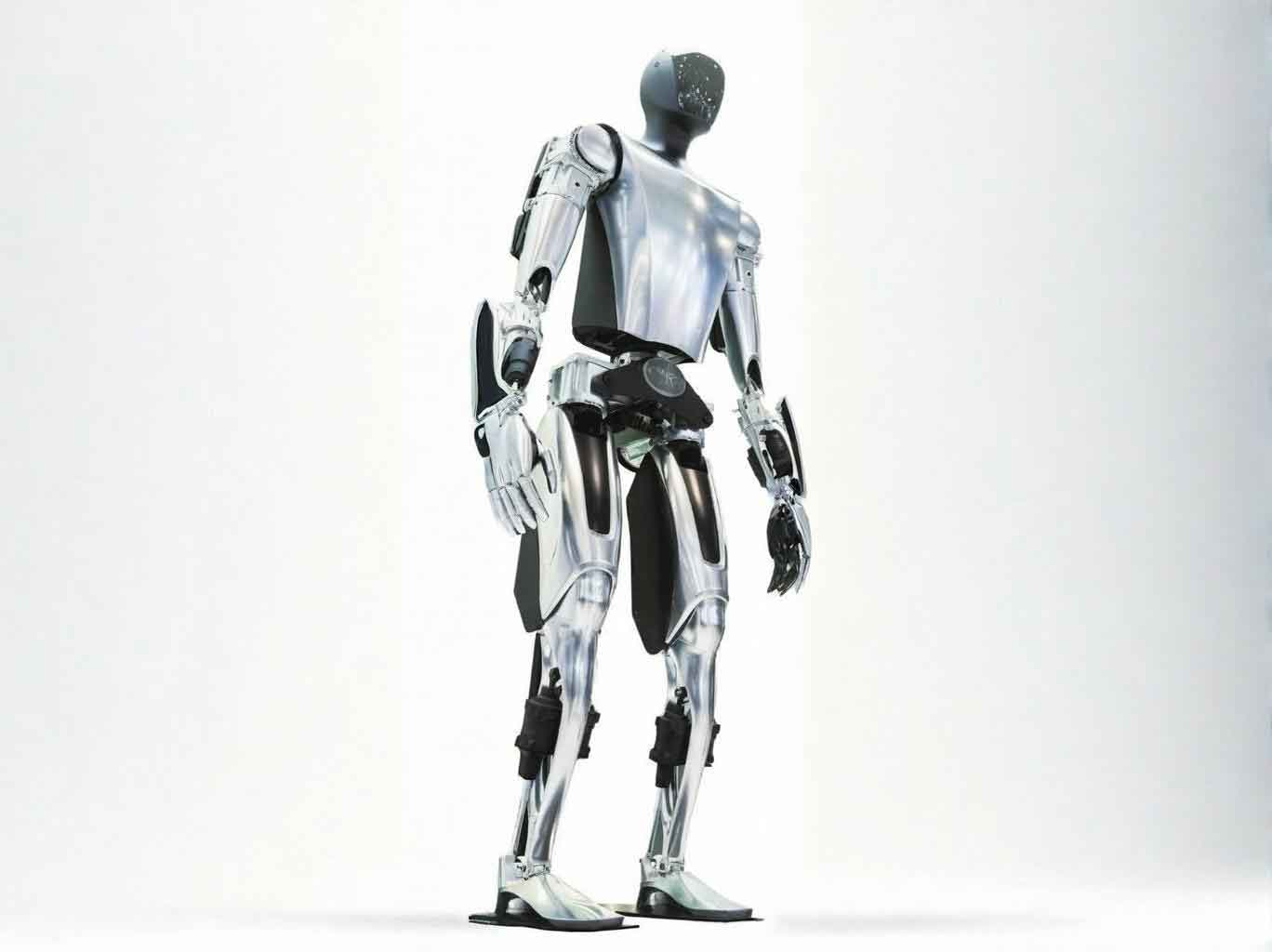
The image above depicts an embodied AI robot in a manufacturing context, highlighting how synthetic data can replicate such environments for training. By generating synthetic datasets that mirror factory floors, we can train embodied AI robots to optimize logistics, quality control, and collaborative work with humans. This not only reduces downtime but also enhances safety. The versatility of embodied AI robots extends beyond manufacturing to healthcare, agriculture, and domestic assistance, each demanding tailored synthetic data pipelines.
To operationalize synthetic data for embodied AI robots, we must consider the technical infrastructure. Simulation platforms must integrate high-fidelity rendering, physics engines like NVIDIA PhysX or Bullet, and domain randomization techniques. The data generation pipeline can be modeled as a stochastic process:
$$ \mathbf{X} \sim p(\mathbf{X} | \Phi), \quad \Phi = \{\phi_1, \phi_2, \dots, \phi_n\} $$
where \( \mathbf{X} \) is the synthetic data (e.g., images, depth maps, action sequences), and \( \Phi \) represents parameters such as object shapes, lighting angles, and friction coefficients. By sampling from diverse distributions, we ensure that the embodied AI robot encounters a wide spectrum of scenarios. Moreover, reinforcement learning algorithms, such as Proximal Policy Optimization (PPO) or Soft Actor-Critic (SAC), can leverage this data to learn policies \( \pi(a|s) \) that maximize cumulative reward:
$$ J(\pi) = \mathbb{E}_{\tau \sim \pi} \left[ \sum_{t=0}^T \gamma^t r(s_t, a_t) \right] $$
Here, \( \tau \) denotes trajectories generated in synthetic environments, and \( \gamma \) is a discount factor. As the embodied AI robot iterates through synthetic episodes, it refines its policy, gradually improving real-world performance through Sim2Real transfer.
Another critical aspect is the evaluation of synthetic data efficacy. We can define metrics such as Sim2Real gap \( \Delta \), calculated as the performance difference between simulation and reality:
$$ \Delta = \mathcal{P}_{\text{real}} – \mathcal{P}_{\text{sim}} $$
By minimizing \( \Delta \) through iterative refinement—adjusting physics parameters or adding noise models—we enhance the utility of synthetic data for embodied AI robots. This process aligns with active learning paradigms, where the embodied AI robot queries real-world data points to fine-tune synthetic distributions. Over time, this creates a virtuous cycle: synthetic data trains the embodied AI robot, real-world deployments provide feedback, and the simulation is updated accordingly.
Looking ahead, the synergy between synthetic data and embodied AI robots will unlock new frontiers. As compute power grows, we can generate even more complex datasets, enabling embodied AI robots to master dexterous manipulation, social interaction, and adaptive planning. The scaling law for embodied AI robots may evolve to incorporate factors like multi-robot collaboration, where data from multiple embodied AI robots is aggregated to accelerate learning. This can be represented as:
$$ D_{\text{total}} = \sum_{i=1}^k D_i + D_{\text{synth}} $$
where \( D_i \) is data from robot \( i \), and \( D_{\text{synth}} \) is synthetic data. In such settings, synthetic data serves as a force multiplier, allowing swarms of embodied AI robots to learn collectively without physical bottlenecks.
In conclusion, synthetic data is not merely a supplement but a foundational enabler for scaling embodied AI robots. Its ability to provide unlimited, diverse, and physically accurate data addresses the core challenges of embodied intelligence. By adhering to the conditions of realistic interaction, human demonstration, scene richness, and闭环 validation, we can harness synthetic data to propel embodied AI robots toward human-level competence in the physical world. The journey ahead involves continuous innovation in simulation technologies, but the potential—from revolutionizing industries to enhancing daily life—makes it a pursuit worth championing. As we refine these approaches, embodied AI robots will become increasingly adept, transforming from experimental prototypes into integral partners in our world.