
For the past few years, the development of artificial intelligence has followed two distinct, yet ultimately convergent, paths. The first, vividly represented by the rise of AIGC (AI-Generated Content) and large language models, aims to endow machines with cognitive capabilities analogous to the human mind—reasoning, knowledge synthesis, and creative generation. The second path, embodied intelligence, seeks to grant machines the perceptual and interactive capacities of a physical body, enabling them to act within and learn from the real world. While the cognitive revolution has captured global attention, I argue that the journey of the embodied AI robot towards “emergent” general intelligence represents a more profound, albeit more challenging, frontier. This convergence of mind and body, or “mind-body synergy,” is the critical next milestone on the road to Artificial General Intelligence (AGI).
To assess any technology’s revolutionary potential, we must evaluate it on three fundamental axes: its foundational nature, its impact on productivity, and its influence on the social superstructure. By these measures, AIGC has already proven its revolutionary credentials. However, the current generation of embodied AI robot systems has not yet crossed this threshold. Their impact on productivity remains largely additive or linear, unlike the exponential potential of cognitive automation. Furthermore, their application and scaling are constrained by significant safety and ethical considerations. The true revolutionary potential lies in fusing advanced cognition with physical capability, creating a new quality of productive force.
Overcoming the Data Wall: The Core Challenge for Embodiment
The scaling laws that propelled large language models (LLMs) to prominence are hitting a different set of constraints in the physical world. For the embodied AI robot, data quality and training strategy have surpassed sheer scale as the most critical factors. The paradigm is shifting from pre-training for broad “knowledge” to post-training for deep “reasoning” and skill acquisition. This can be summarized as a transition in priorities:
$$ \text{Pre-training Focus: } \max(\text{Data Scale}, \text{Parameter Count}) \rightarrow \text{Post-training Focus: } \max(\text{Data Quality}, \text{Algorithm Design}) $$
A fundamental tenet in AI development is that model architecture sets the lower bound of performance, while data determines the upper bound. For embodiment, the data challenge is orders of magnitude more complex than for language. The following table contrasts the data landscapes:
| Aspect | Large Language Model (LLM) | Embodied AI Robot |
|---|---|---|
| Primary Data Modality | Text tokens (symbolic, sequential) | Multi-modal tokens (visual, proprioceptive, tactile, force, temporal sequences) |
| Data Scale Benchmark | Trillions of tokens | Billions of tokens (current state) |
| Parameter Scale | Hundreds of billions to trillions | Tens of billions |
| Data Generation | Web-scale scraping, synthetic text | Real-world interaction (costly, slow), simulation (reality gap), synthetic data (limited fidelity) |
| “ChatGPT Moment” Analogy | Achieved (GPT-3, ChatGPT) | Not yet achieved; arguably at the “BERT stage” |
The difficulty is twofold. First, individual experience is incredibly hard to codify. Describing the simple act of “sitting in a chair” requires capturing high-dimensional data from every joint, muscle tension, balance adjustment, and tactile feedback over time—far beyond processing a string of symbols. Second, environmental expression is infinitely varied. Building a world model for an embodied AI robot requires capturing the physics, object affordances, and dynamic changes of countless real-world scenarios.
Several strategies are being pursued to bridge this data gap and accelerate the emergence of generalization in embodied AI robot systems:
- Intensive Trial-and-Error Training: Maximizing learning from limited real data through reinforcement learning and exploration in diverse environments. The learning objective can be framed as:
$$ \max_{\pi} \mathbb{E}_{\tau \sim \pi} \left[ \sum_{t} \gamma^t R(s_t, a_t) \right] $$
where $\pi$ is the robot’s policy, $\tau$ is a trajectory of states ($s_t$) and actions ($a_t$), $R$ is a reward function, and $\gamma$ is a discount factor. The goal is to learn a policy that generalizes across unseen states. - Learning Human-Like Generalization Mechanisms:
- Analogical Reasoning: Transferring knowledge from learned skills to novel but structurally similar tasks.
- Inductive-Deductive Learning: Extracting general principles from specific experiences (induction) and applying them to new situations (deduction).
- Hierarchical Knowledge Distillation: Using large cognitive models (LLMs) to guide and structure the learning of physical skills, potentially reducing the required interaction data. This can be modeled as minimizing a distillation loss:
$$ \mathcal{L}_{distill} = \text{KL}( P_{LLM}(a|s, g) \, || \, P_{Robot}(a|s, g) ) $$
where the robot’s policy distribution is trained to align with the task knowledge encoded in the LLM’s distribution over actions ($a$) given a state ($s$) and goal ($g$).
Mind-Body Synergy and the Three Foundational Paradigms
The ultimate goal is not merely a robot with a separate “brain” and “body,” but a system capable of true mind-body synergy. In humans, the body shapes cognition (e.g., movement influencing mood and thought), and cognition directs the body. This bidirectional shaping is crucial for adaptive, general intelligence. Today’s most advanced systems, when integrating separate cognitive and motor modules, often exhibit a marked drop in coherent intelligence—highlighting the absence of this deep synergy.
Interestingly, all current approaches to building an embodied AI robot still fall within the three philosophical paradigms outlined in the mid-20th century:
| Paradigm | Core Premise | Embodied AI Robot Manifestation | Learning Analogy |
|---|---|---|---|
| Symbolism | Intelligence arises from manipulating symbols and logical rules. | Using LLMs for task planning, symbolic reasoning about objects and actions. | Formal Education (learning from textbooks). |
| Connectionism | Intelligence emerges from distributed computation in neural networks, learning statistical patterns. | Training Vision-Language-Action (VLA) models on multi-modal token sequences via gradient descent. | Experiential Learning from Raw Data. |
| Behaviorism | Intelligence is shaped by interaction with the environment through trial, error, and reward. | Reinforcement Learning (RL) and embodied interaction where the robot learns from consequences. | Apprenticeship / Learning by Doing. |
A complete embodied AI robot solution will necessarily integrate all three paradigms: connectionist models for perception and low-level control, symbolic reasoning for high-level planning and knowledge, and behaviorist principles for skill refinement through interaction.
Industrialization Logic: Specialization vs. Generalization
A critical question for the industry is whether to pursue a general-purpose embodied AI robot or specialized task-specific agents. The history of LLMs offers a lesson: the path to capability may start with building broad, foundational cognitive models (like ChatGPT) before fine-tuning for specialization. However, this logic does not translate directly to the physical world due to hardware constraints.
The industrial logic for the embodied AI robot must be scenario-driven and task-oriented. The form factor (the “body”) must be optimally designed for a primary set of tasks. Scale can be achieved within that domain, but forced integration of disparate capabilities onto a single, potentially ill-suited platform is economically and technically unsound. For example, a robot designed for precise laboratory work will have a different embodiment than one for logistics in a warehouse.
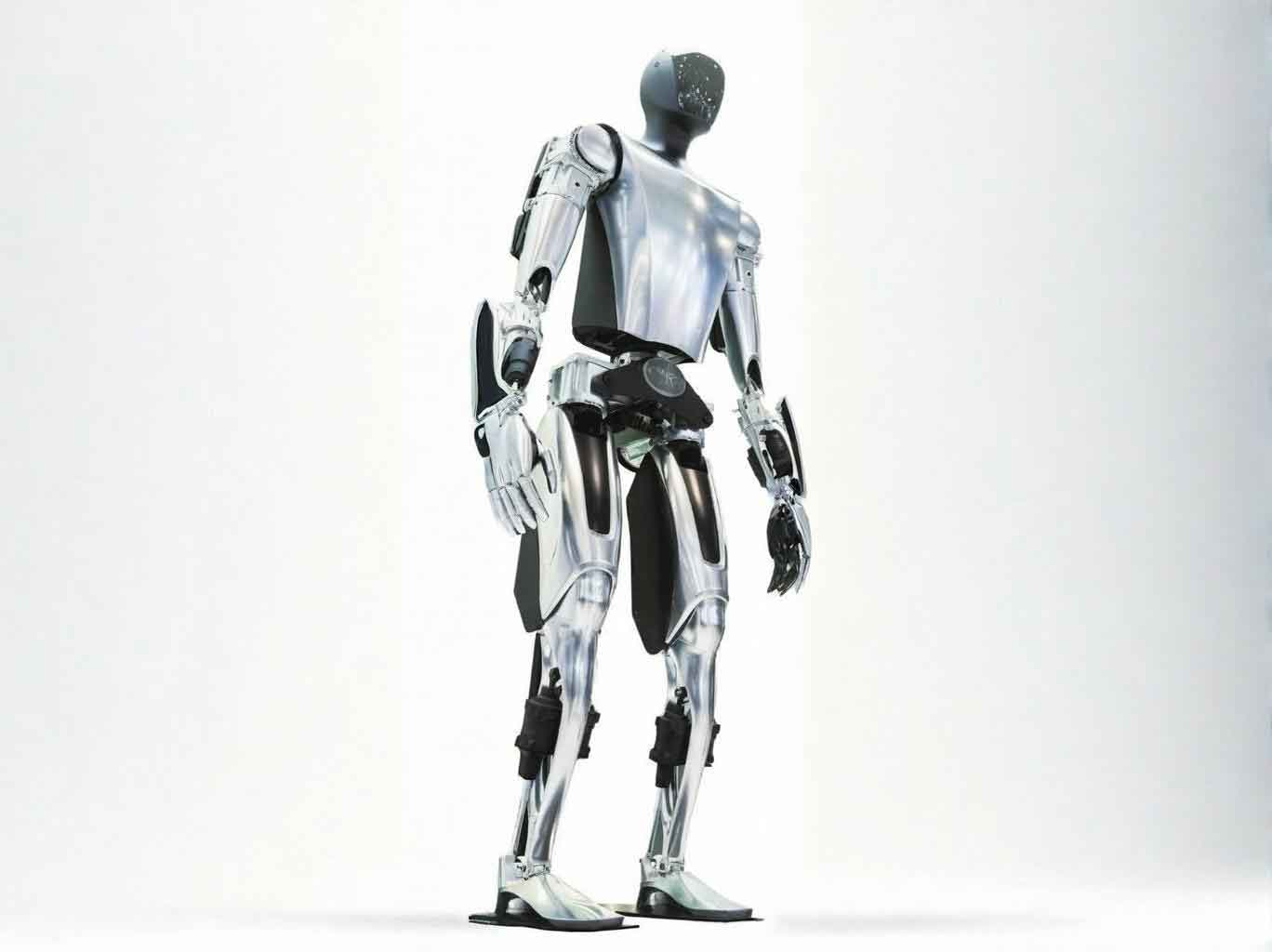
As seen in the image, application in structured environments like manufacturing is a likely early and scalable path for specialized embodied AI robot systems. The key to lowering cost and improving predictability lies not in forcing a single robot to do everything, but in perfecting the integration of adaptable AI within a well-defined physical form for a clear set of economic tasks.
Alignment, Risk, and the Paradox of the Body
As capabilities grow, so do concerns about risk and alignment. The iconic fear is of a physically capable embodied AI robot causing harm. However, this perspective may be inverted. The human body is both an enabler and a constraint; it limits our physical reach and power. Similarly, equipping an AI with a physical body can serve as a built-in safety mechanism, limiting its operational domain and potential for large-scale, instantaneous harm.
The far greater, more insidious risk comes from highly intelligent but disembodied AI. An AI capable of sophisticated deception, manipulation, or strategic planning could cause catastrophic societal disruption without ever moving a physical actuator. The risk equation might be conceptualized as:
$$
\text{Risk Index} = f(\text{Cognitive Capability}, \text{Autonomy}, \text{Misalignment}) \gg g(\text{Physical Capability})
$$
Where $f(.)$ grows super-linearly with cognitive factors, and $g(.)$ is bounded by physical laws and design.
Therefore, a dual approach to safety is paramount:
- Advanced AI Safety Benchmarking: Developing rigorous, ongoing evaluations to detect emerging capabilities like deception, power-seeking, or subtle value misalignment. This may necessitate new professions, such as “AI Risk Auditors,” empowered with monitoring and intervention protocols.
- Deepening Technical and Value Alignment: Intensifying research into making AI systems robustly aligned with complex human values and intentions. Crucially, many alignment challenges are reflections of unresolved contradictions within human society itself. Achieving consensus on a stable, beneficial value framework for AI may first require progress in our own social and philosophical discourse.
Education and Human Value in the Age of Embodied AI
The advent of capable embodied AI robot systems will force a fundamental re-evaluation of human purpose and education. If AI can perform both cognitive and physical labor, what is the unique value of a human? To prevent systemic human degeneration—both mental and physical—we must act proactively.
First, we must establish firm norms for the appropriate use of AI, prioritizing human development and flourishing over mere efficiency. The guiding question should shift from “Can we use AI for this?” to “Should we use AI for this?”
Second, education must undergo a radical transformation. The industrial-era model focused on imparting standardized knowledge and skills is becoming obsolete. The future curriculum must balance core foundational skills (which remain essential for developing higher-order thinking) with the cultivation of distinctly human, AI-resistant capacities:
| Industrial-Era Education Focus | AI-Era Education Imperative |
|---|---|
| Knowledge Memorization | Critical Thinking & Metacognition |
| Standardized Test Performance | Creativity & Divergent Thinking |
| Specialized Technical Skill | Interdisciplinary Synthesis |
| Efficiency in Routine Tasks | Ethical Reasoning & Value Judgment |
| Individual Competition | Collaboration & Empathic Leadership |
The third and most profound task is the redefinition of human value. As material and basic intellectual needs are met by AI, humanity’s drive must turn outward and inward. We must expand our cognitive boundaries by exploring uncharted interdisciplinary frontiers and deepen our introspective understanding of consciousness, meaning, and experience. Work may transition from a means of survival to a chosen form of experiential fulfillment and self-expression.
The journey of the embodied AI robot toward emergent intelligence is not just a technical quest; it is a mirror forcing us to confront our own nature. By guiding its development with foresight—focusing on specialized utility, rigorous alignment, and the preservation of human potential—we can navigate this path to create a future where artificial and human intelligence co-evolve, each amplifying the best of the other.