
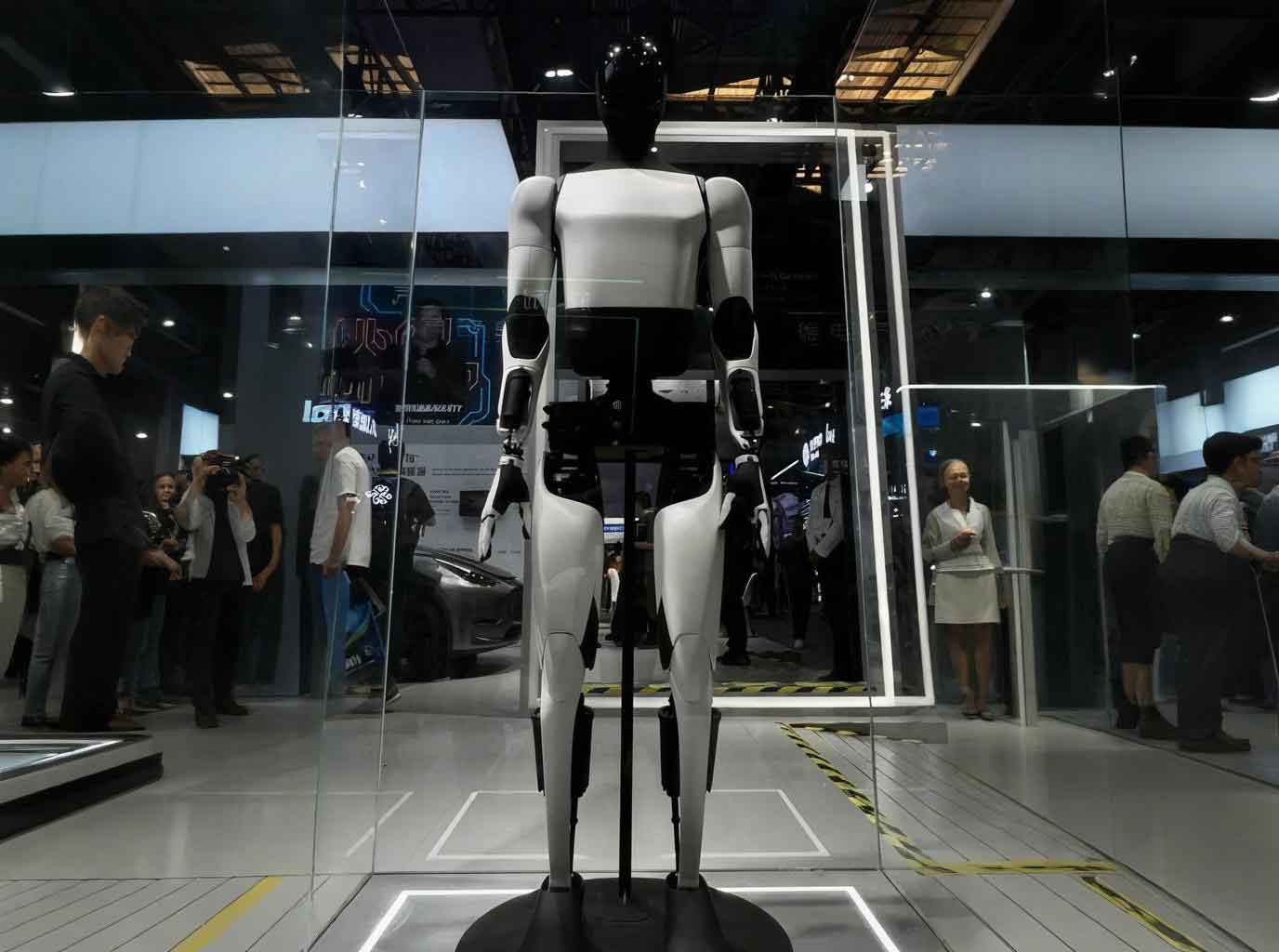
From the steam engine that augmented human muscle to the CNC machine that extended our precision, machines have historically served as external amplifiers of human capability—dutiful, tireless, but ultimately unaware. They were “external muscles” and “external nerves,” executing pre-programmed sequences without understanding their own physical presence or the context of their actions. We are now witnessing a profound shift, a quiet technological revolution where machines are crossing the threshold into a form of “bodily awareness.” This shift, embodied in the embodied AI robot, is overturning a half-century of industrial inertia, moving us from a paradigm where humans must adapt to machines, to one where the embodied AI robot adapts to us.
For decades, industrial automation was narrated through metrics of cycle time, precision, and cost. Robots were rigid executors, following offline trajectories. Any minor environmental perturbation required costly re-programming by engineers. The factory floor was organized around the machine’s needs. Today, breakthroughs in large language models (LLMs), vision-language-action (VLA) models, neuromorphic chips, and high-precision force control are converging. This convergence grants the embodied AI robot a “perception-cognition-action” loop, mirroring biological intelligence. It begins to understand not just “what to do,” but “who it is,” “where it is,” and “how its body couples with the environment.” The factory is being reshaped by this nascent consciousness.
Cornerstone: The Technical Definition of “Bodily Awareness”
The “bodily awareness” of an embodied AI robot is not a metaphor but a construct defined by three measurable technical breakthroughs. These breakthroughs collectively enable the “intent-action-outcome” self-closure that defines true autonomy.
1. Proprioceptive Sensing Precision: This refers to the resolution at which the robot senses its own state and contact forces. Key thresholds include:
$$ \text{Spatial Resolution of 6-Axis Force/Torque Sensor Array} \leq 0.1 \, \text{N·m} $$
$$ \text{Tactile Discrimination of Fingertip E-Skin} \leq 0.05 \, \text{mm} $$
This high-fidelity sensing provides the raw data stream necessary for understanding physical interaction.
2. Action Generation Latency: The time delay between perception and action generation must approach biological reflexes. Modern diffusion policy networks have achieved:
$$ \text{Inference Latency for Trajectory Generation} \approx 7 \, \text{ms} $$
This places the embodied AI robot‘s reaction speed in the same order of magnitude as human spinal reflexes, enabling real-time adaptation.
3. Causal Inference Depth: The ability to reason about physical cause and effect, including counterfactuals. An LLM integrated with a physics simulator can answer queries like: “How would the part deform if I applied 3N less force?” This moves planning from statistical correlation to physical understanding.
When these three indicators simultaneously cross the “perceptibility threshold” for human-robot interaction, the fundamental relationship changes. The embodied AI robot is no longer a mere executor.
Leapfrog: Three Waves of Technological Transition
The convergence of the core technologies sparks three sequential waves of transition, each amplifying the capabilities of the embodied AI robot and driving industry toward a technological inflection point.
| Transition Wave | Core Shift | Key Enabling Technologies | Impact Metric |
|---|---|---|---|
| First Wave: From Offline to Online Adaptive | Fixed programming → Millisecond real-time adjustment based on multi-modal sensor fusion. | Deep Reinforcement Learning (RL), Multi-modal sensors (Vision, Force, Acoustic). | Debugging time reduced from 1 week to 2 hours; defect rate lowered from 2.3% to 0.1% in precision assembly tasks. |
| Second Wave: From Single-Task to Model-Generalized | Hard-coded skills → Zero/few-shot skill acquisition via embodied foundational models. | Distilled Large Multimodal Models (GPT-4V, RT-2), Natural Language Instruction. | Re-tasking via natural language command in ~10 seconds, eliminating reprogramming for parameter changes. |
| Third Wave: From Single-Agent to Swarm Embodied Cloud | Isolated unit → Federated skill sharing across a robot population. | Federated Learning, Cloud-edge Skill Libraries, High-performance Computing Pods. | New robot deployment achieves proficiency in micro-skills (e.g., “0.4mm pitch FPC insertion”) within 10 minutes of download. |
The stack’s chemical reaction produces a critical new variable: Skill Half-Life.
$$ T_{1/2}^{\text{(traditional)}} \sim \text{years} \quad \rightarrow \quad T_{1/2}^{\text{(embodied AI)}} \sim \text{weeks} $$
This compression signifies that the knowledge and capability of an embodied AI robot are now living, evolving assets rather than static deployments.
Ten Foresight Applications: A Timeline
The following table outlines prospective applications, showcasing the transformative potential of the embodied AI robot across diverse sectors.
| Application Domain | Timeframe (Est.) | Core Challenge | Embodied AI Robot Solution | Quantifiable Impact |
|---|---|---|---|---|
| Adaptive Precision Assembly | 2030 ± 2 yrs | Controlling thermal paste thickness within ±3μm for EV power modules. | Uses fingertip e-skin for real-time measurement and 7ms Z-axis pressure adjustment. | Line changeover from 4hr to 18min; First-pass yield from 96.4% to 99.7%. |
| Neuro-Symbolic Disassembly | 2031 ± 2 yrs | Recovering materials from end-of-life battery packs without damage. | LLM parses manuals for disassembly graph; force feedback finds weakest points; micro-laser cuts rivets. | 99% material integrity recovery; creates a “digital passport” for recycling. |
| Humanoid On-Call Maintenance | 2032 ± 2 yrs | Unplanned downtime in 24/7 semiconductor fabs (e.g., AMHS failure). | Humanoid robot diagnoses via digital twin, physically replaces faulty components overnight. | Reduces Mean Time To Repair (MTTR) from hours to ~20 minutes. |
| Morphing Production Line | 2033 ± 3 yrs | High-mix, low-volume aerospace part manufacturing with costly changeovers. | Line with reconfigurable linkages and joints physically reshapes to part topology. | Changeover time reduced from 8 hours to 45 minutes between radically different parts. |
| Unmanned “Dark” Testing | 2034 ± 3 yrs | Lengthy, manual reliability testing for consumer electronics (thermal cycling, drop tests). | Self-testing robots operate in sealed chambers, applying stimuli and using acoustic emission to detect microfractures. | Automates 1000-hour test cycles; provides AI-driven improvement suggestions, reducing failure rates. |
| Emergency Response Clusters | 2035 ± 3 yrs | Coordinating response in hazardous, unstructured disaster sites (e.g., chemical plant leak). | Heterogeneous swarm (legged, tracked, aerial) shares a dynamic 3D chemical map to locate and seal leaks. | Reduces incident severity from “potential explosion” to “controlled leak” within 30 minutes. |
| In-Space On-Orbit Assembly | 2036 ± 4 yrs | Assembling large-scale infrastructure (e.g., solar farms) in microgravity and extreme temperatures. | Humanoid robots with specialized joints and soft grippers perform fine alignment and locking in -150°C vacuum. | |
| Immersive Remote Service | 2037 ± 3 yrs | Servicing offshore wind turbines requiring specialist travel. | Technician in haptic exoskeleton controls distant embodied AI robot with <10ms force feedback delay. | Cuts per-repair carbon footprint from ~1.2 tons to ~30 kg. |
| Bio-Hybrid Manufacturing | 2038 ± 4 yrs | 3D printing living tissue constructs that require mechanical strength and biological viability. | Robot senses cellular growth stresses in real-time, dynamically adjusting print path and nutrient flow. | Improves printing precision for biocompatible structures from ±100μm to ±10μm. |
| Plant-Wide Carbon Optimization | 2039 ± 3 yrs | Minimizing carbon cost of manufacturing across a global supply chain. | Robots act as mobile sensor nodes; data feeds a blockchain carbon ledger that dynamically schedules production. | At €60/ton carbon price, system reduces carbon cost by 18% via smart production routing. |
System-Level Deployment: The Trinity Architecture
The full potential of the embodied AI robot is unlocked not in isolation, but through a trinity of integrated systems: the Digital Twin, the Foundational Model, and the Robot Body itself.
1. The Evolving Digital Twin: The twin evolves from a geometric replica to a “physical-chemical-behavioral” twin. For an aluminum electrolysis carbon block grinding process, the twin synchronizes real-time data on temperature ($T$), friction coefficient ($\mu$), and surface roughness ($R_a$), enabling predictive maintenance:
$$ \text{Remaining Useful Life (RUL)} = f(T(t), \mu(t), R_a(t), \text{Wear Models}) $$
2. The Plug-and-Play Foundational Model Framework: Standardized interfaces (e.g., a Robotics Foundation Model – RFM) are emerging. The architecture is layered:
$$ \text{RFM}_{\text{interface}} = \{ \text{Task}_{\text{NL/CAD/G-code}}, \text{Skill}_{\text{atomic}}, \text{Execution}_{\text{Real-time Control}} \} $$
Any third-party embodied AI robot exposing its API can integrate within days.
3. Hardware-Software Co-evolution: Advancements are symbiotic.
- Hardware: Neuromorphic chips (e.g., Loihi 2) achieve ~1W power for control loops. Soft actuators reach torque densities >100 N·m/kg.
- Software: Diffusion models reduce motion planning from seconds to milliseconds. Federated continual learning allows a population of robots to learn collectively without sharing raw data.
A Comparative Lens: Diverging Paths in Technology and Industry
The global development of embodied AI robot technology is characterized by distinct, complementary paths, primarily between two major players.
| Dimension | Path A: Upstream Model & Chip Leadership | Path B: Downstream Deployment & Data Leadership |
|---|---|---|
| Core Focus | General-purpose embodied AI models, high-performance AI chips (GPU/TPU). | Vertical, scenario-specific model optimization, full-stack system integration. |
| Technical Strategy | “One model to rule them all.” Leverages scale of generic LLMs/VLMs for broad but shallow skill transfer. | “Scenario-specific distillation.” Trains models on dense, vertical industrial data for high precision in known domains. |
| Ecosystem Strength | Tight coupling of Silicon Valley VC, cloud giants, and university AI labs. Superior semiconductor supply chain. | Dense “4-hour industrial cluster” for rapid prototyping and integration. Unparalleled volume and diversity of real-world manufacturing data. |
| Governance Approach | Voluntary risk frameworks, industry-led ethics standards emphasizing innovation pace. | Regulatory-driven technical standards with mandatory safety/ethics modules (e.g., Value Alignment Module – VAM). |
| Inherent Tension | Risk of “model hallucination” in complex, long-tail industrial edge cases. | Risk of high migration cost between verticals; dependency on foreign high-end core components. |
This divergence suggests a future of layered decoupling and selective cooperation. In the short term, Path A leads in foundational models and compute, while Path B leads in deployment speed and scenario depth. In the long term, we may see a global ecosystem where embodied AI robot solutions are composed of a general-purpose “brain” from one path and a deeply specialized “body of experience” from the other, mediated by open interoperability standards.
Governance and Ethics: From Functional Safety to Value Alignment
As embodied AI robot systems become more autonomous, governance must evolve beyond traditional functional safety (preventing physical harm) to encompass ethical alignment (ensuring actions reflect human values).
1. Engineering Value Alignment: The Value Alignment Module (VAM) becomes a critical, pluggable subsystem. Before execution, it performs a check using principles like Reinforcement Learning from Human Feedback (RLHF):
$$ \text{VAM}( \text{Proposed Action} ) = \begin{cases}
\text{Execute}, & \text{if } \neg(\text{Harm}_H \lor \text{Harm}_E \lor \text{Leak}_D) \\
\text{Suspend + Explain}, & \text{otherwise}
\end{cases} $$
where $H$ is humans, $E$ is environment, and $D$ is data.
2. Dynamic Risk-Sharing Models: A three-tier authorization model, inspired by aviation, allocates control based on risk:
| Authorization Level | Risk/Economic Profile | Control Protocol |
|---|---|---|
| A: Full Autonomy | Low risk, High economic value (e.g., palletizing) | Robot executes independently. |
| B: Human Confirmation | Medium risk (e.g., tool change, precision assembly) | Action proposed, requires human approval. |
| C: Full Teleoperation | High risk (e.g., nuclear facility repair) | Human directly controls via immersive interface. |
3. Data Sovereignty and Labor Transition: The data generated by embodied AI robot systems contains critical process know-how. New frameworks allow encrypted feature vectors (not raw parameters) to cross borders for collaborative learning. Simultaneously, the workforce must transition. While traditional operational roles may decline, new categories like “Robot Skill Trainer” and “Digital Twin Architect” will emerge, necessitating large-scale reskilling initiatives.
Conclusion: Toward a Self-Evolving Industrial Organism
The rise of the embodied AI robot signifies more than just smarter machines. It heralds a paradigm shift in the very fabric of industrial ecology. Production factors are being redefined: data, compute, and the physical “body” of the robot become core capital. Value networks are being reconstituted from linear chains into self-organizing, adaptive meshes. Governance is upgrading from static, rule-based compliance to dynamic, value-based alignment.
When an embodied AI robot possesses the capacity for continuous learning and adaptation, industry gains, for the first time, an adaptive resilience akin to biological evolution. The factory of the future ceases to be a static box of concrete and steel. Instead, it becomes an organic entity that can breathe with demand fluctuations, learn from every interaction, and self-heal from disruptions. In this new era, the journey will be defined by both the immense promise of this “self-evolving industrial civilization” and the profound responsibility of guiding its development. Humans and embodied AI robot systems will together redefine the meaning of creation and jointly bear the associated risks and honors.