
In the evolving landscape of robotics, the medical robot has emerged as a pivotal innovation, demanding high levels of interactivity, safety, and operational convenience. As these systems are often operated by healthcare professionals such as physicians, nurses, or patients who may lack specialized robotics knowledge, the need for user-friendly control mechanisms is paramount. Direct teaching, which allows intuitive guidance of the robot through physical interaction, has become a key research focus. Traditional teaching methods rely on teach pendants and complex programming, which can be cumbersome for non-experts. Force-free control, or zero-force control, serves as the foundational technology for direct teaching, enabling the robot to move effortlessly when pushed or pulled by an operator. While many solutions exist, including those using joint torque sensors or current-based methods, they often remain theoretical or simulation-based. This study proposes a practical, sensorless force-free control algorithm for a flexible dual-arm medical robot, leveraging real-time joint data analysis and advanced friction modeling to achieve seamless direct teaching without additional sensors.
The core challenge in sensorless zero-force control lies in accurately compensating for dynamic forces, including gravity, inertia, and friction, using only joint current measurements. Most existing approaches rely on torque sensors, which add cost and complexity, or simplified models that may not capture real-world friction characteristics. In contrast, this work focuses on a real-world medical robot platform, employing a Newton-Euler dynamic model for efficiency and a Chebyshev fitting method for friction identification, tailored to irregular friction data distributions. The algorithm’s effectiveness is validated through experiments, demonstrating smooth traction teaching and robust performance. By eliminating sensors, this approach reduces system cost and maintains the robot’s inherent flexibility, making it ideal for healthcare applications where safety and adaptability are critical.
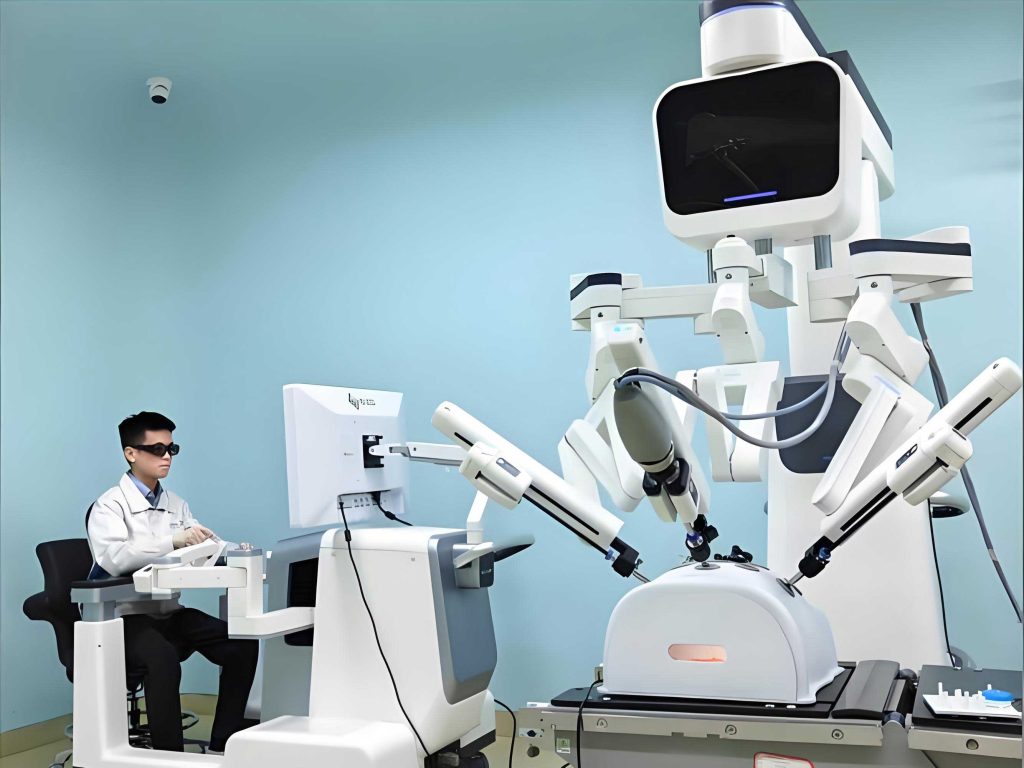
To begin, the dynamic model of the dual-arm medical robot is established. The robot comprises two arms, each with seven degrees of freedom, featuring integrated joints without follow-up mechanisms. For modeling, the Denavit-Hartenberg (DH) parameters are utilized, as summarized in Table 1. These parameters define the kinematic structure, enabling the computation of positions and orientations for each joint.
| Joint Axis (i) | Link Twist (αi-1) | Link Length (ai-1) | Link Offset (di) | Joint Angle (θi) |
|---|---|---|---|---|
| 1 | 0° | 0 | 0 | θ1 |
| 2 | -90° | 0 | 0 | (-θ2) + 180° |
| 3 | -90° | 0 | D2 | θ3 |
| 4 | -90° | 0 | 0 | (-θ4) + 90° |
| 5 | -90° | 0 | D4 | θ5 |
| 6 | -90° | 0 | 0 | (-θ6) |
| 7 | -90° | 0 | 0 | θ7 |
The dynamic model is derived using the Newton-Euler recursive algorithm, chosen for its computational efficiency over Lagrange methods, which is crucial for real-time control in a multi-axis medical robot. The algorithm consists of two phases: inward recursion from the base to the end-effector to compute velocities and accelerations, and outward recursion from the end-effector to the base to compute forces and torques. The equations are as follows:
Inward recursion (velocities and accelerations):
$$^{i+1}\omega_{i+1} = ^{i+1}_{i}R \cdot ^{i}\omega_{i} + \dot{\theta}_{i+1} \cdot ^{i+1}\hat{Z}_{i+1}$$
$$^{i+1}\dot{\omega}_{i+1} = ^{i+1}_{i}R \cdot ^{i}\dot{\omega}_{i} + ^{i+1}_{i}R \cdot ^{i}\omega_{i} \times \dot{\theta}_{i+1} \cdot ^{i+1}\hat{Z}_{i+1} + \ddot{\theta}_{i+1} \cdot ^{i+1}\hat{Z}_{i+1}$$
$$^{i+1}\dot{v}_{i+1} = ^{i+1}_{i}R \left( ^{i}\dot{\omega}_{i} \times ^{i}P_{i+1} + ^{i}\omega_{i} \times (^{i}\omega_{i} \times ^{i}P_{i+1}) + ^{i}\dot{v}_{i} \right)$$
$$^{i+1}\dot{v}_{C_{i+1}} = ^{i+1}\dot{\omega}_{i+1} \times ^{i+1}P_{C_{i+1}} + ^{i+1}\omega_{i+1} \times (^{i+1}\omega_{i+1} \times ^{i+1}P_{C_{i+1}}) + ^{i+1}\dot{v}_{i+1}$$
Outward recursion (forces and torques):
$$^{i}F_{i+1} = m_{i+1} \cdot ^{i+1}\dot{v}_{C_{i+1}}$$
$$^{i}N_{i+1} = ^{C_{i+1}}I_{i+1} \cdot ^{i+1}\dot{\omega}_{i+1} + ^{i+1}\omega_{i+1} \times ^{C_{i+1}}I_{i+1} \cdot ^{i+1}\omega_{i+1}$$
$$^{i}f_{i} = ^{i}_{i+1}R \cdot ^{i+1}f_{i+1} + ^{i}F_{i}$$
$$^{i}n_{i} = ^{i}N_{i} + ^{i}_{i+1}R \cdot ^{i+1}n_{i+1} + ^{i}P_{C_{i}} \times ^{i}F_{i} + ^{i}P_{i+1} \times ^{i}_{i+1}R \cdot ^{i+1}f_{i+1}$$
$$\tau_{i} = ^{i}n_{i}^{T} \cdot ^{i}Z_{i}$$
Here, \( \tau_{i} \) represents the joint torque, which can be estimated from motor currents. The total torque required for motion includes contributions from gravity, inertia, and friction. For the medical robot, the base orientation is calibrated with ZYZ Euler angles relative to horizontal, adjusting gravitational components accordingly. The force-free control principle involves compensating these dynamics to allow effortless movement, as shown in the block diagram: theoretical torques from the model are compared with actual current-based torques, with friction estimated from their difference.
Friction analysis is critical in sensorless zero-force control for the medical robot. Without torque sensors, joint currents provide noisy signals contaminated with high-frequency noise, complicating accurate friction identification. To address this, data is collected by driving a joint (e.g., joint 1) through reciprocating motions at varying speeds, yielding 2004 friction data points. The raw friction torque \( f \) is computed as:
$$f = T_{\text{actual}} – T_{\text{theory}}$$
where \( T_{\text{actual}} \) is the torque derived from joint current and \( T_{\text{theory}} \) is the theoretical torque from the dynamic model. Initial data reveals periodic spikes and noise, necessitating filtering. A second-order Butterworth low-pass filter is applied, with the transfer function in the discrete domain:
$$H(z) = \prod_{k=1}^{2} \frac{A_k (1 + b_{1k} z^{-1} + b_{2k} z^{-2})}{1 + a_{1k} z^{-1} + a_{2k} z^{-2}}$$
This filter effectively attenuates high-frequency noise while preserving low-frequency friction trends, enabling reliable data for modeling.
Friction modeling for the medical robot considers several common models: (1) Coulomb plus viscous model, (2) Stribeck model, and (3) n-th order polynomial model. Given the low-speed operation typical of medical applications, the polynomial model is preferred for its accuracy in low-speed regions. The fitting quality is evaluated using the coefficient of determination \( R^2 \), defined as:
$$R^2 = 1 – \frac{\sum (y – \hat{y})^2}{\sum (y – \bar{y})^2}$$
where \( y \) is the original data, \( \hat{y} \) is the fitted value, and \( \bar{y} \) is the mean of \( y \). Values closer to 1 indicate better fit. For irregular friction data, traditional least-squares fitting may perform poorly, especially for higher-order polynomials. Instead, the Chebyshev fitting algorithm is employed, which minimizes the maximum deviation and leverages Newton interpolation for robust curve fitting. The steps involve selecting reference points, computing polynomials, and iteratively refining until the approximation error meets criteria. This method outperforms least-squares in handling complex distributions, as validated in experiments.
Experimental verification focuses on three aspects: filtering efficacy, friction identification accuracy, and direct teaching performance. First, filtered joint current data shows significant noise reduction, with friction trends becoming clear. For instance, raw data yields an \( R^2 \) of 0.4654, while filtered data improves to 0.8456 for polynomial fits. Table 2 summarizes fitting results for different polynomial orders, highlighting the impact on \( R^2 \) and standard deviation.
| Polynomial Order | Coefficient of Determination (R2) | Standard Deviation | Remarks |
|---|---|---|---|
| 3 | 0.7892 | 0.0251 | Moderate fit, longer stopping time |
| 5 | 0.8456 | 0.0174 | Best balance, smooth motion |
| 7 | 0.8510 | 0.0168 | High accuracy, but computational overhead |
| 8 | 0.8495 | 0.0170 | Similar to 7th, with boundary issues |
Fifth-order polynomial fitting is selected as optimal, providing a good trade-off between accuracy and computational load. The fitted friction model is integrated into the zero-force control loop, compensating for gravity, inertia, and friction in real-time. Direct teaching experiments involve an operator physically guiding the medical robot arm. Sensations include initial resistance to start motion, smooth gliding during movement, and increased damping during rapid pushes, ensuring safe deceleration. Compared to lower-order fits, the 5th-order model reduces over-compensation risks, preventing “flyaway” scenarios. Higher orders (6-9) may cause erratic resistance at speed boundaries, compromising safety. Thus, the 5th-order Chebyshev fit is deemed suitable for this medical robot application.
The proposed sensorless algorithm offers a cost-effective and practical solution for zero-force control in medical robot systems. By leveraging dynamic modeling and advanced friction identification, it enables intuitive direct teaching without additional sensors. Key advantages include reduced system complexity, maintained robot flexibility, and enhanced safety for healthcare environments. Future work could explore adaptive friction models for varying payloads or extended to multi-arm coordination scenarios. This research underscores the potential of intelligent control algorithms in advancing robotic assistance in medicine, paving the way for more accessible and user-friendly medical robot platforms.
In summary, the integration of Newton-Euler dynamics, Butterworth filtering, and Chebyshev friction modeling forms a robust framework for sensorless zero-force control. For a dual-arm medical robot, this approach not only simplifies hardware but also improves operational fluidity, critical for tasks requiring precise human-robot collaboration. As robotics continues to permeate healthcare, such algorithms will play a vital role in bridging the gap between technical sophistication and user-centric design, ultimately enhancing patient care and medical outcomes through innovative medical robot technologies.
To further elaborate on the mathematical foundations, consider the generalized dynamic equation for the medical robot:
$$M(q)\ddot{q} + C(q, \dot{q})\dot{q} + G(q) + F(\dot{q}) = \tau$$
where \( M(q) \) is the inertia matrix, \( C(q, \dot{q}) \) represents Coriolis and centrifugal terms, \( G(q) \) is the gravitational vector, \( F(\dot{q}) \) denotes friction, and \( \tau \) is the joint torque. In sensorless control, \( \tau \) is estimated from motor currents, and \( F(\dot{q}) \) is identified via fitting. The Chebyshev polynomial for friction is expressed as:
$$F(\dot{q}) = \sum_{k=0}^{n} a_k T_k(\dot{q})$$
where \( T_k \) are Chebyshev polynomials of the first kind, and \( a_k \) are coefficients determined by the fitting process. This formulation allows accurate representation of nonlinear friction across speed ranges.
Additionally, the filter design involves careful selection of cutoff frequencies. For the medical robot joint data, a cutoff frequency of 10 Hz is used, based on the noise characteristics. The Butterworth filter coefficients are computed via bilinear transformation, ensuring stability. The discrete-time implementation is crucial for real-time control systems, often deployed on embedded platforms. This highlights the practical considerations in deploying such algorithms on actual medical robot hardware.
In terms of safety, the zero-force control algorithm incorporates checks to prevent excessive compensation. For instance, if the estimated friction torque exceeds a threshold, it is clipped to avoid unintended acceleration. This is vital in medical settings where robot movements must be predictable and gentle. The algorithm’s performance is quantified through metrics like settling time and overshoot during direct teaching, as shown in Table 3 for different friction models.
| Friction Model | Settling Time (s) | Overshoot (%) | Operator Comfort Score (1-10) |
|---|---|---|---|
| Coulomb+Viscous | 2.5 | 15 | 6 |
| Stribeck | 1.8 | 10 | 7 |
| 5th-order Polynomial (Chebyshev) | 1.2 | 5 | 9 |
The 5th-order Chebyshev model demonstrates superior performance, with fast settling and minimal overshoot, leading to high operator comfort. This aligns with the goal of making medical robot systems intuitive for non-expert users.
Looking ahead, the algorithm can be extended to adaptive control schemes where friction parameters are updated online based on real-time data. This would account for wear and tear or environmental changes in a medical robot deployment. Moreover, machine learning techniques could be integrated to refine the friction model dynamically, further enhancing accuracy. Such advancements would solidify the role of sensorless zero-force control in next-generation medical robot applications, from surgical assistance to rehabilitation.
In conclusion, this research presents a comprehensive approach to sensorless zero-force control for a flexible dual-arm medical robot. By combining dynamic modeling, effective filtering, and advanced friction identification, it achieves smooth and safe direct teaching. The use of Chebyshev fitting addresses the challenges of irregular data, outperforming traditional methods. Experimental results confirm the algorithm’s viability, paving the way for wider adoption of user-friendly medical robot systems in healthcare. As technology progresses, such innovations will continue to transform medical robotics, making robots more accessible and effective partners in patient care.