
As a researcher specializing in artificial intelligence and legal systems, I have dedicated significant effort to understanding the implications of intelligent medical robots in healthcare. These advanced machines, which I refer to collectively as intelligent medical robots, represent a convergence of AI technology and medical science, offering unprecedented accuracy and efficiency in diagnostics and treatment. However, their deployment introduces complex legal challenges, particularly in determining tort liability when these robots cause harm. In this article, I will systematically explore the legal status of intelligent medical robots and analyze how existing liability frameworks, such as medical damage liability and product liability, can be adapted to address these emerging issues. My goal is to provide a comprehensive perspective that balances innovation with accountability, ensuring that the benefits of intelligent medical robots are realized without compromising patient safety.
To begin, let me define what I mean by intelligent medical robots. In my view, intelligent medical robots are AI-driven devices designed to perform or assist in medical procedures, characterized by their accuracy, efficiency, autonomy, and learning capabilities. For instance, some intelligent medical robots utilize algorithms like ant colony optimization or fuzzy logic to achieve diagnostic precision surpassing human doctors. These robots can be categorized based on AI maturity: weak AI medical robots operate as tools under direct human control, strong AI medical robots exhibit greater autonomy but remain dependent on humans, and super AI medical robots are purely theoretical entities with full independence. Currently, most intelligent medical robots fall into the weak AI category, functioning as sophisticated instruments in clinical settings.
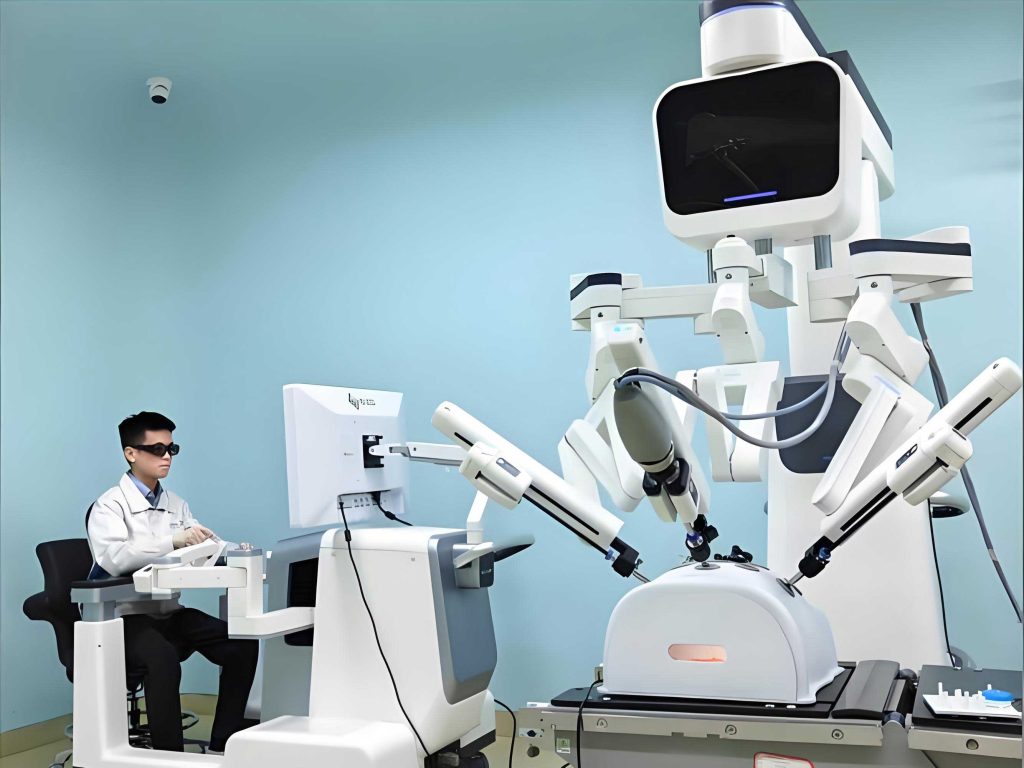
The integration of intelligent medical robots into healthcare systems is accelerating globally, driven by their potential to alleviate resource shortages and improve outcomes. However, as I have observed, this integration raises critical liability questions. When an intelligent medical robot causes injury—whether due to a surgical error, misdiagnosis, or system failure—identifying the responsible party becomes fraught with difficulty. This stems from the unique “intelligent” attributes of these robots, which blur traditional legal boundaries between human actors and machines. In my analysis, I will delve into two primary liability pathways: medical damage liability, which focuses on healthcare providers, and product liability, which targets manufacturers. Throughout, I will emphasize the need for legal frameworks to evolve alongside technological advancements in intelligent medical robots.
Legal Status of Intelligent Medical Robots: A Foundational Inquiry
In my research, I have found that the legal status of intelligent medical robots is a pivotal issue that must be resolved before liability can be effectively assigned. There are broadly two camps: those who advocate for granting legal personhood to intelligent medical robots and those who argue for treating them as objects. I will examine both viewpoints and explain why I favor the latter approach.
| Perspective | Key Arguments | Liability Implications | Examples from Global Practices |
|---|---|---|---|
| Affirmative View (e.g., Electronic Personhood) | Intelligent medical robots possess autonomy and decision-making abilities; recognizing them as legal subjects facilitates their societal integration and encourages innovation. | The intelligent medical robot itself could be held liable, potentially owning assets or insurance to cover damages, similar to corporations. | EU’s draft laws on electronic persons; Russian proposals for “robot-agents” with limited rights. |
| Negative View (e.g., Object Status) | Intelligent medical robots lack consciousness, independent will, and inherent purpose; they are creations of human ingenuity and should be regulated as products or tools. | Liability rests with human entities—manufacturers, healthcare institutions, or users—under existing tort laws like product liability or medical malpractice. | UNESCO’s classification of robots as technological products; prevailing legal treatments in most jurisdictions. |
After thorough consideration, I conclude that intelligent medical robots should be regarded as legal objects, specifically as advanced medical devices or products. My reasoning is based on several factors that I have distilled from legal theory and practical observations. First, intelligent medical robots fundamentally differ from natural persons. Their intelligence is not innate but programmed by humans, and they operate without independent goals—their purpose is always derivative of human intent. For example, an intelligent medical robot designed for surgery executes tasks based on algorithms and data inputs, not personal motivation. Second, equating intelligent medical robots with legal persons like corporations is flawed. Corporations have separate legal identity, property, and the ability to bear liability through assets, whereas intelligent medical robots lack such independent resources. Granting them personhood could inadvertently allow owners to shield themselves from responsibility, undermining accountability. Third, and most importantly, assigning legal subject status to intelligent medical robots does not practically enhance liability resolution. In scenarios where harm occurs, whether the robot is a subject or object, healthcare institutions or manufacturers will ultimately be held responsible due to their control and oversight roles. Thus, from an efficiency standpoint, it is more logical to treat intelligent medical robots as objects under existing liability regimes. This approach minimizes legal complexity while ensuring that victims receive compensation through established channels.
To illustrate this point, I often use a risk-allocation model. Let $$ L_{total} $$ represent the total liability burden, $$ L_{robot} $$ the liability assigned to the intelligent medical robot if it were a subject, and $$ L_{human} $$ the liability assigned to human parties (e.g., producers or healthcare providers). In practice, $$ L_{robot} $$ would likely be zero because intelligent medical robots lack independent assets, making $$ L_{human} $$ the de facto source of compensation. This can be expressed as:
$$ L_{total} = L_{robot} + L_{human} \approx L_{human} $$
This formula underscores why I view the subject-status debate as somewhat academic; the practical outcome remains focused on human accountability for intelligent medical robots.
Applicability of Medical Damage Liability to Intelligent Medical Robot Incidents
In my exploration of tort liability, I have focused on how traditional medical damage liability can be applied when intelligent medical robots are involved. Medical damage liability typically arises from faults in technical care, management, ethics, or products. However, the autonomy and learning capabilities of intelligent medical robots complicate fault determination. I will break down each category and propose adaptations to address these complexities.
Medical Technical Damages and Fault Assessment
For medical technical damages, fault is assessed against the prevailing standard of care. With intelligent medical robots, this standard must evolve. I propose two key criteria that I have developed through my analysis:
- Decision-making by Medical Staff: Healthcare professionals must exercise due diligence in selecting and deploying intelligent medical robots. For instance, if a surgeon chooses an inappropriate medical robot for a procedure based on patient-specific factors, and harm ensues, fault can be attributed to the staff. I recommend documenting such decisions in medical records to facilitate review.
- Preventive Measures by Healthcare Institutions: Institutions using intelligent medical robots must implement robust protocols, including training for operators, regular maintenance schedules, and contingency plans for robot failures. Failure to adopt these measures constitutes negligence.
To quantify this, I have devised a risk model where the probability of harm from an intelligent medical robot, denoted $$ P_h $$, depends on both technical fault rates and human oversight. Let $$ F_r $$ be the inherent fault rate of the medical robot (e.g., derived from historical data), and $$ H_e $$ represent human error probability. Then, the overall risk $$ R $$ can be modeled as:
$$ R = P_h = \alpha \cdot F_r + \beta \cdot H_e $$
where $$ \alpha $$ and $$ \beta $$ are weighting factors reflecting the relative contributions of robot and human factors. For example, if an intelligent medical robot has a high autonomy level, $$ \alpha $$ might dominate, necessitating stricter technical standards.
| Factor | Description | Fault Indicator | Mitigation Strategy |
|---|---|---|---|
| Robot Selection | Choosing the right intelligent medical robot for a specific medical condition. | If selection is inappropriate given medical guidelines, fault exists. | Implement decision-support systems and staff training. |
| Maintenance Frequency | Regular servicing of intelligent medical robots to ensure optimal performance. | If harm occurs due to lack of maintenance, fault is present. | Adhere to manufacturer schedules and conduct independent audits. |
| Emergency Response | Ability to intervene when an intelligent medical robot malfunctions. | If staff fail to intervene promptly, fault is established. | Develop real-time monitoring and manual override protocols. |
Medical Managerial Damages and Institutional Duties
Medical managerial damages involve breaches of organizational responsibilities. With intelligent medical robots, healthcare institutions assume new duties that I have categorized as follows:
- Maintenance and Update Obligations: Intelligent medical robots require periodic software updates and hardware checks to address emerging risks. Institutions that neglect these duties may be found at fault. For instance, if a medical robot’s algorithm becomes outdated and causes a diagnostic error, the institution could be liable.
- Supervision and Control Requirements: Institutions must monitor the operations of intelligent medical robots and ensure that staff can intervene in emergencies. This includes setting up fail-safe mechanisms and training personnel on emergency procedures.
I often represent these duties using a compliance score $$ C $$, where $$ C = 1 $$ if all duties are met, and $$ C = 0 $$ otherwise. Fault $$ F $$ can then be defined as:
$$ F = 1 – C $$
This binary model simplifies fault assessment, though in practice, I recommend a graduated scale based on the severity of lapses.
Medical Ethical Damages and Informed Consent
Medical ethical damages pertain to violations of professional ethics, such as informed consent and confidentiality. The use of intelligent medical robots introduces unique challenges here. In my view, institutions must:
- Provide comprehensive disclosure to patients about the involvement of intelligent medical robots in their care, including potential risks, benefits, and alternatives. This aligns with the principle of autonomy.
- Ensure the security of electronic health records generated or processed by intelligent medical robots, protecting against unauthorized access or manipulation.
If a patient is harmed due to inadequate information or data breaches, fault can be presumed under a rebuttable presumption rule. I support using a formula to assess ethical fault: let $$ I $$ represent the adequacy of information provided (on a scale from 0 to 1), and $$ S $$ represent data security measures (also from 0 to 1). Then, ethical fault $$ E_f $$ can be expressed as:
$$ E_f = 1 – (w_1 \cdot I + w_2 \cdot S) $$
where $$ w_1 $$ and $$ w_2 $$ are weights reflecting the importance of each factor, typically summing to 1. This approach quantifies ethical lapses, aiding in consistent liability determinations for incidents involving intelligent medical robots.
Applicability of Product Liability to Intelligent Medical Robots
In my analysis, I treat intelligent medical robots as products, making product liability laws highly relevant. Product liability centers on defects—whether in manufacturing, design, or warnings. Under standard frameworks, a product is defective if it poses an unreasonable danger or fails to meet mandatory safety standards. However, intelligent medical robots present special challenges due to their complexity and learning abilities. I will outline how product liability can be adapted for these cases.
First, I assert that intelligent medical robots qualify as products because they are manufactured, distributed, and sold for use in healthcare. Even with autonomous functions, they are ultimately tools under human direction. This classification holds producers accountable for defects, incentivizing safety in the design and production of intelligent medical robots. From a policy perspective, I believe this encourages innovation while protecting consumers.
Defect Determination for Intelligent Medical Robots
Determining defects in intelligent medical robots is complex. I propose a multi-criteria framework that I have developed based on legal principles and technological insights:
- Mandatory Standards Compliance: Intelligent medical robots must adhere to both AI-specific regulations and medical device standards. These standards should be dynamic, updated regularly to reflect technological progress. Non-compliance indicates a defect.
- Unreasonable Danger Assessment: This is the core of defect analysis. I advocate using a consumer expectation test: if an intelligent medical robot poses risks beyond what a reasonable patient would anticipate, it is defective. For example, if a medical robot unexpectedly malfunctions during routine surgery, causing injury, it likely constitutes unreasonable danger.
- Development Risk Defense: Producers should not be liable for defects that were scientifically unknowable at the time of production, given the rapid evolution of AI. This defense balances fairness with innovation. However, it must be coupled with subsequent observation duties.
To operationalize this, I have created a defect score $$ D $$ that combines these elements. Let $$ U $$ be a binary variable for unreasonable danger (1 if present, 0 otherwise), $$ M $$ for non-compliance with mandatory standards (1 if non-compliant, 0 otherwise), and $$ K $$ for knowability of the defect at production time (1 if knowable, 0 otherwise). Then, defect $$ D $$ can be modeled as:
$$ D = \begin{cases} 1 & \text{if } U = 1 \text{ or } M = 1 \\ 0 & \text{otherwise} \end{cases} $$
But with development risk, producer liability $$ L_p $$ might be:
$$ L_p = D \cdot K $$
This means liability applies only if the defect was knowable. However, if producers fail in subsequent duties, $$ K $$ could be set to 1 regardless, as I will explain.
Subsequent Observation Duties of Producers
Producers of intelligent medical robots have a continuing responsibility to monitor their products post-market. I term this “subsequent observation duties,” which include:
- Regular software updates to address newly discovered vulnerabilities in intelligent medical robots.
- Conducting “black-box testing” to verify that medical robots function as intended without needing to understand internal algorithms.
- Providing warnings to users about emerging risks associated with intelligent medical robots.
If a producer neglects these duties and a defect causes harm, the development risk defense should not apply. I represent this with an observation score $$ O $$ (1 if duties are fulfilled, 0 otherwise). Then, the liability model becomes:
$$ L_p = D \cdot (K + (1 – O)) $$
where $$ (1 – O) $$ penalizes lapses in observation. This incentivizes producers to actively engage in safety monitoring for intelligent medical robots.
| Aspect of Product Liability | Traditional Application | Adaptation for Intelligent Medical Robots | Practical Example |
|---|---|---|---|
| Design Defects | Based on foreseeable risks and alternative designs. | Incorporate AI safety principles, such as fail-safe algorithms and transparency in decision-making for medical robots. | If an intelligent medical robot’s design allows it to learn unsafe procedures, it may be defective. |
| Manufacturing Defects | Deviations from intended specifications during production. | Include software bugs or hardware flaws that arise in the manufacturing of medical robots, even if linked to AI components. | A batch of intelligent medical robots with corrupted firmware causing surgical errors. |
| Warning Defects | Inadequate instructions or warnings about product use. | Provide detailed guidance on the limitations and risks of autonomous functions in medical robots, including updates for new findings. | Failure to warn about a medical robot’s susceptibility to cyber-attacks, leading to patient data breaches. |
Synthesis and Recommendations for Liability Frameworks
Based on my extensive analysis, I propose a synthesized approach to tort liability for intelligent medical robots. This approach integrates medical damage liability and product liability, recognizing that both play crucial roles. I have formulated several recommendations that I believe can guide policymakers and legal practitioners.
First, I recommend that intelligent medical robots be consistently treated as products under product liability law, while also considering healthcare institutions’ duties under medical damage liability. This dual-track system ensures comprehensive coverage. For instance, if an intelligent medical robot fails due to a design defect, the producer is liable under product liability; if the failure is due to poor maintenance by the hospital, the institution is liable under medical managerial damages. In cases of overlap, joint and several liability may apply, but I suggest clear allocation rules to avoid confusion.
Second, I advocate for enhanced fault-assessment methodologies that account for the autonomy of intelligent medical robots. This includes using quantitative models like those I have presented—for example, risk formulas and defect scores—to standardize evaluations. Courts and regulators could adopt these tools to make liability determinations more objective and consistent.
Third, I emphasize the importance of ongoing education and regulation. As intelligent medical robots evolve, legal standards must keep pace. This might involve establishing specialized bodies to set safety protocols for medical robots or creating insurance schemes to distribute liability risks. From my perspective, proactive measures will prevent liability gaps and foster trust in these technologies.
To illustrate the interplay of factors, I have developed a comprehensive liability equation that summarizes my approach. Let $$ L_{total} $$ represent the total liability compensation owed to a victim. It can be expressed as a function of medical fault $$ F_m $$ (from healthcare institutions) and product defect liability $$ L_p $$ (from producers), weighted by their respective contributions:
$$ L_{total} = \gamma \cdot F_m + (1 – \gamma) \cdot L_p $$
where $$ \gamma $$ is a factor between 0 and 1 that reflects the degree of institutional control versus product inherent risk. For highly autonomous intelligent medical robots, $$ \gamma $$ might be lower, shifting liability toward producers. This model, while simplified, captures the dynamic nature of liability allocation in the context of intelligent medical robots.
Conclusion
In this article, I have explored the intricate landscape of tort liability for intelligent medical robots. Through my analysis, I have argued that intelligent medical robots should be regarded as legal objects—specifically, as advanced medical products—and that existing liability frameworks can be adapted to address the challenges they pose. By expanding fault assessment in medical damage liability and refining defect standards in product liability, we can create a robust system that holds both healthcare providers and manufacturers accountable. The integration of formulas and tables, as I have demonstrated, offers practical tools for implementing these concepts. As intelligent medical robots become more prevalent, continuous legal innovation will be essential to balance technological progress with patient protection. I am confident that the approaches outlined here provide a solid foundation for future developments, ensuring that intelligent medical robots serve society safely and effectively.
Throughout my discussion, I have consistently highlighted the centrality of intelligent medical robots in modern healthcare and the need for tailored legal responses. By fostering collaboration between technologists, legal experts, and medical professionals, we can navigate the complexities of liability and harness the full potential of these remarkable machines. The journey is ongoing, but with careful analysis and adaptive frameworks, I believe we can achieve a harmonious integration of intelligent medical robots into our legal and healthcare systems.