
As I survey the evolving landscape of geriatric care, I am increasingly convinced that medical robots represent a pivotal technological convergence. They integrate advancements from medicine, robotics, materials science, computer vision, and artificial intelligence (AI). My understanding is that their primary role is to augment and enhance care delivery, particularly in the challenging domain of home-based support for the aging population. The core technological pillars enabling modern medical robots include sophisticated sensor arrays for environmental and physiological perception, advanced machine learning algorithms for adaptive behavior and personalized care planning, and natural language processing for more intuitive human-robot interaction. The evolution of these systems has progressed from simple assistive tools to intelligent companions capable of complex decision-support.
From my analytical standpoint, medical robots deployed in home care can be systematically categorized based on their primary function. The following table delineates this taxonomy with representative examples and core technological enablers.
| Primary Category | Key Functions | Example Systems / Concepts | Enabling Technologies |
|---|---|---|---|
| Health Status Monitoring Robots | Vital sign measurement (BP, HR, SpO₂, glucose), fall detection, activity pattern tracking, sleep monitoring. | Robots with integrated non-contact sensors; wearable device integrators. | Biometric sensors, mmWave radar, computer vision, inertial measurement units (IMUs), data fusion algorithms. |
| Assistive Daily Living (ADL) Robots | Mobility assistance (transfer, ambulation), medication management and dispensing, meal preparation and feeding assistance. | Smart wheelchairs, robotic transfer aids, automated pill dispensers, robotic feeding arms. | Autonomous navigation (SLAM), compliant manipulator design, computer vision for object recognition, secure scheduling software. |
| Rehabilitation Robots | Guided physical therapy, gait training, upper/lower limb motor function exercises, progress quantification. | Exoskeletons, end-effector based gait trainers, robotic arms for repetitive task practice. | Haptic feedback systems, adaptive resistance control, motion trajectory tracking, performance analytics software. |
| Socially Assistive Robots (SARs) | Companionship, cognitive stimulation, reminders, social facilitation, mood assessment. | Pet-like or humanoid robots capable of conversation, games, and reminiscence therapy. | Affective computing, sentiment analysis, dialogue management systems, expressive actuators. |
The mathematical foundation for many monitoring functions of a medical robot can be described as a sensor fusion problem. For instance, estimating a patient’s state (e.g., “falling,” “resting,” “walking”) from multiple sensor inputs. Let $ \mathbf{s}_t $ represent the state vector at time $ t $, and $ \mathbf{z}_t $ represent the observation vector from $ N $ sensors. A Bayesian filtering approach, such as a Kalman Filter or Particle Filter, is often employed:
$$
P(\mathbf{s}_t | \mathbf{z}_{1:t}) \propto P(\mathbf{z}_t | \mathbf{s}_t) \int P(\mathbf{s}_t | \mathbf{s}_{t-1}) P(\mathbf{s}_{t-1} | \mathbf{z}_{1:t-1}) d\mathbf{s}_{t-1}
$$
Here, $ P(\mathbf{z}_t | \mathbf{s}_t) $ is the sensor model (likelihood), and $ P(\mathbf{s}_t | \mathbf{s}_{t-1}) $ is the state transition model. The optimal state estimate maximizes the posterior probability $ P(\mathbf{s}_t | \mathbf{z}_{1:t}) $. For a medical robot monitoring heart rate via radar, $ \mathbf{z}_t $ might contain phase variations from the reflected signal, and the state $ \mathbf{s}_t $ includes the true heart rate and respiratory rate.
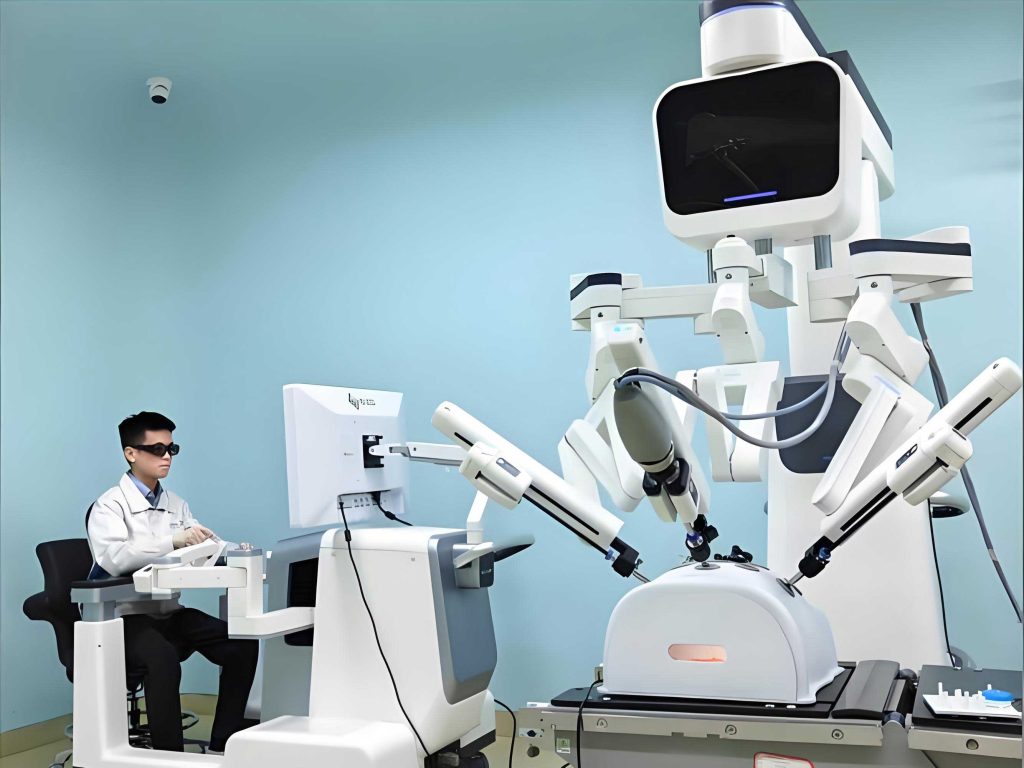
In my assessment, the application of a medical robot for health monitoring is one of its most critical functions. Beyond simple measurement, an intelligent medical robot can establish baselines and detect anomalies. For example, the continuous, unobtrusive monitoring of sleep patterns or activity levels by a domestic medical robot can provide early warning signs of health deterioration, such as the onset of infection or worsening heart failure. The data stream from such a medical robot, when processed through trend-analysis algorithms, can be summarized for clinicians, transforming raw sensor data into actionable clinical insights.
The second major domain is assistance with Activities of Daily Living (ADLs). Here, the medical robot acts as a physical surrogate or assistant. The mathematical challenge often involves motion planning and control. The trajectory $ \mathbf{q}(t) $ for a robotic arm assisting with feeding can be computed to minimize jerk and ensure safety:
$$
\text{Minimize } \int_{t_0}^{t_f} \left\| \frac{d^3\mathbf{q}(t)}{dt^3} \right\|^2 dt
$$
Subject to constraints: $ \mathbf{q}_{min} \leq \mathbf{q}(t) \leq \mathbf{q}_{max} $ (joint limits), $ \mathbf{p}_{tool}(t) \notin \mathcal{O} $ (collision avoidance with obstacles $ \mathcal{O} $), and $ \mathbf{p}_{tool}(t_f) = \mathbf{p}_{target} $ (reaching the target). This ensures the movement of the medical robot is smooth, within its mechanical limits, safe, and accurate.
For rehabilitation, the medical robot is not just an assistant but a quantifiable therapy platform. It can provide consistent, repetitive, and measurable exercise. The assist-as-needed control paradigm is fundamental, where the robotic aid $ \tau_{assist} $ is a function of the patient’s effort $ \tau_{patient} $ and the desired trajectory $ \mathbf{q}_{d}(t) $:
$$
\tau_{assist} = K_p (\mathbf{q}_d – \mathbf{q}) + K_d (\dot{\mathbf{q}}_d – \dot{\mathbf{q}}) – \alpha \cdot \tau_{patient}
$$
Here, $ K_p $ and $ K_d $ are gain matrices, and $ \alpha \in [0, 1] $ is an adaptation parameter that reduces assistance as patient effort increases. This allows the rehabilitation medical robot to personalize therapy in real-time, a significant advantage over static equipment.
The role of the socially assistive medical robot is more subtle but equally important. Its efficacy can be modeled as a function of engagement. If we let $ E_t $ represent the user’s engagement level at time $ t $, and $ a_t $ represent the robot’s action (e.g., tell a story, ask a question, play music), the goal is to choose actions that maximize long-term engagement. This can be framed as a Markov Decision Process (MDP) or a reinforcement learning problem:
$$
\text{Maximize } \mathbb{E} \left[ \sum_{t=0}^{\infty} \gamma^t R(E_t, a_t) \right]
$$
where $ \gamma $ is a discount factor and $ R(\cdot) $ is a reward function that increases with desirable states (high engagement, positive affect). The socially assistive medical robot learns a policy $ \pi(a_t | E_t) $ to select the most engaging action for the current state.
However, integrating a medical robot into the intimate setting of a private home presents profound challenges, which I must address systematically.
| Challenge Domain | Specific Issues | Proposed Mitigation Strategies |
|---|---|---|
| Technical Reliability & Safety | Sensor inaccuracies in dynamic home environments; mechanical failures during physical assistance; algorithmic errors in critical decisions (e.g., fall detection). | Multi-modal sensor fusion for robustness; rigorous failure mode and effects analysis (FMEA); implementation of redundant safety features (e.g., emergency stop, passive compliant mechanisms); continuous validation in real-world settings. |
| Data Security & Privacy | Continuous collection of highly sensitive biometric, video, and audio data; risk of data breaches or unauthorized access; potential for profiling and manipulation. | End-to-end encryption for data in transit and at rest; strict adherence to privacy-by-design principles; federated learning approaches to train algorithms without centralizing raw data; transparent user controls over data collection and sharing. |
| Ethical & Psychosocial Impact | Risk of emotional deception and attachment to machines; reduction in human-to-human contact (social isolation); ambiguity in accountability for errors; potential degradation of professional caregiving ethos. | Clear positioning of the medical robot as a tool to augment, not replace, human care; design guidelines to avoid overt anthropomorphism that encourages unhealthy attachment; mandatory inclusion of human oversight loops in care plans; ongoing ethical impact assessments. |
| Cost & Accessibility | High development and unit costs leading to inequitable access; complexity of setup and maintenance for non-technical users. | Promotion of modular, scalable platforms to reduce cost; exploration of public-health funding or insurance reimbursement models; investment in ultra-simple user interfaces and reliable remote maintenance capabilities. |
| User Acceptance & Trust | Fear, skepticism, or discomfort among older adults and their families; lack of familiarity with robotic technology; perceived loss of autonomy or dignity. | Inclusive, participatory design processes involving older adults from the outset; long-term, real-world pilot studies to demonstrate tangible benefits; effective educational campaigns highlighting the supportive role of the medical robot. |
From an engineering ethics perspective, the deployment of a medical robot necessitates a formal risk assessment framework. One can model the acceptable risk boundary $ \mathcal{R}_{boundary} $ as a function of the robot’s autonomy level $ A $ and the criticality of the task $ C $ (e.g., administering medication vs. playing a game):
$$
\mathcal{R}_{boundary}(A, C) = \beta \cdot \frac{A^\gamma}{C}
$$
where $ \beta $ and $ \gamma $ are society-defined constants ($ \gamma > 1 $). The actual risk $ \mathcal{R}_{actual} $ posed by the medical robot, estimated through testing and analysis, must satisfy $ \mathcal{R}_{actual} \ll \mathcal{R}_{boundary} $ for the system to be deemed ethically deployable. This is especially crucial for a medical robot operating in an unsupervised home.
Looking forward, I anticipate several converging trends. The next generation of the home-based medical robot will likely be a multifunctional platform, seamlessly switching between monitoring, assistance, and companionship roles based on context learned through AI. Interoperability will be key—the medical robot must function as a node within a broader “smart health home” ecosystem, communicating with other IoT devices, electronic health records, and telehealth platforms. The evolution of soft robotics will lead to safer physical interaction, and advances in explainable AI (XAI) will help build trust by allowing the medical robot to justify its actions and recommendations to users and clinicians.
In conclusion, my comprehensive analysis affirms that the medical robot is a transformative force in geriatric home care. Its potential to enhance safety, promote independence, provide companionship, and deliver data-driven insights is immense. However, realizing this potential in a responsible, equitable, and trustworthy manner requires a co-evolution of technology, clinical practice, ethical governance, and social policy. The future home care medical robot will not be a replacement for human compassion, but rather a sophisticated tool that empowers caregivers and allows older adults to age with greater dignity and security in their preferred environment. The technical and ethical equations guiding its development must be solved with equal rigor.