
As a participant in the field of medical robotics, I have observed the rapid advancements and transformative potential of medical robots in healthcare. The integration of robotics into medical practices is revolutionizing diagnosis, surgery, rehabilitation, and patient care. In this article, I will explore the current state, technological innovations, and future prospects of medical robots, drawing from recent developments and industry insights. The medical robot sector represents a convergence of robotics, life sciences, and artificial intelligence, driving precision medicine, remote healthcare, and smart medical solutions.
The growth of medical robots is supported by robust policy frameworks and collaborative efforts across academia, industry, and healthcare institutions. Governments and regulatory bodies are emphasizing the need for high-quality medical equipment to enhance patient safety and health outcomes. Medical robots, as flagship products in high-end medical devices, are pivotal in overcoming human limitations and improving clinical accuracy. For instance, initiatives to establish surgical robot application centers have accelerated the adoption of medical robots, fostering innovation from research to real-world implementation. Below, I summarize key policy directions that are shaping the medical robot landscape:
| Policy Focus Area | Description | Impact on Medical Robots |
|---|---|---|
| Bottleneck Breakthroughs | Addressing technical shortcomings and cultivating industry leaders | Enhances innovation in medical robot components and systems |
| Safe and Effective Supply | Promoting advanced, reliable medical equipment production | Increases availability of certified medical robots for clinical use |
| New Models and Formats | Exploring 5G+ healthcare, telemedicine, and integrated care | Expands applications of medical robots in remote and community settings |
| Industrial Clustering | Developing manufacturing hubs for medical devices | Boosts production capacity and collaboration in medical robot ecosystems |
| Open Cooperation | Encouraging international partnerships and investment | Facilitates global knowledge exchange and market access for medical robots |
From a technical perspective, medical robots rely on sophisticated algorithms and engineering principles. The kinematics of a surgical medical robot, for example, can be described using transformation matrices. For a robotic arm with multiple joints, the position and orientation of the end-effector are given by:
$$ \mathbf{T}_n^0 = \prod_{i=1}^{n} \mathbf{A}_i(\theta_i) $$
where $\mathbf{T}_n^0$ is the homogeneous transformation matrix from the base to the end-effector, and $\mathbf{A}_i(\theta_i)$ represents the transformation for joint $i$ with angle $\theta_i$. This ensures precise control in procedures such as orthopedic surgery, where accuracy is critical. Moreover, the control system of a medical robot often employs PID (Proportional-Integral-Derivative) controllers to maintain stability:
$$ u(t) = K_p e(t) + K_i \int_0^t e(\tau) d\tau + K_d \frac{de(t)}{dt} $$
Here, $u(t)$ is the control output, $e(t)$ is the error signal, and $K_p$, $K_i$, $K_d$ are tuning parameters. These formulas underpin the reliability of medical robots in tasks ranging from bone cutting to soft tissue manipulation.
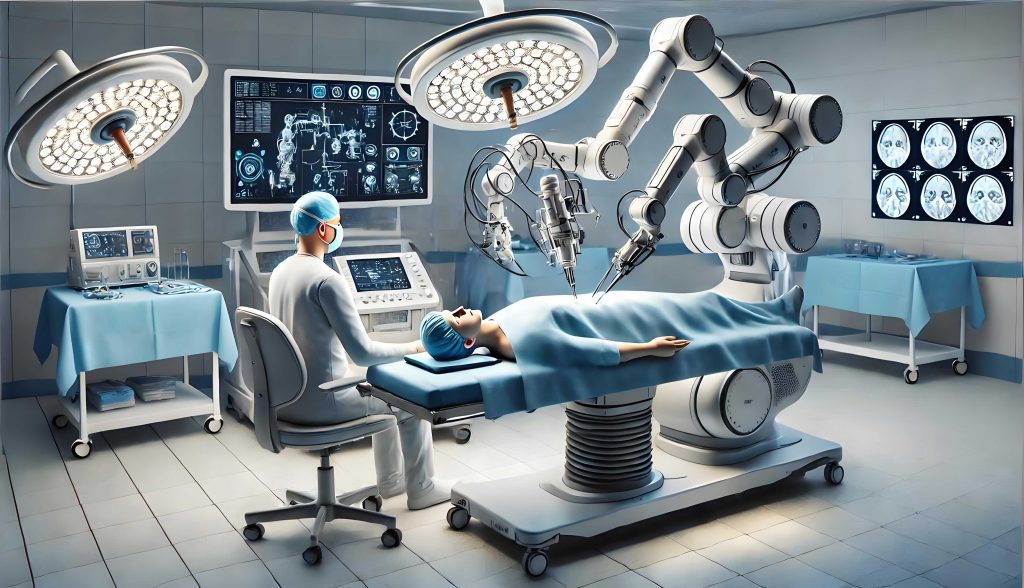
In clinical applications, medical robots have achieved significant milestones, particularly in orthopedic surgery. The establishment of robot-assisted surgery centers has led to widespread adoption, with numerous procedures performed globally. I have compiled data on the progress of such centers, highlighting the expansion of medical robot usage:
| Metric | Value (as of mid-2021) | Significance for Medical Robots |
|---|---|---|
| Number of Lead Hospitals | 16 | Demonstrates institutional commitment to medical robot integration |
| Collaborative Hospitals | 69 | Shows network effect in disseminating medical robot technologies | Total Units Installed | 85 | Indicates growing deployment of medical robot systems |
| Surgeries Performed | 16,880 | Reflects clinical acceptance and efficacy of medical robots |
| New Surgical Techniques | 19 internationally pioneered | Highlights innovation driven by medical robot capabilities |
| Training Sessions Conducted | Over 5,000 personnel | Ensures skilled workforce for operating medical robots |
| Remote Surgeries via 5G | 40+ cases | Showcases telemedicine potential of medical robots |
The innovation in medical robots extends beyond surgery to rehabilitation and assistive devices. Rehabilitation medical robots, for instance, aid in patient recovery by providing controlled therapy. The dynamics of such systems can be modeled using Lagrangian mechanics. For a lower-limb exoskeleton medical robot, the equations of motion are:
$$ \mathbf{M}(\mathbf{q})\ddot{\mathbf{q}} + \mathbf{C}(\mathbf{q}, \dot{\mathbf{q}})\dot{\mathbf{q}} + \mathbf{G}(\mathbf{q}) = \boldsymbol{\tau} $$
where $\mathbf{q}$ is the vector of joint angles, $\mathbf{M}$ is the inertia matrix, $\mathbf{C}$ represents Coriolis and centrifugal forces, $\mathbf{G}$ is the gravitational vector, and $\boldsymbol{\tau}$ denotes the applied torques. This framework allows for personalized rehabilitation protocols, enhancing outcomes for stroke or injury patients. The medical robot industry is thus diversifying into various niches, each with unique technical demands.
Looking at future trends, artificial intelligence (AI) is becoming integral to medical robots. Machine learning algorithms enable autonomous decision-making and adaptive behavior. For example, a medical robot can use computer vision to identify anatomical structures, with accuracy measured by metrics such as precision and recall:
$$ \text{Precision} = \frac{TP}{TP + FP}, \quad \text{Recall} = \frac{TP}{TP + FN} $$
Here, $TP$ stands for true positives, $FP$ for false positives, and $FN$ for false negatives. These metrics are crucial for evaluating the performance of medical robots in image-guided procedures. Additionally, swarm robotics concepts are emerging for multi-robot systems in healthcare, where coordination is achieved through consensus algorithms:
$$ \dot{x}_i = \sum_{j \in N_i} (x_j – x_i) $$
where $x_i$ is the state of robot $i$, and $N_i$ is its neighborhood. This could lead to collaborative medical robots working in tandem during complex surgeries or diagnostics.
The economic and regulatory aspects also play a vital role in the proliferation of medical robots. Pricing mechanisms and insurance coverage are critical for market penetration. In some regions, reimbursement policies have been adjusted to include robot-assisted surgeries, reducing financial barriers. The cost-effectiveness of a medical robot can be analyzed using return on investment (ROI) calculations:
$$ \text{ROI} = \frac{\text{Net Benefits} – \text{Costs}}{\text{Costs}} \times 100\% $$
Net benefits may include reduced hospital stays, improved patient outcomes, and lower complication rates. As medical robots become more affordable, their adoption is expected to rise, particularly in developing countries. Standardization efforts, such as the development of international safety standards for medical robots, further ensure quality and interoperability.
In terms of research and development, interdisciplinary collaboration is key to advancing medical robots. The synergy between engineers, clinicians, and entrepreneurs drives innovation from concept to clinic. For instance, the development of a pelvic reduction medical robot involves addressing challenges in real-time imaging and force feedback. The system’s performance can be optimized using control theory, such as linear quadratic regulators (LQR):
$$ J = \int_0^\infty (\mathbf{x}^T \mathbf{Q} \mathbf{x} + \mathbf{u}^T \mathbf{R} \mathbf{u}) dt $$
where $\mathbf{x}$ is the state vector, $\mathbf{u}$ is the control input, and $\mathbf{Q}$ and $\mathbf{R}$ are weighting matrices. Minimizing $J$ leads to stable and efficient operation of the medical robot. Similarly, navigation systems in medical robots rely on sensor fusion algorithms, combining data from IMUs, cameras, and electromagnetic trackers.
The potential of medical robots in telemedicine is particularly exciting. With 5G technology, remote surgeries have become feasible, allowing experts to operate on patients from afar. The latency requirements for such systems are stringent, often modeled by network delay equations:
$$ \tau_{\text{total}} = \tau_{\text{transmission}} + \tau_{\text{processing}} + \tau_{\text{propagation}} $$
For a medical robot to perform safely in real-time, $\tau_{\text{total}}$ must be below a threshold, typically milliseconds. This enables applications like telesurgery in rural areas or disaster zones, expanding access to high-quality care. The medical robot thus acts as a bridge, connecting patients with specialized healthcare providers.
Despite the progress, challenges remain for medical robots. Technical hurdles include miniaturization for minimally invasive procedures, enhanced dexterity for complex anatomies, and improved human-robot interaction. Safety is paramount, with risk assessments guided by probabilistic models. The failure rate of a medical robot component might be analyzed using reliability functions:
$$ R(t) = e^{-\lambda t} $$
where $\lambda$ is the failure rate and $t$ is time. Redundancy and fault-tolerant designs are essential to mitigate risks. Ethical considerations, such as accountability in autonomous medical robots, also require ongoing dialogue among stakeholders.
To illustrate the multifaceted nature of medical robot development, I present a comparison of different types of medical robots and their applications:
| Type of Medical Robot | Primary Application | Key Technologies | Current Challenges |
|---|---|---|---|
| Surgical Medical Robot | Precision surgery (e.g., orthopedic, neurosurgery) | Robotic arms, navigation, haptic feedback | High cost, training requirements |
| Rehabilitation Medical Robot | Physical therapy for motor recovery | Exoskeletons, sensors, AI-driven protocols | Personalization, user comfort |
| Diagnostic Medical Robot | Medical imaging and sample analysis | Automated platforms, image processing | Integration with existing systems |
| Telepresence Medical Robot | Remote consultation and monitoring | Mobile bases, video conferencing, 5G | Network reliability, privacy concerns |
| Pharmacy Medical Robot | Medication dispensing and management | Automated storage, barcode scanning | Error prevention, space constraints |
In conclusion, the trajectory of medical robots is poised for exponential growth. As a key player in this field, I believe that continued investment in research, supportive policies, and cross-sector partnerships will unlock new possibilities. The medical robot is not merely a tool but a catalyst for transforming healthcare delivery, making it more precise, accessible, and efficient. From algorithm design to clinical validation, every aspect of medical robot development contributes to this vision. The future will likely see medical robots becoming ubiquitous in hospitals, clinics, and even homes, ushering in an era of personalized and proactive medicine.
The mathematical foundations of medical robots, as discussed, underpin their functionality. For instance, in path planning for a surgical medical robot, the trajectory can be optimized using calculus of variations. Given a cost function $C$ that depends on the path $\mathbf{p}(t)$, we seek to minimize:
$$ \min_{\mathbf{p}(t)} \int_{t_0}^{t_f} L(\mathbf{p}(t), \dot{\mathbf{p}}(t), t) dt $$
where $L$ is a Lagrangian representing factors like time, energy, or smoothness. This ensures efficient and safe movements during operations. Similarly, in swarm medical robots for drug delivery, diffusion models can describe the spread of agents:
$$ \frac{\partial \rho}{\partial t} = D \nabla^2 \rho – k \rho $$
with $\rho$ as the robot density, $D$ as the diffusion coefficient, and $k$ as a decay rate. Such models help in designing coordinated systems for targeted therapy.
Ultimately, the success of medical robots hinges on their ability to integrate seamlessly into healthcare workflows. User-centered design, involving feedback from clinicians and patients, is critical. The adoption curve for medical robots can be modeled using logistic growth equations:
$$ N(t) = \frac{K}{1 + \left(\frac{K – N_0}{N_0}\right) e^{-rt}} $$
where $N(t)$ is the number of medical robots in use at time $t$, $K$ is the carrying capacity (market saturation), $N_0$ is the initial adoption, and $r$ is the growth rate. With current trends, $r$ is positive, indicating rapid expansion. As we move forward, the medical robot will continue to evolve, driven by technological breakthroughs and societal needs, shaping the future of medicine for generations to come.