
As a designer focused on healthcare technology, I have observed a critical gap in the development of micro medical robots: the lack of affinity in their appearance. These tiny devices, which operate inside the human body for diagnosis and treatment, often evoke feelings of coldness and fear among patients. This not only affects user acceptance but also undermines the trust necessary for effective medical interventions. In this article, I explore a design methodology rooted in product affinity to create micro medical robots that are perceived as亲切, trustworthy, and emotionally resonant. By integrating principles from industrial design and human-centered approaches, I aim to enhance the user experience and pave the way for broader adoption of these innovative medical devices.
The concept of product affinity refers to the ability of a product to foster a sense of closeness, safety, and comfort in users. For micro medical robots, this is especially crucial because patients are often in vulnerable states due to illness. The absence of affinity can lead to anxiety and resistance, hindering the therapeutic process. Through my research, I have identified two core dimensions of product affinity: perceptual familiarity and emotional compatibility. Perceptual familiarity relates to the external attributes of the medical robot, such as shape, color, material, and usage mode, which directly engage human senses. Emotional compatibility, on the other hand, involves the deeper connection users form with the medical robot based on cultural values and emotional needs like security and trust. By addressing both dimensions, designers can create micro medical robots that are not only functional but also psychologically supportive.
To analyze the current state of micro medical robot design, I collected and evaluated numerous samples from global sources, including commercial products and conceptual prototypes. After filtering for relevance and innovation, I selected six representative micro medical robots for detailed study. These samples vary in application, such as吞服型 devices for gastrointestinal monitoring and微创手术型 robots for precise surgical procedures. By comparing their design elements, I aimed to extract insights into what makes a medical robot more亲和. Below, I summarize the key attributes of these samples in Table 1, focusing on visual and tactile aspects that influence perceptual familiarity.
| Sample | Shape | Color | Material | Usage Mode |
|---|---|---|---|---|
| Sample 1 | Angular and mechanical | Black and transparent | Synthetic metal | External surgery |
| Sample 2 | Biomimetic with触手 | Metallic gray | Nickel alloy | Intracranial surgery |
| Sample 3 | Capsule-like with curves | White and blue | Biological materials | Oral ingestion for surgery |
| Sample 4 | Smooth capsule | Pure white | Polymer | Oral ingestion for monitoring |
| Sample 5 | Streamlined and minimal | Light green | Nanomaterials | Vascular surgery |
| Sample 6 | Ultra-micro scale | Transparent | Biocompatible composites | Cellular-level surgery |
From this analysis, I derived that shapes with rounded,饱满 contours and colors like white or pastel tones tend to evoke greater亲和. For instance, Sample 4, with its simple capsule shape and white color, scored highest in user surveys for perceived friendliness. In contrast, Sample 2’s biomimetic触手 design, while functionally advanced, often triggered unease. To quantify these observations, I developed a formula for affinity score based on weighted design factors: $$A = \sum_{i=1}^{n} w_i \cdot f_i$$ where \(A\) represents the overall affinity score, \(w_i\) denotes the weight of each design factor (e.g., shape, color), and \(f_i\) is the score for that factor derived from user evaluations. For a micro medical robot, factors like shape圆润度 and color warmth can be prioritized to enhance \(A\).
Beyond perceptual aspects, emotional compatibility plays a vital role in sustaining long-term user relationships with a medical robot. Through field studies in hospitals, including interviews and surveys with patients and healthcare professionals, I identified key emotional诉求: safety, trust, companionship, dependence, and care. Among these, safety and trust emerged as the most critical, with over 70% of patients rating them as top priorities. This aligns with the inherent need for reliability in medical devices. Additionally, I explored精神文化内涵 that resonate with users, such as温和高效 (gentle efficiency) and生长延续 (growth and continuity), which reflect aspirations for healing and progress. To integrate these into design, I propose a model where emotional compatibility \(E\) is a function of cultural alignment and情感满足: $$E = \alpha \cdot C + \beta \cdot S$$ Here, \(C\) represents cultural fit (e.g., incorporating symbols of温和高效), \(S\) denotes情感满足 (emotional satisfaction), and \(\alpha\) and \(\beta\) are coefficients adjusted based on user demographics. This model guides designers in embedding meaningful narratives into the medical robot.
In my design practice, I applied these insights to create new concepts for micro medical robots. Starting with perceptual familiarity, I sketched multiple草案 that emphasized soft, organic forms and calming color palettes. For example, one concept featured a pill-shaped medical robot with subtle curves and a gradient of light blue to white, evoking a sense of cleanliness and calm. Another incorporated ergonomic grips for external handling, using matte materials to reduce glare and enhance tactile comfort. To refine these ideas, I conducted color studies, as summarized in Table 2, which compares different color schemes based on their affinity ratings from focus groups.
| Color Scheme | Primary Colors | Affinity Rating (1-5) | User Feedback |
|---|---|---|---|
| Scheme A | White with light blue accents | 4.5 | Perceived as clean and trustworthy |
| Scheme B | Pastel green and beige | 4.2 | Evokes nature and relaxation |
| Scheme C | Gray with orange highlights | 3.8 | Modern but slightly impersonal |
| Scheme D | Pure white with metallic touches | 4.0 | Professional yet approachable |
Based on this, I selected Scheme A for further development, as it aligns with the亲和力 goals for a medical robot. Using 3D modeling software like Rhino and rendering tools such as KeyShot, I created realistic prototypes that embody both perceptual and emotional elements. The design process also involved enhancing emotional compatibility by incorporating symbols of温和高效, such as subtle curves reminiscent of healing waves or icons that暗示 efficiency and care. For instance, I added a small, illuminated indicator on the medical robot that pulses gently, symbolizing生命体征 and providing reassurance to users. This integrates the精神文化内涵 of生长延续, fostering a sense of hope and progression during treatment.
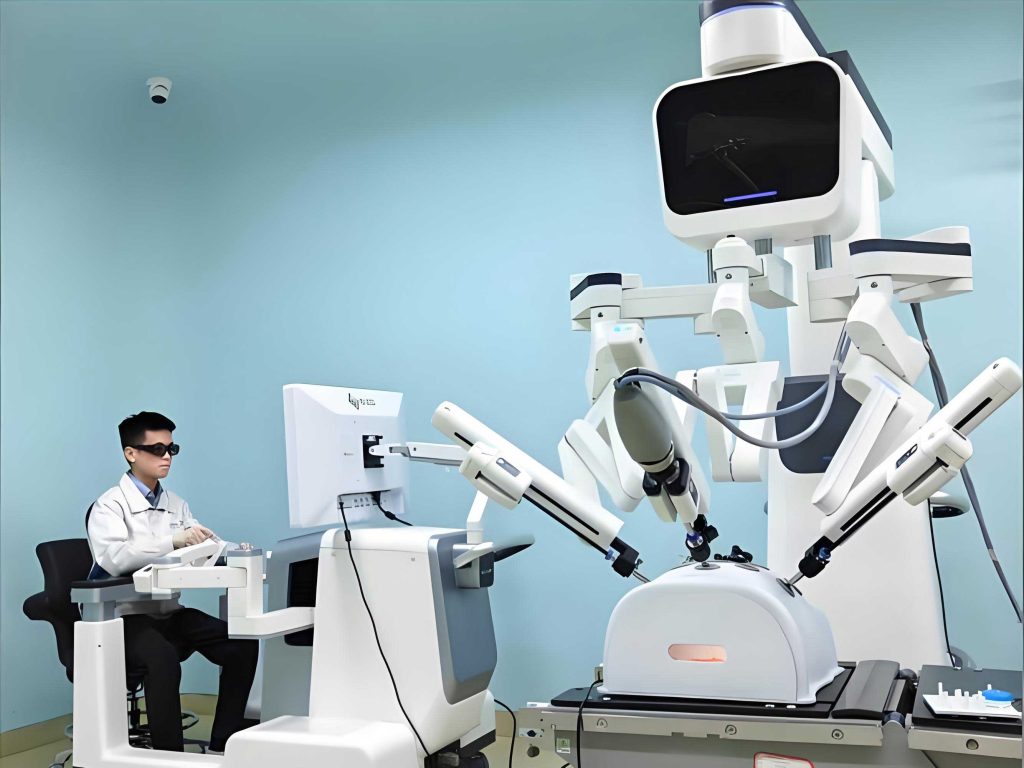
To validate the effectiveness of these affinity-driven designs, I conducted a comparative survey involving 50 participants, including patients and medical staff. They evaluated three of my design concepts alongside the six original samples, using a 5-point scale where 0 indicated low affinity and 4 high affinity. The results, shown in Table 3, demonstrate that my designs consistently outperformed the existing samples in亲和力特征. This confirms the value of applying product affinity principles to micro medical robot development.
| Product | Average Affinity Score (0-4) | Key Strengths |
|---|---|---|
| Design Concept 1 | 3.8 | Soft shape and calming colors |
| Design Concept 2 | 4.0 | Ergonomic material and emotional symbols |
| Design Concept 3 | 4.1 | High cultural alignment and usability |
| Sample 1 | 1.9 | Functional but visually cold |
| Sample 2 | 2.3 | Technically advanced but intimidating |
| Sample 3 | 2.4 | Moderate亲和 but limited emotional appeal |
| Sample 4 | 3.5 | Good baseline亲和力 |
| Sample 5 | 2.0 | Minimalist but lacks warmth |
| Sample 6 | 2.8 | Innovative but too abstract for users |
The superior performance of Design Concept 3, with an affinity score of 4.1, highlights the importance of holistic design that balances perceptual and emotional factors. This medical robot not only looks inviting but also feels emotionally supportive, addressing core user needs like safety and trust. From a technical perspective, the design does not compromise functionality; for example, the rounded shape allows for smooth navigation inside the body, and the materials chosen are biocompatible and easy to sterilize. Furthermore, the emotional compatibility elements, such as the gentle lighting and symbolic forms, contribute to a positive user experience without adding complexity to the medical robot’s operation.
In terms of broader implications, integrating affinity into micro medical robot design can accelerate commercialization and improve healthcare outcomes. As populations age and medical demands grow, these devices offer a scalable solution for minimally invasive procedures. However, user acceptance remains a barrier, often due to psychological resistance. By making medical robots more亲和, designers can reduce this resistance and foster trust, ultimately enhancing patient compliance and treatment efficacy. This aligns with trends in personalized medicine, where the medical robot becomes not just a tool but a companion in the healing journey. Additionally, for healthcare providers, affinity-driven designs can simplify training and reduce stress associated with adopting new technologies.
Looking ahead, I propose several directions for future research. First, the affinity model can be refined using machine learning algorithms to analyze user feedback dynamically, allowing for real-time design adjustments. For instance, an adaptive formula could be: $$A’ = \int_{t=0}^{T} \left( \sum w_i(t) \cdot f_i(t) \right) dt$$ where \(A’\) represents time-varying affinity based on user interactions with the medical robot. Second, cross-cultural studies could explore how亲和力 factors differ globally, enabling tailored designs for diverse markets. Third, sustainability aspects, such as eco-friendly materials for medical robots, could be integrated into the affinity framework to address environmental concerns. These advancements will further solidify the role of design in creating human-centered medical technologies.
In conclusion, my work demonstrates that product affinity is a crucial yet often overlooked aspect of micro medical robot design. By focusing on perceptual familiarity through shapes, colors, and materials, and emotional compatibility via cultural and emotional alignment, designers can create devices that are both effective and beloved. This approach not only benefits patients by alleviating anxiety but also supports healthcare systems by promoting adoption and efficiency. As I continue to innovate in this field, I remain committed to crafting medical robots that embody亲和力, ensuring they serve as trusted partners in health and healing. The journey toward more humane medical technology is ongoing, and with each design iteration, we move closer to a future where micro medical robots are seamlessly integrated into compassionate care.