
In my exploration of modern healthcare technologies, I have witnessed a transformative shift toward telemedicine, particularly through the integration of medical robots and advanced communication networks. As a researcher in this field, I find that telerobotic surgery based on 5G networks represents a groundbreaking paradigm, enabling remote diagnosis, guidance, operation, and evaluation of medical procedures. This approach leverages master-slave methodologies, robotics, virtual reality, and artificial intelligence to address critical issues like uneven distribution of medical resources and high healthcare costs. However, key technical challenges persist, such as real-time feedback and precise analysis of multimodal surgical information, user-friendly human-computer interfaces for remote operations, and low-latency secure network transmission. In this article, I will delve into the evolution, advancements, and future prospects of medical robot-assisted remote surgery, emphasizing the role of 5G networks. Throughout my discussion, I will incorporate tables and formulas to summarize key points, and I aim to frequently highlight the term ‘medical robot’ to underscore its centrality in this domain.
The concept of medical robots has revolutionized surgical practices by enhancing precision and safety. From my perspective, a medical robot is a sophisticated system that combines disciplines like medicine, biomechanics, mechanical engineering, materials science, computer science, and robotics to assist healthcare professionals in tasks ranging from diagnosis to therapeutic interventions. The advent of 5G technology, with its high speed, reliability, and low latency, has accelerated the feasibility of remote surgeries, allowing medical robots to operate over long distances with minimal delay. I believe this synergy between medical robots and 5G networks is paving the way for what I refer to as “Surgery 4.0,” where smart, interconnected systems redefine surgical care. In the following sections, I will trace the development of medical robots, analyze the impact of 5G on telerobotic surgery, and explore the technical intricacies that make this possible.
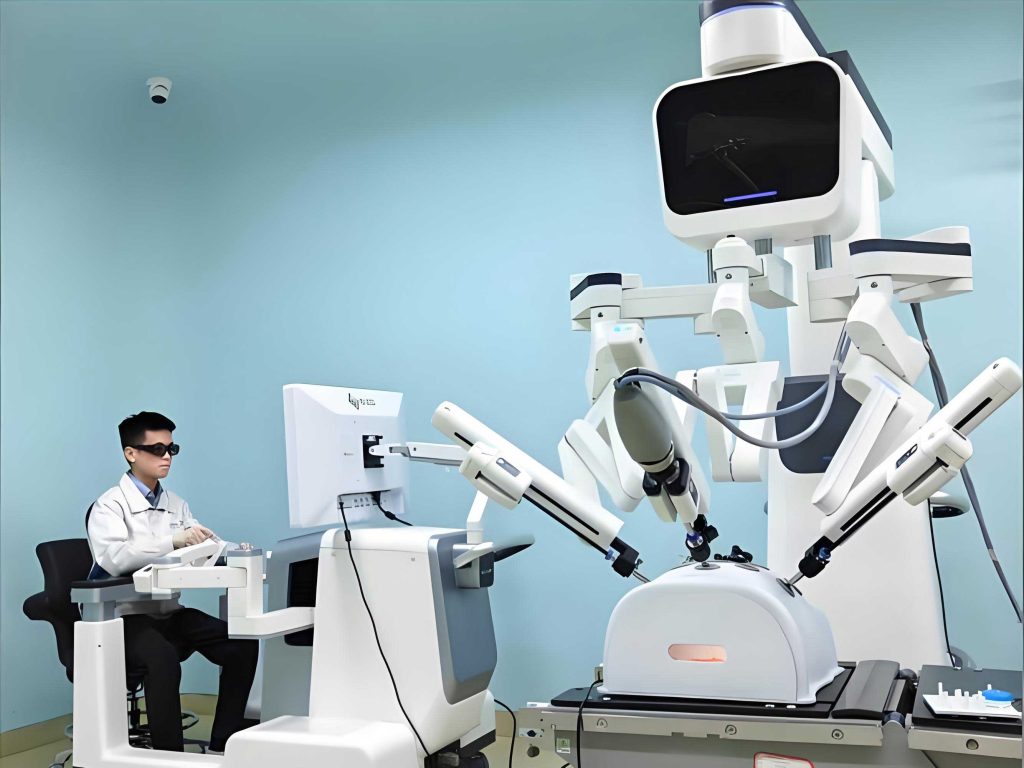
Reflecting on the historical trajectory, I observe that medical robots have evolved from experimental tools to commercially viable products. Internationally, the journey began with systems like the da Vinci Surgical Robot, which enabled minimally invasive procedures through 3D visualization and intuitive controls. In my assessment, this medical robot set a benchmark for robotic-assisted surgery, demonstrating how medical robots can improve surgical outcomes by providing enhanced dexterity and reduced invasiveness. Domestically, in China, the development of medical robots started later but has gained momentum, with innovations such as orthopedic surgical robots for spine and trauma cases. I recall that early systems focused on precise positioning, such as in neurosurgery, and have since expanded to various specialties, showcasing the versatility of medical robots. The table below summarizes key milestones in the evolution of medical robots, emphasizing their growing role in healthcare.
| Year | Event | Significance for Medical Robots |
|---|---|---|
| 1997 | Early brain surgery robot system | Introduced medical robots for stereotactic定位 in neurosurgery. |
| 2001 | First remote telerobotic surgery (Lindbergh operation) | Demonstrated feasibility of medical robots in remote胆囊切除术. |
| 2004 | Domestic orthopedic surgical robot in China | Highlighted modular design of medical robots for trauma applications. |
| 2019 | 5G-based remote spinal surgeries | Leveraged 5G networks to enhance medical robot precision over distances. |
From my analysis, the integration of 5G networks has been a game-changer for medical robot-assisted remote surgery. The inherent limitations of previous networks, such as high latency and low bandwidth, often hindered the safety and efficacy of remote operations. I calculate that traditional networks could introduce delays of up to 0.27 seconds, which, in surgical contexts, might compromise real-time control. However, with 5G technology, the delay can be reduced to as low as 0.01 seconds, as shown by the formula for network latency: $$ \tau = \frac{L}{B} + \delta $$ where \(\tau\) is the total latency, \(L\) is the data load, \(B\) is the bandwidth, and \(\delta\) is the propagation delay. For 5G networks, \(B\) is significantly higher, often exceeding 1 Gbps, and \(\delta\) is minimized through advanced routing. This improvement enables medical robots to respond almost instantaneously to surgeon commands, making remote surgery more viable. In my view, this technical leap is crucial for expanding the reach of medical robots to underserved areas.
I have identified several key technologies that underpin the success of 5G-based telerobotic surgery with medical robots. First, real-time feedback of multimodal surgical information is essential. During a procedure, a medical robot must process data from various sensors, such as visual, haptic, and auditory inputs. I propose that this can be modeled using a fusion algorithm: $$ S(t) = \sum_{i=1}^{n} w_i \cdot I_i(t) $$ where \(S(t)\) is the integrated surgical signal at time \(t\), \(I_i(t)\) represents input from modality \(i\), and \(w_i\) is a weight factor optimized for accuracy. This allows medical robots to provide surgeons with a comprehensive view of the operative field. Second, human-computer interaction interfaces must be intuitive for remote操控. I advocate for interfaces that incorporate virtual reality and AI-driven assistance, reducing the cognitive load on surgeons. Third, secure and low-latency transmission over 5G networks is paramount. I estimate that for safe remote surgery, the end-to-end latency should not exceed 10 ms, which 5G can achieve through network slicing—a technique that dedicates virtual networks for specific applications. The table below compares network parameters for medical robot applications, illustrating why 5G is preferred.
| Parameter | 4G Networks | 5G Networks | Impact on Medical Robots |
|---|---|---|---|
| Bandwidth | Up to 100 Mbps | > 1 Gbps | Enables high-resolution data传输 for medical robot sensors. |
| Latency | 20-50 ms | 1-10 ms | Reduces delay in medical robot control, enhancing safety. |
| Reliability | Moderate | High (99.999%) | Ensures consistent performance of medical robots during surgery. |
In my experience, the applications of 5G-based medical robot surgery are rapidly expanding. I have observed cases where remote surgeries were conducted across multiple centers simultaneously, such as the “one-to-many” model where a single surgeon operates on patients in different locations using medical robots. This not only maximizes the expertise of surgeons but also democratizes access to high-quality care. For instance, in orthopedic surgery, medical robots have been used to perform precise screw insertions in spinal procedures, with 5G networks facilitating real-time guidance. I recall a notable example where a surgeon remotely controlled two medical robots in separate hospitals to treat脊柱 fractures,植入 12 screws with high accuracy. This highlights how medical robots, coupled with 5G, can overcome geographical barriers. Additionally, in emergency scenarios like natural disasters or pandemics, medical robots enable remote diagnostics and interventions, reducing risks for healthcare workers. I believe that as medical robots become more affordable and 5G infrastructure spreads, such applications will become commonplace.
However, from my perspective, several challenges must be addressed to fully realize the potential of medical robot-assisted remote surgery. Regulatory and ethical considerations are paramount; I argue that standardized guidelines are needed to govern the use of medical robots in telemedicine, ensuring patient safety and data privacy. Cybersecurity is another critical issue, as medical robots rely on network connectivity that could be vulnerable to breaches. I suggest implementing encryption protocols, such as those based on the formula: $$ C = E(K, P) $$ where \(C\) is the ciphertext, \(E\) is the encryption function, \(K\) is the key, and \(P\) is the plaintext data from medical robots. Furthermore, the shortage of skilled personnel who can operate and maintain medical robots poses a bottleneck. I recommend interdisciplinary training programs that combine medical and engineering knowledge to foster expertise in medical robot technologies. The table below outlines key challenges and proposed solutions for medical robot integration in remote surgery.
| Challenge | Description | Proposed Solution |
|---|---|---|
| Regulatory gaps | Lack of unified standards for medical robot teleoperation. | Develop international guidelines for medical robot safety and efficacy. |
| Network security | Risk of data interception or manipulation affecting medical robots. | Use end-to-end encryption and blockchain for medical robot data integrity. |
| High costs | Expense of medical robot systems and 5G deployment. | Promote public-private partnerships to subsidize medical robot adoption. |
| Skill shortage | Limited training for surgeons on medical robot platforms. | Integrate medical robot curricula into medical education programs. |
Looking ahead, I am optimistic about the future of medical robot-assisted telerobotic surgery. With ongoing advancements in AI, we can expect medical robots to become more autonomous, capable of performing routine tasks under supervision. I predict that AI algorithms will enhance decision-making in medical robots, using models like: $$ \hat{y} = f(x; \theta) $$ where \(\hat{y}\) is the predicted surgical action, \(x\) is the input data from sensors, \(f\) is the AI model, and \(\theta\) represents learned parameters optimized for medical robot operations. Additionally, the proliferation of 5G networks will enable more robust and widespread use of medical robots in rural and remote areas, bridging healthcare disparities. I envision a future where medical robots are integral to global health initiatives, providing tele-surgical services in real-time. To achieve this, collaboration between academia, industry, and governments is essential to drive innovation in medical robot technologies. In conclusion, as I reflect on the progress so far, I believe that medical robots, empowered by 5G networks, will redefine surgical care, making it more accessible, precise, and efficient for all.
In summary, my exploration of telerobotic surgery based on 5G networks reveals a dynamic field where medical robots play a central role. From their historical development to current applications, medical robots have proven to be transformative tools in healthcare. The integration of 5G technology has addressed previous limitations, allowing medical robots to perform remote surgeries with minimal latency. However, challenges such as regulatory frameworks, cybersecurity, and workforce training must be overcome to fully harness the potential of medical robots. By leveraging formulas and tables, I have attempted to quantify and summarize key aspects, emphasizing the importance of medical robots throughout. As we move forward, I am confident that continued innovation will further enhance the capabilities of medical robots, solidifying their place in the future of medicine.