
The global COVID-19 pandemic served as a profound stress test for healthcare systems worldwide, exposing vulnerabilities and accelerating the adoption of technological solutions. Among these, the medical robot emerged not merely as a helpful tool but as an indispensable force multiplier. Their inherent traits—being impervious to viral infection, capable of relentless operation, and executing tasks with superhuman precision—propelled them from specialized instruments to frontline necessities. This crisis has fundamentally reshaped the perception and trajectory of the medical robot industry, transitioning it from a niche field into a critical component of future-ready healthcare infrastructure. As we analyze this shift, it is clear that the pandemic provided the “perfect storm” of necessity and acceptance, creating a powerful catalyst for rapid development, investment, and integration of robotic systems across the entire medical spectrum.
At its core, a medical robot is defined as a robot designed for and utilized in clinical settings to assist or perform medical procedures. The industry standard, set by the International Federation of Robotics (IFR), categorizes them into four primary types, each with distinct technical requirements and market dynamics. Their position within the technology value chain can be segmented into upstream (core components), midstream (system integration and manufacturing), and downstream (clinical and logistical application). The following table summarizes this taxonomy and value chain:
| IFR Category | Primary Function | Technical Complexity Index (Qualitative) | Key Value Chain Stage |
|---|---|---|---|
| Surgical Robot | Performing or assisting in precise surgical procedures (e.g., laparoscopy, orthopedics, neurology). | Very High | Upstream (Precision Actuators, Sensors), Midstream (System Integration) |
| Rehabilitation Robot | Aiding patient recovery of motor functions through guided, repetitive motion therapy. | High | Midstream (Human-Robot Interaction, Control Algorithms) |
| Assistant/Care Robot | Supporting diagnostics, remote consultation, patient monitoring, and logistical tasks within care. | Medium | Downstream (Software, AI Integration, Connectivity) |
| Service/Logistics Robot | Handling non-clinical tasks: disinfection, delivery of supplies/meals, guided tours, material transport. | Low to Medium | Downstream (Navigation, Fleet Management Software) |
The technical complexity, especially for surgical and advanced rehabilitation medical robot systems, can be conceptualized by a composite metric that factors in degrees of freedom (DoF), required precision, safety redundancy, and integration with imaging systems. A simplified representation of this complexity score (C_m) could be:
$$C_m = \sum_{i=1}^{n} w_i \cdot S_i$$
Where $S_i$ represents a normalized score for a key subsystem (e.g., manipulator precision, sensor fusion, haptic feedback, AI decision-support), and $w_i$ is its associated weight in the overall system. A surgical medical robot would have high weights on precision and safety, resulting in a high $C_m$, whereas a logistics robot’s score would be dominated by navigation and efficiency parameters.
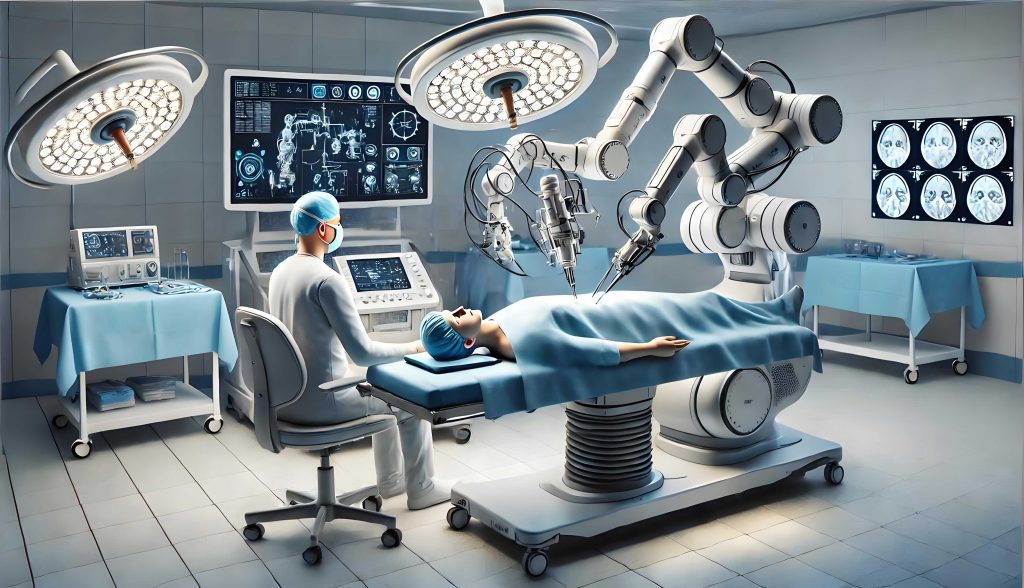
The pandemic unequivocally demonstrated the utility of each category. Surgical robots allowed for minimally invasive procedures on infected patients, reducing aerosol generation and protecting surgeons. Assistant robots powered telemedicine platforms and AI-driven diagnostic analysis of CT scans. Service robots became ubiquitous, performing high-risk duties: UV-C disinfection of wards, contactless delivery of medication and food to isolation rooms, and automated temperature screening at hospital entrances. This real-world validation solved a critical barrier for the medical robot industry: proving operational reliability and return on investment under the most demanding conditions. The deployment data from various global hotspots created a compelling evidence base for hospital administrators and investors alike.
Now, looking forward, the growth trajectory of the medical robot industry can be modeled as a function of multiple accelerating factors unlocked by the pandemic. Let us consider a simplified growth driver model:
$$G_{MR}(t) = \alpha \cdot T(t) + \beta \cdot M(t) + \gamma \cdot P(t) + \delta \cdot C(t)$$
Where:
$G_{MR}(t)$: Growth rate of the medical robot industry at time t.
$T(t)$: Technology maturation index (e.g., AI, 5G, material science).
$M(t)$: Market validation and acceptance factor (boosted by pandemic proof-of-concept).
$P(t)$: Demographic pressure (aging population, rising chronic diseases).
$C(t)$: Capital investment and policy support index.
$\alpha, \beta, \gamma, \delta$: Corresponding positive coefficients representing the sensitivity of growth to each driver.
The pandemic caused a discontinuous jump in $M(t)$, which in turn increased investor confidence, thereby elevating $C(t)$. This positive feedback loop is now propelling $G_{MR}(t)$ to new levels. However, to sustain this growth and capture its full potential, a strategic and analytical approach is required. A comprehensive SWOT (Strengths, Weaknesses, Opportunities, Threats) analysis for a typical region or nation aiming to lead in this sector reveals the following landscape:
| Strengths | Weaknesses |
|---|---|
|
|
| Opportunities | Threats |
|
|
The central challenge illuminated by this analysis is the “midstream gap” and “upstream dependency.” While application (downstream) is strong, the capability to design, integrate, and manufacture the complete medical robot, particularly its most sophisticated forms, and to source its core components domestically, remains a critical weakness. The talent shortage further exacerbates this gap.
Therefore, to accelerate the development of a robust medical robot industry, a multi-pronged, strategic approach is essential. The following framework outlines key actionable pillars:
1. Strategic Foresight and Specialized Roadmapping: Moving beyond generic robotics plans, a dedicated, nuanced roadmap for the medical robot sub-sector is paramount. This roadmap must identify specific niches where competitive advantage can be built—for instance, in rehabilitation robotics for specific pathologies, or in affordable, modular surgical assistant systems. It should prioritize R&D in upstream component technology to reduce external dependencies.
2. Cultivating the Human Capital Pipeline: The interdisciplinary nature of medical robot innovation requires a new breed of engineers. This necessitates:
- Establishing dedicated “Medical Robotics Engineering” programs at major universities, co-taught by engineering and medical faculties.
- Creating national research centers that serve as open platforms for collaboration between academia, hospitals, and industry on fundamental challenges.
- Implementing targeted talent attraction programs to recruit leading global researchers and teams, particularly in core component design and surgical robotics AI.
The return on investment in talent can be seen as a function of innovation output ($I$): $$I = k \cdot (N_{eng} \cdot N_{med})^\phi$$ where $N_{eng}$ and $N_{med}$ are the depth of engineering and medical talent pools engaged, $k$ is a collaboration efficiency constant, and $\phi > 1$ suggests superlinear returns from effective interdisciplinary fusion.
3. Orchestrating Technological Breakthroughs: Closing the technology gap requires concerted effort:
- Direct R&D Investment: Government and venture capital must fund high-risk, high-reward research in precision actuation, force-feedback haptics, and compliant robot-safe manipulation.
- Accelerated Translational Pathways: Creating “test-bed” hospitals with streamlined regulatory sandboxes to conduct clinical trials and iterate rapidly on new medical robot prototypes.
- Open Innovation Challenges: Sponsoring global competitions focused on solving specific technical bottlenecks in medical robot design, such as reducing the cost of a surgical manipulator joint or improving SLAM (Simulation Localization and Mapping) for dynamic hospital environments.
A model for required R&D investment ($I_{R&D}$) over time to achieve a technology threshold could be: $$I_{R&D}(t) = I_g(t) + I_u(t) + I_c(t)$$ where $I_g$, $I_u$, and $I_c$ represent government, university, and corporate R&D spending, respectively, which must be coordinated to avoid duplication and maximize synergy.
4. Precision Ecosystem Development via Strategic Investment: Building the midstream manufacturing base requires attracting anchor tenants. This involves “precision investment attraction” focused on:
- Targeting global leaders in specific medical robot segments or critical component manufacturing for direct investment or joint-venture establishment.
- Fostering local “champion” companies through public-private partnerships, providing them with access to clinical partners and early-adopter markets.
- Developing specialized industrial parks with the necessary clean-room facilities, testing labs, and regulatory consultancy services tailored for medical device and medical robot production.
5. Proliferating Application Frontiers to Fuel Demand: A strong domestic application base drives innovation. Policy can stimulate this by:
- Procurement Incentives: Implementing subsidy programs or favorable financing for public hospitals and care facilities to adopt locally produced or innovative medical robot solutions.
- Expanding Reimbursement Policies: Working with health insurance systems to create clear reimbursement codes for procedures assisted by specific classes of medical robot, making their adoption financially sustainable for healthcare providers.
- Piloting New Models of Care: Supporting large-scale pilot projects that deploy medical robot networks in elderly care communities or rural telehealth hubs, creating new use-case evidence and business models.
In conclusion, the COVID-19 pandemic was a pivotal moment for the medical robot industry, transforming it from an interesting prospect into a proven necessity. The surge in validation ($M(t)$) has initiated a powerful growth cycle. However, long-term leadership in this high-stakes field will not be won by application alone. It requires a deliberate and deep industrial strategy that addresses the fundamental weaknesses in the value chain—particularly in core technology and advanced manufacturing. By implementing a cohesive framework focused on specialized talent development, targeted R&D, strategic ecosystem cultivation, and demand stimulation, regions can position themselves not just as consumers, but as leading innovators and manufacturers in the global medical robot revolution. The race is no longer about mere adoption; it is about mastering the intricate dance of engineering, medicine, and strategy that brings these transformative machines from the lab to the clinic, and ultimately, to the center of a more resilient and effective global healthcare system.