
In the era of rapid technological advancement, smart healthcare has emerged as a critical application within the strategic framework of smart cities, addressing vital民生 needs. With increasing national support for various domains of智慧医疗 and the promotion of智慧医疗 system construction, the medical robot industry is witnessing unprecedented growth opportunities. To adapt to the developments of the new era and mitigate the challenges posed by an aging population, I have designed an intelligent medical assistance robot based on an STM51 microcontroller. This medical robot integrates multiple sensors and employs wheeled驱动, leveraging path planning technologies and北斗 positioning to achieve functionalities such as automatic temperature measurement, blood pressure detection, medication and document dispensing, and visual doctor-patient communication. Through simulation analysis using MATLAB, this medical robot demonstrates fast response times and strong stability, effectively realizing预设 functions and contributing to the advancement of medical informatization.
The智慧医疗 landscape in China has experienced significant expansion in recent years, with investment scales continuously growing. According to statistical data, the investment in China’s智慧医疗 sector surpassed the hundred-billion-yuan mark in 2020, with a compound annual growth rate of 23.86% from 2017 to 2020. It is projected that by 2023, the investment scale will reach approximately 189.6 billion yuan, indicating a period of智能化,高效化, and规模化 development. The following table summarizes the investment trends from 2017 to 2023.
| Year | Investment Scale (Billion Yuan) | Growth Rate |
|---|---|---|
| 2017 | 65.0 | – |
| 2018 | 80.5 | 23.8% |
| 2019 | 98.2 | 22.0% |
| 2020 | 112.0 | 14.1% |
| 2021 | 135.0 | 20.5% |
| 2022 | 162.0 | 20.0% |
| 2023 (Projected) | 189.6 | 17.0% |
Concurrently, the medical robot market, particularly for service-oriented medical robots, has shown robust growth. In 2020, the market size for medical service robots in China reached 5.94 billion yuan, increasing to 7.96 billion yuan in 2021 and further to 9.71 billion yuan in 2022. This growth is driven by policies such as the “14th Five-Year Plan for Intelligent Manufacturing” and the “Medical Equipment Industry Development Plan (2021-2025),” which emphasize innovation in医疗机器人. The aging population exacerbates the demand for智慧养老 solutions, where rehabilitation robots, surgical robots, exoskeleton robots, and service medical robots are becoming increasingly prevalent. By 2050, it is estimated that China’s elderly population will reach 500 million, underscoring the urgency for efficient医疗 assistance systems.
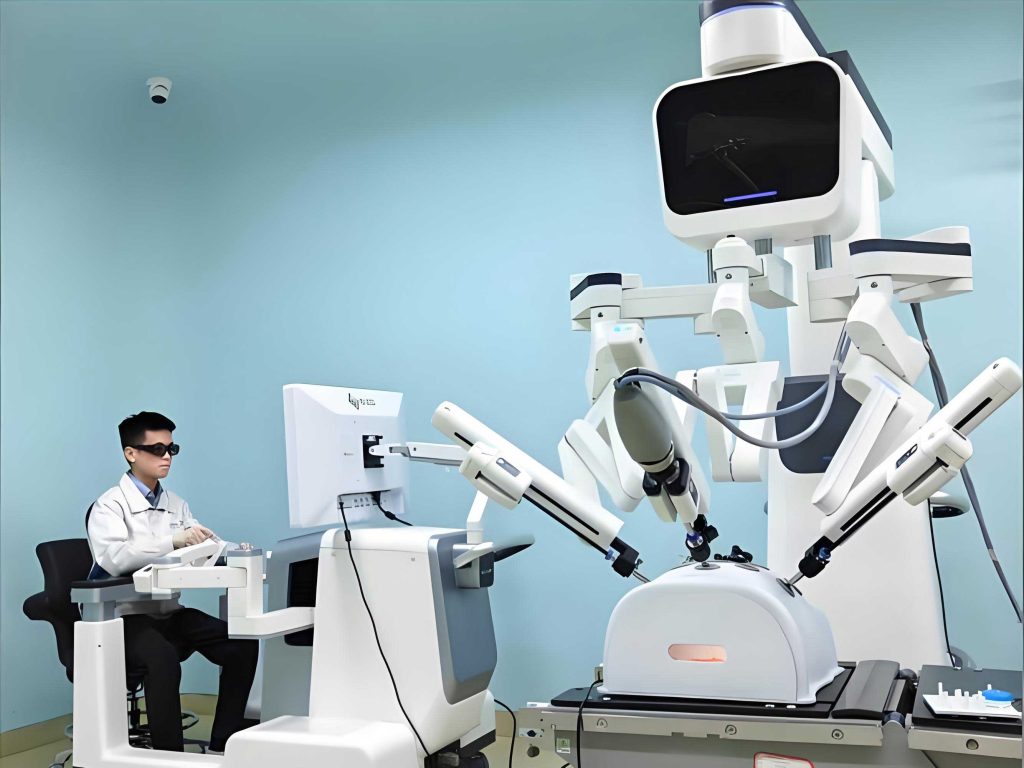
The primary objective of designing this intelligent medical robot is to alleviate hospital staff shortages and紧张 medical resources. This medical robot aims to assist in routine tasks such as measuring patient体温, blood pressure, and heart rate, distributing medications, and facilitating real-time visual communication between doctors and patients. By automating these processes, the medical robot reduces human error, enhances service consistency, and improves overall healthcare quality. Moreover, the integration of人工智能 and data analytics enables this medical robot to support decision-making and standardize medical practices, thereby推动医疗信息化的发展.
In terms of system design, this medical robot adopts a wheeled-drive mechanism with a four-wheel structure, including two independently driven rear wheels and two steering front wheels. This configuration ensures灵活转弯 and stability during operation. The core of the medical robot is an STM51 microcontroller, which coordinates multiple sensors, including ultrasonic sensors for obstacle avoidance, infrared sensors for edge detection and line following, temperature sensors, and blood pressure sensors. The control block structure integrates these components to enable autonomous navigation and task execution. For instance, when the medical robot reaches a designated patient location, it utilizes infrared temperature sensors and blood pressure sensors to collect vital signs, which are then transmitted to a central database for monitoring. The medical robot also incorporates voice interaction modules connected to cloud-based big data, allowing for real-time communication and feedback.
The path planning capability is a critical feature of this medical robot, enabling it to navigate complex hospital environments efficiently. I have implemented both static and dynamic path planning algorithms, namely an improved A* algorithm and a D* algorithm, to optimize route selection. The A* algorithm is a heuristic search method commonly used in grid-based environments. Its estimation function, based on Euclidean distance, guides the medical robot toward the goal while minimizing traversal nodes. The Euclidean distance between two points (x1, y1) and (x2, y2) is given by:
$$d = \sqrt{(x_2 – x_1)^2 + (y_2 – y_1)^2}$$
However, to reduce computational load, the Manhattan distance is often employed as an alternative estimation function:
$$d = |x_2 – x_1| + |y_2 – y_1|$$
For the medical robot’s path planning in a grid map, I define the estimation function f(n) as:
$$f(n) = g(n) + h(n)$$
where g(n) is the cost from the start node to node n, and h(n) is the heuristic estimate from node n to the goal. By refining this function, the improved A* algorithm reduces拐点 and direction changes, as demonstrated in MATLAB simulations. The medical robot can thus follow pre-planned routes during off-peak hours or in低人流 environments, ensuring timely delivery of services.
For dynamic environments, the D* algorithm is utilized to adapt to real-time obstacles and changes. This algorithm generates trajectories based on the medical robot’s kinematic constraints, such as angular velocity and linear acceleration. The motion model can be expressed as:
$$\dot{x} = v \cos(\theta)$$
$$\dot{y} = v \sin(\theta)$$
$$\dot{\theta} = \omega$$
where (x, y) denotes the position, θ is the orientation, v is the linear velocity, and ω is the angular velocity. The D* algorithm accounts for acceleration limits and collision avoidance, ensuring that the medical robot moves safely and efficiently. Simulation results show that the medical robot can dynamically replan paths to avoid obstacles while maintaining optimal speed, making it suitable for emergency scenarios or crowded hospital wards.
To evaluate the performance of this medical robot, I conducted stability and response time analyses using MATLAB. In a simulated grid map, the medical robot was tasked with navigating from a start point to multiple target points. The improved A* algorithm yielded optimal paths with minimal traversal time, as summarized in the table below.
| Target Point | Path Length (Grid Units) | Response Time (Seconds) | Stability Metric |
|---|---|---|---|
| Point 1 | 15 | 5.2 | High |
| Point 2 | 22 | 7.8 | High |
| Point 3 | 18 | 6.5 | High |
The results indicate that the medical robot achieves response times under 8.0 seconds, demonstrating rapid and stable operation. This efficiency is crucial for医疗辅助 tasks, such as monitoring patients in传染病 wards or重症病房, where timely intervention can save lives. Additionally, the medical robot’s ability to integrate with hospital信息系统 enhances data flow between patients, devices, and healthcare providers, streamlining workflows.
In conclusion, the intelligent medical robot designed in this study embodies the convergence of advanced technologies in智慧医疗. By incorporating path planning algorithms, multi-sensor fusion, and real-time communication capabilities, this medical robot addresses critical challenges in healthcare delivery. The simulation analyses confirm that the medical robot exhibits fast response, strong stability, and effective functionality, paving the way for broader adoption in medical settings. As the medical robot industry evolves, continued innovation in人工智能 and robotics will further enhance the capabilities of such医疗辅助 systems, promoting safer, more efficient, and patient-centered care. Future work may focus on scaling the medical robot for diverse clinical environments and integrating advanced machine learning for predictive analytics.