
In the rapidly evolving field of medical technology, medical robots have emerged as transformative tools, enhancing precision, efficiency, and safety in various healthcare applications. As a researcher focused on reliability engineering, I have observed that medical robots play a critical role in surgery, rehabilitation, diagnosis, and patient care, where their performance directly impacts clinical outcomes. However, ensuring the longevity and reliability of these complex systems remains a significant challenge. Reliability allocation, which involves distributing overall reliability targets among subsystems and components, is essential during the design and development phases. Yet, traditional methods often fall short when applied to intricate systems like medical robots. In this article, I explore the application of the Analytic Hierarchy Process (AHP) for reliability allocation in medical robots, leveraging its structured approach to handle complexity and multiple influencing factors. I will detail the AHP model, apply it to a case study, and demonstrate how it can optimize the reliability distribution for medical robot components, aiming for a mean time between failures (MTBF) of at least 8,000 hours. Throughout, I will emphasize the unique advantages of AHP over other methods, using tables and formulas to summarize key concepts, and ensure the keyword ‘medical robot’ is frequently highlighted to underscore its relevance.
The importance of medical robots in modern healthcare cannot be overstated. These systems integrate advanced mechanics, sensors, and control algorithms to perform tasks with high accuracy, reducing human error and expanding treatment capabilities. For instance, surgical medical robots enable minimally invasive procedures, while rehabilitation medical robots assist in patient recovery. However, the reliability of medical robots is paramount, as failures can lead to operational disruptions, safety risks, and compromised patient care. Reliability allocation helps identify weak points, allocate resources effectively, and ensure that each component contributes appropriately to the overall system reliability. Common methods like equal allocation, proportional allocation, AGREE allocation, and scoring allocation have limitations: equal allocation ignores component differences, proportional allocation is subjective, AGREE allocation overlooks existing data, and scoring allocation can be complex and inflexible. In contrast, AHP offers a hierarchical framework that combines qualitative and quantitative assessments, making it ideal for complex systems like medical robots. By breaking down the problem into factors such as complexity, technological maturity, environmental conditions, operating time, and maintenance, AHP facilitates a more nuanced and accurate reliability allocation.
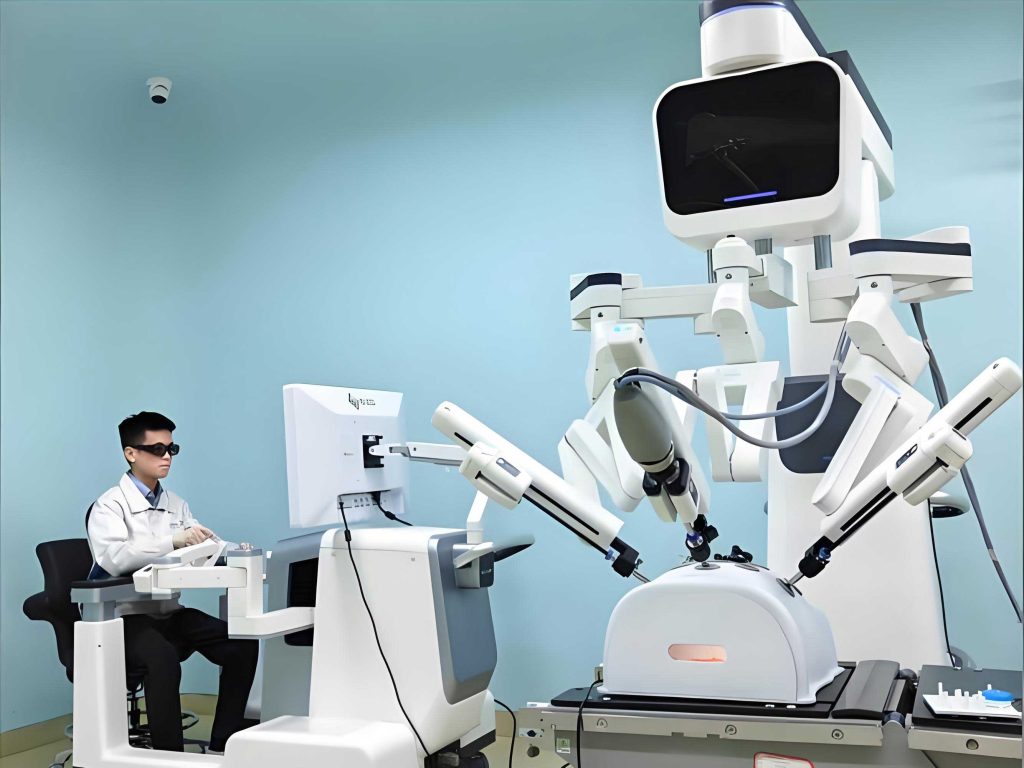
To establish a foundation, let me outline the AHP model for reliability allocation. AHP involves several systematic steps, starting with defining the problem hierarchy. For a medical robot, the top level is the overall reliability goal, the middle level consists of influencing factors, and the bottom level includes the components or subsystems. The factors I consider are: complexity (A1), technological maturity (A2), environmental conditions (A3), operating time (A4), and maintenance (A5). These factors are chosen because they directly impact the reliability of a medical robot; for example, a more complex component may have higher failure rates, while mature technology might enhance durability. Next, I define a judgment scale for pairwise comparisons, as shown in Table 1. This scale quantifies the relative importance between factors or components, using values like 1 for equal importance and 3 for significantly greater importance.
| Judgment Scale | Definition |
|---|---|
| 1/3 | Factor A is significantly less important than Factor B |
| 1/2 | Factor A is less important than Factor B |
| 1 | Factor A and Factor B are equally important |
| 2 | Factor A is more important than Factor B |
| 3 | Factor A is significantly more important than Factor B |
Using this scale, I construct a pairwise comparison matrix for the factors relative to the system, denoted as \( P_A \). This matrix is reciprocal, meaning if \( a_{ij} \) is the comparison of factor i to j, then \( a_{ji} = 1/a_{ij} \). The matrix is given by:
$$ P_A = \begin{bmatrix}
1 & a_{12} & \cdots & a_{1k} \\
1/a_{12} & 1 & \cdots & a_{2k} \\
\vdots & \vdots & \ddots & \vdots \\
1/a_{1k} & 1/a_{2k} & \cdots & 1
\end{bmatrix} $$
where \( k \) is the number of factors (here, \( k = 5 \)). For the medical robot, based on expert assessment, I assume the following comparisons: complexity and technological maturity are equally important and more critical than environmental conditions and operating time, while maintenance is less critical. This leads to a specific matrix, which I will compute later. The next step is to calculate the weight vector \( w_A \) for the factors by finding the principal eigenvector of \( P_A \) and normalizing it. The consistency of the matrix is checked using the consistency index (C.I.), calculated as:
$$ \text{C.I.} = \frac{\lambda_{\text{max}} – n}{n – 1} $$
where \( \lambda_{\text{max}} \) is the maximum eigenvalue of \( P_A \) and \( n \) is the number of factors. A C.I. value less than or equal to 0.1 indicates acceptable consistency; otherwise, the matrix must be revised. Once the factor weights are determined, I proceed to construct pairwise comparison matrices for each factor relative to the components. For a medical robot, the components might include the frame, chassis, body shell, robotic arm, and display, denoted as B1 to B5. For each factor \( A_m \), I create a matrix \( P_{B_m} \) comparing the components pairwise based on that factor’s influence. For example, for complexity (A1), a more complex component like the robotic arm might be rated higher than the frame. The weight vectors \( w_{B_m} \) for each matrix are computed similarly, and their consistency is verified. These vectors are then assembled into a weight matrix \( P_C \), representing the components’ weights under each factor.
The overall weight vector \( w \) for the components relative to the system is obtained by multiplying the factor weight vector \( w_A \) by the matrix \( P_C \):
$$ w = w_A \cdot P_C $$
where \( w = (w_1, w_2, \ldots, w_n) \) for \( n \) components. Finally, the reliability allocation is performed by distributing the system’s failure rate \( \lambda_s \) based on these weights. The failure rate for component i is:
$$ \lambda_i^* = w_i \cdot \lambda_s $$
and the MTBF for component i is the reciprocal: \( \text{MTBF}_i = 1 / \lambda_i^* \). The results are rounded for practicality. This AHP model provides a structured approach to reliability allocation for medical robots, accommodating multiple criteria and reducing subjectivity through consistent pairwise comparisons.
Now, I apply this AHP model to a specific medical robot case study. The medical robot in question is a prototype used for surgical assistance, with a target system MTBF of at least 8,000 hours, corresponding to a failure rate \( \lambda_s = 1.25 \times 10^{-4} \) per hour. The medical robot comprises five key subsystems in a series configuration: frame (B1), chassis (B2), body shell (B3), robotic arm (B4), and display (B5). The reliability block diagram is serial, meaning the failure of any component leads to system failure, so reliability allocation must ensure each part meets its individual target. I begin by defining the factor comparison matrix \( P_A \). Based on the importance of factors for this medical robot, I assign the following comparisons: complexity (A1) and technological maturity (A2) are equally important and are rated as more important than environmental conditions (A3) and operating time (A4), which are equally important, while maintenance (A5) is less important. Using the judgment scale from Table 1, I derive the matrix:
$$ P_A = \begin{bmatrix}
1 & 1 & 2 & 2 & 3 \\
1 & 1 & 2 & 2 & 3 \\
1/2 & 1/2 & 1 & 1 & 2 \\
1/2 & 1/2 & 1 & 1 & 2 \\
1/3 & 1/3 & 1/2 & 1/2 & 1
\end{bmatrix} $$
Calculating the principal eigenvector and normalizing it, I obtain the factor weights. The maximum eigenvalue \( \lambda_{\text{max}} \) is approximately 5.0133, and the eigenvector is (0.6143, 0.6143, 0.3254, 0.3254, 0.1831). Normalization yields \( w_A = (0.2978, 0.2978, 0.1578, 0.1578, 0.0888) \). The consistency index is:
$$ \text{C.I.} = \frac{5.0133 – 5}{5 – 1} = 0.0033 < 0.1 $$
indicating acceptable consistency. Next, I construct the pairwise comparison matrices for each factor relative to the components. For complexity (A1), I assess that the robotic arm and display are more complex than the frame and chassis, while the body shell is simpler. The matrix \( P_{B1} \) is:
$$ P_{B1} = \begin{bmatrix}
1 & 2 & 3 & 2 & 1 \\
1/2 & 1 & 2 & 1 & 1/2 \\
1/3 & 1/2 & 1 & 1/2 & 1/3 \\
1/2 & 1 & 2 & 1 & 1/2 \\
1 & 2 & 3 & 2 & 1
\end{bmatrix} $$
For technological maturity (A2), I assume the frame and chassis are mature, while the robotic arm is less mature due to advanced kinematics. The matrix \( P_{B2} \) is:
$$ P_{B2} = \begin{bmatrix}
1 & 1 & 3 & 2 & 3 \\
1 & 1 & 3 & 2 & 3 \\
1/3 & 1/3 & 1 & 1/2 & 1 \\
1/2 & 1/2 & 2 & 1 & 2 \\
1/3 & 1/3 & 1 & 1/2 & 1
\end{bmatrix} $$
For environmental conditions (A3), the medical robot operates in controlled settings, but the body shell may face more stress. The matrix \( P_{B3} \) is:
$$ P_{B3} = \begin{bmatrix}
1 & 1 & 1/2 & 1 & 2 \\
1 & 1 & 1/2 & 1 & 2 \\
2 & 2 & 1 & 2 & 2 \\
1 & 1 & 1/2 & 1 & 2 \\
1/2 & 1/2 & 1/2 & 1/2 & 1
\end{bmatrix} $$
For operating time (A4), the frame and display are used continuously, while other parts have intermittent usage. The matrix \( P_{B4} \) is:
$$ P_{B4} = \begin{bmatrix}
1 & 2 & 2 & 2 & 1 \\
1/2 & 1 & 1 & 1 & 1/2 \\
1/2 & 1 & 1 & 1 & 1/2 \\
1/2 & 1 & 1 & 1 & 1/2 \\
1 & 2 & 2 & 2 & 1
\end{bmatrix} $$
For maintenance (A5), the robotic arm requires more upkeep, but other components are similar. The matrix \( P_{B5} \) is:
$$ P_{B5} = \begin{bmatrix}
1 & 1 & 3 & 1 & 1 \\
1 & 1 & 3 & 1 & 1 \\
1/3 & 1/3 & 1 & 1/3 & 1/3 \\
1 & 1 & 3 & 1 & 1 \\
1 & 1 & 3 & 1 & 1
\end{bmatrix} $$
I compute the weight vectors for each matrix using eigenvector analysis. For \( P_{B1} \), the weight vector is \( w_{B1} = (0.2978, 0.1558, 0.0888, 0.1578, 0.2978) \). For \( P_{B2} \), \( w_{B2} = (0.3133, 0.3133, 0.0986, 0.1763, 0.0986) \). For \( P_{B3} \), \( w_{B3} = (0.1867, 0.1867, 0.3301, 0.1867, 0.1267) \). For \( P_{B4} \), \( w_{B4} = (0.2857, 0.1429, 0.1429, 0.1429, 0.2857) \). For \( P_{B5} \), \( w_{B5} = (0.2308, 0.2308, 0.0769, 0.2308, 0.2308) \). All matrices have C.I. values below 0.1, ensuring consistency. I then form the weight matrix \( P_C \) by arranging these vectors as rows:
$$ P_C = \begin{bmatrix}
0.2978 & 0.1558 & 0.0888 & 0.1578 & 0.2978 \\
0.3133 & 0.3133 & 0.0986 & 0.1763 & 0.0986 \\
0.1867 & 0.1867 & 0.3301 & 0.1867 & 0.1267 \\
0.2857 & 0.1429 & 0.1429 & 0.1429 & 0.2857 \\
0.2308 & 0.2308 & 0.0769 & 0.2308 & 0.2308
\end{bmatrix} $$
The overall component weight vector \( w \) is calculated as:
$$ w = w_A \cdot P_C = (0.2978, 0.2978, 0.1578, 0.1578, 0.0888) \cdot P_C $$
Performing the matrix multiplication:
$$ w = (0.2978 \times 0.2978 + 0.2978 \times 0.3133 + 0.1578 \times 0.1867 + 0.1578 \times 0.2857 + 0.0888 \times 0.2308, \ldots) $$
I compute each element to get \( w = (0.277, 0.213, 0.135, 0.172, 0.204) \). This indicates the relative importance of each component in the medical robot for reliability allocation. With the system failure rate \( \lambda_s = 1.25 \times 10^{-4} \), the allocated failure rates are:
$$ \lambda_1^* = 0.277 \times 1.25 \times 10^{-4} = 3.4625 \times 10^{-5} $$
$$ \lambda_2^* = 0.213 \times 1.25 \times 10^{-4} = 2.6625 \times 10^{-5} $$
$$ \lambda_3^* = 0.135 \times 1.25 \times 10^{-4} = 1.6875 \times 10^{-5} $$
$$ \lambda_4^* = 0.172 \times 1.25 \times 10^{-4} = 2.15 \times 10^{-5} $$
$$ \lambda_5^* = 0.204 \times 1.25 \times 10^{-4} = 2.55 \times 10^{-5} $$
The corresponding MTBF values are the reciprocals, rounded for practicality, as shown in Table 2. These results ensure that the medical robot meets its overall MTBF target of 8,000 hours, with each component having a tailored reliability goal based on its characteristics and influence factors.
| Component Name | Allocated MTBF (hours) |
|---|---|
| Frame | 28,881 |
| Chassis | 37,559 |
| Body Shell | 59,259 |
| Robotic Arm | 46,521 |
| Display | 39,216 |
The allocation results highlight how AHP effectively distributes reliability targets for the medical robot. For instance, the body shell has the highest MTBF, reflecting its lower complexity and environmental sensitivity, while the frame has a lower MTBF due to higher complexity and usage. This nuanced approach ensures that critical components like the robotic arm, which is vital for the medical robot’s functionality, receive appropriate attention without over-allocating resources to less critical parts. Compared to traditional methods, AHP reduces subjectivity by incorporating multiple criteria and consistency checks, making it robust for complex systems like medical robots. Moreover, the process is scalable; for a medical robot with more subsystems, the hierarchy can be extended without losing clarity. The use of pairwise comparisons also allows for expert input, which is valuable in fields like medical robotics where empirical data may be limited.
To further elaborate on the advantages of AHP for medical robots, let me discuss its integration with other reliability engineering techniques. For example, AHP can be combined with Failure Modes and Effects Analysis (FMEA) to prioritize failure modes based on their impact on reliability allocation. In a medical robot, potential failure modes such as sensor drift in the robotic arm or display malfunction can be evaluated using AHP weights to allocate testing and improvement efforts. Additionally, AHP supports dynamic reliability allocation; as the medical robot evolves with new technologies, the factors and comparisons can be updated to reflect changes. This adaptability is crucial for medical robots, which often undergo rapid innovation. From a mathematical perspective, AHP’s reliance on eigenvector computation ensures that weights are derived from consistent judgments, though it requires careful calibration to avoid biases. In practice, for a medical robot development team, using AHP fosters collaboration by involving multiple stakeholders in the pairwise comparisons, thereby aligning reliability goals with operational needs.
In conclusion, the Analytic Hierarchy Process offers a powerful methodology for reliability allocation in medical robots, addressing the limitations of conventional methods through a structured, multi-criteria approach. By applying AHP to a medical robot case study, I demonstrated how to allocate MTBF targets among components based on factors like complexity, technological maturity, and environmental conditions. The results show tailored reliability goals that support the overall system objective of 8,000 hours MTBF, enhancing the medical robot’s dependability in critical healthcare applications. Future research could explore hybrid models combining AHP with Bayesian networks or machine learning to predict reliability trends for medical robots, or extend AHP to allocate other metrics like availability or maintainability. As medical robots continue to advance, robust reliability engineering practices like AHP will be essential to ensure their safe and effective deployment, ultimately improving patient outcomes and operational efficiency in the medical field.