
The convergence of Artificial Intelligence Generated Content (AIGC) technology and the global resurgence of cultural confidence has created a pivotal moment for industrial design. The consumer-grade robotics market, particularly for quadrupedal or robot dog companions, is experiencing explosive growth, projected to reach a market volume of $15 billion with an annual growth rate exceeding 25%. However, this rapid expansion is marred by a significant design deficit: over 85% of desktop quadruped robot dogs suffer from severe aesthetic homogenization, leading to low brand differentiation and user fatigue. Market research indicates that 75% of users perceive existing products as lacking emotional warmth and cultural depth, while 68% express a willingness to choose a product with distinctive cultural characteristics. This gap between technological capability and design aspiration forms the core impetus for this research. This paper systematically explores the integration of AIGC technology with Eastern aesthetics to innovate the造型 design of robotic canines, proposing a replicable methodology and a viable产业化 path to transition the industry from a purely technology-driven paradigm to one fueled by cultural and emotional value.
I. The Technological Landscape: AIGC in Industrial Design
The domestic development of AIGC has reached a sophisticated stage, offering unprecedented tools for creative generation. Platforms have demonstrated remarkable capabilities, with image generation quality scores reaching 8.7/10, an 88% accuracy rate in understanding Chinese prompts, and near real-time generation speeds. Crucially, these platforms exhibit unique advantages in comprehending the cultural context, abstract concepts, and artistic意境 inherent in Eastern aesthetics. This provides a robust technical foundation for the design innovation proposed herein. However, three critical challenges hinder the large-scale, reliable application of AIGC in industrial design for products like the robot dog:
- Unpredictability & Low Controllability: Generation results can be highly stochastic, making it difficult to consistently output设计方案 that meet precise design intent.
- Engineering Feasibility Gap: There is a significant disconnect between conceptual AIGC visuals and the practical constraints of manufacturing, assembly, and component integration.
- Lack of Systematic Methodology: The effectiveness of AIGC application is heavily reliant on individual user expertise, lacking a standardized, replicable process for cultural translation and design innovation.
These challenges necessitate the development of a structured framework to harness AIGC’s potential effectively, which this research addresses through its core innovative workflow.
II. Theoretical Foundation: A Three-Layer Emotional Design Framework
The design methodology is anchored in Donald Norman’s Three Levels of Emotional Design—Visceral, Behavioral, and Reflective—which provides a comprehensive theoretical scaffold for controlling AIGC generation and ensuring a holistic user experience for the robot dog.
| Design Level | Eastern Aesthetic Principle | Design Focus & AIGC Control Strategy | Target User Response |
|---|---|---|---|
| Visceral (Instinctive) | Harmony with Nature (天人合一) | Precise control over form, color, and material texture. Use of prompts like “rounded and full,” “upright and elegant.” Establishment of a standardized color palette based on traditional five colors (青,赤,黄,白,黑). | Immediate aesthetic attraction, perception of harmony and natural beauty. |
| Behavioral (Usability) | Interaction of Void and Substance (虚实相生) | Balancing functional layout (“substance”) with experiential “void.” Intuitive interaction design, structural reliability. Prompts must integrate ergonomic and mechanical constraints. | Effortless interaction, perceived durability, seamless fit into usage scenarios. |
| Reflective (Cultural) | Profound Artistic Conception (意境深远) | Binding design to cultural archetypes (e.g., Qilin, Crane). Use of a symbolic database mapping cultural meanings to design languages. This layer is the core innovation driver. | Cultural resonance, personal identification, storytelling, and emotional attachment. |
The Reflective layer is the cornerstone of differentiation. A symbolic database of over 200 cultural elements was constructed, explicitly linking each to specific Eastern philosophical principles and providing actionable design translation guides. For instance, the Qilin (麒麟), a benevolent mythical creature, translates into design languages of rounded contours and a non-threatening posture, embodying the concept of harmonious coexistence. The Crane (仙鹤), symbolizing elegance and longevity, informs designs with simplified, graceful structures and a color scheme that suggests purity and tranquility, employing “留白” (strategic emptiness) in its form. This database transforms abstract cultural connotations into operable AIGC prompt parameters.
III. Constructing the AIGC-Enabled Design Methodology
Building upon the theoretical framework, a four-stage design methodology was developed: Cultural Positioning → Theoretical Guidance → AIGC Generation → Engineering Adaptation.
1. Prompt Engineering: A modular, five-layer prompt architecture was devised to enhance control and consistency in generating robot dog concepts.
| Prompt Layer | Function | Example Components |
|---|---|---|
| Core Definition | Establishes the base subject and style. | “A consumer-grade quadruped robot dog, futuristic yet organic, concept design, 3D render, studio lighting.” |
| Form Description | Guides the overall morphology based on cultural archetype. | “Form inspired by a Qilin, benevolent and majestic, robust yet graceful torso, powerful but non-aggressive limbs.” |
| Detail Constraints | Specifies key features and functional elements. | “Clear housing for a central processing unit, integrated camera eyes, joint actuators visible but streamlined, non-slip foot pads.” |
| Style Guidance | Infuses the specific aesthetic and emotional tone. | “Eastern minimalist aesthetics, Zen philosophy, use of ivory white and muted gold colors, ceramic-like smooth surface with subtle matte finish.” |
| Output Requirements | Defines technical specs for the generated image. | “Hyper-detailed, 8K resolution, perspective view, clean background.” |
The quality of generation can be modeled as a function of prompt precision and model training: $$ Q_g = f(P_s, M_t, C_c) $$ where \( Q_g \) is the output design quality, \( P_s \) is the prompt specificity score, \( M_t \) is the model’s training level on the target aesthetic, and \( C_c \) is the cultural coherence parameter derived from the symbolic database.
2. Model Training & Optimization: Specialized training was conducted using an AIGC platform. A curated dataset of over 5,000 images of Eastern art, sculpture, and artifacts was used for fine-tuning. The training employed a progressive strategy with dynamic learning rate adjustment (initial rate 0.001, decaying by 50% every 10 epochs). This targeted training significantly improved the model’s proficiency in interpreting abstract Eastern concepts like “留白,” with a measured increase in generation quality for such prompts exceeding 38% compared to the base model.
IV. Design实践与成果验证 (Practice and Validation)
The methodology was applied to two distinct cultural archetypes: the Qilin and the Crane. A cross-disciplinary team managed the process, ensuring balance between cultural authenticity, aesthetic appeal, and engineering reality.
The design process for the Qilin-themed robot dog underwent four intensive AIGC迭代, starting with broad exploration and refining towards engineering-ready concepts. Key was moving from literal representation to capturing the archetype’s essence—”majestic yet kind”—through abstract prompt engineering. Collaboration with structural engineers was integrated early in later stages to adapt aesthetically promising forms for内部 component layout, material strength, and manufacturability.
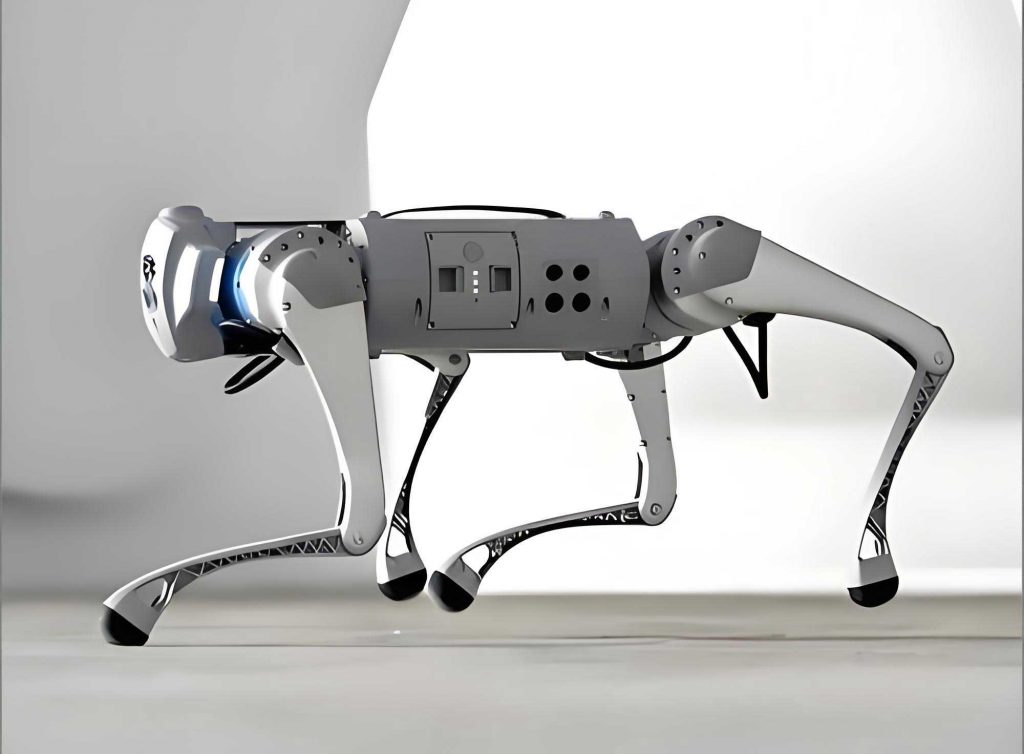
Rigorous evaluation followed a multi-dimensional system. Aesthetic and cultural value was assessed by expert review (scoring innovation, completeness, aesthetic coordination) and user surveys (measuring emotional resonance and purchase intent). The final “Qilin · Auspice” and “Crane · Cloud Elegance” concept robot dogs scored 8.7/10 and 8.5/10 respectively in expert aesthetic evaluation.
Engineering feasibility was validated via 3D modeling, finite element analysis, and cost simulation. A market survey targeting the core demographic (500 valid responses) yielded compelling data: 85%认可度 of the design concepts, with 72% expressing willingness to pay a premium for the cultural differentiation. Willingness was highest (83%) among the 18-35 age group with higher disposable income and interest in cultural trends, confirming strong market viability.
V. Industrialization Pathway and商业 Model Innovation
The transition from design concept to market product requires a structured产业化路径. The proposed model significantly compresses timelines and reduces risk compared to conventional processes.
| Phase | Conventional Process | AIGC-Enhanced Process (Proposed) | Efficiency Gain |
|---|---|---|---|
| Concept Design & Exploration | 3-4 weeks (Manual sketching, 3D modeling) | 3-5 days (AIGC generation & rapid iteration) | ~85% reduction |
| Prototyping & Feedback Loop | High cost per physical prototype; limits iterations. | Low-cost digital prototypes enable extensive virtual iteration; physical prototyping focused on validation. | ~80% reduction in试错成本 |
| Time-to-Market (From idea to launch-ready design) | 4-6 months | 1.5-3 months | 50-65% acceleration |
The产业化路径 can be broken down into three strategic phases:
1. Proof-of-Concept (1-2 months): Generate and refine 3-5 high-fidelity AIGC concepts. Develop high-precision models for 1-2 top directions. Validate with a minimum of 300 target用户 feedback; proceed if ≥80%认可 cultural expression and ≥70% show purchase intent.
$$ P_{proceed} = \begin{cases} 1 & \text{if } R_c \geq 0.8 \text{ and } I_p \geq 0.7 \\ 0 & \text{otherwise} \end{cases} $$
where \( R_c \) is cultural认可度 and \( I_p \) is purchase intent.
2. Agile Product Development (3-4 months): Employ敏捷开发 with 6-8 sprint cycles for engineering落地. Success criteria: Prototype合格率 ≥95%, cultural element还原度 ≥90%.
3. Market Launch & Scaling (Core爆发期 1-2 months): Execute a “Culture + Tech” dual-driver marketing strategy across online/offline channels. Target: ≥5 million online impressions and achieve 60% of sales target within the core launch period.
商业 Model Innovation: To capture the value created by cultural design, three innovative商业 models are proposed:
- Premium Co-branding Model: Partner with prestigious cultural institutions to launch limited-edition, artist-signed robot dogs. This model leverages exclusive IP to command a price premium of 25-35%, while elevating brand prestige.
- Cultural Subscription Service: Offer regular OTA updates with new thematic content (e.g., seasonal aesthetics, interactive stories based on myths), creating recurring revenue and sustaining user engagement. The value is modeled as: $$ LTV_{sub} = (ARPU \times M) – CAC $$ where \( LTV_{sub} \) is subscriber lifetime value, \( ARPU \) is average revenue per user, \( M \) is average subscription duration, and \( CAC \) is customer acquisition cost.
- Open Ecosystem Platform: Create a developer SDK and marketplace for third-party designers to create and sell custom “skin” designs, motion packs, and交互 content for the robot dog platform. This crowdsources innovation and builds a community, enriching the product ecosystem at low marginal cost to the manufacturer.
VI. Conclusion and Future展望
This research demonstrates a successful, systematic fusion of AIGC technology and Eastern aesthetic principles to drive innovation in robotic canine design. The primary contributions are twofold: First, the establishment of a robust theoretical and methodological framework—centered on Emotional Design and a structured AIGC workflow—that guides the可控 and meaningful translation of culture into product form. Second, the validation of this approach through concrete design concepts and a data-backed产业化 strategy that demonstrates clear commercial viability. The results indicate that the AIGC-enhanced process can reduce design cycles by over 80% and lower prototyping costs by approximately 85%, while the cultural赋能 enables a significant product溢价 of 25-35%. This work provides a replicable blueprint for the consumer robotics industry to transcend technical homogenization and compete on a new plane of emotional and cultural value, ultimately paving the way for a new generation of robot dog companions that are not only intelligent but also culturally resonant and emotionally compelling.
Future work will focus on deepening the AI’s understanding of more nuanced aesthetic principles, automating the engineering feasibility check within the AIGC loop, and expanding the cultural symbolic database to encompass a wider, global range of traditional design elements for international market applications.