
In my extensive research and development work, I have witnessed the rapid evolution of the railway transportation industry. The quality and efficiency of line inspection directly impact the safety and reliability of railway operations. Traditional manual inspection methods, however, suffer from high labor intensity, limited coverage, and insufficient real-time capabilities, making it difficult to meet the modern demands for efficient and secure inspections. In this context, the swift advancement of artificial intelligence (AI) technology offers a novel solution. The robot dog, as a cutting-edge product integrating mechanical design, AI, and robotic control technologies, has gradually attracted widespread attention for its application in railway line inspection. With its flexible mobility, robust environmental adaptability, and powerful data processing capabilities, especially when combined with machine vision, path planning, and autonomous navigation technologies, the robot dog can achieve high-precision, multi-scenario automated inspection. This significantly enhances inspection efficiency and safety while reducing labor costs and operational risks. This article, from my first-person perspective as a practitioner in this field, delves into the technical foundations, applications, and key research areas of the robot dog in this critical domain.
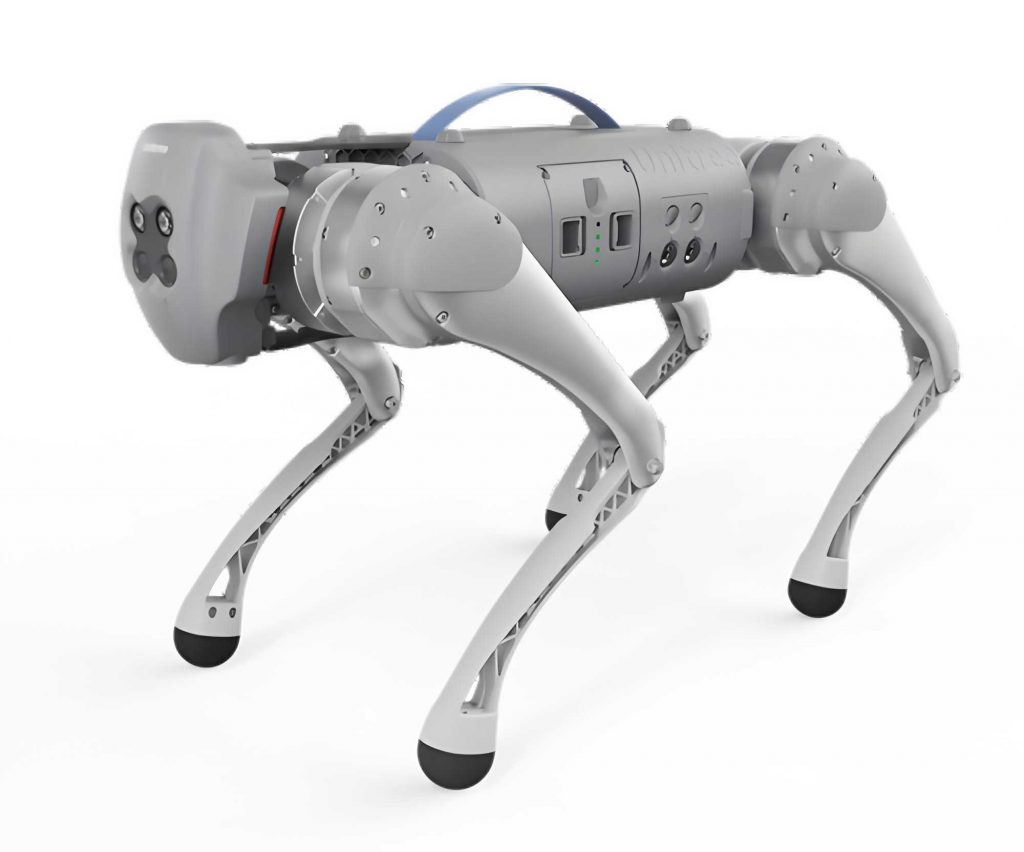
The design of the modern robot dog is a testament to interdisciplinary engineering. In my work, I focus on how its architecture is meticulously crafted to meet the demands of complex environments like railway corridors. The robot dog’s mechanical structure is centered around a quadrupedal drive system, with legs connected via multiple high-degree-of-freedom joints to enable precise and dynamic movement. This allows the robot dog to maintain stability whether traversing obstacles, climbing slopes, or walking on uneven terrain. Many advanced robot dog models I’ve studied also feature expandable robotic arms for executing delicate manipulation tasks during inspections.
The sensory system acts as the perceptual core of the robot dog. It typically integrates LiDAR, cameras, inertial measurement units (IMU), and various other sensor modules. LiDAR and IMU work in concert to detect terrain and obstacles in real-time, aiding in high-precision localization and navigation. The control system, the brain of the robot dog, runs kinematics algorithms and deep learning models on embedded computing modules to perform real-time data analysis and processing. The inclusion of communication modules ensures seamless information exchange between the robot dog and backend systems or other collaborative devices, providing technical support for remote monitoring and task adjustment. The organic integration of these systems grants the robot dog exceptional flexibility and adaptability.
Technical Foundations of the Robot Dog
Structural Composition and Operational Principles
From my design perspective, the robot dog is a symphony of integrated systems. The following table summarizes the key components and their functions based on my analysis:
| System Module | Key Components | Primary Function |
|---|---|---|
| Mechanical Platform | Quadruped legs with servo motors, high-DOF joints, optional robotic arm | Provides locomotion, stability on complex terrain, and manipulation capability. |
| Sensory Suite | LiDAR, HD cameras, depth sensors, IMU, GPS module | Perceives environment (3D mapping, visual data), provides localization and state estimation. |
| Control & Computation | Embedded AI processor (GPU/TPU), motion controllers | Executes perception algorithms, path planning, gait control, and decision-making. |
| Power & Endurance | High-density battery pack, Battery Management System (BMS) | Supplies energy, manages power distribution and charging cycles. |
| Communication | 5G/Wi-Fi/ Satellite communication module | Enables real-time data transmission and remote command reception. |
The dynamics of a single leg for the robot dog can be modeled using the Lagrangian formulation. For a simplified 2D model with two joints (hip and knee), the equations of motion are derived from:
$$ L = T – V $$
where \( T \) is the kinetic energy and \( V \) is the potential energy of the leg segment. The joint torques \( \tau \) are then given by:
$$ \tau = \frac{d}{dt} \left( \frac{\partial L}{\partial \dot{q}} \right) – \frac{\partial L}{\partial q} $$
where \( q \) and \( \dot{q} \) represent the joint angles and velocities, respectively. This foundational mechanics principle is crucial for the stable gait control of the robot dog.
Machine Vision and Perception
In my implementation of perception systems, the robot dog relies on high-definition cameras and depth sensors to capture high-quality images and 3D point cloud data of the railway line from various angles. Deep learning algorithms play a pivotal role. A standard convolutional neural network (CNN) for defect classification involves forward propagation defined by layers of convolution, pooling, and activation. The convolution operation for a single layer can be expressed as:
$$ Z^{[l]} = W^{[l]} * A^{[l-1]} + b^{[l]} $$
$$ A^{[l]} = g^{[l]}(Z^{[l]}) $$
where \( * \) denotes the convolution operation, \( W^{[l]} \) and \( b^{[l]} \) are the weights and bias for layer \( l \), \( A^{[l-1]} \) is the input activation from the previous layer, and \( g^{[l]} \) is the activation function (e.g., ReLU).
For real-time anomaly detection like track cracks or missing bolts, the model is trained to minimize a loss function such as categorical cross-entropy:
$$ J(\theta) = -\frac{1}{m} \sum_{i=1}^{m} \sum_{c=1}^{C} y_{c}^{(i)} \log(\hat{y}_{c}^{(i)}) $$
where \( m \) is the number of training samples, \( C \) is the number of classes (e.g., normal, crack, bolt loose), \( y^{(i)} \) is the one-hot encoded true label, and \( \hat{y}^{(i)} \) is the predicted probability distribution. To enhance reliability in challenging conditions like varying illumination, I employ image enhancement techniques such as histogram equalization, which transforms pixel intensity values. The transformation for a grayscale image is given by:
$$ s_k = T(r_k) = \sum_{j=0}^{k} \frac{n_j}{n} $$
where \( r_k \) is the original intensity level, \( s_k \) is the enhanced level, \( n_j \) is the number of pixels with intensity \( r_j \), and \( n \) is the total number of pixels. Multi-modal fusion of camera images and LiDAR point clouds further refines the perception capability of the robot dog.
Path Planning and Autonomous Navigation
My approach to enabling the robot dog to navigate autonomously hinges on Simultaneous Localization and Mapping (SLAM). The core SLAM problem can be framed as estimating the robot dog’s pose \( x_{1:t} \) and the map \( m \) given a sequence of sensor observations \( z_{1:t} \) and control inputs \( u_{1:t-1} \):
$$ P(x_{1:t}, m | z_{1:t}, u_{1:t-1}) $$
Algorithms like LiDAR-based SLAM (e.g., LOAM) optimize this by minimizing the distance between current scan points and the map. For path planning, I utilize algorithms like A* search to find an optimal path from start \( s \) to goal \( g \). The cost function \( f(n) \) for a node \( n \) is:
$$ f(n) = g(n) + h(n) $$
where \( g(n) \) is the cost from the start node to \( n \), and \( h(n) \) is a heuristic estimate of the cost from \( n \) to the goal. For dynamic obstacle avoidance, this is integrated with real-time sensor updates. Furthermore, I apply deep reinforcement learning (DRL) where the robot dog, as an agent, learns a policy \( \pi_\theta(a|s) \) to maximize the expected cumulative reward \( R_t = \sum_{k=0}^{\infty} \gamma^k r_{t+k+1} \). The policy gradient update rule is:
$$ \nabla_\theta J(\theta) = \mathbb{E}_{\pi_\theta} \left[ \nabla_\theta \log \pi_\theta(a|s) Q^{\pi_\theta}(s,a) \right] $$
This allows the robot dog to adapt its path in response to unexpected obstacles like railway maintenance zones.
Application in Railway Line Inspection
System Architecture for Inspection
In my design of a comprehensive inspection system, the robot dog operates within a layered architecture. The following table outlines the data and control flow between these layers:
| Layer | Components | Function & Interaction |
|---|---|---|
| Physical Layer (Robot Dog) | Mechanical platform, sensors, actuators | Executes locomotion, collects raw sensor data (images, point clouds, IMU). |
| Edge Processing Layer | On-board AI computer | Runs real-time perception (defect detection), local path planning, and immediate obstacle avoidance. |
| Communication Layer | 5G/Wi-Fi/Satellite link | Transmits processed alerts and compressed data uplink; receives task commands and map updates downlink. |
| Cloud/Backend Layer | Central server, data analytics platform, control dashboard | Stores historical data, performs deep analysis, orchestrates multiple robot dogs, generates maintenance reports. |
The overall system ensures that the robot dog is not just an autonomous entity but a node in a larger intelligent network for railway management.
Task Planning and Multi-Robot Scheduling
When deploying multiple robot dogs for large-scale inspection, efficient task planning is paramount. I model the railway line as a graph \( G = (V, E) \), where vertices \( V \) represent inspection points or segments, and edges \( E \) represent track sections with associated traversal cost \( c(e) \). The problem of assigning \( K \) robot dogs to cover all vertices can be formulated as a variant of the Vehicle Routing Problem (VRP). The objective is to minimize the maximum tour cost (makespan) or total distance:
$$ \text{Minimize } \max_{k \in \{1,\ldots,K\}} \sum_{e \in \text{Tour}_k} c(e) $$
subject to constraints that each inspection segment is visited at least once. For dynamic rescheduling due to an obstacle, a re-planning algorithm quickly solves a modified version of this problem. The coordination between robot dogs to avoid conflict is managed by the backend, which assigns spatial-temporal corridors using constraints like:
$$ |t_i – t_j| > \Delta \quad \text{or} \quad \text{dist}(p_i, p_j) > D \quad \text{for robots } i \neq j \text{ in proximity} $$
where \( t \) is time and \( p \) is position.
Fault Detection and Identification Pipeline
The core of the robot dog’s inspection value lies in its automated fault detection. I have developed a pipeline where sensor data is processed through specialized algorithms. For track crack detection, the CNN model outputs a probability map. A post-processing step applies thresholding and connected-component analysis to identify crack regions. The severity \( S \) of a detected crack can be quantified by features like length \( L \) and average width \( W \):
$$ S = \alpha L + \beta W $$
where \( \alpha \) and \( \beta \) are weighting coefficients determined from engineering standards.
For bolt loosening detection, a template matching score based on normalized cross-correlation (NCC) is used alongside geometric analysis. The NCC between a template image \( T \) and a search region \( I \) at position \( (u,v) \) is:
$$ R(u,v) = \frac{\sum_{x,y} [T(x,y) – \bar{T}] [I(x+u, y+v) – \bar{I}_{u,v}]}{\sqrt{\sum_{x,y}[T(x,y) – \bar{T}]^2 \sum_{x,y}[I(x+u, y+v) – \bar{I}_{u,v}]^2}} $$
A significant drop in \( R \) indicates potential loosening. The following table summarizes key fault types and the primary algorithmic approach used by the robot dog:
| Fault Type | Primary Sensor | Core Algorithm/Metric |
|---|---|---|
| Track Crack | HD Camera | Deep CNN (Segmentation), Crack Severity Index \( S \). |
| Bolt Loosening/Missing | HD Camera, Depth Sensor | Template Matching (NCC score \( R \)), Geometric Analysis. |
| Obstacle Intrusion | LiDAR, Camera | 3D Point Cloud Clustering, Bounding Box Detection. |
| Track Settlement/Geometry | LiDAR, IMU, Profilometer | Height difference calculation: \( \Delta h = h_{\text{measured}} – h_{\text{baseline}} \). |
Data Acquisition, Transmission, and Processing
The data workflow for the robot dog is designed for efficiency and reliability. Let \( D_{\text{raw}} \) represent the raw multi-sensor data acquired per time step. This includes image frames \( I_t \), LiDAR point cloud \( P_t \), and IMU data \( (\mathbf{a}_t, \boldsymbol{\omega}_t) \). On the robot dog, edge processing compresses this data. For images, a compression ratio \( \rho \) is applied, reducing size to \( \rho \cdot \text{size}(I_t) \). The transmission process over a channel with bandwidth \( B \) and latency \( L \) must ensure critical alerts are prioritized. The end-to-end delay \( T_{\text{total}} \) for an alert from detection to backend receipt is:
$$ T_{\text{total}} = T_{\text{proc}} + T_{\text{queue}} + \frac{S_{\text{packet}}}{B} + L $$
where \( T_{\text{proc}} \) is on-board processing time and \( S_{\text{packet}} \) is the packet size. My system design aims to minimize \( T_{\text{total}} \) for fault alerts to enable swift response.
Key Technical Research Challenges and Solutions
Navigation and Localization in Complex Environments
One of the most significant challenges I address is ensuring the robot dog’s precise navigation along railway tracks, which often feature gravel, steep embankments, and dynamic obstacles like maintenance vehicles. My solution employs a tightly coupled sensor fusion approach. The state estimation problem is solved using an Extended Kalman Filter (EKF) that fuses LiDAR SLAM, visual odometry, and IMU data. The state vector \( \mathbf{x}_k \) at time \( k \) includes position, orientation, and velocity:
$$ \mathbf{x}_k = [\mathbf{p}_k^T, \mathbf{q}_k^T, \mathbf{v}_k^T]^T $$
The prediction step uses IMU measurements \( \mathbf{u}_k \) (acceleration and angular rate):
$$ \hat{\mathbf{x}}_{k|k-1} = f(\hat{\mathbf{x}}_{k-1|k-1}, \mathbf{u}_k) $$
$$ \mathbf{P}_{k|k-1} = \mathbf{F}_k \mathbf{P}_{k-1|k-1} \mathbf{F}_k^T + \mathbf{Q}_k $$
where \( f \) is the nonlinear motion model, \( \mathbf{F}_k \) is its Jacobian, \( \mathbf{P} \) is the error covariance, and \( \mathbf{Q}_k \) is the process noise covariance. The update step incorporates LiDAR and visual measurements \( \mathbf{z}_k \):
$$ \mathbf{K}_k = \mathbf{P}_{k|k-1} \mathbf{H}_k^T (\mathbf{H}_k \mathbf{P}_{k|k-1} \mathbf{H}_k^T + \mathbf{R}_k)^{-1} $$
$$ \hat{\mathbf{x}}_{k|k} = \hat{\mathbf{x}}_{k|k-1} + \mathbf{K}_k (\mathbf{z}_k – h(\hat{\mathbf{x}}_{k|k-1})) $$
$$ \mathbf{P}_{k|k} = (\mathbf{I} – \mathbf{K}_k \mathbf{H}_k) \mathbf{P}_{k|k-1} $$
Here, \( h \) is the measurement model, \( \mathbf{H}_k \) is its Jacobian, and \( \mathbf{R}_k \) is the measurement noise covariance. This fusion provides the robustness needed for the robot dog to operate reliably in complex railway environments.
Intelligent Algorithm for Line Defect Recognition
My research into defect recognition focuses on improving accuracy and reducing false positives. Beyond standard CNNs, I employ architectures like U-Net for pixel-wise crack segmentation. The loss function for such a network often combines Dice loss and cross-entropy:
$$ \mathcal{L} = \lambda \mathcal{L}_{\text{Dice}} + (1-\lambda) \mathcal{L}_{\text{CE}} $$
where the Dice coefficient for two sets (prediction \( P \) and ground truth \( G \)) is:
$$ \text{Dice}(P, G) = \frac{2|P \cap G|}{|P| + |G|} $$
and \( \mathcal{L}_{\text{Dice}} = 1 – \text{Dice}(P,G) \). For multi-modal fusion (image + point cloud), I design a network that extracts features from both modalities and fuses them at a mid-level. The fused feature \( \mathbf{F}_{\text{fused}} \) can be a simple concatenation or an attention-weighted sum:
$$ \mathbf{F}_{\text{fused}} = \mathbf{W}_I \mathbf{F}_{\text{img}} \oplus \mathbf{W}_P \mathbf{F}_{\text{point}} $$
where \( \mathbf{W} \) are learnable weights and \( \oplus \) denotes fusion operation. This significantly boosts the robot dog’s ability to identify defects under diverse conditions.
Energy Consumption Optimization and Endurance Management
Ensuring the robot dog can complete long inspection routes is a critical practical concern. My energy optimization strategy operates at multiple levels. The total energy consumed \( E_{\text{total}} \) during a mission is the sum of propulsion energy \( E_{\text{prop}} \), computation energy \( E_{\text{comp}} \), and sensory system energy \( E_{\text{sens}} \):
$$ E_{\text{total}} = E_{\text{prop}} + E_{\text{comp}} + E_{\text{sens}} $$
Propulsion energy is highly dependent on gait and terrain. I model the cost of transport (COT) as a key metric:
$$ \text{COT} = \frac{E_{\text{prop}}}{m g d} $$
where \( m \) is the robot dog’s mass, \( g \) is gravity, and \( d \) is distance traveled. The path planning algorithm incorporates an energy-aware cost function \( c_{\text{energy}}(e) \) for each edge \( e \) in the graph, which estimates the COT for that terrain type. The optimization problem becomes:
$$ \text{Minimize } \sum_{e \in \text{path}} c_{\text{energy}}(e) $$
subject to completing all inspection points. Furthermore, the gait control parameters (stride frequency, leg stiffness) are adapted using a policy learned via reinforcement learning to minimize instantaneous power draw \( P(t) = \tau(t)^T \dot{q}(t) \). The Battery Management System (BMS) employs state-of-charge (SOC) estimation using a Kalman filter on cell voltage and current, enabling intelligent scheduling of return-to-charge missions when SOC falls below a threshold \( \theta \).
Conclusion and Future Perspectives
In my view, the integration of the robot dog into railway line inspection represents a paradigm shift towards intelligent infrastructure management. The robot dog, with its embodied AI, is more than just a mobile sensor platform; it is an active agent capable of perception, analysis, and adaptation in harsh and dynamic environments. Through the synergistic operation of perception, decision-making, execution, and feedback, the robot dog provides comprehensive technical support for railway inspection. This not only addresses the limitations of traditional methods but also propels the industry toward greater efficiency and intelligence. Looking ahead, I am convinced that continued advancements in AI and robotics will further elevate the capabilities of the robot dog. We will see more sophisticated sensor suites, more efficient and robust algorithms for navigation and defect recognition, and innovative energy solutions like wireless charging or solar supplementation. The potential for swarm intelligence, where fleets of robot dogs collaborate seamlessly, promises unprecedented coverage and redundancy. My ongoing research is dedicated to overcoming current limitations and unlocking the full potential of the robot dog as an indispensable guardian of railway safety and reliability. The journey of the robot dog in transforming railway inspection has just begun, and its future trajectory is bound to be marked by continuous innovation and deeper integration into the smart transportation ecosystem.