
In modern industrial environments, such as cable tunnels, emergency inspections often involve significant uncertainties and safety risks, including potential collapses, falling objects, or toxic gas leaks. Traditional manual巡检 methods expose personnel to these hazards, prompting the need for automated solutions. I have designed an intelligent inspection system centered around a quadruped robot dog, which leverages advanced robotics, adaptive control, and deep learning to perform high-precision, high-quality巡检 tasks in complex settings. This system replaces human workers in dangerous scenarios, enhancing safety and efficiency. The core innovation lies in integrating a versatile robot dog with remote control, perception modules, and a cloud-based management platform, enabling real-time data transmission,精准 control, and autonomous operation. Throughout this article, I will detail the architecture, software components, platform features, and practical deployment of this system, emphasizing the pivotal role of the robot dog in revolutionizing应急巡检.
The intelligent inspection system I developed comprises four main parts: the robot dog巡检 subsystem, the inspection system server端, a handheld remote control terminal, and a rapidly deployable 5.8Gbps high-power wireless bridge communication network. Each component synergistically ensures stable operation and effective task execution. The robot dog巡检 subsystem acts as the frontline, executing commands and collecting data. It consists of the quadruped robot dog itself, a remote control system, and an image acquisition system. The remote control system incorporates various sensors like wireless gateways and inertial measurement units (IMUs) to achieve low-latency video feedback and precise remote manipulation. The image acquisition system, equipped with a high-definition deep-learning camera with a pan-tilt unit and microphones, enables visual and auditory巡检 tasks. The inspection system server端 serves as the management platform, providing data, computing power, and service support for the entire system. The handheld remote control terminal allows operators to control the robot dog’s movements, avoid obstacles, display real-time trajectories, and record equipment locations. The wireless communication network establishes a dedicated channel for transmitting audio, video, and sensor data between the front-end and back-end, ensuring quality, speed, and real-time performance. To summarize the architecture, I present the following table:
| Component | Key Elements | Primary Function |
|---|---|---|
| Robot Dog巡检 Subsystem | Quadruped robot dog, remote control system (wireless gateway, IMU), image acquisition system (HD camera, microphone) | Execute巡检 commands, collect video, audio, and sensor data |
| Inspection System Server端 | Cloud-based platform with deep learning algorithms | Manage data, provide compute resources, and offer services for system stability |
| Handheld Remote Control Terminal | Control interface with display and input devices | Remotely operate the robot dog, monitor trajectories, and log information |
| Wireless Communication Network | 5.8Gbps high-power wireless bridges | Enable low-latency, reliable data transmission between all components |
The quadruped robot dog is the heart of this system, chosen for its strong environmental adaptability and运动 flexibility, derived from bionics and mechanical engineering. To empower the robot dog for autonomous巡检, I developed specialized software modules including mapping, navigation, and AI model recognition. These modules enable the robot dog to perceive its surroundings, plan paths, and identify巡检 targets intelligently.
The mapping module utilizes Simultaneous Localization and Mapping (SLAM) technology to construct accurate environmental maps and provide real-time localization for the robot dog. In long cable tunnels, precise navigation is crucial; thus, I equipped the robot dog with a SLAM-assisted navigation system that uses deep-learning cameras and IMUs. This system comprises four key submodules: front-end scan matching, loop closure detection, back-end optimization, and point cloud map building. The front-end scan matching estimates the robot dog’s pose by correlating sequential sensor data. For instance, the state estimation can be modeled as:
$$ \mathbf{x}_t = f(\mathbf{x}_{t-1}, \mathbf{u}_t) + \mathbf{w}_t $$
where $\mathbf{x}_t$ represents the state vector (e.g., position and orientation) of the robot dog at time $t$, $\mathbf{u}_t$ is the control input, and $\mathbf{w}_t$ denotes process noise. The function $f$ encapsulates the motion model. Loop closure detection identifies revisited locations to correct accumulated errors, enhancing map consistency. Back-end optimization integrates constraints from all frames to globally refine poses, often formulated as a nonlinear least-squares problem:
$$ \min_{\mathbf{X}} \sum_{i,j} \rho \left( \| \mathbf{z}_{ij} – h(\mathbf{x}_i, \mathbf{x}_j) \|^2_{\Sigma_{ij}} \right) $$
Here, $\mathbf{X}$ is the set of all states, $\mathbf{z}_{ij}$ is the measurement between states $\mathbf{x}_i$ and $\mathbf{x}_j$, $h$ is the observation model, $\Sigma_{ij}$ is the covariance matrix, and $\rho$ is a robust cost function. Finally, the map building module processes point clouds to generate occupancy grid maps for navigation and path planning. The capabilities of these submodules are summarized below:
| SLAM Submodule | Function | Key Technologies |
|---|---|---|
| Front-End Scan Matching | Estimate short-term robot dog poses and local maps | IMU integration, visual odometry, LiDAR scan matching |
| Loop Closure Detection | Recognize historical scenes to correct errors | Place recognition algorithms, feature matching |
| Back-End Optimization | Globally optimize poses and reduce drift | Graph-based optimization, bundle adjustment |
| Map Building | Construct and maintain global maps for navigation | Point cloud processing, occupancy grid mapping |
The navigation module enables the robot dog to autonomously move between target points by planning paths. It encompasses localization and path planning, with the latter divided into global and local planning. Global path planning operates on the environmental map, generating an optimal route from the robot dog’s current position to a goal. Algorithms like A* are employed, where the cost function is:
$$ f(n) = g(n) + h(n) $$
with $g(n)$ being the cost from the start node to node $n$, and $h(n)$ a heuristic estimate from $n$ to the goal. Local path planning handles dynamic obstacles during traversal, computing real-time velocities and angles to avoid collisions while adhering to the global plan. Techniques such as Dynamic Window Approach (DWA) optimize trajectories by evaluating feasible velocity pairs $(v, \omega)$ within kinematic constraints:
$$ \max_{v, \omega} \left( \alpha \cdot \text{heading}(v,\omega) + \beta \cdot \text{dist}(v,\omega) + \gamma \cdot \text{velocity}(v,\omega) \right) $$
where $\text{heading}$ rewards alignment with the goal, $\text{dist}$ penalizes proximity to obstacles, and $\text{velocity}$ encourages speed, with $\alpha, \beta, \gamma$ as weights. This ensures the robot dog smoothly navigates complex terrains.
The AI model recognition software equips the robot dog to perform巡检 tasks traditionally done by humans, such as measuring parameters, identifying sounds, and reading gauges. By integrating microphones, HD cameras, and infrared cameras, I built a deep-learning-based perception system. Key algorithms include YOLO for object detection and DeepLabV3 for image segmentation. For example, the YOLO model divides images into a grid and predicts bounding boxes and class probabilities. The loss function combines localization, confidence, and classification errors:
$$ \mathcal{L} = \lambda_{\text{coord}} \sum_{i=0}^{S^2} \sum_{j=0}^{B} \mathbb{1}_{ij}^{\text{obj}} \left[ (x_i – \hat{x}_i)^2 + (y_i – \hat{y}_i)^2 + (w_i – \hat{w}_i)^2 + (h_i – \hat{h}_i)^2 \right] + \sum_{i=0}^{S^2} \sum_{j=0}^{B} \mathbb{1}_{ij}^{\text{obj}} \left( C_i – \hat{C}_i \right)^2 + \lambda_{\text{noobj}} \sum_{i=0}^{S^2} \sum_{j=0}^{B} \mathbb{1}_{ij}^{\text{noobj}} \left( C_i – \hat{C}_i \right)^2 + \sum_{i=0}^{S^2} \mathbb{1}_{i}^{\text{obj}} \sum_{c \in \text{classes}} \left( p_i(c) – \hat{p}_i(c) \right)^2 $$
Here, $S^2$ is the grid size, $B$ is the number of bounding boxes per cell, $\mathbb{1}_{ij}^{\text{obj}}$ indicates if the $j$th box in cell $i$ is responsible for an object, $(x, y, w, h)$ are box coordinates, $C$ is confidence, $p(c)$ is class probability, and $\lambda$ terms are weighting factors. This enables the robot dog to detect烟火, leaks, and gauges accurately. The table below outlines common巡检 tasks and corresponding AI models:
| 巡检 Task | Sensor Used | AI Model/Algorithm | Output |
|---|---|---|---|
| Fire/Smoke Detection | HD camera, infrared camera | YOLO-based object detection | Bounding boxes with confidence scores |
| Gas Leak Identification | HD camera, acoustic sensors | DeepLabV3 for segmentation, sound analysis | Segmented leak areas, audio anomalies |
| Gauge/Meter Reading | HD camera | Combined YOLO and OCR (Optical Character Recognition) | Numerical readings from dials or displays |
| Equipment Sound Analysis | Microphone | Deep learning audio classifiers (e.g., CNNs on spectrograms) | Abnormal sound detection and classification |
The intelligent inspection system management platform is a web-based interface that provides operators with information display, command issuance, data retrieval, and remote monitoring. I designed it with four core modules: real-time monitoring, task management,巡检 results, and system settings. Each module enhances the usability and effectiveness of the robot dog巡检 system.
Real-time monitoring includes two subfunctions: intelligent巡检 and remote control. During巡检 tasks, the platform displays live feeds from the robot dog’s cameras (HD, infrared) and overlays the robot dog’s position on a map, alongside device detection alerts and巡检 data. Operators can control the robot dog and camera gimbal via this interface. Task management allows administrators to create and modify巡检 plans. By selecting points from a predefined library, they set巡检 frequency, timing, and content, then track completion status (e.g., finished vs. pending tasks).巡检 results module processes data collected by the robot dog, applying comparison techniques to analyze operational conditions. It generates alerts for anomalies, stores historical data for AI-powered diagnostics, and enables打印 of structured巡检 reports. System settings handle user accounts, permissions, robot dog calibration (e.g., gimbal alignment), battery thresholds for auto-return,巡检 point library maintenance, and alert configuration (thresholds, notification methods). The functionalities are encapsulated in the following table:
| Platform Module | Subfunctions | Key Features |
|---|---|---|
| Real-Time Monitoring | Intelligent巡检 display, remote control of robot dog and gimbal | Live video feeds, map localization, alert display, real-time control |
| Task Management | 巡检 plan creation, modification, and tracking | Point library integration, schedule setting, progress monitoring |
| 巡检 Results | Data analysis, alerting, historical query, report generation | Automated anomaly detection, AI diagnostics, report templates |
| System Settings | User management, robot dog configuration, point library, alert setup | Role-based access, calibration tools, threshold adjustment |
For field deployment and application, I tested the system in a cable tunnel环境 characterized by narrow passages, pillar obstacles, and sloped floors. The process involved several steps. First, I demarcated the area for environmental mapping and used the robot dog’s SLAM system to construct a high-precision map. This map facilitated navigation and定位 testing, ensuring the robot dog could reliably reach designated target points. The robot dog’s agility allowed it to traverse challenging terrains, as illustrated in deployment scenarios. Second, I established inspection stations near equipment, ensuring optimal angles for data capture and defining specific巡检 tasks (e.g., temperature measurement, leak detection) to avoid omissions. Third, I designed巡检 plans covering routine and special inspections, equipping the robot dog with appropriate sensors and scheduling daily or periodic巡检. Fourth, upon task assignment, the robot dog executed巡检 autonomously, performing identifications like thermal imaging and leak detection. Data transmitted via the 5G communication network to the management platform allowed real-time viewing. The platform’s automated analysis flagged anomalies, triggering alerts (e.g., audio warnings, pop-ups) for operator intervention.
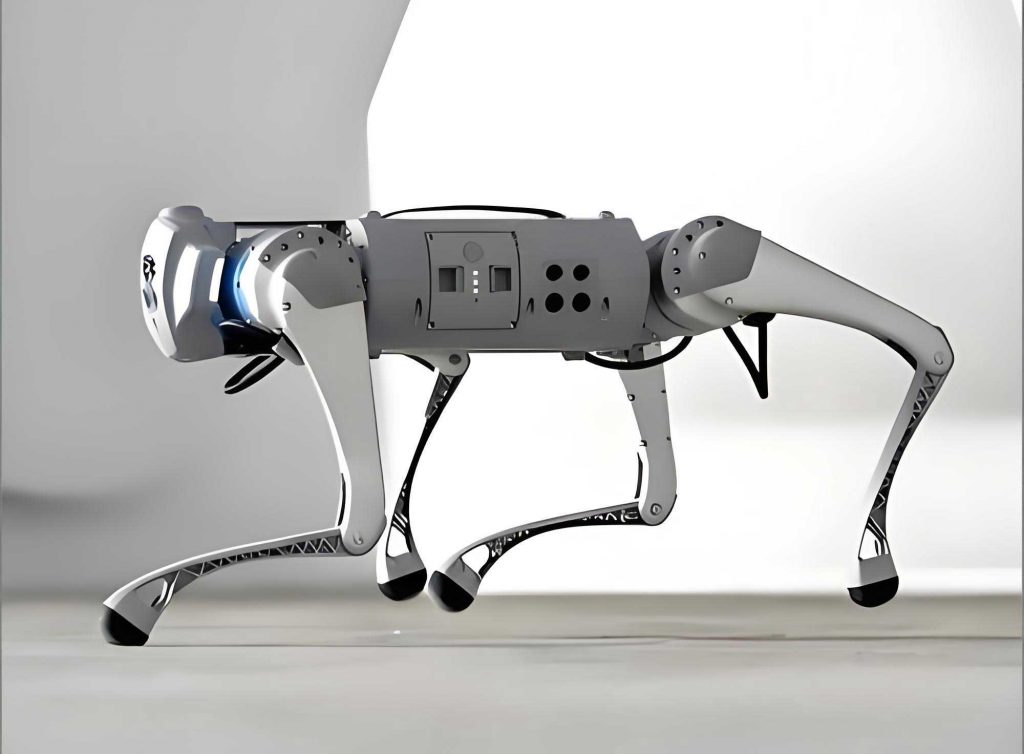
The deployment demonstrated the robot dog’s capability to adapt to complex environments, with the SLAM system providing accurate localization and the AI models enabling reliable detection. For instance, in a tunnel section with multiple pillars, the robot dog successfully navigated using local path planning, while its infrared camera identified overheating components on equipment. The integration of deep learning algorithms reduced false positives in smoke detection, enhancing巡检 accuracy. This practical application underscores the system’s value in mitigating safety risks and improving operational efficiency.
In conclusion, the intelligent inspection system based on a quadruped robot dog addresses the challenges of high-risk, uncertain应急巡检 in complex environments like cable tunnels. By leveraging the robot dog’s environmental adaptability, coupled with SLAM-based navigation, advanced path planning, and deep learning perception, the system achieves high-precision, automated巡检. It eliminates human exposure to hazards, increases巡检 frequency and consistency, and provides actionable insights through a comprehensive management platform. Future work could explore multi-robot dog coordination for larger areas, enhanced AI models for更复杂 anomaly detection, and integration with IoT sensors for broader environmental monitoring. The robot dog, as a versatile mobile platform, continues to evolve, promising even greater contributions to industrial safety and automation.