
The field of mobile robotics is broadly divided into wheeled (including tracked) systems and biomimetic robots. Among biomimetic forms, legged locomotion, inspired by animals like horses, cows, and dogs, has always captivated researchers due to its superior ability to traverse unstructured, rough terrain where wheeled vehicles fail. Legged movement requires only discrete ground contact points, allowing it to step over obstacles and move omnidirectionally with minimal ground damage, offering unique advantages. Since the pioneering work on quadrupedal walking machines in the 1980s, the development of multi-legged robots has been a significant focus. Today, advanced quadruped robots can walk on uneven ground, climb slopes, and step over obstacles. However, despite progress, fundamental theoretical challenges remain. As noted by some roboticists, the theoretical underpinnings of walking robots often lag behind technological demonstrations. In my work, I address several practical issues prevalent in common quadruped robot designs, such as structural complexity, poor rigidity, and control difficulty, by proposing a novel walking mechanism. My core innovation is the application of a single-degree-of-freedom (DOF) planar six-bar linkage as the primary walking mechanism for a robot dog. This approach aims to create a more compact, rigid, and easily controllable platform.
Common walking mechanisms for legged robots present several trade-offs. The most frequent design is the open-chain serial linkage, resembling a mammalian leg with rotary joints at the hip, knee, and ankle. While offering a large workspace and flexible trajectory planning, this architecture requires multiple actuators (motors) per leg, leading to complex control, accumulated positional errors at the foot-end, and inherently lower rigidity due to its serial structure. Alternatively, closed-loop four-bar linkages offer excellent rigidity and require only one actuator. However, they possess inherent dead-center positions which can cause locking and have a fixed, non-adjustable output trajectory, severely limiting adaptability. Five-bar linkages, with two DOFs, provide tunable flexibility but necessitate two precisely coordinated actuators per leg, doubling the control complexity and power requirements for a quadruped. My analysis led me to explore a middle ground: a planar six-bar linkage with one DOF. This configuration combines the rigidity of closed-chain mechanisms with the kinematic benefits of more complex linkages, while requiring only one actuator per leg. It eliminates dead points, reduces cumulative error, and through careful dimensional synthesis, can produce a foot-end trajectory well-suited for walking.
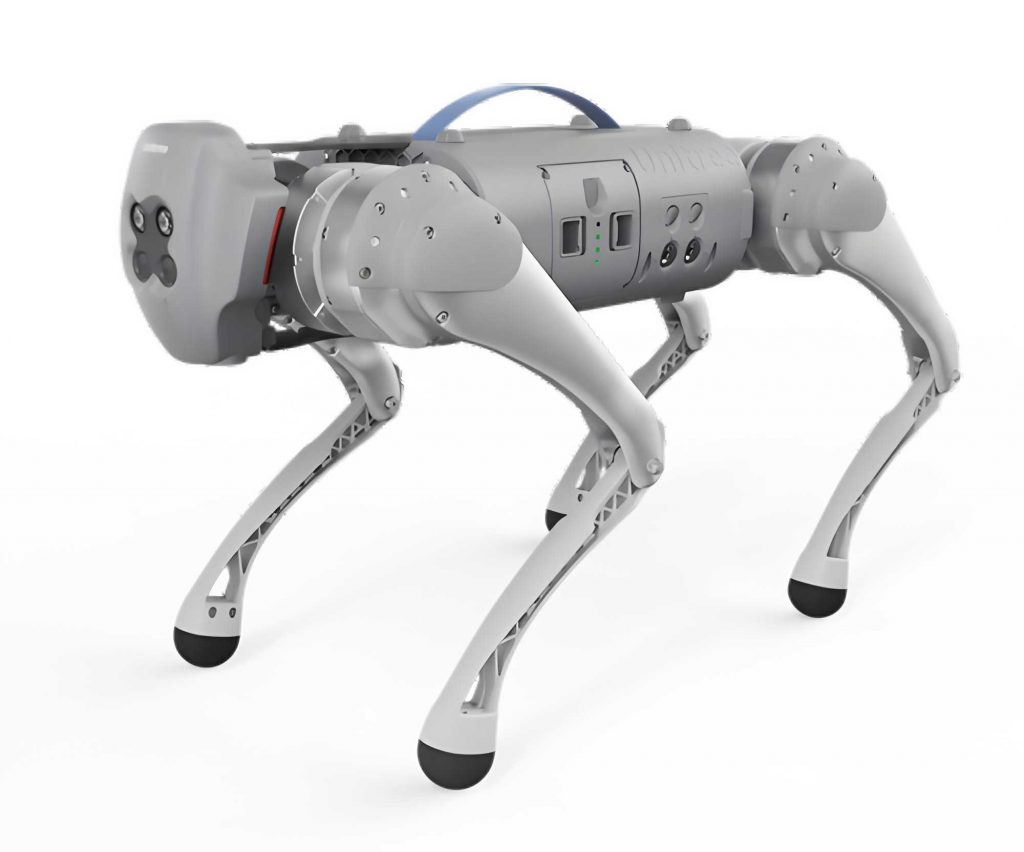
The biological inspiration for any robot dog starts with canine anatomy. A dog’s leg is a complex structure with multiple bones and joints allowing for flexion/extension, abduction/adduction, and rotation. Precisely replicating this with 3-5 DOFs per leg would require an impractical number of actuators (up to 20 for a quadruped) and immensely complex control. Therefore, a functional simplification is essential. I focused on replicating the core walking function during steady-state, periodic motion. The key requirement is a foot-end path that lifts the leg off the ground, moves it forward, lowers it, and then pulls the body forward during the support phase—approximating an elliptical path. The single-DOF six-bar linkage is capable of generating such a trajectory. For static stability during slow walking, a quadruped must maintain at least three feet on the ground, forming a stable triangular support polygon. The four-leg configuration is optimal for this static walking gait. Therefore, my robot dog utilizes four identical, independently actuated six-bar linkage assemblies.
| Mechanism Type | Degrees of Freedom (per leg) | Actuators Required (per leg) | Rigidity | Key Advantages | Key Disadvantages |
|---|---|---|---|---|---|
| Open-Chain Serial | 3 (or more) | 3 (or more) | Low | Large workspace, flexible trajectory | Complex control, error accumulation, low rigidity |
| Four-Bar Linkage | 1 | 1 | High | Simple, robust, high rigidity | Fixed trajectory, dead-center positions |
| Five-Bar Linkage | 2 | 2 | Medium-High | Tunable trajectory, good rigidity | Complex coordinated control required |
| Six-Bar Linkage (Proposed) | 1 | 1 | High | High rigidity, adjustable trajectory via design, no dead points, simple control | More complex dimensional synthesis |
The kinematic design of the six-bar linkage is central to my robot dog. The chosen mechanism has five moving links and seven revolute joints (lower pairs). Its mobility (DOF) is calculated using Gruebler’s equation for planar mechanisms:
$$ F = 3n – (2p_l + p_h) $$
where \( n = 5 \) (number of moving links), \( p_l = 7 \) (number of lower pairs), and \( p_h = 0 \) (number of higher pairs). Thus,
$$ F = 3 \times 5 – (2 \times 7 + 0) = 15 – 14 = 1 $$
This confirms a single input (the crank rotation) determines the motion of the entire leg mechanism. The specific linkage topology was selected to separate the leg into upper and lower segments, facilitating a more biological profile. The dimensional synthesis was performed iteratively using dynamic simulation software (ADAMS). The goal was to optimize link lengths to produce a foot-end (point F) trajectory that effectively clears the ground and provides adequate stride length. The final link dimensions are summarized below.
| Link / Parameter | Symbol | Length / Value (mm) | Description |
|---|---|---|---|
| Fixed Frame | O1O2 | 200 | Distance between fixed pivots |
| Crank | O2A | 40 | Input link, connected to motor |
| Upper Triangle Link 1 | AB | 128 | Part of the first ternary link |
| Upper Triangle Link 2 | AC | 128 | Part of the first ternary link |
| Upper Triangle Angle | ∠ABC | 37° | Internal angle of the first ternary link |
| Rocker 1 | O1B | 120 | First rocker link |
| Rocker 2 | O1D | 120 | Second rocker link (parallelogram configuration) |
| Coupler Link 1 | BC | 400 | Primary coupler link |
| Coupler Link 2 | DE | 400 | Parallel coupler link (forms parallelogram BCDE) |
| Connecting Rod 1 | CE | 110 | Connects the two parallelogram sides |
| Connecting Rod 2 | BD | 110 | Connects the two parallelogram sides |
| Lower Leg Link | EF | 450 | Extends to the foot point F |
| Foot Link | CF | 450 | Completes the lower leg triangle |
The foot-end trajectory, \( \vec{r}_F(\theta) \), where \( \theta \) is the crank angle, was the critical output. The synthesis aimed for a path with a pronounced swing phase (non-contact) and a support phase (contact) that moves slightly backward relative to the body, propelling the robot dog forward. The trajectory can be approximated by parametric equations derived from the loop-closure equations of the linkage. For the closed-loop O1-B-C-F-E-D-O1, we can write vector equations:
$$ \vec{r}_{O1B} + \vec{r}_{BC} + \vec{r}_{CF} = \vec{r}_{O1D} + \vec{r}_{DE} + \vec{r}_{EF} $$
Solving these equations iteratively for all links given the input crank motion \( \vec{r}_{O2A}(\theta) \) yields the precise path of point F. The successful output is an elongated, roughly elliptical curve that meets the walking requirements.
Beyond the legs, the complete robot dog design includes a head and tail to enhance biomimetic expression. Both are simple open-chain mechanisms. The head is attached via a rotary joint at the neck, allowing for panning (side-to-side) motion. An additional joint can be added for pitch (up-and-down) motion. The tail is composed of two links connected in series by rotary joints to the rear of the torso, enabling a wagging motion. These sub-systems require minimal additional actuators and are controlled independently from the walking gait. The main body, or torso, serves as the central chassis and the fixed frame (O1O2 links) for all four leg mechanisms. It houses the actuators and provides the necessary structural integrity. The foot pads are designed with a concave-convex surface pattern to increase the coefficient of friction with the ground, preventing slip during the support phase. The contact force \( F_{friction} \) must satisfy \( F_{friction} \geq \mu_s N \), where \( \mu_s \) is the static friction coefficient enhanced by the tread pattern, and \( N \) is the normal force from the ground reaction.
The gait planning and motion control are implemented through dynamic simulation. A steady, statically stable walking gait was chosen. The sequence for a walking cycle (gait) is as follows: 1) Lift Right Front leg and swing forward; 2) Plant Right Front; 3) Lift Left Hind leg and swing forward; 4) Plant Left Hind; 5) Lift Left Front leg and swing forward; 6) Plant Left Front; 7) Lift Right Hind leg and swing forward; 8) Plant Right Hind. This sequence ensures a minimum of three feet are in contact with the ground at all times, keeping the projection of the center of mass within the continually changing support polygon. The coordination is achieved by phasing the crank rotations of each leg mechanism. If we define the crank rotation for leg \( i \) as \( \theta_i(t) \), the relationship between them for a tetrapodal walk is:
$$ \theta_{RF}(t) = \omega t $$
$$ \theta_{LH}(t) = \omega t + \Phi $$
$$ \theta_{LF}(t) = \omega t + 2\Phi $$
$$ \theta_{RH}(t) = \omega t + 3\Phi $$
where \( \omega \) is the angular speed of the cranks and \( \Phi \) is the phase offset, typically \( \pi/2 \) (or 90°) for this walking pattern. In simulation software like ADAMS, this is controlled using step functions (e.g., STEP(time, t_start, 0, t_end, 2π)) for each joint motion, carefully timing the start and duration of each leg’s step cycle.
The entire robot dog assembly was modeled in 3D CAD software (such as CATIA) and then imported into a multi-body dynamics simulator (ADAMS). The model included all parts, joints, ground contact definitions, and friction parameters. The contact between each foot and the ground was modeled using a restitution-based contact algorithm with defined stiffness and damping. The simulation parameters were iteratively adjusted to achieve stable, realistic motion. Key outputs from the simulation included the trajectories of all body parts, joint reaction forces, and foot-ground contact forces. The simulation successfully demonstrated the primary walking gait along with coordinated head and tail motions. The stability was verified by monitoring the vertical projection of the system’s center of mass relative to the convex hull of the ground contact points. The robot dog maintained balance throughout the simulated walk cycle. The use of a single actuator per leg significantly simplified the control input scheme, requiring only the synchronization of four rotary motors.
In conclusion, my design and analysis present a functional and simplified approach to a quadrupedal robot dog. The core contribution is the application of a single-DOF planar six-bar linkage as the walking mechanism. This design offers distinct advantages over common alternatives: it achieves high structural rigidity due to its closed-loop and triangular link architecture; it reduces the number of required actuators to one per leg, simplifying the control system and reducing weight and cost; and it minimizes the kinematic error accumulation associated with long serial chains. While the foot trajectory is fixed once the links are manufactured, it can be optimized during the design phase for a specific walking pattern. The successful simulation validates the kinematic design and gait planning. This mechanism provides a robust and controllable foundation for a basic robot dog platform. Future work could explore the integration of compliant elements into the linkages for dynamic walking, the use of variable-length links for adaptive trajectories, or the implementation of sensors and feedback control for terrain adaptation. Nonetheless, this single-DOF six-bar linkage serves as an excellent and instructive design solution for compact, rigid, and easily controllable quadrupedal robots.