
The evolution of robotics, while significant, has often been constrained by complex and unintuitive human-machine interfaces. The quest for more natural interaction has consistently pointed towards spoken language as the most efficient and fundamental channel of human communication. Enabling a machine to comprehend and act upon verbal commands represents a pivotal step towards creating robots that can seamlessly integrate into daily life and service scenarios. This article, from my research perspective, delves into the design and implementation of a comprehensive speech control system for an intelligent quadrupedal robot, commonly conceptualized as a ‘robot dog’. The core innovation lies in the integration of a large-vocabulary continuous speech recognition (LVCSR) engine with a deterministic control model based on Finite State Machine (FSM) theory, creating a robust framework for translating human intent into fluid robotic motion.
The fundamental premise is that for a service or companion ‘robot dog’ to be truly practical, it must be operable without specialized training or cumbersome remote controls. Voice offers this directness. My approach addresses this by constructing a two-tiered system: a powerful but modular speech processing front-end, and a reactive, state-based control back-end specifically tailored for the dynamic locomotion and behaviors of a quadruped.
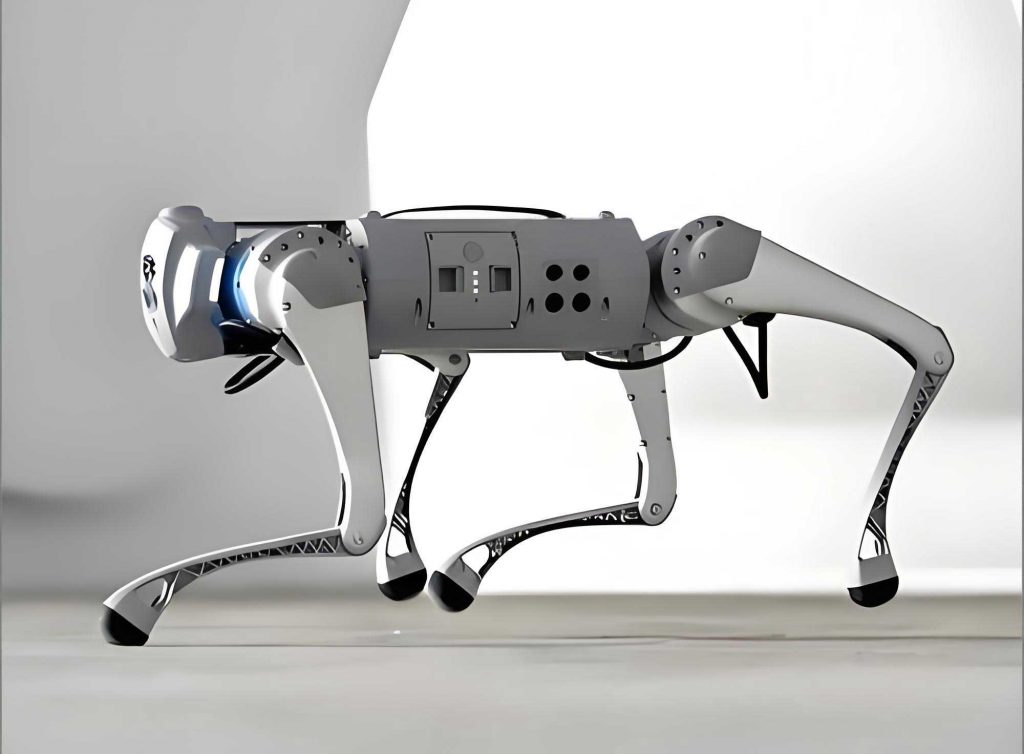
The overall system architecture is designed with modularity and computational distribution in mind. The hardware stack is logically separated into three primary layers to balance processing load and ensure real-time performance. At the top sits a dedicated speech recognition platform, responsible for the computationally intensive task of converting audio signals into textual commands. This unit communicates wirelessly via a standard TCP/IP network with the core robot controller embedded on the ‘robot dog’ body. This mid-tier controller functions as the central “brain,” hosting the decision-making agents and the FSM-based control model. Finally, it delegates low-level actuator commands via a high-speed serial bus to dedicated motor drivers which manage the precise joint angles of the robotic legs and tail. This hierarchical structure prevents any single processor from becoming a bottleneck, allowing the ‘robot dog’ to simultaneously listen, think, and act.
The software philosophy mirrors this distributed hardware, employing a multi-agent system (MAS) framework. In this paradigm, distinct software modules or “agents” are responsible for specific competencies: one for speech recognition, another for sensor fusion (e.g., infrared obstacle detection), another for high-level behavior selection, and a dedicated agent for managing the Finite State Machine. These agents operate asynchronously, communicating through a standardized message-passing protocol. This design offers tremendous flexibility; agents can be collocated on a single powerful computer or distributed across the network of embedded controllers previously described, with the communication layer abstracting the underlying physical transport. The primary flow of control in this ‘robot dog’ system initiates with the Speech Recognition Agent capturing and processing audio. The extracted command is passed to a Behavior Decision Agent, which, in the absence of a command, might maintain an autonomous idle or exploration routine. For an explicit voice command, the intent is forwarded to the Action & Control Agent. This agent consults the Finite State Machine Agent to determine the appropriate action sequence based on the current state of the ‘robot dog’. This sequence is then packaged and sent to a Command Manager Agent for execution on the physical actuators. Crucially, a Reflex Agent runs in parallel, monitoring short-range sensors. It can issue immediate obstacle-avoidance maneuvers directly to the Command Manager, ensuring the ‘robot dog’’s safety without waiting for the higher-level decision loop.
Engineering the Ears: Building a Robust Speech Recognition Subsystem
For the ‘robot dog’ to understand spoken commands, a reliable and efficient speech recognition engine is paramount. The chosen solution leverages established open-source tools: the Hidden Markov Model Toolkit (HTK) for building acoustic models, and the Julius decoder for the real-time recognition task. This combination provides a flexible and powerful LVCSR platform adaptable to a constrained command-and-control vocabulary.
The speech recognition subsystem rests on three pillars: the Acoustic Model, the Language Model, and the Decoder. The Acoustic Model is a statistical representation of the sounds that make up speech. It is built using Hidden Markov Models (HMMs), which are excellent at modeling time-series data like audio signals. Each basic sound unit (phoneme) or word in the vocabulary is represented by an HMM characterized by states, transition probabilities between states, and observation probabilities for feature vectors within each state. The training process involves using HTK to align and iteratively refine these models from a corpus of labeled speech data. Given a sequence of acoustic feature vectors $O = \\{o_1, o_2, …, o_T\\}$ extracted from the input speech, and an HMM $\\lambda$ for a word, the probability that the model generated the observation sequence is approximated. The core problem of recognition is to find the word sequence $W^*$ that maximizes the probability given the acoustic observations:
$$
W^* = \arg\max_{W} P(O | W, \\lambda_{acoustic}) \\cdot P(W)
$$
Here, $P(O | W, \\lambda_{acoustic})$ is provided by the Acoustic Model, and $P(W)$ is provided by the Language Model.
The Language Model in this context is deliberately simplified. Since the ‘robot dog’ is expected to respond to imperative commands (e.g., “walk,” “turn left,” “sit”), a full grammatical parse of natural language sentences is unnecessary. Instead, a finite-state grammar or a simple n-gram model defining the allowed sequences of command words is sufficient. This focused approach significantly reduces the search space for the decoder, improving both speed and accuracy for the target domain. For instance, the grammar may specify that a valid command is a verb optionally followed by a direction, effectively covering phrases like “walk,” “turn left,” or “stop.”
The Decoder, powered by Julius, performs the actual search. It takes the stream of incoming acoustic feature vectors and uses the Viterbi algorithm or a similar beam search technique to find the most probable path through the network defined by the combined Acoustic and Language Models. The output is the recognized string of words, from which the core action verb (the command) is trivially extracted for the control system. This entire recognition pipeline is encapsulated as a service running on the dedicated speech processor, awaiting audio input and outputting discrete command tokens to the rest of the ‘robot dog’ control system.
Architecting the Instincts: A Finite State Machine Control Model
Translating a discrete command like “walk” into the complex, coordinated motion of a twelve-degree-of-freedom ‘robot dog’ requires a sophisticated control strategy. Inspired by the ethology of real canines and the need for deterministic behavior management, a Finite State Machine (FSM) model was adopted as the core control paradigm for the ‘robot dog’.
The first step is a behavioral analysis. A real dog exhibits distinct locomotory gaits such as walk, trot (diagonal run), and gallop, along with stationary behaviors like sitting, scratching, or stretching. Mapping this to a robotic platform with three active joints per leg (hip ab/adduction, hip flexion/extension, and knee flexion/extension) requires simplification. The designed ‘robot dog’ control system categorizes its operational modes into five primary states:
| State Name | Description | Key Characteristics |
|---|---|---|
| Initial (Stand) | Power-on configuration. All joints move to a predefined “neutral” standing pose. | Zero velocity, upright posture. |
| Walk | Slow, stable locomotion. Typically uses a crawling or walking gait with static stability. | Low speed, high stability, used for precise movement and obstacle navigation. |
| Trot (Diagonal Run) | Faster, dynamic locomotion. Legs on diagonal corners move in phase, creating a bounding motion. | Higher speed, requires dynamic balance control. |
| Stationary Action | In-place behaviors without body translation. Includes sitting, stretching, head shaking, tail wagging. | Zero net displacement, focus on coordinated limb and appendage motion. |
| Stop / Terminate | System halt state. Motors may be disabled or put into a low-power torque mode. | No motion, end of control cycle. |
The FSM provides a rigorous mathematical framework to manage transitions between these states. Formally, the control model for the ‘robot dog’ is defined as a 5-tuple:
$$
M = (Q, \\Sigma, \\delta, q_0, F)
$$
Where:
- $Q = \\{q_{stand}, q_{walk}, q_{trot}, q_{stationary}, q_{stop}\\}$ is the finite set of states.
- $\\Sigma = \\{“walk”, “turn\_left”, “turn\_right”, “sit”, “stretch”, “shake”, “stop”, “stand”\\}$ is the finite input alphabet, representing the set of valid voice commands.
- $\\delta: Q \\times \\Sigma \\rightarrow Q$ is the state transition function. It defines the next state based on the current state and the input command.
- $q_0 = q_{stand} \\in Q$ is the initial state.
- $F = \\{q_{stop}\\} \\subseteq Q$ is the set of final (accepting) states.
The function $\\delta$ is designed to embody logical behavior for the ‘robot dog’. Not all commands are valid from every state. For example, the command “walk” is only valid from the $q_{stand}$ or $q_{stationary}$ states, triggering a transition to $q_{walk}$. The command “stop” is valid from any locomotion state ($q_{walk}$, $q_{trot}$) and causes a transition to $q_{stand}$. A subset of the transition rules can be summarized as follows:
$$
\\delta(q_{stand}, “walk”) = q_{walk}
$$
$$
\\delta(q_{walk}, “turn\_left”) = q_{walk} \\quad \\text{(The dog remains in walk state but executes a left turn maneuver)}
$$
$$
\\delta(q_{walk}, “stop”) = q_{stand}
$$
$$
\\delta(q_{stand}, “sit”) = q_{stationary}
$$
$$
\\delta(q_{stationary}, “stand”) = q_{stand}
$$
In practical implementation, the transition function $\\delta$ is often extended to also output an action sequence $Y$. Thus, a more complete mapping is $\\delta(q_x, \\omega) = (q_y, Y)$, where $q_x$ is the current state, $\\omega$ is the input command, $q_y$ is the next state, and $Y$ is the specific sequence of joint angle trajectories or motor commands to execute. This action sequence $Y$ is what the Command Manager Agent ultimately sends to the servo controllers. This FSM model ensures that the ‘robot dog’ behaves predictably, prevents invalid state sequences (like trying to “run” from a “sitting” position directly), and provides a clear structure for expanding the robot’s behavioral repertoire.
System Integration and Operational Workflow
The synergy between the speech recognition front-end and the FSM-based control back-end is critical for the ‘robot dog’’s fluid operation. The integrated workflow follows a sequential but efficient pipeline. Upon system start, the ‘robot dog’ initializes into the $q_{stand}$ state. The speech recognition agent on the remote processor is actively listening. When a user speaks a command, the following process unfolds:
- Audio Capture & Preprocessing: The raw audio is sampled, quantized, and preprocessed (e.g., noise reduction, endpoint detection).
- Feature Extraction: Acoustic feature vectors (like Mel-Frequency Cepstral Coefficients – MFCCs) are computed from the audio frames. For a frame at time $t$, a feature vector $o_t$ is derived.
$$
o_t = \\text{MFCC}(\\text{AudioFrame}_t)
$$ - Decoding: The sequence $O = \\{o_1, o_2, …, o_T\\}$ is fed to the Julius decoder, which uses the acoustic and language models to find the most likely word sequence $W^*$.
- Command Extraction: The textual output $W^*$ is parsed to extract the canonical command token $\\omega \\in \\Sigma$ (e.g., extracting “walk” from the recognized phrase “dog, walk forward”).
- Network Transmission: The command token $\\omega$ is packetized and sent via a wireless TCP/IP link to the main controller on the ‘robot dog’.
- State Processing: The Action & Control Agent, maintaining the current FSM state $q_{current}$, invokes the transition function: $(q_{next}, Y) = \\delta(q_{current}, \\omega)$.
- Action Execution: The action sequence $Y$, which is essentially a timed script of target angles for all 12 servos, is dispatched to the Command Manager Agent. This agent sequentially sends the low-level packets over the serial servo bus, causing the ‘robot dog’ to move smoothly into the desired action, whether it’s a step cycle for walking or a pose for sitting.
This entire cycle, from the end of spoken utterance to the initiation of physical movement, constitutes the system’s reaction time. The distributed architecture ensures that the heavy lifting of speech recognition does not stall the real-time control loop running on the ‘robot dog’’s main controller.
Experimental Validation and Performance Analysis
The efficacy of the proposed framework for the ‘robot dog’ was evaluated through rigorous testing focusing on two key metrics: the accuracy of the speech recognition subsystem and the correctness and fluidity of the resulting robotic actions. The acoustic model was trained on a purpose-recorded speech corpus with a sampling rate of 16 kHz and 16-bit quantization. The vocabulary was limited to the command set $\\Sigma$. Performance was measured using standard metrics: Word Correctness and Word Accuracy, defined as:
$$
\\text{%Correct} = \\frac{N – D – S}{N} \\times 100\\%
$$
$$
\\text{%Accuracy} = \\frac{N – D – S – I}{N} \\times 100\\%
$$
where $N$ is the total number of reference words, $H$ is the number of correctly recognized words, $S$ is the number of substitution errors, $D$ is the number of deletion errors, and $I$ is the number of insertion errors.
Initial isolated tests on the speech recognizer showed a baseline performance. However, the more relevant test is the integrated end-to-end operation. A live interaction test was conducted where multiple users issued voice commands to the ‘robot dog’ system. The following table summarizes the results from 20 command trials per user:
| User Profile | Voice Commands Tested | Correct Recognition Count | Correct Action Execution Count | Recognition Error (Wrong Command) | No Operation (Deletion/Timeout) |
|---|---|---|---|---|---|
| Male A (in training set) | “Walk”, “Stop”, “Turn Left”, “Sit”, etc. | 16 | 16 | 1 | 3 |
| Male B (not in training set) | “Walk”, “Stop”, “Turn Left”, “Sit”, etc. | 15 | 15 | 2 | 3 |
| Male C (not in training set) | “Walk”, “Stop”, “Turn Left”, “Sit”, etc. | 14 | 14 | 5 | 2 |
| Female D (not in training set) | “Walk”, “Stop”, “Turn Left”, “Sit”, etc. | 12 | 12 | 6 | 2 |
The results demonstrate several key points. First, for users whose voices were represented in the training data (Male A), the command recognition and subsequent action execution were highly reliable (~80% success rate in this trial). Second, the system generalized reasonably well to unseen male voices, maintaining a correct action rate above 70%. The performance drop for the female voice highlights a common challenge in speech recognition—acoustic model bias towards the gender and vocal characteristics present in the training data. This indicates a clear path for improvement by diversifying the training corpus. Most importantly, in all cases where the command was correctly recognized, the FSM-based control system successfully executed the corresponding action sequence without fail. The ‘robot dog’ transitions between states like standing, walking, and sitting were observed to be smooth and stable, confirming the effectiveness of the state machine in orchestrating complex low-level motor controls. The system’s latency was subjectively assessed to be within a tolerable range for interactive control, with the ‘robot dog’ beginning its movement within a second or two of the command utterance.
Conclusion and Future Trajectories
This work presents a validated and practical framework for intelligent voice control of a quadrupedal robot dog. By integrating a robust, open-source large-vocabulary speech recognition system with a logically structured Finite State Machine control model, the research demonstrates a significant step towards natural and accessible human-robot interaction for complex mobile platforms. The distributed multi-agent software architecture ensures modularity and scalability, allowing components like the speech processor or specific behavior agents to be upgraded or replaced independently. The FSM provides a verifiable and predictable core for the ‘robot dog’’s behavior, essential for safe operation in human environments.
The experimental outcomes affirm the viability of the approach, showing competent command recognition and flawless execution linkage. However, the research also opens several avenues for enhancement. The speech recognition accuracy, particularly for speaker-independent and gender-diverse scenarios, can be substantially improved by employing modern deep learning-based acoustic models (like those based on Deep Neural Networks or Convolutional Neural Networks) instead of or in hybrid with the traditional GMM-HMM models. The language model could be expanded from a simple command grammar to a more flexible statistical n-gram model or even a neural language model to understand a wider variety of natural phrasings for the same intent.
On the control side, while the FSM is excellent for deterministic behavior, augmenting it with hierarchical or probabilistic state machines (like POMDPs) could allow the ‘robot dog’ to handle uncertainty and make more autonomous decisions in complex environments. Integrating more advanced sensors, such as cameras for visual object recognition (“go to the red ball”) or depth sensors for terrain mapping, would feed more context into the decision-making agents, moving the ‘robot dog’ from mere voice-commanded control towards true semantic understanding and task-level autonomy. Ultimately, the goal is to evolve this framework so that interacting with a robotic companion feels as intuitive and rich as interacting with a living being, paving the way for their deeper integration into assistive, service, and social roles.