
The field of biomimetic robotics, seeking to emulate the extraordinary capabilities of living organisms, represents one of the most dynamic frontiers in modern engineering. Within this domain, the development of quadrupedal machines, or robot dogs, has garnered significant attention for their potential in traversing complex, unstructured terrains where wheeled or tracked vehicles may falter. However, many existing biomimetic robots, including quadrupedal platforms, predominantly rely on serial kinematic chains for limb articulation. While offering straightforward control and relatively simple construction, this prevalent architecture is fundamentally constrained by inherent weaknesses in structural stiffness and often fails to fully replicate the sophisticated, multi-directional mobility of biological joints. This limitation can impede performance in dynamic locomotion, balance recovery, and adaptive posture changes. To overcome these challenges, this work proposes a novel design paradigm for a robot dog by integrating parallel mechanisms into its skeletal structure. The core of this approach involves a systematic method for simplifying the complex biological joints of a canine based on a functional hierarchy, followed by the strategic implementation of specific parallel and serial joints to create a high-degree-of-freedom, stiff, and agile hybrid serial-parallel robot dog.
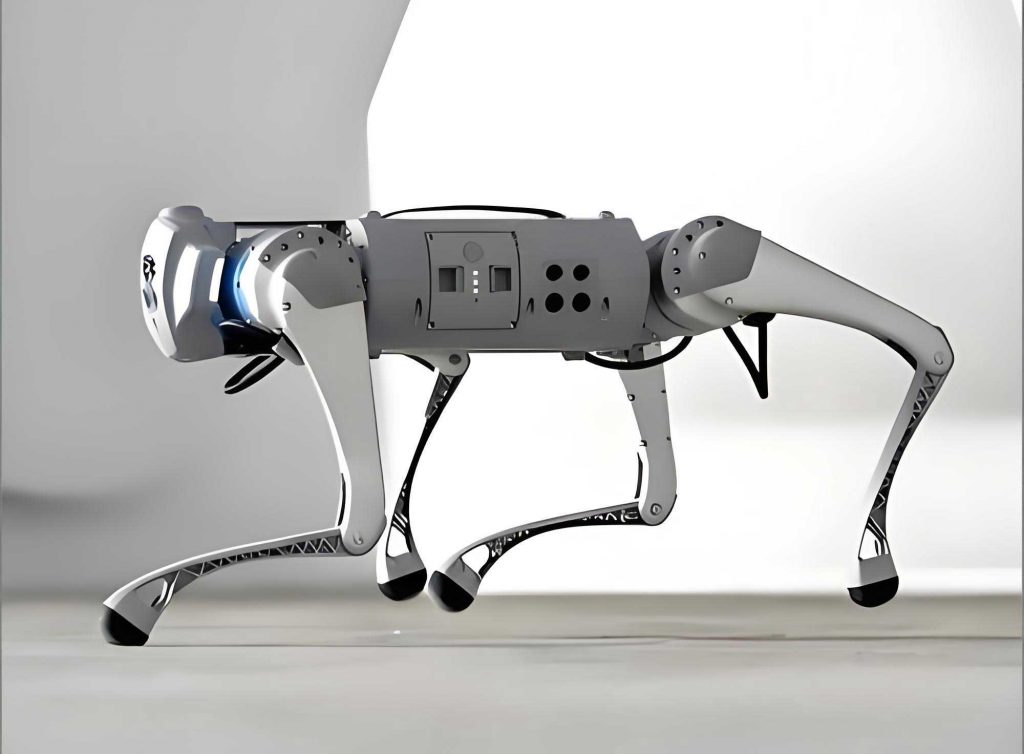
The biological inspiration for any biomimetic robot dog must begin with a detailed analysis of canine anatomy. The canine skeletal system is a marvel of evolutionary engineering, comprising numerous bones connected by joints of varying complexity. The spine, consisting of cervical, thoracic, lumbar, sacral, and coccygeal vertebrae, provides the central axis. Limb movement is enabled by the shoulder (scapulohumeral) and hip (coxal) joints—both multi-axial ball-and-socket joints—along with the primarily hinge-like elbow and knee joints, and the more complex wrist (carpal) and ankle (tarsal) joints. These biological joints facilitate a range of motions: flexion/extension (bending and straightening), abduction/adduction (movement away from/toward the body midline), and rotation. For instance, the shoulder and hip allow for significant flexion/extension coupled with limited abduction/adduction and rotation, while the spine permits bending and twisting along its length. Accurately replicating this full spectrum of motion with mechanical components is impractical. Therefore, a critical step in designing a functional robot dog is to simplify these biological joints by prioritizing their most essential functions relative to the desired robotic behaviors, such as stable walking, running, turning, and terrain adaptation.
This study introduces the “Importance/Weight” method as a principled framework for this simplification. Each primary motion capability of a biological joint is assigned a priority等级 (e.g., A, B, C, where A > B > C) based on its criticality to the fundamental locomotion and operational tasks of the robot dog. The mechanical design of each robotic joint then focuses on implementing the high-priority (A-level) motions, potentially sacrificing lower-priority (B or C-level) ones to achieve a tractable, robust, and manufacturable design. The table below summarizes the analysis for key joints of a medium-sized working dog, such as a German Shepherd, which serves as our model organism.
| Body Section | Biological Joint | Primary Biological Motions | Simplified Independent Motions (RPY Notation*) | Priority (A>B>C) |
|---|---|---|---|---|
| Head & Neck | Cervical (Atlas & Axis) | Flexion/Extension, Lateral Tilt, Rotation | RP, RY | A, A |
| Thoracic Spine | Limited Rotation | RY | B | |
| Lumbar Spine | Flexion/Extension, Lateral Bending | RP, RR | A, B | |
| Forelimb | Shoulder | Flexion/Extension, Abduction/Adduction, Rotation | RP, RR, RY | A, C, B |
| Elbow | Flexion/Extension | RP | A | |
| Wrist | Flexion/Extension, Pronation/Supination | RP, RY | A, B | |
| Hindlimb | Hip | Flexion/Extension, Abduction/Adduction, Rotation | RP, RR, RY | A, B, C |
| Knee | Flexion/Extension | RP | A | |
| Ankle (Hock) | Flexion/Extension, Inversion/Eversion | RP, RY | A, B |
* RP: Pitch (flexion/extension), RR: Roll (abduction/adduction), RY: Yaw (rotation).
The next cornerstone of our robot dog design is the selection of appropriate mechanical joints to realize the prioritized motions. Traditional serial revolute joints are simple but lack stiffness. Instead, we employ two types of 2-degree-of-freedom (2-DOF) parallel rotation mechanisms, designated RGRR-I and RGRR-II, alongside standard 1-DOF revolute joints. These parallel mechanisms, based on a gear-and-linkage (planetary) configuration, offer a superior stiffness-to-weight ratio and a compact form factor compared to serial chains. Their kinematic properties are derived as follows.
The RGRR-I mechanism, with its fixed bevel gear, driving bevel gear, and rotating carrier (link), provides two rotational outputs. Establishing coordinate systems as described in the foundational work, the relationship between the input angles (α₁ for the driving gear, α₃ for the carrier) and the output angles (θ₁, θ₂) of the moving platform (the output bevel gear) can be expressed by the rotation matrix derived from the mechanism’s geometry. The angular velocity and acceleration relationships are obtained through differentiation, which is crucial for dynamic modeling and control of the robot dog.
$$ \begin{pmatrix} \dot{\theta}_1 \\ \dot{\theta}_2 \end{pmatrix} = \begin{pmatrix} 1 & -1 \\ 0 & 1 \end{pmatrix} \begin{pmatrix} \dot{\alpha}_1 \\ \dot{\alpha}_3 \end{pmatrix} $$
$$ \begin{pmatrix} \ddot{\theta}_1 \\ \ddot{\theta}_2 \end{pmatrix} = \begin{pmatrix} 1 & -1 \\ 0 & 1 \end{pmatrix} \begin{pmatrix} \ddot{\alpha}_1 \\ \ddot{\alpha}_3 \end{pmatrix} $$
In terms of workspace, the RGRR-I mechanism enables a pitch motion (RP) of approximately ±90° about one axis and a full 360° yaw rotation (RY) about the orthogonal axis. It is characterized by high structural stiffness, making it suitable for joints bearing significant loads.
The RGRR-II mechanism, a topological variation, swaps the roles of the fixed and output elements. Its input-output kinematic relations are similarly derived, leading to the following velocity mapping:
$$ \begin{pmatrix} \dot{\beta}_1 \\ \dot{\beta}_2 \end{pmatrix} = \begin{pmatrix} 0 & 1 \\ 1 & 0 \end{pmatrix} \begin{pmatrix} \dot{\alpha}_1 \\ \dot{\alpha}_3 \end{pmatrix} $$
$$ \begin{pmatrix} \ddot{\beta}_1 \\ \ddot{\beta}_2 \end{pmatrix} = \begin{pmatrix} 0 & 1 \\ 1 & 0 \end{pmatrix} \begin{pmatrix} \ddot{\alpha}_1 \\ \ddot{\alpha}_3 \end{pmatrix} $$
Here, β₁ and β₂ represent the output pitch and yaw angles, respectively. The RGRR-II offers a different workspace: a full 360° yaw rotation (RY) coupled with a pitch motion (RP) of about ±90°. A key advantage is its ability to cover a near-hemispherical workspace without singularities inside, providing greater orientational dexterity, albeit with slightly lower inherent stiffness than the RGRR-I type.
Guided by the Importance/Weight analysis and the properties of the available joints, we now synthesize the complete architecture for the hybrid serial-parallel robot dog.
- Neck Joint: Priority motions are RY (A) and RP (A). The head is a relatively low-inertia module requiring wide-ranging motion for environmental sensing. Therefore, the RGRR-II mechanism is selected for its dexterous, near-hemispherical workspace, enabling the robot dog to look up, down, and side-to-side extensively.
- Lumbar (Waist) Joint: Priority motions are RP (A) and RR (B). This joint connects the fore and hind quarters and must support considerable dynamic loads during galloping or climbing. The high stiffness of the RGRR-I mechanism makes it the ideal choice to provide pitch and roll between the body segments, enhancing the robot dog’s balance and maneuverability.
- Shoulder & Hip Joints: The primary motion for locomotion is flexion/extension (RP, priority A). While the biological joint has three degrees of freedom, abduction/adduction (RR) and rotation (RY) are assigned lower priorities (C and B). The RGRR-I mechanism, providing RP and RY, is selected. It perfectly delivers the critical pitch motion while offering yaw as a secondary capability for subtle leg adjustment, all within a very stiff package crucial for weight-bearing.
- Elbow & Knee Joints: These are simplified to pure hinge joints, performing only flexion/extension (RP, priority A). A standard, high-torque serial revolute joint is sufficient and cost-effective here.
- Wrist & Ankle (Hock) Joints: Priority motions are RP (A) and RY (B). These distal joints require stiffness for push-off and terrain contact, as well as some orientation adjustment. The RGRR-I mechanism is again employed to provide the necessary pitch and yaw, giving the robot dog’s feet adaptive orientation capabilities on uneven ground.
This systematic joint assignment results in a sophisticated hybrid serial-parallel robot dog with a total of 24 degrees of freedom. Each limb contributes 6 DOFs: 2 (Shoulder/Hip, RGRR-I) + 1 (Elbow/Knee) + 2 (Wrist/Ankle, RGRR-I) + 1 (Toe flexion). The spine adds 3 DOFs: 2 (Lumbar, RGRR-I) + 1 (Thoracic twist), and the neck adds 2 DOFs (RGRR-II). This configuration provides an exceptional combination of dexterity and strength. The pervasive use of parallel mechanisms in load-bearing joints ensures the overall structure of the robot dog is remarkably stiff, allowing it to resist bending and vibrational deflections under dynamic loads. This stiffness translates directly into more precise foot placement, more efficient force transmission, and greater stability. Furthermore, the designed kinematics, while simplified, capture the most essential biomimetic motions, enabling a wide repertoire of gaits and maneuvers.
The proposed design methodology and the resulting robot dog architecture offer significant advancements. The “Importance/Weight” method provides a generalizable, systematic framework for transitioning from complex biological inspiration to practical engineering design in biomimetic robotics, applicable beyond the robot dog to humanoid, avian, or piscine robots. By strategically deploying compact, stiff parallel rotation mechanisms like RGRR-I and RGRR-II at key locations, the fundamental limitations of traditional serial-chain biomimetic robots are directly addressed. The resultant 24-DOF hybrid serial-parallel robot dog embodies a potent combination of structural robustness, kinematic agility, and functional fidelity. Future work will involve detailed dynamic modeling, actuator selection, control system development, and physical prototyping to fully validate the performance advantages of this novel robot dog design in real-world locomotion tasks.