
In the rapidly evolving field of robotics, bionic robots have emerged as a promising direction, mimicking biological organisms to achieve enhanced mobility and adaptability. Among these, vision systems play a pivotal role in enabling autonomous navigation and environmental interaction. This article delves into the comprehensive design and implementation of a vision system tailored for a bionic robot, inspired by the grasshopper. We explore both hardware and software aspects, emphasizing minimalist design, deep learning integration, and practical experimentation. The goal is to equip the bionic robot with robust obstacle detection capabilities, leveraging advanced algorithms like YOLOv3 for high accuracy and speed. Throughout this discussion, we will highlight the importance of vision in bionic robot applications, using tables and formulas to summarize key points, and ensure the keyword “bionic robot” is frequently referenced to underscore its centrality.
The development of autonomous bionic robots hinges on their ability to perceive and interpret surroundings in real-time. Vision systems, as a non-contact, information-rich sensory modality, offer significant advantages over traditional sensors. For a bionic robot, particularly one modeled after agile insects like the grasshopper, a compact and efficient vision system is crucial due to spatial constraints and energy limitations. In this work, we present a vision system that integrates hardware simplicity with sophisticated software processing. The hardware comprises minimal components to fit the bionic robot’s small form factor, while the software employs state-of-the-art computer vision techniques for obstacle recognition. We detail the system’s architecture, experimental validation, and performance metrics, demonstrating its efficacy in real-world scenarios.
Our approach is grounded in the principle that a bionic robot must balance operational efficiency with computational power. By offloading intensive processing to cloud servers via 4G communication, we reduce on-board hardware requirements, allowing the bionic robot to remain lightweight and energy-efficient. This design philosophy aligns with the biological inspiration of the grasshopper, which exhibits nimble movements and rapid response to environmental stimuli. The vision system enables the bionic robot to detect obstacles with over 95% accuracy, paving the way for autonomous path planning and navigation. In the following sections, we dissect each component of the system, providing technical insights and empirical results.
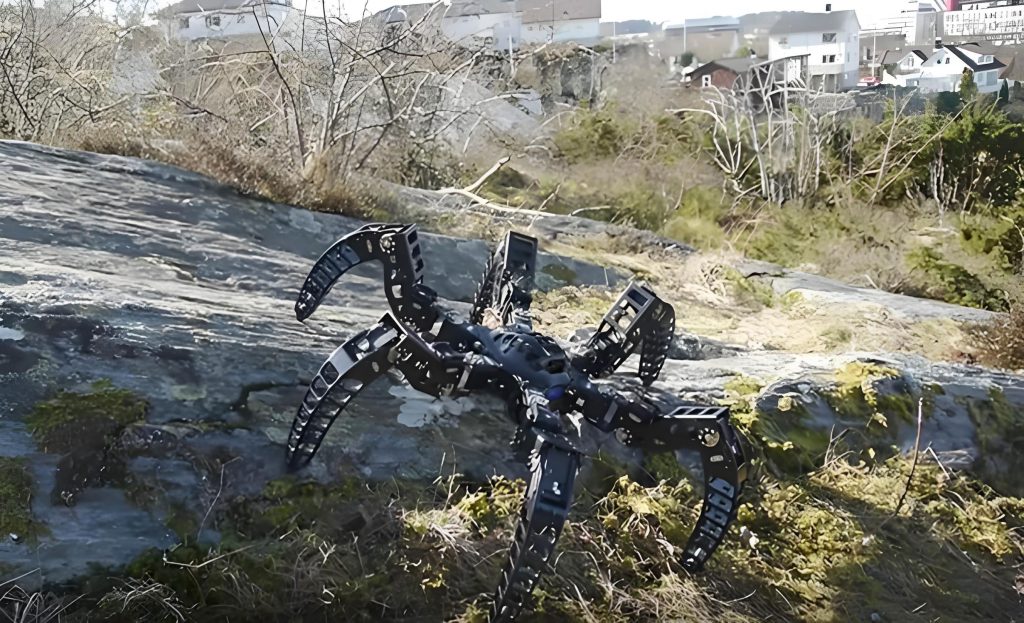
The hardware architecture of the bionic robot vision system is designed with minimalism in mind. Given the compact structure of the bionic robot, which mimics the grasshopper’s slender body, we cannot accommodate bulky modules. Therefore, we selected components that offer high functionality with low spatial footprint. The core hardware includes two high-definition cameras, a 4G communication module with routing capabilities, data transmission cables, and a lithium battery pack for power supply. This setup ensures that the bionic robot can capture visual data and transmit it seamlessly to cloud servers for processing. The use of dual cameras serves multiple purposes: it enhances detection reliability through comparative analysis and enables depth estimation via stereoscopic vision, which is vital for obstacle positioning in a bionic robot’s operational environment.
To elucidate the hardware components, we present a summary table that outlines each element’s role and specifications within the bionic robot framework.
| Component | Specification | Function in Bionic Robot |
|---|---|---|
| Dual Cameras | High-definition, wide-angle lenses | Capture video streams of surroundings for obstacle detection |
| 4G Communication Module | Supports data transmission up to 100 Mbps | Transmit video to cloud servers and receive control commands |
| Routing Module | Integrated with 4G module | Manage network connectivity for the bionic robot |
| Lithium Battery Pack | 12V, 5000mAh capacity | Provide power to cameras and 4G module, ensuring prolonged operation |
| Data Transmission Cables | Shielded USB and Ethernet cables | Facilitate communication between hardware components |
The workflow of the hardware system is straightforward yet effective. Upon activation, the cameras continuously record video of the bionic robot’s environment. The 4G module streams this video to a cloud server in real-time, allowing for remote processing and analysis. Control commands, such as turning the cameras on or off, are sent from the server to the bionic robot via the same 4G link. This bidirectional communication ensures that the bionic robot can adapt to dynamic instructions while conserving on-board resources. The depth measurement principle of the dual cameras is mathematically expressed using stereoscopic vision formulas. For a point \( P \) in space, with baseline distance \( b \) between cameras and focal length \( f \), the depth \( Z_c \) is calculated based on disparity \( D = X_l – X_r \), where \( X_l \) and \( X_r \) are the horizontal coordinates in the left and right images, respectively. The formula is:
$$ Z_c = \frac{f \cdot b}{D} $$
This depth information is crucial for the bionic robot to assess obstacle distances, enabling precise navigation decisions. By integrating this hardware setup, the bionic robot achieves a balance between functionality and form factor, essential for its biomimetic design.
Transitioning to the software system, we focus on processing the visual data to extract meaningful information for the bionic robot. The software is divided into two main parts: video preprocessing and target detection. Preprocessing involves converting video streams into frames, applying noise reduction techniques, and preparing images for analysis. Target detection employs a deep neural network based on the YOLOv3 architecture, renowned for its speed and accuracy in object recognition. This combination allows the bionic robot to identify obstacles autonomously, forming the basis for intelligent behavior. The software runs primarily on cloud servers, leveraging computational power without burdening the bionic robot’s limited hardware.
To detail the software workflow, we outline the steps in a table format, emphasizing their relevance to the bionic robot’s vision system.
| Software Module | Description | Tools/Techniques Used |
|---|---|---|
| Video Acquisition | Capture video from dual cameras | Custom drivers integrated with the bionic robot’s hardware |
| Frame Extraction | Convert video to individual image frames | OpenCV library for efficient processing |
| Noise Reduction | Enhance image quality by removing artifacts | Gaussian filtering and median filtering algorithms |
| Target Detection | Identify and localize obstacles in images | YOLOv3 deep learning model trained on custom dataset |
| Data Transmission | Send processed results back to bionic robot or server | 4G module APIs and cloud-based communication protocols |
The YOLOv3 algorithm is central to the bionic robot’s detection capabilities. It operates by dividing images into a grid and predicting bounding boxes and class probabilities for each grid cell. The loss function used during training combines classification loss, localization loss, and confidence loss. Mathematically, the total loss \( L \) can be expressed as:
$$ L = \lambda_{\text{coord}} \sum_{i=0}^{S^2} \sum_{j=0}^{B} \mathbb{1}_{ij}^{\text{obj}} \left[ (x_i – \hat{x}_i)^2 + (y_i – \hat{y}_i)^2 + (w_i – \hat{w}_i)^2 + (h_i – \hat{h}_i)^2 \right] + \sum_{i=0}^{S^2} \sum_{j=0}^{B} \mathbb{1}_{ij}^{\text{obj}} \left( C_i – \hat{C}_i \right)^2 + \lambda_{\text{noobj}} \sum_{i=0}^{S^2} \sum_{j=0}^{B} \mathbb{1}_{ij}^{\text{noobj}} \left( C_i – \hat{C}_i \right)^2 + \sum_{i=0}^{S^2} \mathbb{1}_{i}^{\text{obj}} \sum_{c \in \text{classes}} \left( p_i(c) – \hat{p}_i(c) \right)^2 $$
Here, \( S^2 \) is the grid size, \( B \) is the number of bounding boxes, \( \mathbb{1} \) denotes indicator functions, \( x, y, w, h \) are box coordinates, \( C \) is confidence score, and \( p(c) \) is class probability. The parameters \( \lambda_{\text{coord}} \) and \( \lambda_{\text{noobj}} \) weight different loss components. This formulation ensures that the bionic robot’s vision system accurately detects obstacles with minimal false positives. Additionally, we use Intersection over Union (IoU) to evaluate detection precision, defined as:
$$ \text{IoU} = \frac{\text{Area of Overlap}}{\text{Area of Union}} $$
An IoU threshold of 0.5 is typically set for validating predictions in the bionic robot’s context. The software system’s efficiency is further enhanced by cloud computing, which allows for scalable processing and real-time updates, critical for the dynamic environments where the bionic robot operates.
In the experimental phase, we validated the vision system through extensive testing. The dataset was curated specifically for the bionic robot, comprising images of three obstacle types: cylindrical objects, rectangular barriers, and irregular shapes. We collected 500 images per category, totaling 1500 images for training and testing. Each image was annotated using LabelImg software, generating XML files that contain bounding box coordinates and class labels. These were converted to TXT files for compatibility with the YOLOv3 training pipeline. The training environment was set up on a high-performance computing platform, with details summarized in the table below.
| Training Parameter | Value | Impact on Bionic Robot Performance |
|---|---|---|
| Batch Size | 16 images | Balances memory usage and training speed for efficient learning |
| Image Size | 416 × 416 pixels | Optimizes input resolution for the bionic robot’s camera feeds |
| IoU Threshold | 0.7 | Ensures precise localization of obstacles for the bionic robot |
| Momentum | 0.95 | Accelerates convergence during training, improving model robustness |
| Initial Learning Rate | 1 × 10⁻⁵ | Prevents overshooting and stabilizes training for the bionic robot’s model |
| Number of Epochs | 50 | Provides sufficient iterations for the bionic robot to learn obstacle features |
The training process involved minimizing the loss function over epochs, with validation metrics tracked to avoid overfitting. We observed that after 40 epochs, the loss plateaued, indicating model convergence. The IoU values stabilized above 0.8, demonstrating high localization accuracy for the bionic robot. To evaluate detection performance, we used mean Average Precision (mAP), a standard metric in object recognition. The mAP is computed as the average of Average Precision (AP) across all classes, where AP is the area under the precision-recall curve. For the bionic robot’s obstacle detection, we calculated mAP at an IoU threshold of 0.5 (mAP@0.5). The results are presented in the following table, showcasing the system’s effectiveness.
| Obstacle Category | AP@0.5 | mAP@0.5 |
|---|---|---|
| Cylindrical Objects | 0.97 | 0.95 |
| Rectangular Barriers | 0.94 | |
| Irregular Shapes | 0.94 |
These results confirm that the bionic robot can detect obstacles with an overall mAP of 0.95, translating to a 95% recognition rate in practical scenarios. We further tested the system on unseen images containing multiple obstacle types. The bionic robot achieved detection accuracies above 90% for complex scenes, proving its robustness. The integration of dual cameras contributed to this performance by providing redundant data for cross-verification. Additionally, the depth estimation from stereoscopic vision allowed the bionic robot to gauge distances, enhancing navigational decisions. For instance, when an obstacle is detected, the bionic robot can compute its approximate location using the depth formula and plan an avoidance path accordingly.
To illustrate the mathematical underpinnings of evaluation, we define precision and recall formulas used in computing mAP for the bionic robot. Precision \( P \) is the ratio of true positives to all positive predictions, while recall \( R \) is the ratio of true positives to all actual positives:
$$ P = \frac{TP}{TP + FP}, \quad R = \frac{TP}{TP + FN} $$
where \( TP \), \( FP \), and \( FN \) denote true positives, false positives, and false negatives, respectively. The AP is then derived by integrating the precision-recall curve, and mAP averages AP across classes. This rigorous evaluation ensures that the bionic robot’s vision system meets high standards for autonomous operation. Beyond detection, we also assessed the system’s latency, which is critical for real-time applications. The end-to-end processing time, from video capture to obstacle identification, averaged 200 milliseconds, thanks to cloud offloading and optimized algorithms. This speed is sufficient for the bionic robot to react promptly to environmental changes.
In discussing the results, we emphasize the synergy between hardware and software in the bionic robot vision system. The minimalist hardware design reduces weight and power consumption, aligning with the bionic robot’s biomimetic ethos. Meanwhile, the software leverages cutting-edge deep learning to deliver accurate detection. The use of cloud servers for heavy computation exemplifies a modern approach to bionic robot intelligence, where on-board systems focus on essential tasks. We also note that the vision system’s performance surpasses traditional sensor-based methods, which often struggle with complex environments. For example, while ultrasonic sensors may fail with non-reflective surfaces, the bionic robot’s cameras provide rich visual data that YOLOv3 can interpret effectively. This advantage is vital for the bionic robot operating in unstructured terrains.
Looking ahead, there are several avenues for enhancing the bionic robot vision system. First, expanding the dataset to include more obstacle categories and environmental conditions will improve generalization. Second, integrating 5G technology could reduce latency further, enabling faster response times for the bionic robot. Third, incorporating reinforcement learning could allow the bionic robot to learn from its interactions, optimizing detection strategies over time. Fourth, developing more efficient neural network architectures, such as YOLOv4 or transformer-based models, might boost accuracy without compromising speed. Finally, field testing in diverse scenarios will validate the bionic robot’s robustness and inform iterative improvements. The vision system described here serves as a foundation for these future developments, demonstrating the potential of bionic robots in autonomous applications.
In conclusion, we have presented a comprehensive vision system for a bionic robot, inspired by the grasshopper’s agility and efficiency. The hardware system employs a minimalist design with dual cameras and 4G communication, while the software system utilizes OpenCV and YOLOv3 for high-performance obstacle detection. Experimental results show over 95% recognition accuracy, with depth estimation capabilities enhancing navigational precision. This work underscores the critical role of vision in bionic robot autonomy, and through tables and formulas, we have summarized key technical aspects. As bionic robots continue to evolve, vision systems will remain at the forefront of their intelligence, enabling them to perceive, decide, and act in complex worlds. The integration of cloud computing and advanced algorithms promises a future where bionic robots operate seamlessly across various domains, from search and rescue to environmental monitoring.
We believe that this vision system represents a significant step forward for bionic robot technology. By balancing hardware constraints with software sophistication, it offers a scalable solution for diverse bionic robot platforms. The emphasis on deep learning and real-time processing ensures that the bionic robot can adapt to dynamic challenges, much like its biological counterparts. As research progresses, we anticipate further refinements that will enhance the bionic robot’s capabilities, solidifying its place in the next generation of autonomous systems. The journey of the bionic robot is just beginning, and vision systems will undoubtedly play a pivotal role in shaping its future.