
In the field of robotics, the development of mobile systems capable of traversing complex, unstructured terrains is a significant challenge. Traditional wheeled or tracked robots often face limitations in mobility, especially on steep slopes, rocky paths, or soft ground, due to constraints like approach/departure angles and turning radius. To overcome these limitations, I have focused on the design and simulation of a bionic robot, specifically a quadrupedal walking machine inspired by biological counterparts like the horse. This bionic robot aims to combine the adaptability and stability of legged animals with engineering robustness for tasks such as payload transport in hazardous environments. The core of this work involves using virtual prototyping and finite element analysis to validate the robot’s gait performance and structural integrity, ensuring it meets targeted speed and load-bearing requirements. Throughout this paper, the term ‘bionic robot’ will be emphasized to highlight the biomimetic approach central to this research.
The inspiration for this bionic robot comes from quadrupedal mammals, particularly horses, which have evolved over millennia to carry loads efficiently while maintaining agility across varied landscapes. The bionic robot designed here mimics the skeletal and muscular structure of a horse, aiming to achieve similar dynamic capabilities. The primary objectives are to achieve a walking speed of at least 0.2 m/s in a trotting gait and support a payload of up to 40 kg, with the robot’s own mass kept under 70 kg. To realize this, I have adopted a systematic approach: first, designing the leg mechanism and overall architecture; second, deriving the forward kinematics for motion control; third, constructing a virtual prototype for dynamic simulation; and fourth, performing finite element analysis to assess structural reliability under impact forces. This comprehensive methodology ensures that the bionic robot is both functionally effective and mechanically sound.
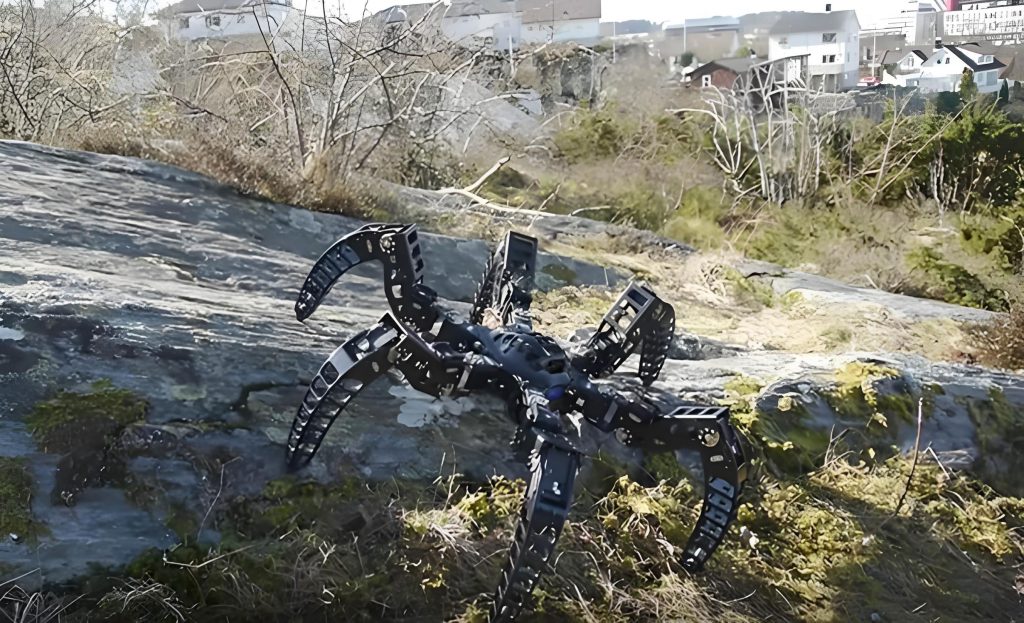
Legged robots, especially quadrupedal ones, offer distinct advantages over their wheeled counterparts. They can step over obstacles, adjust foot placement for stability, and navigate discontinuous terrains where wheels would fail. However, designing such a bionic robot involves complex trade-offs between degrees of freedom, actuation efficiency, and control complexity. In this study, I address these challenges by focusing on a simplified yet biomimetic leg structure. The bionic robot’s legs are configured in an elbow-knee style, similar to a horse’s limb arrangement, which provides better performance on inclines and aligns with mammalian anatomy. Each leg has three degrees of freedom: one at the hip for lateral swing and two at the knee and ankle for planar motion, allowing for versatile foot trajectories. This design balances simplicity with the necessary mobility for adaptive walking.
To mathematically model the bionic robot’s leg movement, I use the Denavit-Hartenberg (D-H) convention for forward kinematics. This approach establishes coordinate frames for each link in the leg, enabling the calculation of the foot’s position relative to the robot’s body. The bionic robot’s single leg consists of three links: the thigh, shank, and foot, connected by revolute joints. The D-H parameters for these links are summarized in Table 1, where $a_i$ represents link lengths, $\theta_i$ denotes joint angles, and $\alpha_i$ are twist angles. These parameters are essential for deriving the transformation matrices that describe the leg’s posture in space.
| Link (i) | $d_i$ | $a_i$ | $\alpha_i$ (degrees) | $\cos \alpha_i$ | $\sin \alpha_i$ |
|---|---|---|---|---|---|
| 1 | 0 | $a_1$ | 90 | 0 | 1 |
| 2 | 0 | $a_2$ | 0 | 1 | 0 |
| 3 | 0 | $a_3$ | 0 | 1 | 0 |
The transformation matrix between consecutive links is given by the standard D-H formula:
$$
A_i = \begin{bmatrix}
\cos \theta_i & -\sin \theta_i \cos \alpha_i & \sin \theta_i \sin \alpha_i & a_i \cos \theta_i \\
\sin \theta_i & \cos \theta_i \cos \alpha_i & -\cos \theta_i \sin \alpha_i & a_i \sin \theta_i \\
0 & \sin \alpha_i & \cos \alpha_i & d_i \\
0 & 0 & 0 & 1
\end{bmatrix}
$$
For the bionic robot’s leg, substituting the parameters from Table 1 yields the matrices for each joint. The overall transformation from the body frame to the foot frame is obtained by multiplying these matrices:
$$
^{R}T_{H} = A_{a0} A_1 A_2 A_3
$$
where $A_{a0}$ is the transformation from the body centroid to the leg’s base. The resulting foot position coordinates $(P_x, P_y, P_z)$ in the global frame are:
$$
P_x = a_3 \sin(\theta_2 + \theta_3) + a_2 \sin \theta_2 + m
$$
$$
P_y = a_3 \sin \theta_1 \cos(\theta_2 + \theta_3) + a_2 \sin \theta_1 \cos \theta_2 + a_1 \sin \theta_1 + n
$$
$$
P_z = c – a_3 \cos \theta_1 \cos(\theta_2 + \theta_3) – a_2 \cos \theta_1 \cos \theta_2 + p
$$
Here, $m, n, p$ define the leg’s attachment point on the body, and $c$ is a constant offset. These equations form the basis for gait planning and control in the bionic robot, allowing precise foot placement during locomotion.
The overall architecture of the bionic robot is designed to replicate the proportions and load-bearing capacity of a horse. The main body is a reinforced box structure measuring approximately 1 m in length, 0.5 m in width, and 0.9 m in height, providing a stable platform for the legs and payload. The leg lengths are scaled to match biological ratios, with $a_1$, $a_2$, and $a_3$ set to values that optimize stride length and ground clearance. This bionic robot incorporates four identical legs symmetrically arranged, each driven by actuators at the hip and knee joints. The spine-like body allows for slight flexing to absorb shocks, enhancing stability. The design prioritizes lightweight materials, such as titanium alloys, to keep mass low while maintaining strength. This biomimetic approach ensures that the bionic robot can handle dynamic loads and uneven terrain effectively.
To analyze the bionic robot’s mobility, I calculate its degrees of freedom (DOF) using a formula for spatial mechanisms. The robot, when in stance phase with $n$ legs on the ground, can be modeled as a multi-loop parallel mechanism. The DOF is given by:
$$
F = \sum_{i=1}^{p} f_i – \sum_{i=1}^{L} \lambda_i – f_p – F_1 + \lambda_0
$$
where $p$ is the number of joints, $f_i$ is the DOF of each joint, $L$ is the number of independent closed loops, $\lambda_i$ are constraint conditions, $f_p$ is passive DOF, $F_1$ is local DOF, and $\lambda_0$ is redundant constraints. For this bionic robot, with $n$ supporting legs, we have $p = 4n$, $f_i = 1$ for the first $3n$ joints (revolute), and $f_i = 3$ for the remaining $n$ joints (spherical). The closed loops $L = n-1$, and $\lambda_i = 6$. Substituting these values:
$$
F = (3n \cdot 1 + n \cdot 3) – 6(n-1) = 6n – 6n + 6 = 6
$$
This result shows that the bionic robot retains 6 DOF regardless of gait, enabling full control over its position and orientation. This flexibility is crucial for adapting to complex environments, making the bionic robot highly versatile.
Virtual prototyping is a key tool in developing and testing the bionic robot without physical construction. I use SolidWorks with integrated Motion analysis, which employs an ADAMS solver for dynamic simulation. The bionic robot’s 3D model is built in SolidWorks, with all joints defined as revolute pairs. To simulate realistic motion, I apply the following simplifications and assumptions: (1) The robot’s body and ground are treated as rigid bodies; (2) The feet are made of rubber with a high friction coefficient to prevent slipping; (3) Joint friction is neglected, assuming smooth bearings; (4) Gravity is included; and (5) The mass of motors and reducers is ignored to focus on structural dynamics. These assumptions streamline the simulation while capturing essential behaviors of the bionic robot.
For gait generation, I implement a trotting pattern, which is a diagonal couplet gait where front and hind legs on opposite sides move together. This gait is common in quadrupedal animals and offers a balance of speed and stability for the bionic robot. The joint actuation is controlled by drive functions based on sinusoidal and half-wave patterns, emulating biological motion. The hip and knee joint drive functions for each leg are defined as time-dependent equations. For example, for the front-right and hind-left hip joints:
$$
\text{Hip angle} = -21 \cdot \sin(4\pi t)
$$
And for the corresponding knee joints:
$$
\text{Knee angle} = 3.5 \cdot \cos(4\pi t) + |3.5 \cdot \cos(4\pi t)|
$$
Similarly, mirrored functions are used for the other diagonal pair. These functions ensure smooth, periodic leg movements that mimic mammalian locomotion. The simulation runs for 5 seconds, with the bionic robot moving along the negative X-axis, starting from its centroid position.
The simulation results provide insights into the bionic robot’s performance. The displacement of the robot’s centroid along the X-axis over time is plotted, showing a linear trend. From this data, the average speed is calculated as 0.516 m/s, exceeding the design target of 0.2 m/s. This demonstrates that the bionic robot can achieve efficient locomotion with the proposed gait and drive functions. Additionally, the reaction forces at the hip joints are analyzed. These forces exhibit周期性 peaks due to ground impact during foot strike, with a period of about 0.5 seconds. The maximum impact force recorded is 1,042 N, which is critical for structural assessment. The friction forces at the feet, which propel the bionic robot forward, vary with contact time and reach a maximum of 97 N. These dynamic loads are essential for evaluating the durability of the bionic robot.
To further validate the bionic robot’s design, I conduct a finite element analysis (FEA) on the body structure under the maximum impact forces. The body, made of titanium alloy with a yield strength of 600 MPa, is subjected to transient stress analysis using ALGOR software. The loading condition is based on the periodic hip impact force of 1,024 N (simplified from simulation data), applied perpendicularly at the four hip attachment points. The analysis uses direct integration for transient response, with 200 time steps of 0.01 seconds each for accuracy. The von Mises stress distribution is computed, revealing a maximum stress of 17.55 MPa, well below the material’s allowable stress. The maximum vertical displacement is 0.42 mm, indicating minimal deformation under load. This confirms that the bionic robot’s structure is robust and reliable for operational conditions, ensuring safe payload carriage.
The integration of virtual prototyping and FEA offers a comprehensive validation framework for the bionic robot. By simulating dynamic gait performance and structural strength, I can optimize design parameters iteratively. For instance, adjusting leg lengths or drive functions could further enhance speed or stability. The bionic robot’s biomimetic approach proves effective, as seen in its ability to replicate biological motion patterns. However, challenges remain, such as incorporating adaptive control for uneven terrain or reducing energy consumption. Future work on this bionic robot could involve adding sensors for real-time feedback or testing more complex gaits like galloping. The insights from this study contribute to advancing legged robotics, particularly for applications in search-and-rescue or exploration where traditional robots falter.
In conclusion, this research successfully designs and simulates a bionic quadruped robot inspired by equine anatomy. Through detailed kinematic modeling, virtual prototyping, and finite element analysis, the bionic robot demonstrates a walking speed of 0.516 m/s in a trotting gait and structural integrity under impact loads. The use of biomimetic drive functions and lightweight materials ensures both agility and durability. This work underscores the potential of bionic robots for navigating complex environments, with implications for autonomous transport and hazardous mission support. Continued refinement of control algorithms and material choices will further enhance the capabilities of such bionic robots, paving the way for more advanced legged systems in robotics.