
The pursuit of advanced robotic systems that can mimic the elegance, efficiency, and adaptability of biological organisms has been a central theme in modern robotics. Among these, bionic robots, designed to emulate the locomotion and operational mechanics of animals, present unique challenges and opportunities. A critical subsystem governing their performance and stability is the booster or assistive drive control system. This system is responsible for managing torque, speed, and power distribution to various joints or limbs, enabling smooth, energy-efficient, and stable movement, whether it’s walking, running, grasping, or jumping. The quality of this control directly impacts the robot’s autonomy, operational precision, and ability to interact with unpredictable environments.
Traditional control architectures for robotic drives often rely on centralized microprocessors or digital signal processors (DSPs). While powerful, these systems can face limitations in deterministic real-time response, modularity, and robustness in electrically noisy industrial or outdoor settings. This paper explores and elaborates on a robust design paradigm: utilizing a Programmable Logic Controller (PLC) as the core logic and sequence processor for a bionic robot booster control system. PLCs are renowned for their reliability, real-time determinism, and ease of integration with a wide array of industrial sensors and actuators. By coupling a PLC with specialized co-processors like a DSP for high-speed signal filtering and an ARM processor for upper-layer tasks, we can create a hierarchical, fault-tolerant, and highly responsive control architecture. The proposed system aims to significantly enhance adaptive matching capability, integrated control performance, and overall system stability for bionic robot applications, moving beyond the initial conceptual framework to a detailed, implementable design.
System Architecture and Hierarchical Control Strategy
The proposed booster control system adopts a multi-layered, distributed architecture to balance computational load, ensure real-time performance, and enhance modularity. The overall design moves from high-level planning to low-level execution, facilitated by a clear division of labor among processing units.
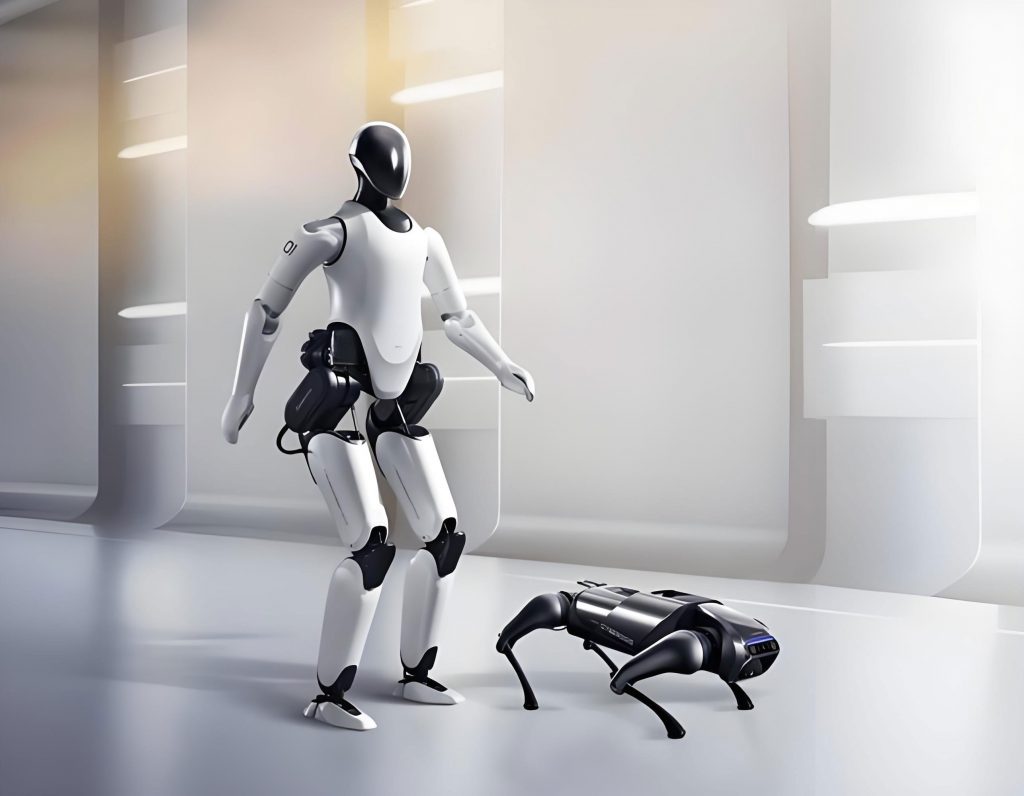
The core of the real-time control loop resides with the PLC and the DSP. The PLC acts as the master sequencer and safety supervisor. It executes the main control program written in ladder logic or structured text, which is inherently scan-based and deterministic. Its primary roles include:
- Processing discrete I/O from limit switches, emergency stops, and mode selectors.
- Executing the state machine for the bionic robot‘s gait or operation cycle (e.g., stance, swing, lift, place).
- Calculating setpoints for speed, torque, or position based on high-level commands from the ARM processor or sensor fusion results.
- Implementing critical safety interlocks and fault-handling routines (e.g., overload detection, communication timeout).
The DSP (e.g., Texas Instruments TMS320F28335 or Analog Devices ADSP-21160) serves as a high-speed computational slave. It is dedicated to signal processing tasks that require rapid numerical computation:
- Executing the core control algorithm (e.g., Fuzzy-PID) at a very high frequency.
- Processing raw data from analog sensors (current, force, high-resolution position) via its integrated ADCs.
- Performing real-time filtering (Kalman filters, low-pass filters) to reduce noise in sensor feedback.
- Generating precise PWM signals for motor drives or sending processed analog command signals.
The ARM-based embedded processor (e.g., Cortex-M4 or A-series) forms the management and interface layer. It handles non-time-critical but complex tasks:
- Running a real-time operating system (RTOS) like FreeRTOS to manage multiple software threads.
- Hosting the sensor fusion algorithm, combining data from an Inertial Measurement Unit (IMU), vision system, laser rangefinder, and joint encoders to estimate the bionic robot‘s full body state.
- Managing communication protocols (Ethernet/IP, CAN bus, UART) for the HMI and remote supervisory control.
- Logging operational data for diagnostics and performance optimization.
Communication between these layers is vital. A high-speed, deterministic bus is essential for the PLC-DSP link. While VXI was mentioned, contemporary designs favor buses like PCI Express, EtherCAT, or even high-speed parallel interfaces for minimal latency. The ARM-to-PLC link can use industrial Ethernet or CANopen, providing both command/status exchange and network management.
The fundamental model for a single joint of a bionic robot can be represented as a driven rotational system. The dynamics are often approximated by:
$$ J\ddot{\theta} + B\dot{\theta} + \tau_{fric}(\dot{\theta}) + \tau_{load} = \tau_{motor} $$
Where:
- \( J \) is the moment of inertia of the joint and limb.
- \( B \) is the viscous damping coefficient.
- \( \tau_{fric} \) is the nonlinear friction torque, a function of velocity.
- \( \tau_{load} \) is the external load torque, which can be highly variable for a bionic robot interacting with its environment.
- \( \tau_{motor} \) is the torque generated by the actuator (e.g., servo motor).
The booster control system’s objective is to compute and apply \( \tau_{motor} \) such that the joint angle \( \theta \) tracks a desired trajectory \( \theta_d(t) \) robustly, despite variations in \( \tau_{load} \) and system parameters. This necessitates an adaptive and robust control law.
| Processor | Primary Role | Key Strengths | Typical Tasks |
|---|---|---|---|
| PLC | Logic Sequencing & Safety | Determinism, Reliability, Easy I/O Integration | State Machines, Interlocks, Setpoint Calculation |
| DSP | High-Speed Signal & Control | Numerical Computation Speed, Integrated Peripherals | Fuzzy-PID Execution, ADC Processing, PWM Generation |
| ARM | System Management & Fusion | High-Level OS Support, Connectivity, Complex Algorithms | Sensor Fusion, HMI, Network Comm, Data Logging |
Detailed Hardware Module Implementation
The system’s robustness is built upon carefully designed hardware modules. Each module must meet stringent requirements for speed, accuracy, and noise immunity to support the precise control of a dynamic bionic robot.
High-Fidelity Sensing and Signal Conditioning Module
Accurate state feedback is the foundation of control. This module encompasses all sensors and their conditioning circuits.
- Joint State Sensing: High-resolution absolute encoders (e.g., 20-bit) provide position feedback \( \theta \). Tachogenerators or the derivative of encoder data provide velocity \( \dot{\theta} \). Strain gauges in series with actuators can provide direct joint torque measurement \( \tau_{motor} \).
- Body State Sensing: A 9-DOF IMU (3-axis gyro, 3-axis accelerometer, 3-axis magnetometer) provides orientation and acceleration data. A Kalman filter running on the ARM processor fuses this data to estimate roll, pitch, yaw, and their rates.
- Force/Torque Sensing: Six-axis force/torque sensors at the feet or end-effectors measure interaction forces \( \tau_{load} \) with the environment, crucial for adaptive gait control.
- Signal Conditioning: Raw analog signals are buffered, scaled, and filtered before ADC conversion. Anti-aliasing filters are mandatory. For the DSP’s integrated ADCs, the signal must be conditioned to match its input range (e.g., 0-3V). A dedicated, multi-channel simultaneous sampling ADC (like the AD7606) can be used for superior synchronization if the DSP’s internal ADCs are insufficient.
The signal path for a torque sensor can be modeled. The sensor output voltage \( V_{sensor} \) is related to torque \( \tau \) by sensitivity \( S \): \( V_{sensor} = S \cdot \tau + V_{offset} \). The conditioning circuit amplifies and shifts this signal: \( V_{ADC} = G \cdot V_{sensor} + V_{ref} \), ensuring \( V_{ADC} \) is within the ADC’s input range.
Core Processing and Control Module
This module houses the PLC, DSP, and their immediate support circuitry. The PLC is selected for its fast scan time (e.g., < 1 ms) and sufficient I/O count. It receives digital status bits from the DSP (e.g., “algorithm running,” “fault detected”) and sends setpoint commands (e.g., target position, max torque).
The DSP is the mathematical engine. Its selection criteria include:
- High Clock Speed & Floating-Point Unit (FPU): Essential for rapid control law calculations.
- Fast, Integrated ADCs: 12-bit or higher, with sample rates exceeding 1 MSPS per channel.
- High-Resolution PWM Modules: For direct drive of servo amplifiers.
- Adequate On-Chip Memory: To store program, lookup tables for fuzzy logic, and data buffers.
The interface between the PLC and DSP is critical for low-latency command transfer. A dual-port RAM (DPRAM) or a high-speed parallel host port interface (HPI) provides the fastest data exchange. The PLC writes setpoints and reads status from designated memory locations in the DPRAM, which the DSP polls or is interrupted by. This is far faster than serial communication for this core loop.
The power delivery network for these processors must be clean and stable. Each core voltage (e.g., 1.2V for DSP core, 3.3V for I/O) requires its own low-noise, low-dropout regulator (LDO) with proper decoupling capacitors placed close to the pins. A watchdog timer circuit, possibly overseen by the PLC, resets the entire module in case of a software hang.
Actuation and Power Drive Module
This module converts the control signals from the DSP into physical motion. It typically consists of:
- Servo Amplifiers/Drives: These receive analog voltage commands (from the DSP’s DAC) or PWM/direction signals and drive the brushless DC (BLDC) or advanced synchronous motors commonly used in bionic robots. They handle high-current switching and implement low-level current (torque) control loops.
- Power Stage: Involves high-current MOSFET or IGBT bridges, gate drivers, and comprehensive protection (over-current, over-temperature, under-voltage).
- Energy Recuperation: For efficient bionic robot operation, the drive system should include regenerative braking circuits to feed energy back to the bus during deceleration, mimicking the energy recycling of biological muscles.
The transfer function from command voltage \( V_{cmd} \) to motor torque \( \tau_{motor} \) can be simplified for controller design. Assuming a well-tuned inner current loop in the servo drive, it can be approximated as a first-order system:
$$ \frac{\tau_{motor}(s)}{V_{cmd}(s)} = \frac{K_m}{\tau_m s + 1} $$
where \( K_m \) is the motor/drive gain and \( \tau_m \) is its electrical time constant.
Communication and Human-Machine Interface (HMI) Module
This module enables system configuration, monitoring, and external control. It is primarily managed by the ARM processor.
- Ethernet Interface: Provides a TCP/IP stack for remote monitoring, data streaming, and firmware updates. An industrial protocol stack (e.g., Modbus TCP, OPC UA) can be layered on top for interoperability with SCADA systems.
- CAN Bus Interface: A robust, differential serial bus ideal for connecting distributed sensor nodes or multiple joint controllers within the bionic robot itself.
- Local HMI: A small touchscreen LCD connected via SPI or parallel interface displays real-time status (joint angles, currents, errors), system alerts, and allows parameter tuning.
- Wireless Module (Optional): A Bluetooth or Wi-Fi module can provide a convenient setup and debugging link without physical connection.
| Module | Key Components | Performance Specification | Interface |
|---|---|---|---|
| Sensing & Conditioning | 20-bit Encoder, 6-Axis F/T Sensor, IMU, AD7606 ADC, Op-amp Circuits | Sample Rate > 10 kHz, Noise < 1 LSB, Bandwidth DC-500 Hz | SPI, Analog, I2C to DSP/ARM |
| Core Processing | PLC (e.g., Siemens S7-1200), DSP (TI TMS320F28379D), Dual-Port RAM, LDOs | PLC Scan Time < 1ms, DSP Clock > 200 MHz, FPU present | DPRAM (PLC-DSP), SPI/I2C (DSP-ADC) |
| Actuation & Power | BLDC Servo Drives, MOSFET H-Bridge, Gate Drivers, DC Bus Caps | Peak Current 20A, Bus Voltage 48V, Switching Freq. 20 kHz | PWM/Analog from DSP, Power Connectors |
| Communication & HMI | ARM Cortex-M7, Ethernet PHY, CAN Transceiver, 7″ Touchscreen | Ethernet 100Base-T, CAN 1 Mbps, HMI Refresh 60 Hz | Ethernet, CAN, UART, SPI to Display |
Software Architecture and Adaptive Control Algorithm
The hardware provides the platform, but the intelligence of the bionic robot booster control is embodied in its software and control algorithms.
Fuzzy-PID Control Algorithm
Proportional-Integral-Derivative (PID) control is ubiquitous but can struggle with the nonlinear, time-varying dynamics of a bionic robot. A Fuzzy-PID controller adapts the PID gains online based on the system’s error \( e(t) = \theta_d(t) – \theta(t) \) and error derivative \( \dot{e}(t) \), providing superior performance.
The algorithm executed on the DSP involves two main parts:
- Fuzzy Inference System (FIS): This is the brain of the adaptation. It uses linguistic rules to adjust the PID gains \( K_p \), \( K_i \), \( K_d \). Inputs to the FIS are the normalized error \( E \) and change-in-error \( CE \). Outputs are the adjustment factors \( \Delta K_p \), \( \Delta K_i \), \( \Delta K_d \).
Membership functions for \( E \) and \( CE \) might be “Negative Large (NL),” “Negative Small (NS),” “Zero (Z),” “Positive Small (PS),” “Positive Large (PL).” A typical rule is: IF \( E \) is PS AND \( CE \) is Z THEN \( \Delta K_p \) is PS, \( \Delta K_i \) is Z, \( \Delta K_d \) is NS. The rule base is designed to increase \( K_p \) for large errors to reduce them quickly, increase \( K_d \) when the error is changing fast to damp oscillations, and adjust \( K_i \) to eliminate steady-state error without causing integral windup.
- PID Computation: The final, adapted gains are calculated:
$$ K_p^{final} = K_p^{base} + \Delta K_p, \quad K_i^{final} = K_i^{base} + \Delta K_i, \quad K_d^{final} = K_d^{base} + \Delta K_d $$
The control output \( u(t) \) (which corresponds to \( V_{cmd} \)) is then computed using the discrete-time PID formula:
$$ u[k] = K_p^{final} e[k] + K_i^{final} T_s \sum_{j=0}^{k} e[j] + K_d^{final} \frac{(e[k] – e[k-1])}{T_s} $$
where \( T_s \) is the sampling period of the DSP control loop.
To prevent integral windup, a clamping or back-calculation anti-windup scheme must be implemented, especially important when the bionic robot‘s joint hits a limit.
Multi-Tasking Software on ARM Processor
The ARM processor runs an RTOS managing several concurrent tasks:
- Sensor Fusion Task: Fuses IMU, encoder, and potentially vision data at a moderate rate (100-500 Hz) using a complementary filter or Extended Kalman Filter (EKF) to estimate body pose.
- Gait Planner/Trajectory Generator Task: Based on the desired motion command (e.g., “walk forward at 0.5 m/s”), this task calculates the continuous joint trajectory setpoints \( \theta_d(t) \) for each leg. For a walking bionic robot, this might involve inverse kinematics and a central pattern generator (CPG) model.
- Communication Task: Manages all network interfaces, parsing incoming commands and packaging outgoing telemetry data.
- HMI Task: Updates the display and reads touch inputs.
- Data Logger Task: Streams critical variables (errors, torques, states) to non-volatile memory or over the network for post-analysis.
Inter-task communication uses RTOS primitives like queues and semaphores. For example, the Gait Planner places new setpoints into a queue read by the Communication Task for sending to the PLC.
PLC Ladder Logic/Structured Text Program
The PLC program is the orchestrator. It is typically cyclical with a main scan sequence:
- Read Inputs: Read digital inputs from emergency stops, enable buttons, and status bits from the DSP/ARM.
- Execute Logic:
- Check for faults. If any critical fault is active, jump to a safe shutdown routine.
- Execute the main state machine (e.g., IDLE, INITIALIZING, HOMING, OPERATING, FAULT).
- In the OPERATING state, read the latest trajectory setpoint from the ARM (via communication interface) and write the next setpoint for each joint to the DPRAM for the DSP.
- Monitor joint errors from the DSP. If an error exceeds a threshold for a sustained time, trigger a fault.
- Write Outputs: Set digital outputs to enable servo drives, turn on status lights, etc.
| \( \Delta K_p \) / \( E \) → \( CE \) ↓ |
NL | NS | Z | PS | PL |
|---|---|---|---|---|---|
| NL | PL | PL | PS | Z | NS |
| NS | PL | PS | PS | Z | NS |
| Z | PS | PS | Z | NS | NS |
| PS | PS | Z | NS | NS | NL |
| PL | Z | NS | NS | NL | NL |
System Integration, Testing, and Performance Validation
Integrating the modules of a complex bionic robot control system requires a meticulous, phased approach. Testing begins at the module level and progresses to full system integration.
Module-Level Testing
- Sensing Module: Each sensor is calibrated individually. Encoder counts are verified against known angles. Force/torque sensors are loaded with known weights. The ADC circuitry is tested with precision voltage sources to ensure linearity and lack of noise.
- DSP Control Loop: The DSP code is first tested in a simulation environment like MATLAB/Simulink with a plant model. It is then run on the hardware with a dummy load (e.g., a motor disconnected from the robot) to verify PWM generation and ADC reading. The Fuzzy-PID algorithm is tuned by observing its response to step changes in setpoint.
- PLC Logic: The PLC program is tested using its built-in simulator or by connecting dummy inputs and monitoring output actions and internal states to verify the state machine logic and safety interlocks.
- Communication: Each bus (DPRAM, Ethernet, CAN) is tested for data integrity and latency. Ping tests, loopback tests, and sustained data transfer tests are performed.
System Integration and Motion Testing
After module verification, the system is integrated step-by-step:
- Connect DSP to servo drives and a single joint motor with a known inertia. Close the control loop using only the DSP’s PID. Tune for stable operation.
- Integrate the PLC. The PLC provides the setpoint via DPRAM. Verify that the joint accurately follows trajectories commanded by the PLC.
- Integrate the ARM processor. The ARM now generates trajectories and sends them to the PLC. Test simple point-to-point moves.
- Integrate the full sensor suite (IMU, F/T sensors). Enable the sensor fusion and adaptive control algorithms on the ARM and DSP.
- Finally, attach the integrated system to the full bionic robot platform. Begin with static load tests, then progress to slow, constrained motions before attempting full dynamic gaits.
Performance Metrics and Validation
The system’s performance is quantified using several key metrics, measured with oscilloscopes, data loggers, and high-speed motion capture systems for the bionic robot:
- Tracking Error: The RMS and peak error \( e(t) \) during a standard test trajectory (e.g., a sinusoidal or complex gait cycle). This directly measures control accuracy. The adaptive Fuzzy-PID should show a significant reduction in error compared to a fixed-gain PID, especially under varying loads. For example, error might converge to values below 0.01 rad for a high-performance system.
$$ e_{RMS} = \sqrt{ \frac{1}{T} \int_{0}^{T} e(t)^2 dt } $$
- Settling Time: The time taken for the joint angle to reach and stay within a specified error band (e.g., ±2%) after a step change in setpoint.
- Torque Ripple and Smoothness: Measured by the current sensors in the drives. Lower ripple indicates smoother, more efficient motion and less vibration in the bionic robot structure.
- Power Efficiency: The ratio of mechanical work output to electrical power input during a cycle. Systems with regenerative braking will show higher efficiency.
- Phase Margin & Gain Margin: Assessed by frequency response analysis (injection of a sine sweep) to ensure robust stability. A phase margin > 45° is typically targeted.
- Response to Disturbances: Applying an external force or shock to the bionic robot and measuring how quickly and accurately the control system rejects it and returns to the desired trajectory.
Comparative testing is crucial. The system should be tested under two main control modes: 1) using the proposed Fuzzy-PID with the full hierarchical (PLC+DSP+ARM) architecture, and 2) using a conventional fixed-gain PID on a standalone microcontroller. The data, presented in tables and graphs, would compellingly demonstrate the advantages of the proposed design in terms of adaptability, stability under load, and energy efficiency for the bionic robot.
| Test Condition | Control Method | RMS Tracking Error (rad) | Settling Time (ms) | Peak Power (W) |
|---|---|---|---|---|
| Nominal Load, Sine Traj. | Fixed PID | 0.0085 | 45 | 120 |
| Nominal Load, Sine Traj. | Fuzzy-PID (Proposed) | 0.0042 | 32 | 115 |
| Sudden 50% Load Increase | Fixed PID | 0.0210 | 110 | 180 |
| Sudden 50% Load Increase | Fuzzy-PID (Proposed) | 0.0078 | 50 | 165 |
Conclusion and Future Directions
The design and implementation of a booster control system based on a PLC-centric hierarchical architecture present a compelling solution for advanced bionic robot applications. This approach successfully marries the rugged, deterministic logic control of industrial PLCs with the high-speed computational power of DSPs and the connectivity and algorithmic flexibility of modern ARM processors. The resulting system is more than the sum of its parts; it provides a framework for reliable, adaptable, and high-performance control that is essential for bionic robots to operate effectively in real-world scenarios.
The use of an adaptive Fuzzy-PID control algorithm, executed efficiently on the dedicated DSP, allows the bionic robot to handle nonlinearities and varying payloads with greater finesse than traditional controllers. The clear separation of concerns—sequencing and safety with the PLC, signal processing and control law with the DSP, and management and fusion with the ARM—enhances system reliability, eases debugging, and simplifies future upgrades.
Future work can extend this architecture in several promising directions:
- Advanced Adaptive Algorithms: Replacing or augmenting Fuzzy-PID with model reference adaptive control (MRAC), sliding mode control (SMC), or neural network-based controllers for even more challenging and dynamic environments.
- Predictive Energy Management: Integrating a predictive control layer that optimizes torque distribution and motion trajectories in real-time to minimize energy consumption, extending the operational life of a battery-powered bionic robot.
- Cloud Connectivity and Digital Twin: Leveraging the ARM’s networking capability to stream operational data to a cloud-based digital twin. This twin could run more computationally intensive simulations for predictive maintenance, performance optimization, and even learning new gaits through reinforcement learning, which are then downloaded to the physical robot.
- Enhanced Sensor Integration: Incorporating vision-based feedback (e.g., depth cameras) directly into the control loop for terrain adaptation and obstacle negotiation, requiring even more sophisticated sensor fusion algorithms on the ARM processor.
In conclusion, the PLC-based hierarchical design is not merely an academic exercise but a practical, robust, and scalable engineering paradigm. It provides a solid foundation upon which the next generation of intelligent, efficient, and highly autonomous bionic robots can be built, bringing us closer to realizing machines that move and interact with the fluidity and adaptability of the living organisms that inspire them.