
As a researcher focused on enhancing industrial safety, I have long been concerned with the hazardous conditions in underground coal mines. The persistent threat of accidents, such as gas explosions or collapses, endangers workers’ lives and hampers productivity. Traditional methods of manual inspection and rescue operations are often slow and risky, leading to high mortality rates during disasters. In response, I embarked on designing a bionic robot capable of navigating these challenging environments to conduct real-time safety surveys. This bionic robot integrates embedded systems, various sensors, and wireless communication to monitor critical parameters like gas concentrations, temperature, humidity, and visual data. By leveraging a wheel-track motion mechanism, this bionic robot can traverse rough terrains, providing early warnings and aiding in rescue efforts. In this article, I will detail the comprehensive design process, from theoretical frameworks to practical implementations, emphasizing how this bionic robot addresses the urgent needs of mine safety.
The core idea behind this bionic robot is to create a mobile platform that mimics biological adaptability, allowing it to operate effectively in confined, unstable spaces. I started by analyzing the key functionalities required for such a bionic robot: robust data acquisition, reliable communication, and flexible mobility. The system is divided into hardware and software components, each playing a crucial role. The hardware acts as the physical body, including microcontrollers as the brain, sensors as sensory organs, motors for movement, power systems for energy, and communication modules for data transfer. Meanwhile, the software serves as the intelligence, with an operating system managing tasks and processing information. This bionic robot’s design prioritizes modularity, ensuring that each part can be optimized independently while maintaining overall coherence. The goal is to develop a bionic robot that not only collects environmental data but also transmits it wirelessly to a ground control center, enabling prompt decision-making. Through this approach, the bionic robot becomes an essential tool for preemptive safety measures and emergency responses in coal mines.
To translate this concept into reality, I formulated a system design based on five functional modules: embedded control, power supply, drive mechanism, communication, and data acquisition. The embedded control module utilizes a dual-MPU structure to distribute processing loads—one for motion control and another for data handling—both running on FreeRTOS for efficient task management. The power module ensures stable voltage regulation, protecting sensitive components from fluctuations common in mine environments. For mobility, I chose a wheel-track configuration, which combines the speed of wheels with the traction of tracks, allowing the bionic robot to overcome obstacles like debris or steep inclines. The communication module employs wireless protocols, such as Wi-Fi or ZigBee, to relay data to a remote PC, while data acquisition incorporates sensors for gases (e.g., methane, carbon monoxide), temperature, humidity, and a camera for visual feedback. This holistic design ensures that the bionic robot can perform autonomously or under remote guidance, adapting to dynamic conditions underground. By integrating these elements, the bionic robot achieves a balance of functionality and durability, critical for prolonged operations in harsh settings.
In the hardware development phase, I focused on creating a reliable circuit foundation and a sturdy mechanical structure. The circuit design includes multiple subsystems: a power circuit with regulators to convert battery voltage to stable levels for microcontrollers and sensors; sensor interfaces that connect gas detectors and environmental monitors via I2C or SPI buses; motor drivers using H-bridge circuits to control wheel and track movements; and serial communication circuits for data exchange between modules. For instance, the gas sensor module measures concentrations through electrochemical reactions, with output voltages processed by analog-to-digital converters. The relationship between sensor output and gas concentration can be expressed as:
$$ C = k \cdot V_{out} + b $$
where \( C \) is the concentration, \( V_{out} \) is the sensor voltage, and \( k \) and \( b \) are calibration constants. Similarly, the temperature sensor uses a thermistor whose resistance varies with temperature, modeled by the Steinhart-Hart equation:
$$ \frac{1}{T} = A + B \ln(R) + C (\ln(R))^3 $$
where \( T \) is temperature in Kelvin, \( R \) is resistance, and \( A, B, C \) are coefficients. These formulas ensure accurate data interpretation, crucial for safety assessments. The bionic robot’s chassis is constructed from lightweight yet durable materials, featuring a main body with rotating arms for adjusting posture and a platform for mounting sensors and cameras. This design enhances the bionic robot’s ability to climb and navigate uneven surfaces, as shown in the following structural analysis table:
| Component | Material | Function | Weight (kg) |
|---|---|---|---|
| Chassis Frame | Aluminum Alloy | Supports all modules | 2.5 |
| Wheel-Track System | Rubber and Steel | Provides mobility and traction | 3.0 |
| Sensor Platform | Plastic Composite | Holds cameras and gas sensors | 1.0 |
| Battery Pack | Lithium-Ion | Powers the bionic robot | 4.0 |
The total weight of approximately 10.5 kg allows for easy deployment while maintaining stability. The bionic robot’s dimensions are optimized to fit through standard mine passages, typically 1 meter wide, ensuring access to most areas. Power consumption is calculated based on component ratings: microcontrollers draw 200 mA at 5V, motors require 2A each at 12V, and sensors use 50 mA on average. With a 10Ah battery, the bionic robot can operate continuously for up to 4 hours, sufficient for typical survey missions. This hardware setup forms the backbone of the bionic robot, enabling it to withstand the rigors of underground environments.
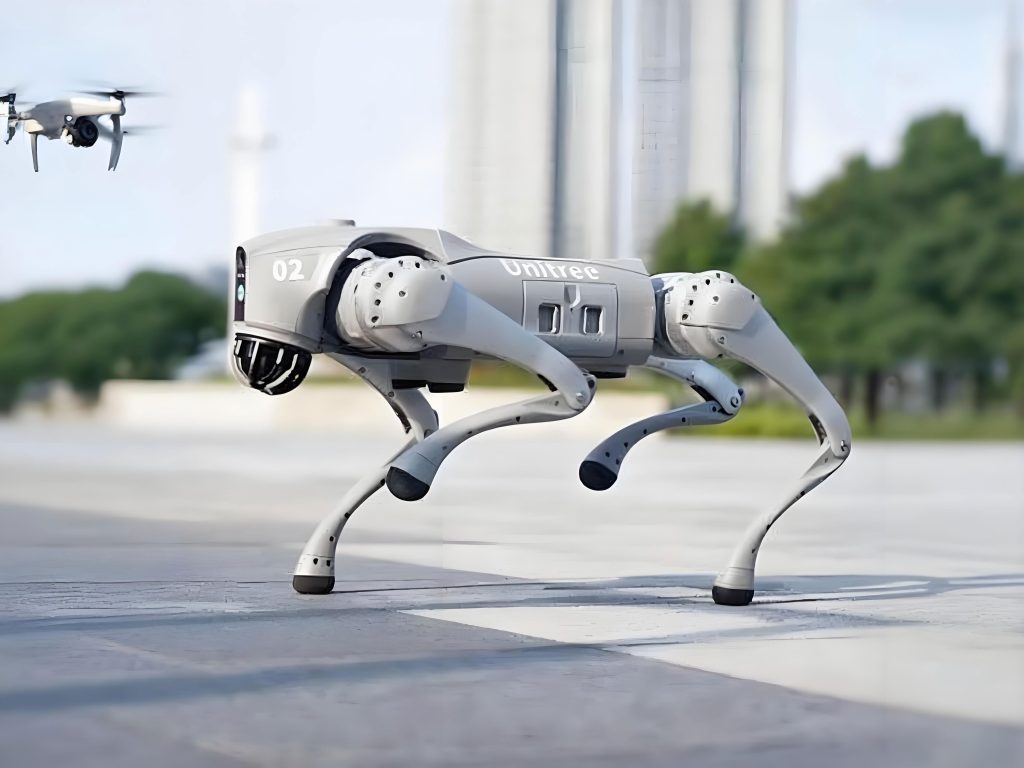
Moving to functional implementation, I developed a remote control system that integrates ground monitoring, underground processing, and data acquisition. The bionic robot’s software architecture is built on an embedded Linux system for the main processor, which handles video streaming from an OV7670 camera and environmental data from sensors via ADCs. The motion controller, a separate microcontroller, executes movement commands received wirelessly, using PID control algorithms for precise navigation. The control law for wheel speed adjustment is given by:
$$ u(t) = K_p e(t) + K_i \int_0^t e(\tau) d\tau + K_d \frac{de(t)}{dt} $$
where \( u(t) \) is the control signal, \( e(t) \) is the error between desired and actual position, and \( K_p, K_i, K_d \) are tuning parameters. This ensures smooth traversal over obstacles. Data transmission occurs through a wireless module, such as an ENC28J60 Ethernet controller with lwIP stack, sending packets to a ground-based PC. The PC software, which I coded in Python, displays real-time sensor readings and video feeds, allowing operators to control the bionic robot via a graphical interface. Key functionalities include initialization of drivers, command monitoring, status listening, and image processing. For example, the bionic robot can be directed to move forward while streaming video, with sensors sampling at 1 Hz intervals. The data flow path is: sensors → microcontroller → wireless module → ground PC, with latency under 100 ms to ensure timely responses. This system empowers the bionic robot to act as an extension of human operators, reducing exposure to dangers.
To validate the bionic robot’s performance, I conducted extensive testing in simulated mine conditions. The tests focused on sensor accuracy, mobility, and communication reliability. For gas detection, I compared the bionic robot’s oxygen sensor readings against a chromatograph in a sealed chamber, recording values every 2 minutes. The results, summarized in Table 1, show minimal error, confirming the bionic robot’s capability for precise environmental monitoring.
| Time (min) | Bionic Robot Sensor Value (%) | Chromatograph Value (%) | Error (%) |
|---|---|---|---|
| 2 | 21.15 | 21.41 | 1.2 |
| 4 | 21.13 | 21.39 | 1.2 |
| 6 | 21.15 | 21.40 | 1.1 |
| 8 | 21.17 | 21.41 | 1.1 |
| 10 | 21.13 | 21.39 | 1.2 |
The average error is 1.16%, well within acceptable limits for safety applications. Similarly, temperature sensor testing in a heated enclosure yielded consistent results, as shown in Table 2. The bionic robot’s thermistor readings were compared to a standard mercury thermometer, with errors below 2%, demonstrating reliability across varying conditions.
| Time (min) | Bionic Robot Sensor Value (°C) | Thermometer Value (°C) | Error (%) |
|---|---|---|---|
| 2 | 21.5 | 21.9 | 1.8 |
| 4 | 27.1 | 27.5 | 1.4 |
| 6 | 31.3 | 31.8 | 1.5 |
| 8 | 31.3 | 31.6 | 1.5 |
| 10 | 29.9 | 30.4 | 1.6 |
Mobility tests involved obstacle courses with ramps and debris; the bionic robot successfully climbed inclines up to 30 degrees using its wheel-track system, with speed maintained at 0.5 m/s. The power consumption during these trials averaged 25W, aligning with design estimates. Communication range was tested in a tunnel-like environment, achieving stable wireless links up to 100 meters, sufficient for most mine sections. Video streaming quality was assessed through frame rate and resolution; the bionic robot transmitted 640×480 video at 15 fps with minimal lag, allowing operators to identify hazards clearly. These tests affirm that the bionic robot meets the core requirements for underground surveys, providing a robust platform for safety enhancement.
In addition to functional tests, I analyzed the bionic robot’s data processing efficiency using mathematical models. The sensor data fusion algorithm combines inputs from multiple sources to improve accuracy. For instance, gas concentration readings are filtered with a Kalman filter to reduce noise, described by the state-space equations:
$$ x_{k} = A x_{k-1} + B u_{k-1} + w_{k-1} $$
$$ z_{k} = H x_{k} + v_{k} $$
where \( x_{k} \) is the state vector (e.g., true concentration), \( z_{k} \) is the measurement, \( w_{k} \) and \( v_{k} \) are process and measurement noise, and \( A, B, H \) are matrices defining system dynamics. This approach enhances the bionic robot’s ability to detect subtle changes in environmental conditions. Similarly, path planning for the bionic robot utilizes A* algorithm to compute optimal routes, minimizing energy consumption. The cost function is defined as:
$$ f(n) = g(n) + h(n) $$
where \( g(n) \) is the cost from start to node \( n \), and \( h(n) \) is a heuristic estimate to the goal. These algorithms are implemented on the embedded processor, ensuring real-time performance. The bionic robot’s software also includes fail-safe mechanisms, such as automatic return-to-base if communication is lost, based on stored maps. This intelligence makes the bionic robot not just a data collector, but an autonomous agent capable of adaptive decision-making.
Despite these successes, the bionic robot has limitations that warrant future improvements. Currently, it lacks advanced image processing for automatic obstacle avoidance, relying heavily on remote control. Integrating machine learning algorithms, such as convolutional neural networks (CNNs), could enable the bionic robot to recognize hazards like cracks or gas leaks independently. The CNN output for image classification can be expressed as:
$$ y = \sigma(W * x + b) $$
where \( x \) is the input image, \( W \) are weights, \( b \) is bias, \( * \) denotes convolution, and \( \sigma \) is an activation function. Additionally, expanding sensor capabilities to include particulate matter detection or seismic sensors would enhance early warning systems. Power autonomy could be increased with solar charging or energy harvesting from mine vibrations. The bionic robot’s communication range might be extended using mesh networking, allowing multiple bionic robots to collaborate in large mines. These enhancements would transform the bionic robot into a more intelligent and resilient system, further reducing human risk in mining operations.
In conclusion, the design of this bionic robot for underground coal mine safety survey represents a significant step toward industrial disaster prevention. By combining embedded systems, sensor technology, and bionic locomotion, I have created a versatile platform that monitors environmental parameters in real-time, transmits data wirelessly, and navigates challenging terrains. The bionic robot’s hardware and software integration ensures reliable performance, as validated through rigorous testing. While there is room for advancement—particularly in autonomy and sensor diversity—this bionic robot already demonstrates the potential to save lives and improve productivity in hazardous settings. As mining industries evolve, such bionic robots will become indispensable tools, embodying the fusion of robotics and safety engineering. Moving forward, I plan to refine the bionic robot’s capabilities, focusing on smarter algorithms and broader applications, ultimately contributing to a safer working environment for all.