
In the field of rescue operations, especially in confined environments such as mines, oil wells, and narrow shafts, traditional human labor and large machinery often face significant challenges due to space limitations and safety risks. To address these issues, we have developed a novel bionic robot inspired by the locomotion and functionality of spiders. This bionic robot utilizes a pendulum-based vector grasping mechanism controlled by a microcontroller, enabling it to perform detection, repair, and basic rescue tasks in vertical or deep underground settings. The core innovation lies in mimicking spider silk-spinning for descent and pendulum-like swinging for obstacle avoidance and targeted access, offering a versatile solution for specialized environments. This study delves into the design principles, mechanical structures, control systems, and experimental validation of this bionic robot, emphasizing its potential to revolutionize rescue and repair operations in hazardous spaces.
The concept of rescue robots has evolved significantly, with various forms including aerial, aquatic, and terrestrial platforms. However, existing robots often struggle in vertical, narrow, and complex environments like mine shafts or oil wells. Our approach leverages bionics, specifically spider-inspired mechanisms, to overcome these limitations. While many bionic robots replicate spider walking for multi-legged mobility, our design incorporates additional biomimetic features such as simulated silk-spinning for controlled descent and pendulum-based vector grasping for precise navigation. This combination enhances the bionic robot’s adaptability to deep vertical channels, where conventional multi-legged robots may fail. The integration of these features not only addresses practical challenges but also expands the application scope of bionic robots in engineering contexts, paving the way for more innovative solutions in disaster response and industrial maintenance.
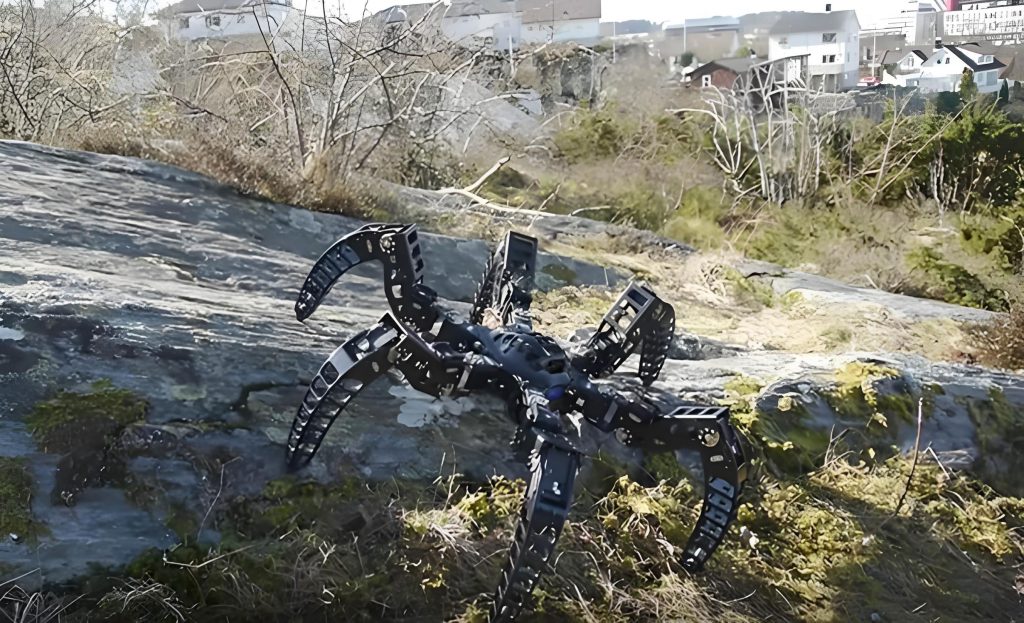
The working principle of our bionic robot revolves around a coordinated system of descent, swinging, and grasping. It operates by suspending from a cable, much like a spider lowering itself on silk, with the cable controlled by a winch mechanism managed by a microcontroller. This allows the bionic robot to descend or ascend to desired depths in vertical shafts. During descent, if obstacles, target objects, or trapped individuals are detected, the bionic robot employs a vector thrust system to initiate a pendulum motion. By adjusting the thrust direction and magnitude, it swings toward the target, enabling precise positioning. Once within range, the bionic robot’s six mechanical arms coordinate to grasp and secure items or persons. Finally, the winch retracts the cable to retrieve the bionic robot along with its payload. This process is automated through sensors and control algorithms, ensuring efficient operation in dark or hazardous conditions. The bionic robot’s ability to combine pendulum dynamics with vector control sets it apart from traditional救援 machines, offering a unique blend of flexibility and precision.
To realize this bionic robot, we utilized SolidWorks for comprehensive structural design, resulting in a model with dimensions of 310 mm × 250 mm × 180 mm and a mass of 2.3 kg. The design encompasses four main components: the spider-like main body, six mechanical arms, a vector air propulsion system, and a cable release-retrieval mechanism. Each component was optimized for weight, strength, and functionality, using materials such as lightweight aluminum alloy for the arms, carbon fiber composites for the body, and high-strength woven rope for the cable. The bionic robot’s compact size ensures it can navigate narrow passages, while its robust construction withstands the rigors of underground environments. The following sections detail each subsystem, highlighting how they contribute to the overall performance of this advanced bionic robot.
Mechanical Arm Design for Enhanced Mobility and Grasping
The mechanical arms of our bionic robot are critical for both locomotion and grasping tasks. Inspired by spider legs, we adopted a six-arm configuration instead of eight to simplify control and reduce complexity, while maintaining sufficient degrees of freedom for versatile movement. Each arm consists of three segments: a front leg, middle leg, and rear leg, connected by three servo motors, providing three degrees of freedom per arm. This design allows the bionic robot to perform complex maneuvers such as crawling, grasping, and stabilizing during pendulum motions. The front legs are elongated and fitted with silicone sleeves for enhanced grip and support on uneven surfaces, while the middle and rear legs facilitate bending and swinging motions. Compared to traditional six-legged robots, our design features enlarged joint dimensions for increased durability, essential for withstanding forces during pendulum-based抓取. The coordination of all six arms enables the bionic robot to execute synchronized actions, such as抱合抓取, making it highly effective in confined spaces. The table below summarizes key parameters of the mechanical arms:
| Component | Material | Length (mm) | Degrees of Freedom | Function |
|---|---|---|---|---|
| Front Leg | Aluminum Alloy | 150 | 1 (bending) | Support and grip |
| Middle Leg | Aluminum Alloy | 100 | 2 (bending and rotation) | Connection and motion |
| Rear Leg | Aluminum Alloy | 80 | 1 (swinging) | Attachment to body |
The dynamics of the mechanical arms can be analyzed using kinematic equations. For instance, the position of each joint can be described by forward kinematics, where the end-effector position (x, y, z) is derived from joint angles (θ₁, θ₂, θ₃). Using the Denavit-Hartenberg parameters, we can model each arm as a series of links and joints. For a single arm, the transformation matrix from the base to the end-effector is given by:
$$ T = A_1 \cdot A_2 \cdot A_3 $$
where each A_i represents the homogeneous transformation matrix for joint i. This allows precise control of the bionic robot’s grasping posture, essential for interacting with targets in three-dimensional space. The integration of these arms into the bionic robot’s framework enhances its ability to perform rescue tasks, such as retrieving objects or stabilizing itself during descent.
Vector Air Propulsion System for Precise Pendulum Motion
To enable pendulum motion in suspended mode, the bionic robot is equipped with a vector air propulsion system. This system generates thrust through rotating propellers, with the direction controlled by servos to achieve vectorized output. Initially, we tested simple propeller setups but found issues with instability and limited torque. Thus, we incorporated a ducted fan design, which improves thrust efficiency, directional stability, and torque, making it ideal for the confined airflow conditions in shafts. The propulsion system is mounted on the bionic robot’s back, allowing it to swing laterally or longitudinally by adjusting thrust vectors. The thrust force (F_thrust) is calculated based on propeller dynamics:
$$ F_{\text{thrust}} = \rho \cdot A \cdot (V_{\text{exit}}^2 – V_{\text{inlet}}^2) $$
where ρ is air density, A is the propeller disk area, and V_exit and V_inlet are exit and inlet velocities, respectively. By modulating servo angles, the bionic robot can control swing amplitude and direction, ensuring accurate targeting. This system is pivotal for the bionic robot’s obstacle avoidance and access capabilities, as it allows controlled pendulum swings of up to 75° from the vertical, as confirmed in tests. The propulsion system’s parameters are summarized below:
| Parameter | Value | Unit |
|---|---|---|
| Thrust Force | 27 | N |
| Propeller Diameter | 120 | mm |
| Duct Length | 150 | mm |
| Control Servo Range | 0-180 | degrees |
The bionic robot’s pendulum motion is governed by physics principles. When swinging, it behaves as a compound pendulum due to distributed mass along the cable and robot body. The period (T) of a compound pendulum is given by:
$$ T = 2\pi \sqrt{\frac{I}{mgh}} $$
where I is the moment of inertia, m is total mass, g is gravity, and h is the distance from pivot to center of mass. For our bionic robot, with mass m₀ = 2.3 kg and cable linear density m₁ = 0.05 kg/m, the moment of inertia for a swing length L₃ is:
$$ I = \frac{1}{3} m_1 L_3^3 + m_0 L_3^2 $$
This allows us to predict swing dynamics and optimize thrust application. The bionic robot’s ability to harness vector thrust for controlled swinging exemplifies how bionic principles can be engineered for practical救援 scenarios.
Cable Release-Retrieval Mechanism for Simulated Silk-Spinning
Mimicking spider silk-spinning, the bionic robot incorporates a cable release-retrieval mechanism for descent and ascent. This mechanism consists of a winch driven by a motor, controlled by a microcontroller to precisely manage cable length. The cable is made of high-strength woven rope, chosen for its flexibility and load-bearing capacity, attached to the bionic robot via a pulley system to reduce friction. The winch’s operation is based on feedback control: sensors measure deployed length, and the microcontroller adjusts the motor accordingly. This enables the bionic robot to descend at a controlled speed of 0.5 m/s, as tested, ensuring safe and stable operation in deep shafts. The mechanism’s design parameters include winch drum diameter, motor torque, and cable strength, all tailored to support the bionic robot’s weight and additional payload during retrieval. The use of this mechanism transforms the bionic robot into a versatile tool for vertical exploration, akin to abseiling in human救援 operations.
The force analysis for the cable system involves tension (T) calculations. During descent, tension must balance gravity and any additional forces:
$$ T = m_0 g + F_{\text{external}} $$
where F_external includes aerodynamic drag or interaction forces. The winch motor must provide sufficient torque τ:
$$ \tau = T \cdot r $$
with r being the drum radius. This ensures reliable operation, a key aspect of the bionic robot’s reliability in harsh environments.
Pendulum-Based Vector Grasping: Theory and Implementation
The core functionality of our bionic robot is pendulum-based vector grasping, which combines swinging motion with precise grasping. The process begins with the bionic robot descending to a depth L₁, while photoelectric sensors scan horizontally for targets at distance L₂. Using these measurements, the microcontroller computes the required swing length L₃ to reach the target:
$$ L_3 = \sqrt{L_1^2 + L_2^2} $$
Upon reaching L₃, the vector propulsion system activates to initiate a pendulum swing. The swing dynamics are analyzed using energy methods. The kinetic energy (E) at the lowest point of the swing is derived from potential energy conversion:
$$ E = m_0 g L_3 (1 – \cos \theta) $$
where θ is the swing angle. For small angles, this simplifies to:
$$ E \approx \frac{1}{2} m_0 g L_3 \theta^2 $$
The velocity (v) at the bottom is:
$$ v = \sqrt{2g L_3 (1 – \cos \theta)} $$
In tests, with θ up to 75°, we achieved a descent speed of 0.5 m/s. The grasping force of the mechanical arms is designed to be 30 N, sufficient to hold objects or stabilize during retrieval. The vector thrust required to control the swing is calculated from acceleration needs. For instance, to achieve a stable swing within 2 seconds, acceleration a = v/t yields a thrust force F = m₀a ≈ 0.575 N, though our system provides up to 27 N for robustness. This integrated approach allows the bionic robot to navigate around obstacles and access otherwise unreachable areas, showcasing the versatility of bionic robot designs.
The grasping process involves coordinated arm movements. Each arm’s servo motors are controlled to envelop targets, with force sensors ensuring secure grip without damage. This makes the bionic robot suitable for delicate operations, such as retrieving tools or assisting trapped individuals. The table below summarizes key performance metrics from our vector grasping tests:
| Test Metric | Average Value | Range | Unit |
|---|---|---|---|
| Swing Angle | 70.5 | 65-75 | degrees |
| Grasping Force | 30.0 | 29.9-30.1 | N |
| Vector Thrust | 27.0 | 26.8-27.3 | N |
| Descent Speed | 0.50 | 0.48-0.52 | m/s |
Control System Architecture for Autonomous Operation
The bionic robot’s control system is built around an ARM7 microcontroller, specifically the LPC2131 chip, which serves as the core for both manual and autonomous modes. The system is divided into上位机 and下位机 components, though we refer to them as the central controller and peripheral modules for clarity. The下位机 includes sensor modules, actuator drivers, and communication interfaces, while the上位机 involves a LabVIEW-based interface for data monitoring and command issuance. Sensors such as photoelectric detectors and temperature probes feed environmental data to the microcontroller, which processes it to guide the bionic robot’s actions. For example, if an obstacle is detected, the system triggers pendulum motion via the vector propulsion system. The control flow is illustrated in the software flowchart, where initialization is followed by mode selection: manual control allows remote operation, while autonomous mode uses sensor feedback for decision-making. This dual-mode capability enhances the bionic robot’s adaptability in unpredictable救援 scenarios.
Mathematically, control algorithms involve PID (Proportional-Integral-Derivative) controllers for precise movement. For the winch mechanism, position control is achieved by:
$$ u(t) = K_p e(t) + K_i \int e(t) dt + K_d \frac{de(t)}{dt} $$
where u(t) is the control signal, e(t) is error in cable length, and K_p, K_i, K_d are tuning parameters. Similarly, for vector thrust direction, servo angles are adjusted based on target coordinates. The bionic robot’s autonomy is further enhanced by wireless data transmission, allowing operators to monitor status and intervene if necessary. This robust control framework ensures that the bionic robot can perform complex tasks with minimal human input, reducing risk in dangerous environments.
Experimental Validation and Performance Analysis
We constructed a physical prototype of the bionic robot and conducted extensive tests to validate its design. The prototype matches the SolidWorks model, with a mass of 2.3 kg and dimensions as specified. Tests were performed in simulated shaft environments to evaluate descent, swinging, grasping, and retrieval functions. Key results are consolidated in the table below, demonstrating consistent performance across multiple trials. The bionic robot achieved a maximum swing angle of 75°, with grasping forces around 30 N and vector thrust up to 27 N. Descent speed was maintained at approximately 0.5 m/s, ensuring controlled movement. These tests confirm the bionic robot’s capability to operate in vertical spaces, with potential applications in mine救援, oil well inspection, and industrial maintenance. The reliability of the bionic robot was high, with no failures observed during testing, underscoring the durability of its components.
| Trial | Descent Speed (m/s) | Vector Thrust (N) | Max Swing Angle (degrees) | Grasping Force (N) |
|---|---|---|---|---|
| 1 | 0.50 | 27.1 | 65 | 30.1 |
| 2 | 0.52 | 27.3 | 70 | 30.0 |
| 3 | 0.51 | 26.8 | 74 | 29.9 |
| 4 | 0.49 | 26.9 | 66 | 30.0 |
| 5 | 0.50 | 26.9 | 75 | 30.0 |
| 6 | 0.48 | 27.0 | 73 | 30.0 |
| Average | 0.50 | 27.0 | 70.5 | 30.0 |
Further analysis involved stress simulations on mechanical arms using finite element methods in SolidWorks. The results indicated maximum stresses well below yield limits for aluminum alloy, ensuring safety during grasping operations. Additionally, we tested the bionic robot’s power system, which uses polymer lithium batteries and voltage regulators, providing over 2 hours of continuous operation. This endurance is crucial for extended救援 missions. The bionic robot’s performance metrics align with design goals, validating the effectiveness of our biomimetic approach.
Conclusion and Future Directions
In this study, we have presented a comprehensive design and analysis of a pendulum-based bionic robot for rescue and repair tasks in confined vertical environments. The bionic robot integrates spider-inspired mechanisms such as simulated silk-spinning and vectorized pendulum grasping, offering a novel solution to challenges in mines, oil wells, and similar settings. Through detailed mechanical design, control system development, and experimental testing, we have demonstrated that the bionic robot can descend at controlled speeds, swing up to 75° for obstacle avoidance, and exert sufficient grasping force for retrieval operations. The use of lightweight materials and efficient propulsion enhances its practicality. This research contributes to the field of bionic robotics by expanding the functionality of multi-legged robots and providing a reference for specialized救援 applications. Future work may focus on miniaturization, enhanced autonomy through machine learning, and integration with drone technologies for above-ground deployment. Overall, the bionic robot represents a significant step forward in making hazardous environment operations safer and more efficient, underscoring the potential of bionic innovations in engineering.
The development of this bionic robot also opens avenues for interdisciplinary collaboration, combining robotics, mechanics, and biology. As bionic robots evolve, they could incorporate adaptive materials, swarm intelligence, or advanced sensors for even greater capabilities. We believe that continued investment in bionic robot research will yield transformative tools for disaster response, industrial maintenance, and exploration, ultimately saving lives and resources. The journey of this bionic robot from concept to prototype illustrates the power of biomimicry in solving real-world problems, and we anticipate further advancements that will push the boundaries of what bionic robots can achieve.