
The pursuit of advanced mobile robotic systems capable of operating in complex, unstructured environments is a central focus of modern robotics research. Inspired by the remarkable adaptability and locomotion efficiency found in nature, the field of bionics offers profound insights. A bionic robot that mimics the structural configuration and movement principles of biological organisms can achieve superior performance in terms of mobility, stability, and terrain negotiation. Among biological models, hexapods, such as insects, demonstrate exceptional stability and versatility through their tripod gait and segmented leg structure. This work presents the design and comprehensive analysis of a novel mobile platform for a bionic reconfigurable robot, drawing inspiration from six-legged crawling insects. The core innovation lies in a wheel-leg hybrid locomotion mechanism mounted on a transformable chassis, enabling the platform to switch between wheeled rolling for speed on flat terrain and legged walking for obstacle negotiation. This article details the mechanical design, conducts rigorous kinematics and gait analysis, and validates the platform’s dynamic performance through simulation and physical experimentation, confirming the feasibility and rationality of this bionic robot architecture.
The mechanical design of the mobile platform is the foundation of its capabilities. The overall architecture is bio-inspired, replicating the key features of a hexapod’s body plan. The platform consists of two primary subsystems: a central chassis and six identical, symmetrically arranged legs.
Leg Mechanism Design: Each leg of this bionic robot is a serial manipulator with four active degrees of freedom (DOFs), providing the necessary articulation for complex leg trajectories. The leg segments are named analogously to insect morphology: the coxa (root link), femur (thigh), and tibia (shank). A wheel is attached at the distal end (foot). The actuation scheme involves servo motors at the hip (coxa-femur joint), knee (femur-tibia joint), and ankle (tibia-wheel assembly) joints. This multi-joint design allows the leg to perform movements such as protraction/retraction (swinging forward/backward) and lifting/lowering, essential for walking gaits. Crucially, the wheel is not passive; it can be engaged for rolling locomotion or disengaged and locked for pure legged walking, embodying the reconfigurable nature of this bionic robot.
Transformable Chassis Design: To enhance adaptability in confined spaces, the chassis is designed to be scalable. It employs a circular plate mounted on a linear guide mechanism actuated by a leadscrew and motor. This allows the diameter of the chassis to expand or contract, effectively changing the robot’s footprint and stability polygon without altering the leg attachment points. This feature is critical for a reconfigurable bionic robot to navigate through narrow passages or adjust its stability for different payloads or slopes.
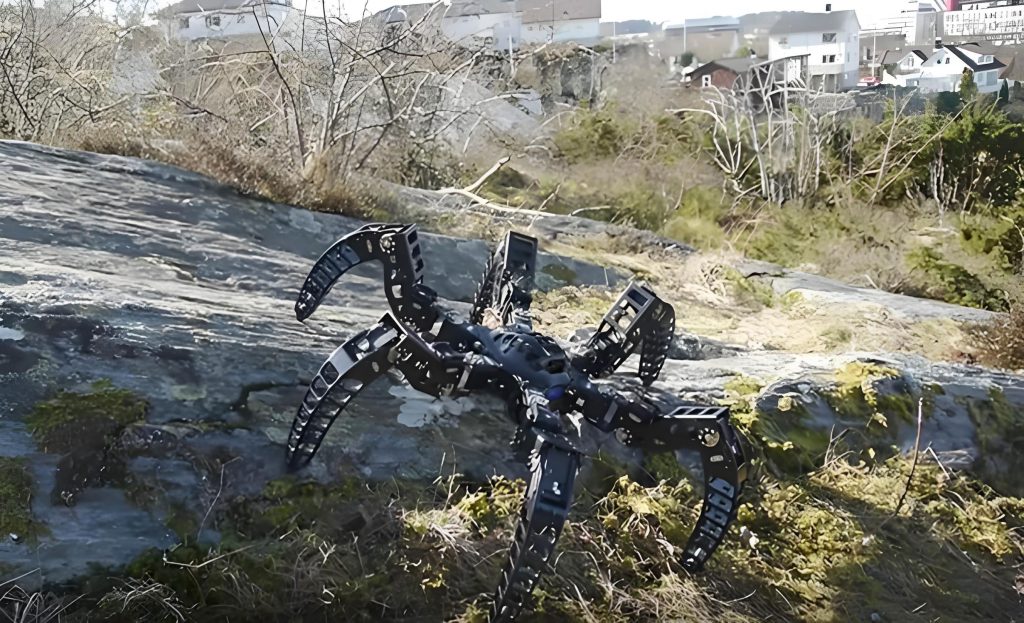
The integrated design of the wheel-leg mechanism and scalable chassis results in a highly versatile bionic robot platform. The physical prototype successfully integrates these components, demonstrating the practical manufacturability of the design. The following table summarizes the key dimensional parameters of the leg mechanism used for analysis.
| Link Name | Symbol | Length (m) |
|---|---|---|
| Coxa Link | $l_1$ | 0.130 |
| Femur Link | $l_2$ | 0.080 |
| Tibia Link | $l_3$ | 0.080 |
| Body Offset (Chassis Radius) | $l_4$ / $H/2$ | 0.060 |
Kinematic Modeling and Gait Analysis
To precisely control the bionic robot, a mathematical model of its leg kinematics is essential. This involves defining the relationship between the joint angles and the position of the foot (or the body) in space.
Forward Kinematics
The Denavit-Hartenberg (D-H) convention is used to assign coordinate frames to each link of a single leg. The base frame $\{O_0\}$ is attached to the foot (end-effector), and the frames $\{O_1\}$, $\{O_2\}$, $\{O_3\}$ are attached to the ankle, knee, and hip joints, respectively. The body frame $\{O_c\}$ is located at the geometric center of the chassis. The D-H parameters are established as follows:
| Link $i$ | $\alpha_{i-1}$ | $a_{i-1}$ | $d_i$ | $\theta_i$ |
|---|---|---|---|---|
| 1 (Ankle to Knee) | 90° | $l_1$ | 0 | $\theta_1$ |
| 2 (Knee to Hip) | 0° | $l_2$ | 0 | $\theta_2$ |
| 3 (Hip to Body) | -90° | $l_3$ | 0 | $\theta_3$ |
The homogeneous transformation matrix between consecutive frames is given by:
$$ ^{i-1}_i T = \begin{bmatrix}
\cos\theta_i & -\sin\theta_i\cos\alpha_{i-1} & \sin\theta_i\sin\alpha_{i-1} & a_{i-1}\cos\theta_i\\
\sin\theta_i & \cos\theta_i\cos\alpha_{i-1} & -\cos\theta_i\sin\alpha_{i-1} & a_{i-1}\sin\theta_i\\
0 & \sin\alpha_{i-1} & \cos\alpha_{i-1} & d_i\\
0 & 0 & 0 & 1
\end{bmatrix} $$
The position of the body center $^0P_c$ with respect to the foot frame is found by concatenating the transformations. Assuming the body center coincides with the geometric center and the chassis width is $H$ (where $H = 2l_4$), the coordinates are:
$$ ^0P_c = ^0_1T \cdot ^1_2T \cdot ^2_3T \cdot ^3P_c $$
This yields the forward kinematic equations:
$$ \begin{aligned}
^0P_{c,x} &= \frac{H}{2} \cos(\theta_1 + \theta_2) \cos \theta_3 + l_1 + l_3 \cos(\theta_1 + \theta_2) \\
^0P_{c,y} &= \frac{H}{2} \sin \theta_3 \\
^0P_{c,z} &= \frac{H}{2} \sin(\theta_1 + \theta_2) \cos \theta_3 + l_2 \sin \theta_1 + l_3 \sin(\theta_1 + \theta_2)
\end{aligned} $$
where $^0P_{c,x}$, $^0P_{c,y}$, $^0P_{c,z}$ are the coordinates of the body center in the foot frame. These equations allow us to calculate the body position for any given set of joint angles $\theta_1, \theta_2, \theta_3$.
Inverse Kinematics
For motion planning, we often need to determine the joint angles required to place the body at a specific position relative to the foot (or vice-versa). Solving the forward kinematics equations for $\theta_1, \theta_2, \theta_3$ gives the inverse kinematic solution:
$$ \begin{aligned}
\theta_3 &= \arcsin\left( \frac{2 \cdot ^0P_{c,y}}{H} \right) \\
\theta_1 &= \arcsin\left( \frac{ ^0P_{c,z} – \left( \frac{H}{2}\cos\theta_3 + l_3 \right) \sqrt{1 – \left( \frac{^0P_{c,x} – l_1}{ \frac{H}{2}\cos\theta_3 + l_3 } \right)^2 } }{l_2} \right) \\
\theta_2 &= \arccos\left( \frac{^0P_{c,x} – l_1}{ \frac{H}{2}\cos\theta_3 + l_3 } \right) – \theta_1
\end{aligned} $$
These equations are fundamental for generating joint trajectories during the gait cycles of the bionic robot.
Maximum Stride Length Analysis
A key performance metric for a walking bionic robot is its stride length. We analyze the simplified leg geometry in the sagittal plane to find the maximum possible step length $h_{max}$. The leg is modeled with links of length $l_1, l_2, l_3$ and a body offset $l_4$. The stride length $h$ for a given hip (root) joint rotation $\alpha$ is related to the projection $r$ and body height $H_1$:
$$ h = 2 \sqrt{r^2 + H_1^2} \cdot \sin(\alpha/2) $$
The term $r^2 + H_1^2$ is a function of the internal joint angles $\beta$ (femur-tibia) and $\gamma$ (coxa-femur):
$$ r^2 + H_1^2 = l_1^2 + l_2^2 + l_3^2 + l_4^2 – 2l_1 l_2 \cos \gamma – 2l_2 l_4 \cos \beta + 2l_2 l_3 \sin \beta + 2l_1 l_4 \cos(\gamma – \beta) + 2l_1 l_3 \sin(\gamma – \beta) $$
Substituting the numerical parameters from the design table and analyzing this function, we find its maximum value $ (r^2 + H_1^2)_{max} \approx 0.08037 \, \text{m}^2 $ occurs at $\beta = 90^\circ$ and $\gamma = 135^\circ$. Assuming a maximum practical hip rotation of $\alpha = 30^\circ$, the theoretical maximum stride length for this bionic robot leg is:
$$ h_{max} = 2 \times \sqrt{0.08037} \times \sin(15^\circ) \approx 0.28 \, \text{m} $$
This calculation provides a target for gait planning and influences the overall mobility speed of the legged platform.
Gait Planning for Legged Locomotion
Efficient and stable legged locomotion requires a coordinated sequence of leg movements, known as a gait. For a hexapod bionic robot, the tripod gait is the most statically stable and efficient for straightforward locomotion. In this gait, the six legs are partitioned into two alternating tripod groups: Group A (Left Front, Right Middle, Left Rear) and Group B (Right Front, Left Middle, Right Rear).
At any instant, one group forms a stable triangular support polygon while the legs in the other group are in the swing phase, lifted and moving forward. This ensures the robot’s center of mass (CoM) always remains within the support polygon, guaranteeing static stability. The duty factor $\beta$ (fraction of cycle time a leg is on the ground) for this gait is 0.5. The phase relationship between legs is critical. The following table defines the ideal phase offsets for a standard tripod gait, where a phase of 0.0 or 1.0 indicates the leg is in sync with the cycle start for the support phase.
| Leg Position | Ideal Phase Offset | Group |
|---|---|---|
| Left Front (LF) | 0.0 | A |
| Right Middle (RM) | 0.5 | B |
| Left Rear (LR) | 0.0 | A |
| Right Front (RF) | 0.5 | B |
| Left Middle (LM) | 0.5 | B |
| Right Rear (RR) | 0.0 | A |
The foot trajectory for a swing leg is typically defined by a curve that lifts the foot off the ground, moves it forward, and lowers it back down smoothly. A common method uses a compound cycloidal or polynomial function to define the foot’s position in the body frame over the swing period $T_{sw}$. For example, the vertical (Z) motion can be defined to clear obstacles:
$$ z(t) = \begin{cases}
h_{max} \cdot \left( \frac{t}{T_{sw}} – \frac{1}{2\pi}\sin\left(\frac{2\pi t}{T_{sw}}\right) \right), & 0 \le t \le T_{sw} \\
0, & \text{otherwise}
\end{cases} $$
where $h_{max}$ is the maximum lift height. The corresponding X (forward) motion is synchronized with this. The inverse kinematics equations are then used to translate these planned foot trajectories into joint angle commands for each servo motor, driving the walking motion of the bionic robot.
Dynamic Simulation and Experimental Validation
To verify the design and control strategies before physical implementation, a dynamic simulation model of the complete bionic reconfigurable robot was developed. The virtual prototype incorporates all 24 active degrees of freedom (4 joints per leg × 6 legs) with realistic mass properties, joint limits, and friction models.
Wheeled Locomotion Mode
In this mode, the ankle joints rotate to position the wheels for ground contact, while the hip and knee joints retract the legs to a compact posture. Propulsion is achieved by directly driving the wheels. The simulation sequence involves: 1) Transition from a standing posture to wheel engagement; 2) Forward rolling motion.
The dynamic response was analyzed by tracking the displacement and acceleration of the platform’s center of mass (CoM). The results show that during steady wheeled motion, the CoM displacement in the forward direction (Y-axis) increases linearly, indicating constant velocity, while displacements in the lateral (X) and vertical (Z) axes remain nearly constant. The forward acceleration is close to zero post-transition, but vertical acceleration shows minor oscillations. These oscillations are attributed to imperfections in joint control and ground contact modeling but do not indicate instability. The simulation confirms that the bionic robot platform can achieve stable, smooth rolling locomotion, validating the mechanical design for this mode.
Legged Tripod Gait Mode
For legged walking, the tripod gait was implemented using the phase table and trajectory planning described earlier. The simulation captures the full cyclic motion of the legs and the resulting body movement.
The CoM trajectory analysis reveals characteristic patterns of statically stable walking. The forward (Y) displacement shows a steady, incremental increase corresponding to each step cycle. The lateral (X) and vertical (Z) displacements exhibit periodic oscillations synchronized with the gait cycle as the body sways slightly over the alternating support tripods. This is a normal and expected behavior for legged bionic robot locomotion. The acceleration profiles further confirm this periodic dynamic, with no evidence of sudden, large jerks that would signify tipping or loss of stability. The simulation successfully demonstrates that the platform can execute a stable, continuous tripod gait.
Physical Prototype Testing
A physical prototype was constructed based on the design. Experiments were conducted for both operational modes, closely following the sequences validated in simulation.
Wheeled Mode Test: The prototype successfully transitioned from a standing configuration to wheeled motion. The sequence involved adjusting the hip and ankle servos to retract the legs and lower the wheels, followed by activating the wheel drives. The platform moved forward smoothly on flat ground, with no noticeable vibration or tendency to overturn, corroborating the simulation predictions.
Legged Mode Test: The platform executed the tripod gait effectively. The alternating groups of three legs lifted, swung forward, and placed down in a coordinated manner, propelling the robot forward. The body remained stable throughout the process, with the support triangle consistently maintaining balance. The successful physical implementation of this complex gait on the bionic robot prototype is strong evidence of the soundness of the mechanical design, kinematic model, and basic gait controller.
Discussion and Comparative Analysis
The development of this hybrid wheel-leg bionic robot platform addresses a fundamental challenge in mobile robotics: combining the speed and efficiency of wheels with the adaptability and obstacle-crossing capability of legs. The presented design offers a distinct solution through mechanical reconfiguration rather than complex control of a single, fixed morphology.
The kinematic analysis provides a closed-form solution for control, which is computationally efficient for real-time operation on embedded systems. The calculated maximum stride length gives a concrete performance bound for locomotion planning. The choice of the tripod gait is well-justified for a hexapod, offering an optimal balance between stability and speed. While more advanced, dynamically stable gaits (like a flying tripod) could be explored for higher speed, the static stability of the implemented gait is a major advantage for a reconfigurable bionic robot that may carry sensitive payloads or operate on precarious surfaces.
The dynamic simulation served as a crucial low-risk design verification tool. It identified potential issues like servo-induced vibrations before physical construction. The close correlation between simulation results and prototype behavior underscores the accuracy of the dynamic models. The scalability of the chassis, though not exhaustively tested in dynamics here, adds a significant layer of functional adaptability, allowing this bionic robot to modify its stability margin and physical footprint on demand.
Compared to purely wheeled or purely legged platforms, this hybrid bionic robot demonstrates clear functional superiority for mixed-terrain applications. Compared to other hybrid designs using complex transformation mechanisms, our approach uses a relatively simple and robust method of switching modes via coordinated joint control. The primary trade-off is increased mechanical complexity (24 actuators) and the associated challenges in weight distribution and power management. Future work will focus on optimizing the control system for seamless mode transitions, implementing terrain sensing for autonomous mode selection, and developing more energy-efficient gait patterns to enhance the operational endurance of the bionic robot.
Conclusion
This work has presented the comprehensive design and analysis of a mobile platform for a bionic reconfigurable robot. Inspired by the robust and stable morphology of hexapod insects, the platform features a wheel-leg hybrid locomotion system and a transformable chassis. Detailed kinematic modeling established the mathematical foundation for controlling the robot’s posture and leg movements, including the determination of its maximum stride length. The adoption of the statically stable tripod gait ensures reliable legged locomotion. Extensive dynamic simulations of both wheeled and legged operational modes predicted stable behavior, which was subsequently confirmed by testing on a physical prototype. The successful integration and functioning of all key features—leg articulation, wheel deployment, chassis scaling, and coordinated gait execution—provide strong validation for the mechanical feasibility and design rationality of this novel bionic robot platform. This research contributes a practical and analytically grounded approach to building versatile mobile robots capable of adapting their locomotion strategy to meet the demands of complex, real-world environments.