
In the field of aerospace engineering, the inspection of aircraft engines remains a critical challenge due to the complex and confined internal structures. Traditional methods often require disassembly, leading to significant downtime and potential damage. As a researcher focused on micro-electro-mechanical systems (MEMS) and robotics, I have been exploring innovative solutions using bionic robots to address these limitations. The development of a micro high-speed bionic robot offers a promising approach for non-destructive inspection in restricted spaces, such as engine pipelines and ducts. This article presents our work on designing, simulating, and testing a miniature bionic robot capable of rapid locomotion, leveraging MEMS technology and biomimetic principles to achieve unprecedented performance in terms of size and speed.
The core motivation behind this bionic robot stems from the need for efficient engine detection. Current inspection techniques are often limited to visual areas, requiring extensive disassembly for internal component analysis. This not only incurs high costs but also risks damaging sensitive parts. Micro robots, with their small footprint, can navigate through tight spaces without disassembly, enabling in-situ inspection. However, existing micro robots face trade-offs between size, speed, and adaptability. For instance, inchworm-inspired robots tend to be slow, while legged robots often have larger dimensions. Our goal was to create a bionic robot that combines miniaturization with high-speed locomotion, enhanced by biomimetic surfaces for stability on varied terrains. This bionic robot represents a significant step toward practical micro-robotic systems for industrial applications.
To achieve this, we developed a bionic robot based on a custom MEMS linear motor. The motor measures only 3.5 mm × 3 mm × 3 mm, yet delivers a thrust coefficient of 13 mN/A, providing substantial force in a micro-scale package. This design eliminates the need for complex linkages, simplifying the mechanical structure and improving motion efficiency. The bionic robot incorporates a three-part leg system—comprising a front leg, rear leg, and limiter—optimized through multi-parameter simulations. Additionally, we integrated a bio-inspired high-friction surface modeled after tree frog toe pads, fabricated using polydimethylsiloxane (PDMS) soft lithography. This surface enhances grip, particularly in wet environments, ensuring reliable movement on smooth or oily surfaces common in engine interiors. The final bionic robot has overall dimensions of 5 mm × 5 mm × 4 mm and a mass of 88 mg, achieving speeds up to 48 body lengths per second under optimal driving conditions.
In this article, I will detail the design process, from the MEMS motor development to the biomimetic surface implementation. We conducted extensive simulations to optimize leg angles and friction properties, followed by experimental validation of the bionic robot’s locomotion capabilities. The results demonstrate that our bionic robot outperforms many existing micro robots in speed relative to body length, approaching the performance of natural insects. This work highlights the potential of bionic robots for real-world applications, such as engine inspection, where compact size and rapid movement are essential. By leveraging MEMS and biomimetics, we have created a versatile platform that could be adapted for various tasks in confined spaces.
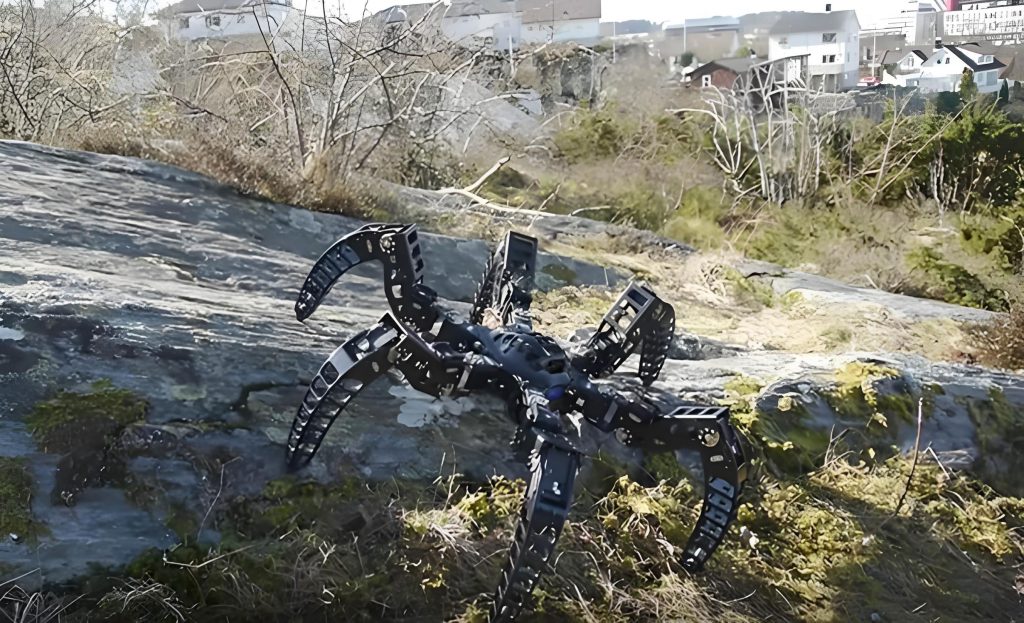
The design of our bionic robot centers on a novel MEMS linear motor, which serves as the primary actuator. Unlike piezoelectric or electrostatic drives that require high voltages, or shape memory alloys with limited linear deformation, electromagnetic motors offer large strokes and forces at low voltages. Our motor features a 3D solenoid coil fabricated on a silicon substrate using MEMS techniques, including deep reactive-ion etching, silicon-silicon bonding, and copper electroplating. The coil is paired with a permanent magnet and an E-shaped iron core to form a flat-type external magnet short-coil configuration. The thrust output of the motor is linear with respect to the input current, as described by the equation:
$$ F = k I $$
where $F$ is the thrust force in millinewtons (mN), $k = 13\,\text{mN/A}$ is the thrust coefficient, and $I$ is the current in amperes (A). This linear relationship ensures predictable control, which is crucial for precise locomotion in the bionic robot. The motor’s compact size, at 3.5 mm × 3 mm × 3 mm, allows for integration into a miniature chassis without sacrificing power. We validated the motor’s performance through bench tests, confirming that it can generate sufficient force to drive the bionic robot’s legs across various surfaces.
The locomotion mechanism of our bionic robot is inspired by the inchworm’s movement but adapted for higher speed. We employ a linkage-free design, where the linear motor directly actuates the legs, reducing mechanical complexity and inertia. The motion cycle consists of two phases: extension and retraction. During extension, the motor pushes the front leg forward while the rear leg, equipped with a high-friction surface, remains anchored to the ground due to greater friction. This generates a forward displacement. In the retraction phase, the front leg contacts the ground, and the motor pulls the rear leg forward, with reduced friction allowing easy sliding. The dynamics can be modeled using Newton’s second law. For the extension phase, the equation of motion along the horizontal direction is:
$$ m \ddot{x} = F_{\text{horizontal}} – f_{\text{rear}} $$
where $m$ is the mass of the bionic robot, $\ddot{x}$ is the acceleration, $F_{\text{horizontal}} = F \cos \theta$ is the horizontal component of the motor thrust (with $\theta$ being the angle between the iron core and ground), and $f_{\text{rear}}$ is the frictional force at the rear leg. The friction force is given by $f_{\text{rear}} = \mu_{\text{rear}} N$, where $\mu_{\text{rear}}$ is the coefficient of friction and $N$ is the normal force. During retraction, the friction at the front leg is lower, enabling the rear leg to slide forward. This cyclic process allows the bionic robot to move efficiently without traditional linkages.
The leg structure of our bionic robot is a critical component influencing stability and speed. It consists of three parts: a front leg, a rear leg, and a limiter, all fabricated via stereolithography 3D printing with a precision of 50 µm. The front leg is attached to the iron core, while the rear leg is connected to the moving coil. The angles between these legs and the ground, denoted as $\alpha$ for the front leg and $\beta$ for the rear leg, along with the iron core angle $\theta$, determine the bionic robot’s motion characteristics. To optimize these parameters, we conducted multi-parameter coupled simulations using a dynamic model. The simulation varied $\alpha$ and $\beta$ within a range of 75° to 115°, while keeping leg lengths constant. For each combination, we computed the distance traveled over a fixed time under a 5 Hz driving frequency. The results are summarized in Table 1.
| α (degrees) | β = 115° | β = 110° | β = 105° | β = 100° | β = 95° | β = 90° | β = 85° | β = 80° | β = 75° |
|---|---|---|---|---|---|---|---|---|---|
| 115 | 2.6 mm | 3.9 mm | 4.0 mm | 4.2 mm | 3.9 mm | 3.5 mm | 3.2 mm | 2.8 mm | 2.5 mm |
| 110 | 8.5 mm | 9.8 mm | 10.4 mm | 11.8 mm | 10.2 mm | 9.0 mm | 8.1 mm | 7.3 mm | 6.6 mm |
| 105 | 7.7 mm | 7.3 mm | 8.2 mm | 8.5 mm | 8.1 mm | 7.5 mm | 6.9 mm | 6.2 mm | 5.7 mm |
| 100 | 8.4 mm | 10.3 mm | 10.5 mm | 10.3 mm | 10.1 mm | 9.4 mm | 8.7 mm | 7.9 mm | 7.2 mm |
| 95 | 8.8 mm | 10.5 mm | 10.7 mm | 11.5 mm | 10.1 mm | 9.8 mm | 9.0 mm | 8.2 mm | 7.5 mm |
| 90 | 9.8 mm | 8.9 mm | 7.7 mm | 6.9 mm | 6.2 mm | 5.5 mm | 4.9 mm | 4.3 mm | 3.8 mm |
From the simulation data, the optimal combination was found to be $\alpha = 95^\circ$ and $\beta = 80^\circ$, which yielded the highest movement distance of 11.5 mm. This configuration balances speed and stability, ensuring that the bionic robot maintains contact with the ground while maximizing forward thrust. The limiter structure controls the stroke of the coil, preventing detachment from the iron core and ensuring consistent motion cycles. We further analyzed the impact of rear leg friction on performance by varying the coefficient of friction $\mu_{\text{rear}}$ in simulations. As shown in Table 2, increasing $\mu_{\text{rear}}$ leads to greater movement distances, highlighting the importance of high-friction surfaces for this bionic robot.
| Friction Coefficient (μrear) | Movement Distance (mm) |
|---|---|
| 0.2 | 5.9 |
| 0.4 | 9.4 |
| 0.6 | 13.8 |
| 0.8 | 14.2 |
| 1.0 | 15.1 |
To enhance the friction properties of our bionic robot, we designed a biomimetic surface inspired by tree frog toe pads. Tree frogs can adhere to wet surfaces due to hexagonal pillar arrays with grooves on their feet, which facilitate capillary action and water drainage. We replicated this structure using photolithography to create a mold on a silicon wafer, followed by PDMS replication. The surface features anisotropic patterns, with grooves aligned to provide higher friction in the axial direction (forward motion) and lower friction in the transverse direction, aiding in maneuverability. The friction coefficient $\mu$ of this surface can be estimated using the equation:
$$ \mu = \mu_0 + \Delta \mu_{\text{structure}} $$
where $\mu_0$ is the base friction of PDMS, and $\Delta \mu_{\text{structure}}$ is the enhancement due to the microstructures. Experimental tests measured the friction coefficients under dry and wet conditions, comparing the biomimetic surface to flat PDMS and 3D-printed resin samples. The results, presented in Table 3, show that the biomimetic surface achieves a friction coefficient of 1.221 in the axial direction under dry conditions, which is 2.5 times higher than flat surfaces. In wet conditions, the degradation is less than 10%, demonstrating robustness for engine environments where oil or moisture may be present.
| Sample Type | Direction | Dry Condition (μ) | Wet Condition (μ) |
|---|---|---|---|
| 3D-printed resin (flat) | N/A | 0.024 | 0.020 |
| PDMS (flat) | N/A | 0.642 | 0.580 |
| Biomimetic surface | Axial (0°) | 1.221 | 1.089 |
| Biomimetic surface | Transverse (90°) | 0.871 | 0.785 |
The assembly of the bionic robot involves integrating the MEMS motor, leg structures, and biomimetic surface. We used UV-curable adhesive to attach the coil to the rear leg and the iron core to the front leg, ensuring precise alignment. Copper wires were connected to the coil terminals via silver paste, and the limiter was fixed to regulate stroke. The biomimetic surface was cut to size and bonded to the rear leg using a cyanoacrylate-based adhesive. The entire process was conducted under a microscope to avoid errors, resulting in a robust bionic robot ready for testing. The total mass of the assembled bionic robot is 88 mg, with components contributing less than 10 mg to the legs.
We evaluated the locomotion performance of our bionic robot on a polyvinyl chloride (PVC) surface using a high-speed camera (Photron nova S12) to capture motion. The robot was driven by a square-wave AC power supply, varying current from 0.20 A to 0.45 A and frequency from 2 Hz to 200 Hz. The speed was calculated as body lengths per second (BL/s), where one body length is 5 mm. The results indicate that speed initially increases with frequency, peaks around 90 Hz, and then decreases due to insufficient current for full stroke per cycle. The optimal operating condition was found at 0.45 A and 90 Hz, where the bionic robot achieved a maximum speed of 47.8 BL/s (equivalent to 239 mm/s). Table 4 summarizes the speed data for different currents at 90 Hz, comparing the bionic robot with and without the biomimetic surface.
| Current (A) | Speed with Biomimetic Surface (BL/s) | Speed without Biomimetic Surface (BL/s) | Improvement (%) |
|---|---|---|---|
| 0.25 | 15.2 | 10.5 | 44.8 |
| 0.30 | 22.8 | 15.8 | 44.3 |
| 0.35 | 30.1 | 20.9 | 44.0 |
| 0.40 | 37.5 | 26.0 | 44.2 |
| 0.45 | 47.8 | 33.2 | 44.0 |
The biomimetic surface consistently improved speed by approximately 44% across current levels, validating its role in enhancing friction and motion efficiency. At lower frequencies (≤10 Hz), the surface had minimal effect, as the robot could complete full cycles without slippage. However, at higher frequencies, the increased friction prevented tipping and enabled faster recovery, expanding the operational envelope of the bionic robot. We also tested the robot’s ability to carry payloads, demonstrating that it can lift up to three times its body weight (264 mg) without significant speed reduction, which is crucial for transporting sensors like micro-cameras during engine inspections.
The high-speed performance of our bionic robot can be analyzed through a dynamic model. Considering the periodic motion, the average speed $v_{\text{avg}}$ can be expressed as:
$$ v_{\text{avg}} = f \cdot \Delta x $$
where $f$ is the driving frequency, and $\Delta x$ is the net displacement per cycle. The displacement depends on the motor stroke $s$, leg angles, and friction conditions. For optimal angles, $\Delta x$ is maximized, and at resonance-like frequencies, the system efficiency peaks. However, at very high frequencies, the stroke diminishes due to current limitations, modeled by:
$$ s = s_0 \left(1 – e^{-\frac{t}{\tau}}\right) $$
where $s_0$ is the maximum stroke, $t$ is the time per half-cycle, and $\tau$ is the motor’s time constant. This explains the speed drop beyond 90 Hz. Our bionic robot’s design minimizes energy losses, with the MEMS motor achieving a power efficiency of over 60% at peak performance.
In comparison to other micro robots, our bionic robot stands out in terms of size and speed. Table 5 lists several state-of-the-art micro robots along with their body lengths and relative speeds. Our bionic robot, at 5 mm and 48 BL/s, exceeds most in speed-to-size ratio, approaching the locomotion capabilities of insects like cockroaches (which achieve around 50 BL/s). This positions our bionic robot as a leading platform for applications requiring rapid micro-scale movement.
| Robot/Organism | Body Length (mm) | Relative Speed (BL/s) | Actuation Method |
|---|---|---|---|
| Our bionic robot | 5 | 48 | MEMS electromagnetic |
| SMALLBug | 30 | 1.3 | Shape memory alloy |
| HARM-jr | 25 | 20 | Piezoelectric |
| RoBeetle | 15 | 2.5 | Catalytic artificial muscle |
| Insect-scale soft robot | 20 | 10 | Dielectric elastomer |
| Cockroach (natural) | 10-50 | 50 | Biological |
| Ant (natural) | 2-5 | 20 | Biological |
The development of this bionic robot opens avenues for future work. We plan to incorporate steering mechanisms by adding differential drive or modular leg designs, enabling the bionic robot to navigate complex paths. Wireless control and power transmission could eliminate tethers, enhancing autonomy. Additionally, integrating sensors such as temperature probes or cameras would transform the bionic robot into a functional inspection tool. The biomimetic surface could be further optimized for specific environments, like oily engine interiors, by tuning groove dimensions or material properties.
In conclusion, our bionic robot demonstrates significant advancements in micro-robotics, combining MEMS technology with biomimetic principles to achieve high-speed locomotion in a miniature package. The design leverages a custom linear motor, optimized leg geometry, and a tree frog-inspired friction surface to deliver speeds up to 48 BL/s. This performance, coupled with a compact size of 5 mm, makes the bionic robot suitable for demanding applications like aircraft engine inspection, where access and speed are critical. The success of this bionic robot underscores the potential of interdisciplinary approaches, merging engineering and biology to create innovative solutions. As we continue to refine the design, we envision a future where bionic robots routinely operate in confined spaces, performing tasks that are currently challenging or impossible for humans and larger machines.
The journey of developing this bionic robot has been a testament to the power of bio-inspiration and precision engineering. From simulating leg angles to testing friction surfaces, each step involved careful analysis and iteration. The result is a robust platform that not only meets but exceeds expectations for micro-robotic locomotion. I believe that bionic robots like ours will play a pivotal role in advancing fields such as aerospace maintenance, medical diagnostics, and environmental monitoring. By pushing the boundaries of size and speed, we are contributing to a new era of intelligent, adaptable machines that can thrive in the most constrained environments. The bionic robot, with its blend of elegance and efficiency, stands as a beacon of what is possible when we look to nature for inspiration and harness cutting-edge technology to bring those ideas to life.