
As a researcher immersed in the fields of robotics and artificial intelligence, I have observed with fascination the rapid evolution of machines from mere tools to entities that increasingly resemble living beings. The advent of highly intelligent bionic robots represents a paradigm shift, not only in technology but in our very interaction with the world. In this article, I will explore the profound implications of these advancements, drawing from current developments and projecting future trajectories. The term “bionic robot” will be central to our discussion, as it encapsulates the fusion of biological inspiration with artificial intelligence. Throughout, I will employ tables and mathematical formulations to summarize key concepts, aiming to provide a comprehensive analysis that underscores why these machines are more than just novelties—they are harbingers of a new era.
To begin, let us contrast traditional robots with their bionic counterparts. Traditional robots, often characterized by heavy motors, rigid shells, and mechanical movements, are designed for repetitive tasks in controlled environments. In contrast, a bionic robot incorporates elements like artificial skin,液压仿生 muscles, and flexible spines, enabling motions that mimic natural organisms. This shift is not merely cosmetic; it fundamentally enhances the robot’s ability to integrate into human spaces. For instance, consider the degrees of freedom (DoF), a critical metric for movement capability. While a traditional industrial robot might have limited DoF, a bionic robot like the “Kengoro” model can achieve over 100 DoF, allowing complex, human-like gestures. This can be mathematically expressed as the sum of independent movements across joints:
$$ \text{Total DoF} = \sum_{i=1}^{n} d_i $$
where \( d_i \) represents the degrees of freedom at the \( i \)-th joint, and \( n \) is the number of joints. Such flexibility is enabled by innovations in materials science, which I will detail next.
The technological bedrock of bionic robots lies in advanced materials and actuators. Take, for example, hydraulic bionic muscles that emulate biological muscle function. These systems often consist of elastic capsules filled with fluid, where pressure changes induce contraction and expansion, mimicking natural movement. The force generated can be modeled using principles of fluid dynamics:
$$ F = P \cdot A $$
where \( F \) is the force, \( P \) is the pressure, and \( A \) is the cross-sectional area. Additionally, conductive fibers used in these robots exhibit remarkable properties: they can stretch up to 10 times their original length while increasing conductivity by a factor of 10. This behavior can be approximated by a linear model:
$$ \sigma(\epsilon) = \sigma_0 (1 + \alpha \epsilon) $$
where \( \sigma \) is the conductivity, \( \sigma_0 \) is the initial conductivity, \( \epsilon \) is the strain, and \( \alpha \) is a material constant (around 10 for some fibers). Such materials contribute to safer, more responsive bionic robots. To summarize these components, I present the following table:
| Component | Description | Function in Bionic Robot |
|---|---|---|
| Artificial Skin | Sensor-dense electronic layer | Provides tactile feedback and environmental awareness |
| Hydraulic Bionic Muscle | Elastic capsule with fluid pressure | Enables smooth, flexible movement akin to biological muscles |
| Artificial Vertebrae | Flexible spinal structure | Allows multi-directional bending and twisting |
| Conductive Fibers | Stretchable conductive materials | Serves as wiring that adapts to movement, maintaining connectivity |
| Expression System | Actuated facial features (eyes, mouth) | Facilitates non-verbal communication and emotional expression |
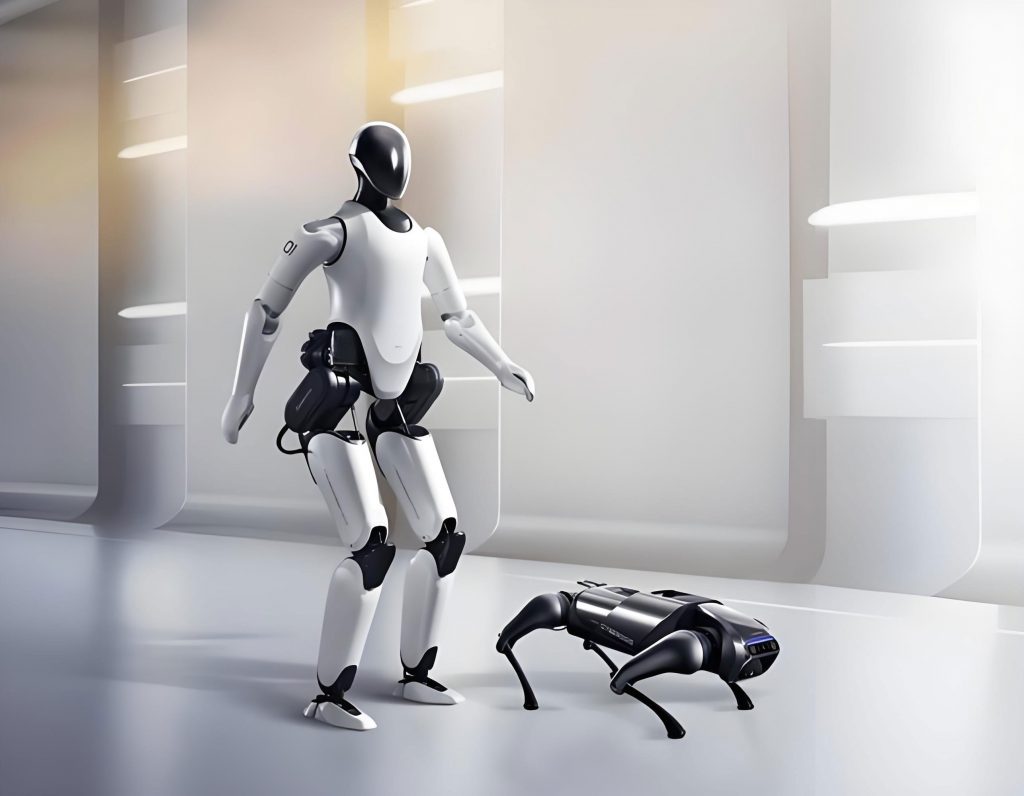
These innovations collectively enhance the bionic robot’s adaptability, making it suitable for diverse tasks—from assisting in healthcare to performing delicate assembly work. The integration of such components is visually embodied in modern designs, as shown below:
Moving beyond physical attributes, the emotional and social impact of bionic robots is equally significant. Humans inherently seek connection, and machines that can simulate understanding and empathy are poised to fill voids in companionship and care. Consider emotion-care robots like “Baymax,” which utilize natural language processing and sentiment analysis to interact with users. The emotional response can be quantified using algorithms that analyze text and facial expressions:
$$ E = \sum_{j=1}^{m} w_j \cdot f_j(\text{input}) $$
where \( E \) is the emotional score, \( w_j \) are weights, and \( f_j \) are features derived from user data. Such robots leverage deep learning to perceive context and respond appropriately, reducing loneliness and stress. For instance, the “ERICA” bionic robot engages in fluent dialogue, with expressions generated through气压 actuators, creating an illusion of genuine interaction. This blurs the line between tool and companion, as summarized in the following table of affective bionic robots:
| Bionic Robot Example | Key Features | Social Role |
|---|---|---|
| ERICA | AI-driven conversation, expressive face, human-like voice | Companion for dialogue, reducing social isolation |
| Baymax (Baidu) | Emotional analytics, cloud data sync, multi-role adaptation | Family-like support, mental health aide |
| Hypothetical Caregiver | Tactile sensors, adaptive learning, mobility assistance | Elderly care, rehabilitation partner |
The proliferation of such bionic robots suggests a future where machines are not just functional but integral to our emotional well-being. This leads us to the core intelligence driving these systems: artificial intelligence. The “brain” of a bionic robot is typically an AI system that has evolved through several cycles of advancement. Since the birth of AI in 1956, the field has experienced three peaks and two troughs, each marked by breakthroughs and setbacks. I summarize this history below:
| Era | Milestone | Impact on Bionic Robots |
|---|---|---|
| 1956-1970s | Dartmouth Conference; perceptron invention | Foundational concepts for machine learning |
| 1970s-1980s | Computational limits; first AI winter | Slowed progress, but spurred hardware research |
| 1980s-1990s | Neural network resurgence; expert systems | Enabled basic pattern recognition in early robots |
| 1990s-2000s | AI hardware failures; second AI winter | Highlighted need for robust algorithms |
| 2010s-present | Deep learning breakthroughs in vision/speech | Catalyzed perceptive intelligence, essential for bionic robot interaction |
Currently, we are in the era of perceptual intelligence, where AI can comprehend language and visual cues. The deep learning algorithms underpinning this rely on neural networks with multiple layers. The forward propagation in such a network can be expressed as:
$$ \mathbf{a}^{(l)} = \sigma(\mathbf{W}^{(l)} \mathbf{a}^{(l-1)} + \mathbf{b}^{(l)}) $$
for layers \( l = 1, 2, \ldots, L \), where \( \mathbf{W}^{(l)} \) and \( \mathbf{b}^{(l)} \) are weights and biases, \( \sigma \) is an activation function like ReLU, and \( \mathbf{a}^{(l)} \) is the activation vector. This mathematical foundation allows bionic robots to learn from vast datasets, improving their performance over time. Moreover, the self-development of bionic robots is accelerated through cloud-based data sharing. As these robots operate in human environments, they accumulate experiential data, which can be modeled as a growth process:
$$ K(t) = K_0 \cdot e^{\int_0^t \lambda(\tau) \, d\tau} $$
where \( K(t) \) is the collective knowledge at time \( t \), \( K_0 \) is initial knowledge, and \( \lambda(\tau) \) is a learning rate that may increase with more interactions. This positive feedback loop means that each bionic robot contributes to the enhancement of all others, fostering rapid innovation.
In practical terms, the deployment of bionic robots spans various sectors. In healthcare, they can assist with surgery or physical therapy, leveraging their precision and adaptability. In domestic settings, they might perform chores while offering companionship. The economic implications are also substantial, as these robots could mitigate labor shortages and boost productivity. To quantify potential benefits, consider a simple cost-benefit analysis for a bionic robot in manufacturing:
$$ \text{Net Benefit} = \sum_{t=1}^{T} \frac{B_t – C_t}{(1 + r)^t} $$
where \( B_t \) and \( C_t \) are benefits and costs in year \( t \), \( r \) is the discount rate, and \( T \) is the time horizon. Benefits include increased output and reduced errors, while costs involve development and maintenance. As technology matures, the net benefit is likely to grow, justifying further investment in bionic robot research.
However, challenges remain. Ethical considerations around autonomy and privacy must be addressed, and technical hurdles like energy efficiency persist. For example, the power consumption of a bionic robot with multiple actuators can be high. Optimizing this requires balancing performance with resource use, perhaps through dynamic control algorithms:
$$ \min_{u(t)} \int_0^T [P(u(t)) + \alpha \cdot \text{error}(t)] \, dt $$
where \( u(t) \) is the control input, \( P \) is power consumption, and \( \alpha \) weights the trade-off between energy and task accuracy. Ongoing research in materials and AI will likely solve many such issues, paving the way for more ubiquitous bionic robots.
In conclusion, the emergence of highly intelligent bionic robots signifies a monumental leap in our technological journey. These machines transcend traditional robotics by blending biological mimicry with advanced AI, enabling them to operate seamlessly in human contexts. From enhancing daily tasks to providing emotional support, and from accelerating their own evolution through learning, bionic robots are poised to become indispensable partners in society. As I reflect on this progress, it is clear that the pursuit of the perfect bionic robot is not just an engineering challenge—it is a quest to create entities that understand and augment the human experience. The future will undoubtedly see these robots becoming more prevalent, and their continued development will hinge on interdisciplinary collaboration, ethical foresight, and relentless innovation. The bionic robot, in essence, embodies humanity’s enduring dream to craft machines in our own image, not merely as tools, but as companions and collaborators in shaping a better world.