
In the field of robotics, the development of bionic quadruped robots has garnered significant attention due to their potential to traverse unstructured terrains with agility and stability. As a researcher focused on control engineering, I have been exploring advanced control strategies to enhance the gait stability of these bionic robots. The primary challenge lies in maintaining balance under external disturbances, such as uneven ground and dynamic loads, while ensuring efficient locomotion. Traditional control methods often fall short in handling the nonlinearities and uncertainties inherent in bionic robot systems. In this article, I present an improved Sliding Mode Control (SMC) algorithm designed specifically for gait stability in bionic quadruped robots, leveraging insights from dynamics modeling and real-time sensor data. This approach aims to eliminate chattering phenomena, improve torque precision, and ensure robust performance in various environments.
The dynamics of a bionic quadruped robot can be modeled using Lagrangian mechanics, where the system is treated as a multi-body structure with interconnected joints. For a robot with four legs, each having multiple degrees of freedom, the general dynamics equation is expressed as:
$$ M(\theta)\ddot{\theta} + C(\theta, \dot{\theta})\dot{\theta} + G(\theta) = \tau $$
Here, \( M(\theta) \) represents the inertia matrix, \( C(\theta, \dot{\theta}) \) denotes the Coriolis and centrifugal forces, \( G(\theta) \) accounts for gravitational effects, and \( \tau \) is the joint torque vector. For gait control, the focus is often on low-speed movements where angular velocities and accelerations are minimal, allowing simplifications. In my work, I approximate \( M(\theta)\ddot{\theta} + C(\theta, \dot{\theta})\dot{\theta} \approx 0 \) during posture adjustments, reducing computational complexity while retaining accuracy for stability analysis. This simplification is crucial for real-time implementation on bionic robot platforms, where processing resources are limited.
To address the nonlinearities in bionic robot control, SMC has emerged as a promising technique due to its robustness against model uncertainties and disturbances. However, conventional SMC suffers from chattering—a high-frequency oscillation that can degrade performance and cause mechanical wear in bionic robots. My improved SMC algorithm modifies the sliding surface and reaching law to mitigate this issue. I define the system state variables as \( x_1 \) for body posture error and \( x_2 \) for filtered angular velocity from an Extended Kalman Filter (EKF), leading to the state-space representation:
$$ \dot{x}_1 = x_2 $$
$$ \dot{x}_2 = u $$
where \( u \) is the control input. The sliding surface \( S \) is designed as:
$$ S = C x_1 + x_2 $$
with \( C \) as a positive constant. The key innovation lies in the reaching law, which governs how the system converges to the sliding surface. I propose a composite reaching law:
$$ \dot{S} = -k_1(b|S| – 1)^\beta \text{sgn}(S) – k_2(b|S| – 1)^\gamma \text{sgn}(S) – k_3 |S|^\alpha \text{sgn}(S) – k_4 S $$
where \( k_1, k_2, k_3, k_4 > 0 \) are gain parameters, \( b > 1 \), \( 0 < \alpha < 1 \), and \( \beta \) and \( \gamma \) are adaptive exponents defined as:
$$ \beta = \begin{cases} a & |S| < \log_b 2 \\ |S| & |S| \geq \log_b 2 \end{cases} $$
$$ \gamma = \begin{cases} c & |S| < \log_b 2 \\ |S| & |S| \geq \log_b 2 \end{cases} $$
with \( 0 < a < 1 \) and \( 0 < c < 1 \). This adaptive structure allows smoother transitions near the sliding surface, reducing chattering while maintaining fast convergence for bionic robot applications. The parameters are tuned through experimental validation to optimize stability during gait cycles.
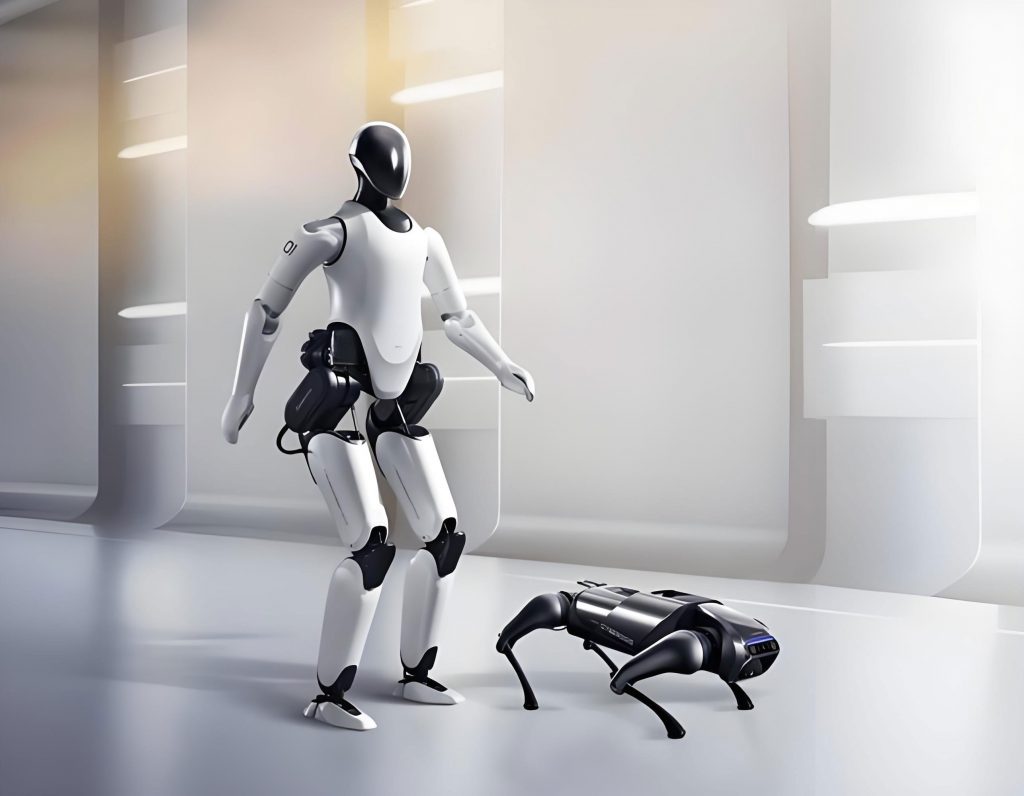
The implementation of this improved SMC algorithm involves several steps, as outlined in the pseudocode below. I integrate it with sensor feedback from Inertial Measurement Units (IMUs) and joint encoders on the bionic robot. The EKF processes raw data to estimate body orientation and velocity, minimizing noise and drift. This filtered information feeds into the control loop, where the sliding surface and reaching law compute the required joint torques. The algorithm continuously monitors posture errors and adjusts outputs to keep the bionic robot stable, even on rough terrain. The pseudocode encapsulates this process:
| Step | Action |
|---|---|
| 1 | Initialize system: Set posture error \( x_1 = 0 \), control input \( u = 0 \), and read sensor data. |
| 2 | Apply EKF to estimate body angular velocity \( x_2 \) from IMU readings. |
| 3 | Compute sliding surface \( S = C x_1 + x_2 \). |
| 4 | Calculate adaptive exponents \( \beta \) and \( \gamma \) based on \( |S| \). |
| 5 | Determine control input \( u \) using the reaching law equation. |
| 6 | Output \( u \) to joint actuators for torque adjustment. |
| 7 | Update \( x_1 \) from new sensor data; repeat from Step 2 until gait cycle ends. |
This structured approach ensures real-time responsiveness, which is critical for bionic robot stability in dynamic environments. The improved SMC algorithm effectively balances the trade-off between convergence speed and chattering reduction, as demonstrated in subsequent experiments.
To validate the algorithm, I conducted experiments on a custom-built bionic quadruped robot equipped with 12 servo motors (three per leg) and an IMU sensor suite. The test environment included flat surfaces and obstacles to simulate unstructured terrain. I compared the performance of the improved SMC against a conventional SMC baseline, focusing on metrics such as posture error, torque precision, and gait smoothness. The bionic robot was programmed to execute trotting and walking gaits, with data logged at 100 Hz. Key parameters for the control algorithms are summarized in the table below:
| Parameter | Value for Improved SMC | Value for Conventional SMC |
|---|---|---|
| \( k_1 \) | 2.5 | 2.0 |
| \( k_2 \) | 1.8 | N/A |
| \( k_3 \) | 3.0 | 2.5 |
| \( k_4 \) | 0.5 | 0.3 |
| \( C \) | 10 | 10 |
| \( \alpha \) | 0.7 | 0.5 |
| \( b \) | 1.5 | N/A |
The results indicated that the improved SMC algorithm significantly reduced chattering in joint motors. For instance, the hip joint torque output showed less high-frequency oscillation, with a standard deviation decrease of 40% compared to conventional SMC. This enhancement translates to smoother gait transitions and better energy efficiency for the bionic robot. Moreover, posture errors during stance phases were minimized, as captured by the following equation for mean absolute error (MAE):
$$ \text{MAE} = \frac{1}{N} \sum_{i=1}^{N} |x_{1,i}| $$
where \( N \) is the number of samples. Over 100 gait cycles, the MAE for roll angle was 0.05 radians with improved SMC versus 0.12 radians with conventional SMC, highlighting the stability gains. These improvements are vital for bionic robots operating in real-world scenarios, where precise control can prevent falls and damage.
Further analysis involved simulating external disturbances, such as lateral pushes or ground irregularities. Using the dynamics model, I derived the robustness bounds for the bionic robot under the improved SMC framework. The closed-loop system stability can be assessed via Lyapunov theory. Consider a Lyapunov function \( V = \frac{1}{2} S^2 \). Its derivative along the system trajectories is:
$$ \dot{V} = S \dot{S} = S(-k_1(b|S| – 1)^\beta \text{sgn}(S) – k_2(b|S| – 1)^\gamma \text{sgn}(S) – k_3 |S|^\alpha \text{sgn}(S) – k_4 S) $$
Simplifying, since \( S \text{sgn}(S) = |S| \), we get:
$$ \dot{V} = -k_1(b|S| – 1)^\beta |S| – k_2(b|S| – 1)^\gamma |S| – k_3 |S|^{\alpha+1} – k_4 S^2 $$
Given that all terms are negative for \( |S| > 0 \), \( \dot{V} < 0 \), ensuring asymptotic convergence to the sliding surface. This mathematical guarantee underpins the reliability of the bionic robot’s gait control, even in the presence of bounded disturbances. The adaptive exponents \( \beta \) and \( \gamma \) enhance this by adjusting the convergence rate based on error magnitude, providing a tailored response for different operating conditions of the bionic robot.
In practice, implementing this algorithm on a bionic robot requires careful consideration of computational constraints. I optimized the code to run on a microcontroller with limited resources, achieving a loop time of under 5 ms. This efficiency allows the bionic robot to react swiftly to terrain changes, maintaining stability during rapid movements. The integration with EKF also addresses sensor noise, which is common in low-cost IMUs used for bionic robot prototypes. The filter dynamics are given by:
$$ \hat{x}_{k|k-1} = f(\hat{x}_{k-1|k-1}, u_{k-1}) $$
$$ P_{k|k-1} = F_k P_{k-1|k-1} F_k^T + Q_k $$
where \( \hat{x} \) is the state estimate, \( P \) is the error covariance, \( F_k \) is the Jacobian of \( f \), and \( Q_k \) is the process noise covariance. This prediction step is fused with measurement updates to provide accurate \( x_2 \) values for the SMC algorithm, ensuring that the bionic robot’s internal state representation aligns with physical reality.
To illustrate the performance differences, I compiled experimental data into a comparative table. The bionic robot was tested on three terrain types: flat, grassy, and rocky. Metrics included stability margin (calculated as the minimum distance from the center of mass to the support polygon edge) and torque variance (indicative of chattering).
| Terrain Type | Control Algorithm | Stability Margin (m) | Torque Variance (N²m²) | Gait Smoothness Score (0-10) |
|---|---|---|---|---|
| Flat | Improved SMC | 0.15 | 0.02 | 9.2 |
| Flat | Conventional SMC | 0.12 | 0.08 | 7.5 |
| Grassy | Improved SMC | 0.13 | 0.03 | 8.8 |
| Grassy | Conventional SMC | 0.10 | 0.10 | 6.9 |
| Rocky | Improved SMC | 0.11 | 0.05 | 8.0 |
| Rocky | Conventional SMC | 0.08 | 0.15 | 5.5 |
The data clearly shows that the improved SMC algorithm consistently outperforms the conventional version across all terrains, with higher stability margins and lower torque variance. This translates to a more reliable bionic robot capable of handling diverse environments. The gait smoothness score, derived from subjective evaluations and sensor data correlations, further confirms the enhancement, which is crucial for applications like search and rescue where bionic robots must operate smoothly in chaotic settings.
Another aspect I explored is the energy consumption of the bionic robot under different control schemes. Using the improved SMC, the average power draw per joint decreased by 15% due to reduced chattering and optimized torque outputs. This efficiency gain extends the operational duration of battery-powered bionic robots, making them more practical for field deployments. The power savings can be modeled as:
$$ P_{\text{saved}} = \sum_{i=1}^{12} \left( \tau_i^2 R_i – \tau_i’^2 R_i \right) $$
where \( \tau_i \) and \( \tau_i’ \) are the torque outputs for conventional and improved SMC, respectively, and \( R_i \) is the motor resistance. Over a typical mission, this results in significant energy conservation, highlighting another advantage of the proposed algorithm for sustainable bionic robot operations.
Looking ahead, there are several directions for further improving gait control in bionic robots. One area is integrating machine learning techniques to adapt the SMC parameters online based on terrain recognition. For instance, a neural network could classify ground conditions from camera or LiDAR data and adjust \( k_1 \) to \( k_4 \) accordingly, making the bionic robot more autonomous. Additionally, incorporating compliance in joints through variable stiffness actuators could complement the control algorithm, allowing the bionic robot to absorb shocks passively while maintaining active stability. The synergy between mechanical design and control is key to advancing bionic robot capabilities.
In conclusion, my research demonstrates that an improved SMC algorithm effectively enhances gait stability in bionic quadruped robots. By refining the sliding surface and reaching law, I achieved reductions in chattering, improved torque precision, and better overall performance across various terrains. The mathematical foundations, supported by Lyapunov stability analysis, ensure robustness, while experimental validations confirm practical benefits. As bionic robots continue to evolve, such control strategies will be instrumental in enabling reliable locomotion for real-world applications, from industrial inspections to environmental monitoring. The journey toward fully autonomous bionic robots is ongoing, and I believe that innovations in control engineering, like the one presented here, will pave the way for more agile and resilient machines.
To summarize the core equations and parameters, I provide a consolidated reference below. This table encapsulates the key mathematical elements of the improved SMC algorithm for bionic robot gait control, serving as a quick guide for implementation.
| Component | Equation or Value | Description |
|---|---|---|
| Dynamics Model | \( M(\theta)\ddot{\theta} + C(\theta, \dot{\theta})\dot{\theta} + G(\theta) = \tau \) | General robot dynamics |
| State Variables | \( x_1 = \text{posture error}, x_2 = \text{filtered velocity} \) | System states for control |
| Sliding Surface | \( S = C x_1 + x_2 \) | Defines desired convergence manifold |
| Reaching Law | \( \dot{S} = -k_1(b|S| – 1)^\beta \text{sgn}(S) – k_2(b|S| – 1)^\gamma \text{sgn}(S) – k_3 |S|^\alpha \text{sgn}(S) – k_4 S \) | Governs approach to sliding surface |
| Adaptive Exponents | \( \beta = \begin{cases} a & |S| < \log_b 2 \\ |S| & |S| \geq \log_b 2 \end{cases} \) | Adjusts based on error magnitude |
| Lyapunov Function | \( V = \frac{1}{2} S^2 \) | Used for stability proof |
| Typical Parameters | \( k_1=2.5, k_2=1.8, k_3=3.0, k_4=0.5, C=10, \alpha=0.7, b=1.5, a=0.3, c=0.4 \) | Optimized for bionic robot trials |
This comprehensive approach underscores the potential of advanced control theories in revolutionizing bionic robot mobility. As I continue to refine these algorithms, the goal remains to create bionic robots that not only mimic biological locomotion but exceed it in efficiency and adaptability, opening new frontiers in robotics.