
In the realm of robotics, the development of quadruped bionic robots has garnered significant attention due to their superior stability, agility, and adaptability compared to bipedal or wheeled systems. These bionic robots mimic the morphology and locomotion of quadrupedal animals, offering promising applications in fields such as military operations, search and rescue, and exploration of unstructured environments. The design and control of such complex bionic robot systems involve intricate considerations of mechanical structure, mass distribution, actuation, and algorithms. To streamline this process, simulation platforms have become indispensable tools, allowing researchers to prototype, test, and refine designs virtually before physical implementation. This reduces costs, accelerates development cycles, and enhances the overall efficiency of creating advanced bionic robot systems. However, many existing simulation solutions are either proprietary, cost-prohibitive, or lack specificity for the unique challenges of quadrupedal locomotion. In this article, we present a dedicated simulation platform for quadruped bionic robots, built upon the SCS (Simulation Construction Set) software package. This platform integrates mechanical modeling, dynamics based on Virtual Model Control (VMC), ground contact modeling, and data processing modules, enabling realistic and efficient motion simulations. Through extensive experiments, we demonstrate the platform’s capability to simulate stable dynamic walking for a 16-degree-of-freedom (DOF) quadruped bionic robot, validating its practicality and reliability for bionic robot research.
The SCS software package, developed by Yobotics, is a powerful tool for 3D motion simulation of complex multi-rigid-body systems, such as mechanical devices and bionic robotic systems. Written entirely in Java, SCS offers an API-extensible user interface and employs three fundamental elements to describe mechanical assemblies: Links, which represent rigid bodies for dynamics computations; LinkGraphics, which define geometric shapes for collision detection; and Joints, which specify constraints between components. SCS incorporates a robust dynamics engine capable of performing accurate and fast calculations for complete rigid-body systems. It can retrieve data on joint positions, velocities, and torques, configure environmental variables like ground geometry and friction coefficients, and provide extensive post-processing features for data visualization and analysis. This makes SCS an ideal foundation for developing specialized simulation environments tailored to specific robotic platforms, such as quadruped bionic robots.
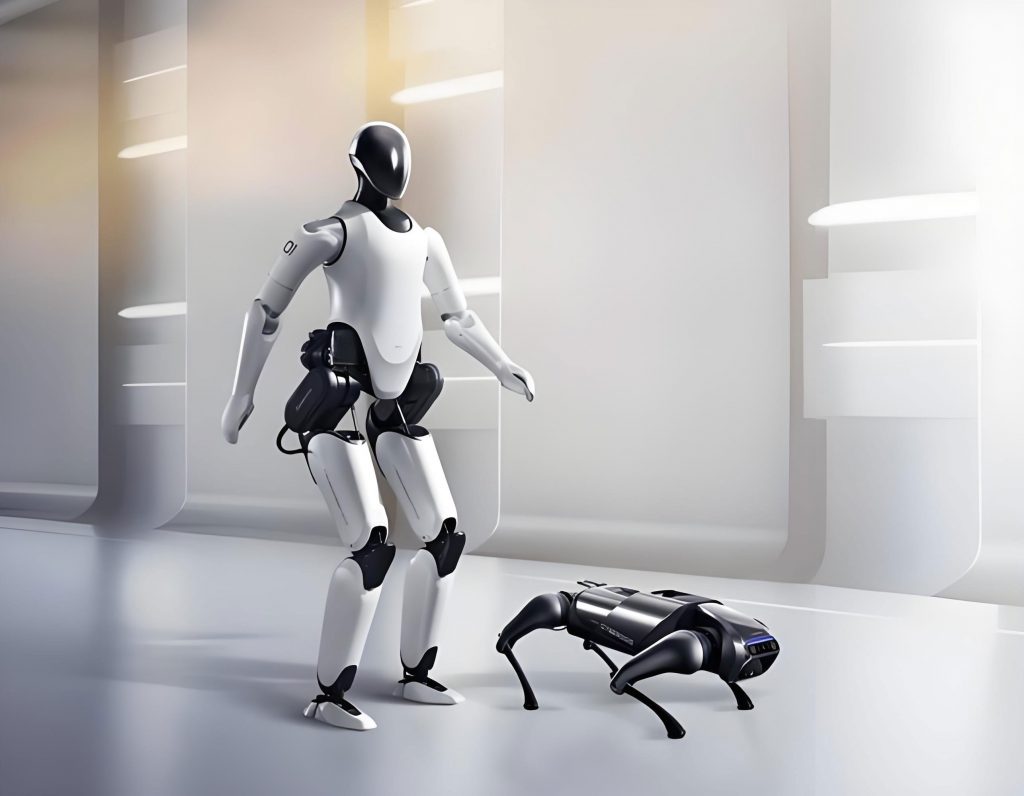
Our simulation platform for quadruped bionic robots is structured around four core components: mechanical modeling, dynamics modeling using VMC, ground contact and environment modeling, and data processing module design. Each component is crucial for achieving high-fidelity simulations that closely replicate real-world bionic robot behavior. Below, we detail the development of each module, emphasizing how they contribute to a comprehensive simulation framework for bionic robot locomotion.
Mechanical Modeling of Quadruped Bionic Robots
Mechanical modeling involves defining the physical and geometric properties of all components in the quadruped bionic robot, along with their interconnections and coordinate systems. For simplicity, we decompose the bionic robot virtual prototype into two sets: a set of Links (rigid bodies) and a set of Joints (constraints). Each Link, such as the torso, thighs, shanks, and feet, is characterized by parameters like mass, center of mass coordinates, dimensions, and rotational matrices. For instance, the torso is modeled as a cuboid, while limb segments use cylindrical shapes with spherical joints. The Link set can be expressed as:
$$ L = \sum l_i(m, c, r, x, y, z, R) $$
where \( l_i \) represents an individual link with mass \( m \), center of mass offset \( c \), radius \( r \), dimensions \( x, y, z \), and rotation matrix \( R \). In practice, we iterate through each link to set these attributes programmatically, as shown in Algorithm 1:
Algorithm 1: Link Creation
1. Create a new Link object with a specified name.
2. Set its mass, center of mass offset, and moment of inertia.
3. Define its geometric shape using LinkGraphics (e.g., addCube or addCylinder).
4. Associate the Link with its LinkGraphics for visualization and collision.
Joints, on the other hand, define the kinematic relationships between links. For a quadruped bionic robot, joints typically include hip roll, hip pitch, knee pitch, and ankle pitch joints, each modeled as rotational joints. The Joint set is represented as:
$$ J = \sum j_i(\text{“name”}, \text{Vector3d}(x, y, z), \text{axis}) $$
where each joint \( j_i \) has an initial center position and an axis of rotation or translation. Algorithm 2 outlines the joint setup process:
Algorithm 2: Joint Configuration
1. Create a Joint object (e.g., UniversalJoint or PinJoint).
2. Define its properties, including center coordinates and axis direction.
3. Connect two links using the joint and add it to the system.
To facilitate motion analysis, we establish a tree-structured relative coordinate system. The world coordinate system aligns with the SCS environment, while the root coordinate system is placed at the torso’s center. Each limb’s coordinate systems are attached near the joints closer to the torso, with distal coordinates moving relative to proximal ones. This hierarchical approach simplifies forward and inverse kinematics computations for the bionic robot. The following table summarizes key parameters for a typical quadruped bionic robot model:
| Component | Type | Mass (kg) | Dimensions (m) | Joint Type |
|---|---|---|---|---|
| Torso | Cuboid | 10.0 | 0.6 x 0.3 x 0.1 | N/A |
| Thigh | Cylinder | 2.5 | Length: 0.3, Radius: 0.05 | Hip Roll/Pitch |
| Shank | Cylinder | 1.5 | Length: 0.25, Radius: 0.04 | Knee Pitch |
| Foot | Sphere | 0.5 | Radius: 0.03 | Ankle Pitch |
This mechanical modeling framework ensures that the bionic robot’s virtual prototype accurately reflects its physical counterpart, enabling realistic simulations of bionic robot motion.
Dynamics Modeling Using Virtual Model Control (VMC)
Dynamics modeling is the computational engine that solves the complex motion and force interactions within the bionic robot and between the bionic robot and its environment. Traditional multi-body dynamics methods can be cumbersome for quadruped bionic robots due to their high degrees of freedom, nonlinearities, and strong coupling. To address this, we adopt Virtual Model Control (VMC), which simplifies the bionic robot system into decoupled spring-damper-mass models across spatial dimensions. This approach provides an intuitive and efficient way to model dynamics for bionic robot locomotion.
In VMC, the bionic robot’s mass is concentrated at its geometric center, with point contacts assumed at the feet. The bionic robot’s dynamics are represented as virtual spring-damper-mass systems in six independent dimensions: three translational (x, y, z) and three rotational (roll, pitch, yaw). As shown in the figure below, each dimension is treated as a separate one-dimensional mass-spring-damper system, allowing for independent control of bionic robot motion.
The high-level walking task is characterized by a set of force vectors applied at the bionic robot’s center of mass. Let \( W = [F^T, M^T]^T \), where \( F = [F_x, F_y, F_z]^T \) is the translational force vector and \( M = [M_x, M_y, M_z]^T \) is the rotational torque vector. The contact forces at each foot are denoted as \( f_i = [f_{xi}, f_{yi}, f_{zi}]^T \) for \( i = 1, 2, 3, 4 \). The virtual forces are computed based on desired trajectories for the bionic robot’s center of mass. Given a desired position \( s(t) \), velocity \( v_{des} \), orientation \( \theta(t) \), and angular velocity \( \dot{\theta}_{des} \) at time \( t \), along with actual values \( s_{curr} \), \( v_{curr} \), \( \theta_{curr} \), and \( \dot{\theta}_{curr} \), the virtual forces and torques are:
$$ F = k_F (s(t) – s_{curr}) + b_F (v_{des} – v_{curr}) $$
$$ M = k_M (\theta(t) – \theta_{curr}) + b_M (\dot{\theta}_{des} – \dot{\theta}_{curr}) $$
Here, \( k_F \) and \( b_F \) are the stiffness and damping coefficients for translational dimensions, while \( k_M \) and \( b_M \) are for rotational dimensions. These equations apply generically across dimensions, omitting subscripts for clarity. For instance, in the x-direction for a bionic robot moving forward, the virtual force \( F_x \) drives the bionic robot toward its desired position and velocity. The parameters \( k_F \), \( b_F \), \( k_M \), and \( b_M \) can be tuned to achieve stable and responsive bionic robot motion, as summarized in the table below:
| Dimension | Stiffness \( k \) (N/m or Nm/rad) | Damping \( b \) (Ns/m or Nms/rad) | Desired Value |
|---|---|---|---|
| X (Translation) | 5000 | 300 | \( v_{x-des} = 1.5 \, \text{m/s} \) |
| Y (Translation) | 5000 | 300 | \( v_{y-des} = 0 \, \text{m/s} \) |
| Z (Translation) | 10000 | 500 | \( s_{z-des} = 0.5 \, \text{m} \) |
| Roll (Rotation) | 200 | 50 | \( \theta_{roll-des} = 0 \, \text{rad} \) |
| Pitch (Rotation) | 200 | 50 | \( \theta_{pitch-des} = 0 \, \text{rad} \) |
| Yaw (Rotation) | 200 | 50 | \( \theta_{yaw-des} = 0 \, \text{rad} \) |
Once the virtual forces are computed, a distribution algorithm allocates these forces to each supporting foot. Using the Jacobian matrix, the foot forces are then mapped to joint torques, translating high-level bionic robot commands into actionable inputs for joint controllers. This VMC-based dynamics model significantly reduces computational complexity while maintaining accuracy for bionic robot simulations.
Ground Contact and Environment Modeling
Accurate simulation of bionic robot locomotion requires realistic modeling of ground interactions. The ground contact model defines the three-dimensional geometry, surface roughness, and mechanical properties of the terrain. In our platform, the ground is simulated as an infinite-mass entity using a linear ground contact model. By specifying the ground’s area and vertical height variation functions, we can create diverse terrains such as slopes, rough surfaces, or trenches, which are essential for testing bionic robot adaptability.
The contact mechanics between the bionic robot’s feet and the ground are modeled using spring-damper systems. In six dimensions, the contact model can be configured as linear spring-damper, nonlinear spring-damper, or hybrid variants, with adjustable stiffness and damping coefficients. For example, a linear spring-damper model in the vertical direction is defined by:
$$ f_z = k_g \Delta z + b_g \Delta \dot{z} $$
where \( f_z \) is the vertical contact force, \( \Delta z \) is the penetration depth, \( \Delta \dot{z} \) is the relative velocity, and \( k_g \) and \( b_g \) are ground stiffness and damping coefficients, respectively. This allows for simulation of various ground types, from hard surfaces (high \( k_g \)) to soft terrain (low \( k_g \)). The following table outlines typical parameters for different ground conditions in bionic robot simulations:
| Ground Type | Stiffness \( k_g \) (N/m) | Damping \( b_g \) (Ns/m) | Friction Coefficient |
|---|---|---|---|
| Concrete (Flat) | 100000 | 1000 | 0.8 |
| Grass (Uneven) | 50000 | 500 | 0.6 |
| Mud (Soft) | 20000 | 200 | 0.3 |
| Sand (Loose) | 30000 | 300 | 0.4 |
Environmental modeling also includes obstacles and inclines to challenge the bionic robot’s mobility. By integrating these elements, our platform enables comprehensive testing of bionic robot performance across realistic scenarios, ensuring that the bionic robot can handle the demands of real-world applications.
Data Processing Module Design
The data processing module is vital for analyzing simulation outcomes and optimizing bionic robot designs. Leveraging SCS’s built-in capabilities, our platform extracts and visualizes key metrics during and after simulations. Data can be displayed as real-time graphs, replayed for review, or exported for further analysis. For quadruped bionic robots, we focus on several critical data streams:
- Center of Mass (CoM) Data: Position, velocity, and acceleration of the bionic robot’s torso provide insights into locomotion stability and speed. For instance, CoM height fluctuations indicate gait smoothness, while forward velocity tracks progress.
- Joint Data: Angles, angular velocities, and torques for each joint are compared against planned trajectories to assess control algorithm performance and joint tracking accuracy.
- Foot Reaction Forces: Forces and moments at the feet evaluate gait compliance and ground interaction, informing spring selection and structural integrity checks for the bionic robot.
These data points are processed using mathematical formulations. For example, the root-mean-square (RMS) error of joint angles is calculated as:
$$ \text{RMS} = \sqrt{\frac{1}{N} \sum_{i=1}^{N} (\theta_{des,i} – \theta_{act,i})^2} $$
where \( \theta_{des,i} \) and \( \theta_{act,i} \) are desired and actual joint angles at sample \( i \), and \( N \) is the number of samples. Similarly, energy consumption can be estimated from joint torques \( \tau \) and velocities \( \dot{\theta} \):
$$ E = \int \sum_{j=1}^{16} |\tau_j \dot{\theta}_j| \, dt $$
where the summation covers all 16 joints of the bionic robot. The data processing module outputs these metrics in tabular or graphical formats, enabling researchers to refine bionic robot parameters iteratively. Below is a summary of typical data outputs for a bionic robot walking simulation:
| Metric | Description | Typical Value (Flat Ground) | Unit |
|---|---|---|---|
| CoM Velocity (Avg) | Average forward speed of bionic robot | 1.2 | m/s |
| CoM Height Variation | Peak-to-peak change in torso height | 0.007 | m |
| Joint Tracking Error (RMS) | Deviation from desired joint angles | 0.05 | rad |
| Max Foot Force | Peak vertical force during stance | 150 | N |
| Energy Consumption per Step | Total mechanical energy used | 50 | J |
This module enhances the platform’s utility by providing actionable insights for improving bionic robot design and control.
Motion Simulation Experiments with a Quadruped Bionic Robot
To validate our simulation platform, we conducted motion simulations using a 16-DOF quadruped bionic robot model inspired by mammalian anatomy. The bionic robot consists of a torso and four identical legs, each with a thigh, shank, and foot. Each leg has four active rotational degrees of freedom: hip roll, hip pitch, knee pitch, and ankle pitch, totaling 16 DOFs for the entire bionic robot. The joint angles are denoted as \( \theta_1, \theta_2, \theta_3, \theta_4 \) per leg, with driving torques \( T_i = [\tau_{i1}, \tau_{i2}, \tau_{i3}, \tau_{i4}] \) for legs \( i = 1, 2, 3, 4 \) (left-front, right-front, right-hind, left-hind). Each link has mass, inertia, velocity, and other dynamic properties, while joints have angle, velocity, acceleration, and pose parameters.
In SCS, we modeled the bionic robot’s body as a set of Links: a cuboid for the torso and cylindrical links with spherical joints for limbs. Joints were defined as rotational constraints with specified centers and axes. A tree structure initialized the bionic robot’s state, with the torso center as the root coordinate and limb coordinates relative to it. This modeling approach ensured a realistic virtual prototype for the bionic robot, as depicted in the simulation interface.
For the simulation experiment, we configured a trot gait pattern, common in quadruped bionic robots for dynamic walking. The gait parameters were set as follows: walking period \( T = 0.5 \, \text{s} \), quadruped support time \( T_{st} = 0.1 \, \text{s} \), double support time \( T_{sw} = 0.15 \, \text{s} \), swing leg foot trajectory with step length \( \Delta X = 50 \, \text{mm} \) and lift height \( \Delta Z = 170 \, \text{mm} \). The control targets for the bionic robot were: desired CoM velocity \( v_{x-des} = 1.5 \, \text{m/s} \), \( v_{y-des} = 0 \, \text{m/s} \), and level torso orientation \( \theta_{pitch-des} = 0 \), \( \theta_{roll-des} = 0 \), \( \theta_{yaw-des} = 0 \). The VMC parameters were tuned as per the earlier table to achieve stable locomotion for the bionic robot.
The simulation results demonstrated successful dynamic walking of the bionic robot on flat ground. The bionic robot maintained steady motion with minimal oscillations. Key performance metrics included:
- CoM Motion: The bionic robot’s CoM moved smoothly with an average forward speed of 1.2 m/s and a peak speed of 1.45 m/s, close to the target. Vertical CoM fluctuations were only 1.4% of the torso height, indicating stable bionic robot posture.
- Body Orientation: Attitude angles in roll, pitch, and yaw remained within ±0.2 rad, showing effective balance control for the bionic robot.
- Joint Performance: Joint angles tracked desired trajectories with low error, confirming the efficacy of the VMC-based controller for the bionic robot.
The simulation process was fluid and fast, with real-time dynamics computations, highlighting the platform’s efficiency for bionic robot research. Data outputs, such as CoM position over time, were captured and analyzed using the processing module. For instance, the CoM position in the z-direction \( z_{com}(t) \) showed periodic variation described by:
$$ z_{com}(t) = z_0 + A \sin(2\pi f t + \phi) $$
where \( z_0 = 0.5 \, \text{m} \) is the nominal height, \( A = 0.007 \, \text{m} \) is the amplitude, \( f = 2 \, \text{Hz} \) is the gait frequency, and \( \phi \) is a phase shift. This harmonic motion reflects the cyclic nature of bionic robot walking. Additionally, foot force profiles exhibited peaks during stance phases, with maximum forces around 150 N, consistent with expected ground reactions for a bionic robot of this size.
To further assess robustness, we simulated the bionic robot on uneven terrain by modifying the ground model with sinusoidal height variations. The bionic robot adapted successfully, adjusting foot placements and maintaining stability, albeit with slightly reduced speed. These experiments underscore the platform’s versatility in simulating diverse conditions for bionic robot locomotion.
Discussion and Future Enhancements
The development of this SCS-based simulation platform marks a significant step forward in bionic robot research. By integrating specialized modules for mechanical, dynamics, and environmental modeling, we have created a tool that addresses the unique needs of quadruped bionic robots. The platform’s ability to simulate stable dynamic walking with a 16-DOF bionic robot validates its practicality and reliability. Compared to generic simulation software, our dedicated approach offers improved accuracy and efficiency for bionic robot applications, thanks to the tailored VMC dynamics and detailed contact models.
Looking ahead, several enhancements can expand the platform’s capabilities for bionic robot development. First, parameterized design features could allow users to rapidly modify bionic robot dimensions, masses, or joint configurations, facilitating optimization studies. For example, a parametric model might express link lengths \( L \) as variables in an optimization function:
$$ \min_{L} \left( \text{Energy Consumption} + \lambda \cdot \text{Stability Margin} \right) $$
where \( \lambda \) is a weighting factor. Second, advancing ground modeling to include natural terrains like grasslands, muddy patches, or rocky surfaces would enable more comprehensive testing of bionic robot adaptability. This could involve stochastic terrain generation or importing real-world elevation data. Third, implementing advanced control strategies, such as neural network-based controllers or adaptive gait generators, could be integrated to explore autonomous learning in bionic robots. The platform’s data processing module could then evaluate these controllers using metrics like reward functions in reinforcement learning.
Moreover, the platform could be extended to simulate multi-bionic robot scenarios or interactions with objects, broadening its applicability. For instance, simulating a bionic robot carrying a load would involve adding mass to the torso and adjusting dynamics accordingly. The modular architecture of our platform makes such extensions feasible, ensuring it remains a valuable asset for ongoing bionic robot innovation.
Conclusion
In summary, we have presented a comprehensive simulation platform for quadruped bionic robots, built on the SCS software package. This platform encompasses mechanical modeling using Links and Joints, dynamics modeling via Virtual Model Control, realistic ground contact and environment modeling, and a robust data processing module. Through simulations of a 16-DOF bionic robot performing dynamic walking, we demonstrated the platform’s effectiveness in achieving stable, efficient locomotion with real-time performance. The results confirm that this dedicated simulation tool can significantly aid in the design, testing, and refinement of bionic robot systems, reducing development risks and costs. As bionic robot technology continues to evolve, platforms like this will play a crucial role in unlocking new capabilities for legged robots in complex environments. Future work will focus on enhancing terrain realism, control algorithms, and parametric design features to further empower bionic robot research and development.