
The pursuit of legged locomotion in robotics is fundamentally driven by the superior adaptability of biological systems to complex, unstructured terrain compared to wheeled or tracked vehicles. This capability holds immense promise for applications in disaster response, logistics, and military operations. Among legged robots, quadrupedal platforms offer an attractive balance between stability and mechanical complexity, making them a primary focus of contemporary research. Our team has developed a hydraulic bionic quadruped robot, a machine that draws inspiration from the elegant and efficient locomotion of quadrupedal animals. The design and control of such a bionic robot present significant challenges, particularly due to its multi-jointed nature and the demanding requirements for sensor fusion and high-precision hydraulic servo control.
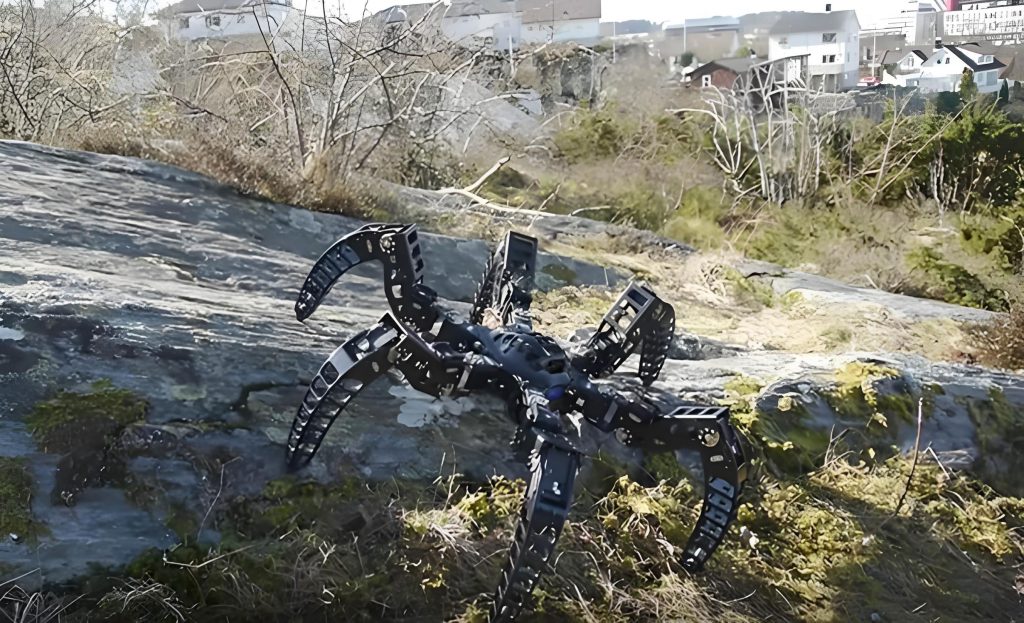
The core mechanical structure of our hydraulic bionic robot consists of four identical legs, each featuring three rotational degrees of freedom. These joints are the abduction/adduction (side-swing) joint at the hip, the hip flexion/extension joint, and the knee flexion/extension joint. The side-swing joint is located on the torso and controls the lateral movement of the entire leg, while the hip and knee joints, driven by hydraulic cylinders, execute the primary swinging motions of the thigh and shank. Precise coordinated control of the stroke and timing of these twelve hydraulic actuators enables the realization of various dynamic gaits, such as walking and trotting, essential for a functional bionic robot.
1. Overall Architecture of the Control System
The operational characteristics and design requirements of the hydraulic bionic quadruped robot necessitate a control system composed of several interrelated subsystems. High-level functions like data acquisition, pose estimation, and path planning constitute the upper control layer, responsible for processing sensor data and generating strategic motion commands. The lower control layer encompasses motion control and drive subsystems, which execute these commands through multi-axis trajectory planning, interpolation, and precise servo control of each hydraulic actuator’s position, velocity, and force. After analyzing prevalent robotic control architectures—centralized, distributed, and hierarchical—we determined that a pure form of any single architecture was insufficient. Centralized systems, while simple, place excessive computational burden on a single CPU. Distributed systems offer excellent scalability but can become overly complex in management. Hierarchical systems provide clear structure and stability but lack flexibility.
Therefore, we conceived a composite architecture that synergizes the strengths of hierarchical and distributed control. The system is first decomposed into functional subsystems, which are then organized into prioritized layers. The proposed control system architecture is structured into three distinct layers, as summarized in Table 1.
| Layer | Primary Function | Hardware Platform | Communication Interface |
|---|---|---|---|
| Decision Layer | Processes environmental & proprioceptive data; receives operator commands; makes high-level motion decisions. | S5PV210 (ARM Cortex-A8) | Ethernet (to Operator Station) |
| Gait Generation Layer | Generates and interpolates leg trajectories based on commands from the Decision Layer. | STM32F407 (ARM Cortex-M4) | Ethernet (from Decision Layer); CAN Bus (to Servo Controllers) |
| Servo Drive Layer (x4) | Executes servo control algorithms (e.g., PID) for three hydraulic joints per leg; samples sensor feedback. | STM32F407 (ARM Cortex-M4) | CAN Bus (from Gait Layer); Analog/Digital I/O |
Table 1: Hierarchical Control System Architecture for the Bionic Robot.
The Decision Layer acts as the central brain of the bionic robot. Its tasks are computationally intensive, involving fusion of data from IMUs, vision sensors, and leg load cells to estimate the robot’s state and perceive its environment. It interprets high-level commands (e.g., “walk forward,” “turn left”) and outputs primary gait parameters (velocity, direction) to the layer below. The Gait Generation Layer is responsible for kinematic planning. It translates the high-level parameters into detailed, time-dependent joint angle trajectories for all twelve actuators. This involves smooth interpolation between keyframe poses to ensure stable motion for the bionic robot. The Servo Drive Layer is implemented in a distributed manner, with one dedicated controller per leg. Each controller receives the target trajectories for its three joints via a network and closes the low-level control loop by reading joint sensors and driving the servo valves. This layered yet distributed approach effectively manages complexity, ensures real-time performance for critical servo tasks, and maintains clear functional boundaries within the bionic robot’s control system.
2. Hardware Design of the Control System
2.1 Selection of Control Microprocessors
The selection of processing units for each layer was critical to meet the specific computational demands of the bionic robot.
- Decision Layer (S5PV210): This layer requires powerful processing capabilities to handle Linux-based operating systems, complex sensor fusion algorithms, and decision-making logic. The ARM Cortex-A8 based S5PV210 application processor, with its high operating frequency and rich peripheral set, is ideally suited for these tasks.
- Gait Generation & Servo Drive Layers (STM32F407): These layers demand deterministic real-time performance. The Gait Layer must perform fast floating-point calculations for trajectory interpolation. The Servo Drive layers need high-speed analog-to-digital conversion (ADC) for sensor reading and precise pulse-width modulation (PWM) or digital-to-analog conversion (DAC) for actuator control. The ARM Cortex-M4 based STM32F407 microcontroller, featuring a floating-point unit (FPU), a 12-bit ADC with up to 1 MHz sampling rate, and advanced timers, perfectly meets the requirements for both layers in our bionic robot.
2.2 Communication Interface Design
Robust and fast communication between layers is vital for the coordinated operation of the bionic robot. Two primary communication channels were established.
Primary Command Interface (Decision Layer to Gait Layer): This is a point-to-point link for sending high-level commands and receiving status updates. We evaluated common interfaces as shown in Table 2. Ethernet was selected for its high bandwidth, long-distance capability, and ease of integration with the Linux-based Decision Layer.
| Interface | Bandwidth | Real-time Suitability | Complexity | Decision |
|---|---|---|---|---|
| UART | Low | Moderate | Low | Rejected |
| SPI | High | High | Moderate | Rejected |
| USB | Very High | Moderate | High | Rejected |
| Ethernet | Very High | High (with protocols) | Moderate | Selected |
Table 2: Evaluation of Primary Command Interface Options.
Servo Bus Interface (Gait Layer to Servo Drive Layers): This is a one-to-many broadcast bus for distributing trajectory setpoints and collecting joint data from the four leg controllers. Table 3 summarizes the evaluation. The Controller Area Network (CAN) bus was chosen for its proven robustness in automotive and industrial applications, inherent multi-master capability, excellent error detection, and real-time performance, making it ideal for the distributed joint control of a bionic robot.
| Bus Type | Topology | Fault Tolerance | Real-time Performance | Decision |
|---|---|---|---|---|
| I²C | Multi-master | Low | Low | Rejected |
| RS-485 | Multi-drop | Moderate | Moderate | Rejected |
| SPI | Master-Slave | Low | Very High | Rejected |
| CAN | Multi-master | Very High | High | Selected |
Table 3: Evaluation of Servo Bus Interface Options.
The CAN bus interface circuit is centered around a CAN transceiver (e.g., TJA1050) which converts the STM32F407’s logic-level signals to the differential CAN bus standard, providing noise immunity crucial for the electrically noisy environment of a hydraulic bionic robot.
2.3 Servo Valve Control & Sensor Feedback Circuitry
The interface between the Servo Drive Layer’s microcontroller and the physical hydraulic system is paramount for the bionic robot’s performance.
Sensor Feedback Interface: Various sensors (linear potentiometers for cylinder position, pressure transducers, temperature sensors) provide feedback. Most output either a 0-10V analog voltage or a 4-20mA current. A unified conditioning circuit was designed to convert all signals to a 0-3.3V range compatible with the STM32F407’s ADC input. The circuit typically consists of an operational amplifier (op-amp) in a voltage-follower configuration for impedance buffering, followed by a resistive voltage divider. For a sensor output \(V_{sensor}\) (0-10V), the conditioned voltage \(V_{adc}\) is:
$$V_{adc} = V_{sensor} \cdot \frac{R_2}{R_1 + R_2}$$
where \(R_1\) and \(R_2\) are chosen such that \(V_{adc(max)} = 3.3V\) when \(V_{sensor}=10V\). The ADC is configured to sample at 100 kHz per channel, allowing for oversampling and digital filtering within the 1 kHz servo control loop.
Servo Valve Drive Interface: The HY130 electro-hydraulic servo valve requires a bidirectional current input (e.g., ±40 mA) to drive its torque motor. The STM32F407’s internal DACs were insufficient for the required number of channels. Therefore, an external quad-channel DAC (DAC8565) is used. Its output voltage is then fed into a voltage-to-current converter circuit based on a precision op-amp and transistor stage. The core principle of this Howland current pump circuit ensures the output current \(I_{out}\) is proportional to the input voltage \(V_{in}\) from the DAC, and largely independent of the load (valve coil) resistance \(R_L\):
$$I_{out} = \frac{V_{in}}{R_s}$$
where \(R_s\) is a precision sense resistor. This design provides the stable, precise current drive necessary for accurate control of the hydraulic actuators in the bionic robot.
3. Software System Design
3.1 Software Architecture
The software architecture mirrors the three-layer hardware design, as illustrated in the functional diagram below. The Decision Layer software, running on a Linux OS, handles multi-sensor data fusion, state estimation, and high-level gait selection algorithms. The Gait Generation Layer software implements trajectory planning algorithms, such as cubic spline interpolation for smooth joint motion. Given a set of key joint angles \(\theta_k\) at times \(t_k\), the interpolated trajectory \(\theta(t)\) for a segment can be expressed as a cubic polynomial:
$$\theta(t) = a_0 + a_1(t – t_k) + a_2(t – t_k)^2 + a_3(t – t_k)^3$$
where coefficients \(a_i\) are solved using boundary conditions for position and velocity. This ensures the motion of the bionic robot is smooth and avoids jerks. The Servo Drive Layer software executes the real-time control loop. It typically implements a Proportional-Integral-Derivative (PID) controller. The control law for a joint’s hydraulic cylinder position can be written as:
$$u(t) = K_p e(t) + K_i \int_0^t e(\tau) d\tau + K_d \frac{de(t)}{dt}$$
where \(u(t)\) is the control output (servo valve current), \(e(t) = \theta_{target}(t) – \theta_{actual}(t)\) is the position error, and \(K_p, K_i, K_d\) are the controller gains. Given the nonlinear, time-varying dynamics of the hydraulic system in a bionic robot, more advanced strategies like gain scheduling or fuzzy-PID adaptation are employed to maintain performance across different operating conditions.
3.2 Operating System Selection for the Decision Layer
The Decision Layer’s tasks are multifaceted and require concurrent execution of processes for sensor I/O, communication, and algorithm computation. A Real-Time Operating System (RTOS) is essential for predictable task scheduling and responsiveness. Among options like QNX, VxWorks, and μC/OS-II, Linux with a real-time kernel patch (PREEMPT_RT) was chosen. This provides a rich development environment, extensive driver support, and the necessary real-time capabilities for the bionic robot’s high-level cognitive functions, while facilitating easier integration of perception and navigation software stacks.
4. System Integration and Experimental Validation
The performance of the integrated control system for the hydraulic bionic quadruped robot was validated through a series of progressive experiments.
4.1 Inverted Half-Body Section Test
Initial tests were conducted on an inverted two-leg section of the bionic robot. This setup allowed safe validation of the full control chain without the risk of the robot falling. A PC simulated the Decision Layer, sending trot gait commands. The data flow was: PC (Ethernet) → Gait Generation Controller → CAN Bus → Leg Servo Controllers. The servo controllers drove the hydraulic cylinders while reading position feedback, which was sent back up the chain to the PC for logging and analysis. The experiment confirmed successful communication across all layers and demonstrated the basic servo system’s ability to accurately track the commanded joint trajectories, a fundamental requirement for the bionic robot.
4.2 Full Robot Locomotion Test
Following successful subsystem tests, the complete control system was deployed on the full-scale hydraulic bionic quadruped robot. For safety during initial trials, the robot was equipped with a lightweight support harness to prevent falls without significantly impeding motion. With the hydraulic system pressurized to 15 MPa, the robot was commanded to execute a diagonal trot gait at a frequency of 1 Hz. The trot is a dynamic gait where diagonal leg pairs move in synchrony. The control system successfully coordinated all twelve joints, generating stable and fluid locomotion. The robot maintained balance and consistent forward motion, demonstrating that the hierarchical-distributed control architecture, hardware design, and software algorithms effectively meet the demanding real-time control requirements of a dynamic, hydraulic bionic robot.
5. Conclusion
This paper presented the comprehensive design and implementation of a control system for a high-performance hydraulic bionic quadruped robot. To address the challenges of multi-joint coordination, real-time servo control, and environmental perception, a composite control architecture was developed. This architecture effectively combines the structured clarity of a hierarchical system with the robustness and scalability of a distributed network. Key hardware components, including the S5PV210 and STM32F407 processors, Ethernet and CAN bus communications, and precision analog interfaces for sensor and servo valve control, were carefully selected and designed. The accompanying software architecture, leveraging a real-time Linux OS and dedicated control algorithms for trajectory generation and servo loop closure, completes the system. Experimental validation, progressing from inverted half-body tests to full robot trotting, confirmed the system’s capability. The bionic robot achieved stable, fluid locomotion, proving that the proposed control system fulfills the stringent requirements for controlling a dynamic, hydraulically actuated quadrupedal platform. This work provides a solid foundation for future advancements in adaptive control, rough-terrain navigation, and enhanced autonomy for legged bionic robots.