
In the field of robotics, the development of bionic robots has garnered significant attention due to their ability to navigate complex, unstructured environments. As a researcher focused on advancing robotic systems, I have explored the challenges associated with redundant driving mechanisms in bionic robots, particularly reptile-like quadruped bionic robots. These bionic robots exhibit redundancy in actuation, making forward kinematics analysis notoriously difficult. Traditional analytical methods often lead to high-degree polynomial equations that are cumbersome to derive and solve. To address this, I propose a digital modeling approach leveraging computer-aided geometric techniques, which simplifies the kinematic analysis without extensive mathematical derivations. This article details the methodology, implementation, and applications of this digital model for bionic robots, emphasizing its utility in motion analysis and beyond. Throughout this discussion, the term “bionic robot” will be frequently referenced to highlight its centrality in this research.
The core idea revolves around using commercial software like SolidWorks to create a parameterized digital model of the bionic robot. By driving the model’s dimensions and active joint angles, the bionic robot can be positioned appropriately based on constraints. Once the posture is set, coordinate systems are established via sketches, and measurement functions in SolidWorks extract parameters. Combining these with homogeneous transformation matrices yields solutions for position and orientation. This method eliminates the need for complex kinematic formulas, relying instead on understanding constraint relationships within the bionic robot. It is especially beneficial for bionic robots with redundant drives, offering a pragmatic alternative to analytical approaches. Below, I will elaborate on the bionic robot configuration, modeling technology, and practical applications, incorporating tables and formulas to summarize key concepts.
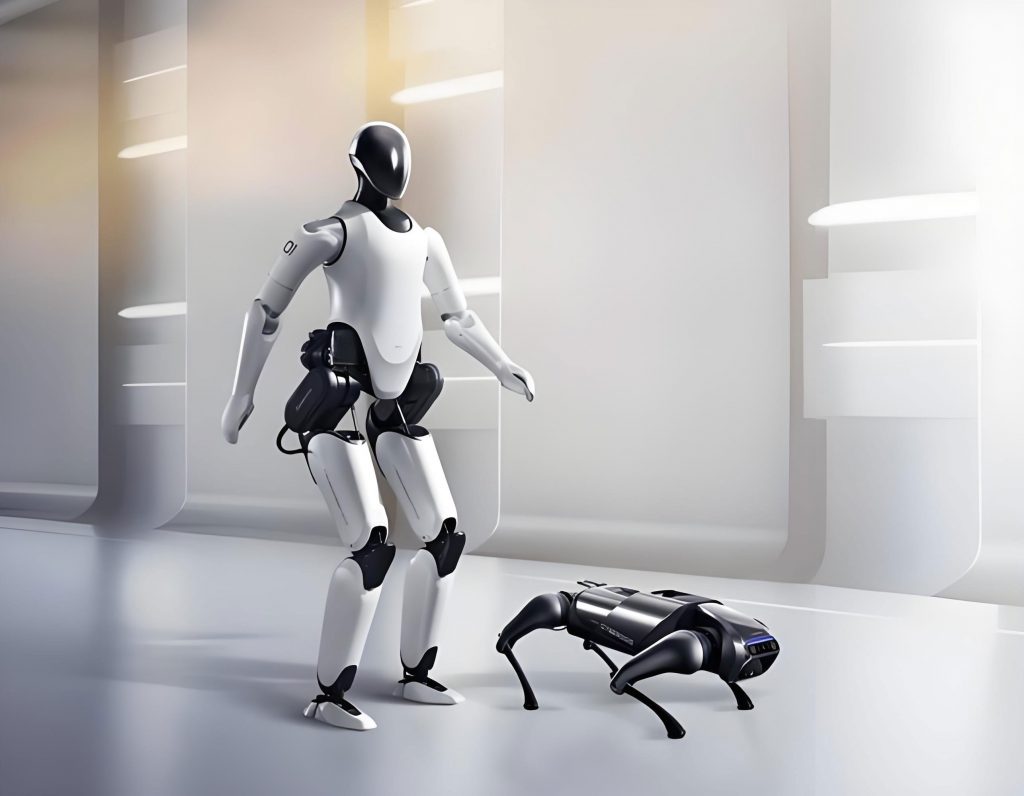
Reptile-like quadruped bionic robots typically consist of a body platform and four legs, each connected via hip joints. Unlike mammalian-style bionic robots where hip joint axes are parallel to the body plane, reptile-like bionic robots have vertical hip joint axes relative to the body. This configuration introduces unique kinematic characteristics. A common example is the MiniQuad-I bionic robot, which features a rectangular body with dimensions 2m and 2n, and legs comprising three actuated joints: hip, thigh, and shank. The lengths are denoted as L1, L2, and L3, with joint angles φ (hip rotation), φ (thigh rotation), and χ (shank rotation). During locomotion, three legs are grounded while one is lifted, leading to nine actuators driving six degrees of freedom—this redundancy complicates analysis. Typically, thigh and shank angles are active drives, while hip angles are passive, requiring determination through constraints. The digital model of this bionic robot facilitates such analysis by simulating real-world behavior in a virtual environment.
To formalize the bionic robot’s structure, I summarize key parameters in Table 1. This table provides a clear overview of the dimensions and variables involved, which are essential for digital modeling.
| Parameter | Description | Typical Value |
|---|---|---|
| 2m | Body length | 376.00 mm |
| 2n | Body width | 325.00 mm |
| L1 | Hip joint length | 67.50 mm |
| L2 | Thigh joint length | 232.00 mm |
| L3 | Shank joint length | 359.00 mm |
| φ | Thigh rotation angle | Variable (°) |
| χ | Shank rotation angle | Variable (°) |
| | Hip rotation angle | Variable (°) |
The digital modeling process relies on SolidWorks for 3D entity modeling and Visual Basic 6.0 for secondary development via API functions. SolidWorks offers feature-based parametric modeling and constraint-driven assembly, allowing components to be driven passively when under-constrained. For the bionic robot, this means that by controlling active drives and foot placement points, the entire assembly adjusts to satisfy all constraints, automatically determining passive joint angles. This leverages the principle that in SolidWorks, parts with incomplete constraints retain degrees of freedom; adding mate relations forces dependent parts to move accordingly. If constraints conflict, errors occur, ensuring validity. This approach mirrors the bionic robot’s physical behavior, making it ideal for kinematic studies.
Implementing the digital model involves several steps: entity modeling, parameterization, mate control, and measurement setup. First, I create 3D parts for the bionic robot’s body, legs, and joints, assembling them with basic rotational constraints. The assembly initially has six degrees of freedom, representing the bionic robot’s unconstrained state. A “ground” part is added, aligned with the assembly’s default coordinate system to serve as a fixed reference. Foot points are marked for position control. Parameterization is achieved by driving sketch dimensions through API functions. For example, to adjust hip length L1, I use VB code to modify the dimension value in SolidWorks, accounting for unit conversions (mm to m). This ensures the bionic robot’s dimensions are dynamically adjustable, as shown in the code snippet below:
In Visual Basic, key API functions include `AddMate3` for adding mates and `SelectByID2` for selecting components. Mate types like `swMateDISTANCE` and `swMateANGLE` control foot positions and joint angles, respectively. The driving sequence matters: active joint angles are set before foot positions to avoid over-definition errors. For instance, to control the angle between the hip and thigh of leg I, I select reference planes and apply an angle mate with a value derived from the active drive φ. The code handles sign conventions via Boolean flags, ensuring correct rotation direction. Similarly, foot positions are constrained by distances to reference planes in the fixed coordinate system. This systematic control enables the bionic robot to achieve desired postures.
To extract kinematic data, coordinate systems are established. The fixed coordinate system Σo is tied to the ground part, while floating systems Σc (body center) and Σe (lifted leg end) are created via sketches. Points are marked along axes at known distances (e.g., 100 mm) from origins. Using SolidWorks’ measurement functions, I obtain coordinates of these points in Σo. The position of the body center pc and orientation matrix Rc are computed from these measurements. The homogeneous transformation matrix from Σc to Σo is given by:
$$^o\mathbf{T}_c = \begin{bmatrix}
\mathbf{r}_x & \mathbf{r}_y & \mathbf{r}_z & \mathbf{p}_c \\
0 & 0 & 0 & 1
\end{bmatrix}$$
where rx, ry, and rz are unit vectors along Σc axes in Σo, derived as:
$$\mathbf{r}_x = \frac{\mathbf{p}_x – \mathbf{p}_c}{100}, \quad \mathbf{r}_y = \frac{\mathbf{p}_y – \mathbf{p}_c}{100}, \quad \mathbf{r}_z = \frac{\mathbf{p}_z – \mathbf{p}_c}{100}$$
Here, px, py, pz are coordinates of axis points. This matrix encapsulates the bionic robot’s pose. The process is repeated for the lifted leg to obtain its endpoint position. All measurements are automated via VB, exporting data for analysis. This geometric method bypasses solving complex equations, as the bionic robot’s digital model inherently satisfies kinematic constraints.
Applying the digital model to forward kinematics involves inputting known parameters: bionic robot dimensions, active joint angles, and grounded foot positions. The system drives the model, measures results, and outputs solutions. For example, consider a case with the following inputs for a bionic robot:
| Parameter | Value |
|---|---|
| L1, L2, L3 | 67.50 mm, 232.00 mm, 359.00 mm |
| 2m, 2n | 376.00 mm, 325.00 mm |
| Grounded foot positions (in Σo) | pJ = [399.78, 534.28, 0]T mm, pK = [-399.78, -214.28, 0]T mm, pI = [399.78, -214.28, 0]T mm |
| Active angles (φ, χ) for legs J, K, L | φJ = 0.25°, χJ = 94.04°; φK = 0.30°, χK = 84.99°; φL = 0.25°, χL = 94.04° |
The digital model computes passive hip angles, body pose, and lifted leg endpoint. Results are shown in Table 2, demonstrating the bionic robot’s resolved configuration.
| Output | Value |
|---|---|
| Body center position pc | [40.00, 160.00, 359.00]T mm |
| Lifted leg endpoint pI | [-3994.78, 534.28, 50.00]T mm |
| Passive hip angles () | J = 129.05°, K = 319.93°, L = 230.95° |
| Orientation matrix Rc | Identity matrix (no rotation) |
To validate, I compared these with analytical solutions from literature, finding exact matches aside from rounding errors. This confirms the digital model’s accuracy for bionic robots. The method’s efficiency stems from its visual and interactive nature, allowing rapid iteration. Moreover, it extends to inverse kinematics, workspace analysis, and dynamic simulations for bionic robots. For instance, by varying inputs and measuring outputs, one can map the bionic robot’s reachable space or optimize gait patterns. The digital model thus serves as a versatile tool for bionic robot development.
Beyond kinematics, this approach aids in error compensation and control system design for bionic robots. Tolerances and deformations can be incorporated into the model to study their effects. Using API functions, one can automate sensitivity analyses, quantifying how dimension variations impact bionic robot performance. Table 3 summarizes potential applications of the digital model in bionic robot research, highlighting its broad utility.
| Application Area | Description | Benefit for Bionic Robots |
|---|---|---|
| Forward Kinematics | Solving pose from joint angles and foot positions | Simplifies redundant drive analysis |
| Inverse Kinematics | Finding joint angles for desired poses | Enables trajectory planning |
| Workspace Analysis | Mapping reachable points | Optimizes design and mobility |
| Dynamic Simulation | Studying forces and motions | Improves control strategies |
| Error Modeling | Assessing tolerance impacts | Enhances accuracy and reliability |
The digital modeling technique also compares favorably with traditional methods. Analytical approaches for bionic robots often yield polynomials of degree 16 or higher, requiring symbolic computation and numerical solvers. In contrast, the geometric method uses commercial software, reducing mathematical overhead. It is more accessible to engineers and researchers focused on practical bionic robot implementation. However, it relies on software licensing and may be slower for real-time applications. For design and analysis phases, though, it offers unparalleled convenience. I have used this method extensively in my work on bionic robots, finding it reduces development time and improves understanding of complex mechanisms.
To further illustrate, consider the homogeneous transformation for a single leg of the bionic robot. The position of foot point A relative to the body center can be expressed as:
$$\mathbf{p}_A = \mathbf{p}_c + \mathbf{R}_c \cdot \left( \sum_{i=1}^{3} \mathbf{L}_i \cdot \mathbf{T}_i(\theta_i) \right)$$
where Li are link vectors, Ti are transformation matrices for joint angles θi, and Rc is body orientation. In the digital model, this is implicit through constraints, avoiding explicit formula derivation. For redundant bionic robots, such implicit solving is efficient. I have implemented this in VB, with code snippets like:
The measurement function in SolidWorks API returns coordinates, which are processed to compute matrices. This integration of CAD and custom programming empowers bionic robot analysis. Looking ahead, the digital model can be extended to other bionic robot types, such as hexapods or bipeds, by adapting constraints. It also facilitates collaboration, as models can be shared and modified easily. In educational contexts, it helps students visualize bionic robot kinematics without deep mathematical background.
In conclusion, the digital modeling approach for reptile-like quadruped bionic robots provides a robust alternative to analytical kinematics. By leveraging SolidWorks’ constraint-driven assembly and VB automation, it solves redundant drive problems intuitively. The method requires only an understanding of constraint relationships, not complex derivations, making it widely applicable to bionic robots and other redundant mechanisms. From motion analysis to workspace studies, this digital model enhances bionic robot design and optimization. As bionic robots continue to evolve, such tools will be crucial for advancing their capabilities in real-world environments. I encourage researchers to adopt similar geometric techniques to streamline their work on bionic robots, fostering innovation in this dynamic field.
Reflecting on my experience, I have found that bionic robots benefit immensely from digital prototyping. The ability to quickly test configurations and analyze outcomes accelerates development cycles. Future work could integrate this model with real-time control systems or machine learning algorithms for adaptive bionic robot behavior. Additionally, expanding the API usage to include dynamic simulation plugins could yield even deeper insights. Ultimately, the fusion of digital modeling and bionic robot research holds promise for creating more agile, efficient, and intelligent machines. This article has detailed the methodology and applications, hoping to inspire further exploration in the bionic robot community.