
The pursuit of robust and agile locomotion in unstructured, complex terrains remains a central challenge in robotics. While wheeled and tracked vehicles excel on flat, prepared surfaces, their performance degrades significantly on rough, uneven ground commonly found in natural environments, disaster sites, or planetary exploration landscapes. This fundamental limitation has driven extensive research into biologically inspired legged systems. Among these, the bionic robot architecture modeled after hexapods (insects) offers a compelling combination of static stability, adaptability, and redundancy. A six-legged configuration allows for multiple stable gaits, enabling the machine to remain statically stable even when several legs are in motion or compromised, a critical feature for reliable operation in unpredictable environments.
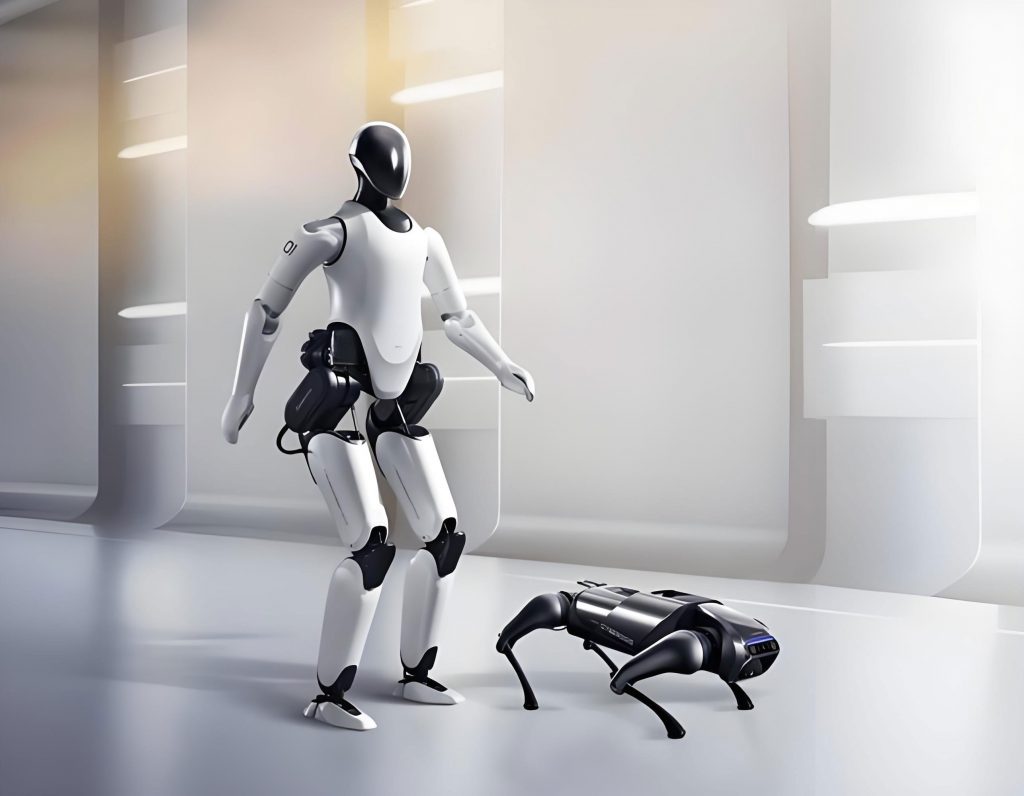
The efficacy of any legged bionic robot is fundamentally rooted in the precise and coordinated control of its individual limbs. Each leg functions as an independent, articulated manipulator, and its performance dictates the overall mobility and stability of the system. This article delves into the comprehensive design and analysis of a single-leg control system for a bionic robot, encompassing kinematic modeling, actuator control, trajectory planning, and higher-level integration. The presented framework serves as the essential building block for the sophisticated, adaptive locomotion behaviors expected from a modern bionic robot.
Mechanical Design and Kinematic Modeling
The design philosophy for the hexapod bionic robot emphasizes modularity, symmetry, and sensor integration to facilitate control, maintenance, and advanced interactive capabilities. The main body, or thorax, houses the central computational and power distribution systems. Radiating from this core are six identical, modular legs. This homogeneity ensures interchangeability and simplifies both manufacturing and control algorithm design.
Each leg module is a serial kinematic chain comprising three rigid links connected by revolute joints, providing three degrees of freedom (3-DOF). From proximal to distal, these are the Coxa (or body-joint), the Femur (or thigh), and the Tibia (or shank). The joints are labeled as the Body-Coxa (B-C) joint, the Coxa-Femur (C-F) joint, and the Femur-Tibia (F-T) joint. Crucially, the B-C and C-F joints are equipped with integrated single-axis torque sensors, while the foot tip (end of the Tibia) incorporates a miniature three-axis force/torque sensor. This multi-modal sensory feedback is indispensable for implementing force-based compliance, terrain adaptation, and dynamic stability control in the bionic robot.
To mathematically describe the leg’s geometry and solve for foot placement, the Denavit-Hartenberg (D-H) convention is employed. A coordinate frame is attached to each link, as shown in the kinematic diagram. The D-H parameters for the leg are summarized in Table 1.
| Joint i | θi (Joint Variable) | αi (Link Twist) | ai (Link Length) | di (Link Offset) |
|---|---|---|---|---|
| 1 (B-C) | θ1 | -90° | l1 | 0 |
| 2 (C-F) | θ2 | 0° | l2 | 0 |
| 3 (F-T) | θ3 | 0° | l3 | 0 |
Here, l1, l2, and l3 are the lengths of the Coxa, Femur, and Tibia links, respectively. The transformation from the foot frame (Frame 3) to the body-attached base frame (Frame 0) is obtained by sequentially multiplying the individual joint transformation matrices:
$$^{0}\mathbf{T}_{3} = ^{0}\mathbf{T}_{1}(\theta_1) \cdot ^{1}\mathbf{T}_{2}(\theta_2) \cdot ^{2}\mathbf{T}_{3}(\theta_3)$$
where each i-1Ti is defined by the standard D-H transformation. The position of the foot tip P = [Px, Py, Pz]T in the leg’s base coordinate frame (Frame 0) is extracted from the fourth column of 0T3. The complete forward kinematics equations are:
$$
\begin{aligned}
P_x &= l_1 \cos\theta_1 + l_2 \cos\theta_1 \cos\theta_2 + l_3 \cos\theta_1 \cos(\theta_2+\theta_3) \\
P_y &= l_1 \sin\theta_1 + l_2 \sin\theta_1 \cos\theta_2 + l_3 \sin\theta_1 \cos(\theta_2+\theta_3) \\
P_z &= -l_2 \sin\theta_2 – l_3 \sin(\theta_2+\theta_3)
\end{aligned}
$$
For legged locomotion control, the inverse kinematics problem—calculating the required joint angles (θ1, θ2, θ3) to achieve a desired foot position (Px, Py, Pz)—is more critical. For this 3-DOF spatial leg with a spherical wrist structure (the last three axes intersect at the C-F joint, simplifying the solution), the joint angles can be solved geometrically:
$$
\begin{aligned}
\theta_1 &= \arctan2(P_y, P_x) \\
r &= \sqrt{P_x^2 + P_y^2} – l_1 \\
D &= \frac{r^2 + P_z^2 – l_2^2 – l_3^2}{2 l_2 l_3} \\
\theta_3 &= \arctan2(\pm\sqrt{1-D^2}, D) \\
\theta_2 &= \arctan2(P_z, r) – \arctan2(l_3 \sin\theta_3, l_2 + l_3 \cos\theta_3)
\end{aligned}
$$
The workspace of the foot tip, which defines all reachable points in 3D space, is a crucial design and planning parameter. It is typically a complex volumetric shape determined by the link lengths and joint limits. Analysis and visualization of this workspace are essential for gait planners to ensure that swing leg trajectories and body motions remain within the physical capabilities of the bionic robot.
Actuator Modeling and Servo Control
Precise joint actuation is the foundation of effective leg control. Each joint of this bionic robot is driven by a high-performance DC servo motor paired with a high-ratio planetary gearhead to achieve the necessary torque. The motor-driver combination is digitally controlled via a CANopen communication network, allowing for centralized command and distributed, real-time execution.
The dynamic behavior of a DC motor is fundamental to designing its controller. The electrical and mechanical dynamics can be described by the following equations:
$$
\begin{aligned}
V_a(t) &= R_a i_a(t) + L_a \frac{di_a(t)}{dt} + K_e \omega_m(t) \quad &\text{(Electrical side)} \\
\tau_m(t) &= K_t i_a(t) = J_m \frac{d\omega_m(t)}{dt} + B_m \omega_m(t) + \tau_l(t) \quad &\text{(Mechanical side)}
\end{aligned}
$$
Where:
$V_a$: Armature voltage (V)
$i_a$: Armature current (A)
$R_a$, $L_a$: Armature resistance (Ω) and inductance (H)
$K_e$: Back-electromotive force constant (V·s/rad)
$\omega_m$: Motor angular velocity (rad/s)
$\tau_m$: Motor torque (N·m)
$K_t$: Torque constant (N·m/A)
$J_m$: Rotor inertia (kg·m²)
$B_m$: Viscous friction coefficient (N·m·s/rad)
$\tau_l$: Load torque (N·m)
Applying the Laplace transform, the transfer function from input voltage $V_a(s)$ to output angular velocity $\omega_m(s)$ (assuming $\tau_l = 0$) is:
$$
\frac{\omega_m(s)}{V_a(s)} = \frac{K_t}{(L_a s + R_a)(J_m s + B_m) + K_t K_e}
$$
And the transfer function to shaft angle $\theta_m(s)$ is:
$$
\frac{\theta_m(s)}{V_a(s)} = \frac{1}{s} \cdot \frac{K_t}{(L_a s + R_a)(J_m s + B_m) + K_t K_e}
$$
To achieve high-performance motion control, a cascaded control architecture is universally adopted. This structure features an inner high-bandwidth current (torque) loop and an outer position (or velocity) loop. This strategy effectively linearizes the motor’s electro-mechanical dynamics and provides independent control over force/torque and motion.
Inner Current Control Loop
The innermost loop regulates the armature current $i_a$, which is directly proportional to the motor torque $\tau_m = K_t i_a$. A Proportional-Integral (PI) controller is standard for this task, as it can achieve zero steady-state error for a current reference. The block diagram for the current loop is shown below. The PI controller compensates for the back-EMF disturbance and the electrical time constant of the motor ($\tau_e = L_a/R_a$).
Let the PI controller be $G_{c,i}(s) = K_{P,i} + \frac{K_{I,i}}{s}$. The closed-loop transfer function for the current, assuming a perfect current measurement and a PWM amplifier modeled as a gain $K_{amp}$, becomes complex. The primary design goal is to achieve a very fast and well-damped response. The bandwidth of the current loop is typically set as high as possible (often in the range of 500 Hz to several kHz) to allow the outer loop to treat the torque generation as an instantaneous process. Through simulation and tuning (e.g., in Simulink), appropriate gains $K_{P,i}$ and $K_{I,i}$ are selected to yield a critically damped or slightly overdamped step response with minimal overshoot and a rapid settling time (e.g., under 5 ms).
Outer Position Control Loop
With a well-tuned, high-bandwidth current loop, the motor’s dynamics from current reference $I_{ref}(s)$ to shaft angle $\theta_m(s)$ can be approximated as a simple integrator ($1/s$) scaled by the gear ratio, as the torque response is nearly instantaneous. The outer loop is responsible for tracking a desired joint angle trajectory. A Proportional-Integral-Derivative (PID) controller is a robust choice for position control. The derivative term provides damping, which is crucial for stabilizing the system and reducing overshoot.
Let the PID controller be $G_{c,p}(s) = K_{P,p} + \frac{K_{I,p}}{s} + K_{D,p}s$. The closed-loop position control system’s performance is evaluated by its step response. Key metrics include rise time, overshoot, settling time, and steady-state error. For a bionic robot leg, a balance must be struck: a fast rise time is desired for agile movements, but excessive overshoot can cause mechanical stress and instability. Using simulation models that include practical effects like encoder resolution, computational delay, and gearbox backlash, the PID gains ($K_{P,p}$, $K_{I,p}$, $K_{D,p}$) are meticulously tuned. A well-tuned response for a leg joint might feature a rise time of 50-100 ms, an overshoot of less than 5%, and zero steady-state error, ensuring precise and stable joint positioning.
Joint Trajectory Planning and Interpolation
In a hierarchical control architecture for a bionic robot, a high-level planner (e.g., gait generator) operates at a lower frequency (e.g., 50-100 Hz), computing key footstep locations and body motions. The low-level joint servo controllers, however, require reference commands at a much higher rate (e.g., 1 kHz) for smooth operation. This necessitates a trajectory planning and interpolation layer within the leg controller.
The planner’s task is to generate a continuous time-history of joint angles $\theta(t)$ (or foot positions) between discrete setpoints commanded by the high-level planner. These setpoints may specify position, and sometimes velocity, at specific future times. The trajectory must satisfy boundary conditions and be smooth to avoid exciting unwanted vibrations. Smoothness implies continuity not just in position, but also in velocity and ideally acceleration.
A cubic polynomial is the minimum-order polynomial that can satisfy boundary conditions on both position and velocity at the start and end of a segment. For a single joint moving from an initial state $(\theta_0, \dot{\theta}_0)$ at time $t_0=0$ to a final state $(\theta_f, \dot{\theta}_f)$ at time $t_f=T$, the trajectory is:
$$
\theta(t) = a_0 + a_1 t + a_2 t^2 + a_3 t^3
$$
The corresponding velocity and acceleration are:
$$
\begin{aligned}
\dot{\theta}(t) &= a_1 + 2a_2 t + 3a_3 t^2 \\
\ddot{\theta}(t) &= 2a_2 + 6a_3 t
\end{aligned}
$$
Applying the four boundary conditions ($\theta(0)=\theta_0$, $\dot{\theta}(0)=\dot{\theta}_0$, $\theta(T)=\theta_f$, $\dot{\theta}(T)=\dot{\theta}_f$) yields a system of linear equations to solve for the coefficients $a_i$. In matrix form:
$$
\begin{bmatrix}
1 & 0 & 0 & 0 \\
0 & 1 & 0 & 0 \\
1 & T & T^2 & T^3 \\
0 & 1 & 2T & 3T^2
\end{bmatrix}
\begin{bmatrix}
a_0 \\ a_1 \\ a_2 \\ a_3
\end{bmatrix}
=
\begin{bmatrix}
\theta_0 \\ \dot{\theta}_0 \\ \theta_f \\ \dot{\theta}_f
\end{bmatrix}
$$
The solution is:
$$
\begin{aligned}
a_0 &= \theta_0 \\
a_1 &= \dot{\theta}_0 \\
a_2 &= \frac{3(\theta_f – \theta_0) – T(2\dot{\theta}_0 + \dot{\theta}_f)}{T^2} \\
a_3 &= \frac{-2(\theta_f – \theta_0) + T(\dot{\theta}_0 + \dot{\theta}_f)}{T^3}
\end{aligned}
$$
This formulation ensures $C^1$ continuity (continuous position and velocity) at the segment boundaries. The acceleration is linear and therefore continuous, but its derivative (jerk) is discontinuous at the boundaries. For most bionic robot applications, cubic splines provide an excellent balance between smoothness and computational simplicity. The interpolation process runs in real-time on the leg’s microcontroller: upon receiving a new target setpoint $(\theta_f, \dot{\theta}_f, T)$ from the high-level planner, it calculates the coefficients for the upcoming segment and then, at every servo control cycle (e.g., 1 ms), evaluates $\theta(t)$ and $\dot{\theta}(t)$ to feed the joint PID controllers. A summary of the interpolation process is shown in Table 2.
| Step | Action | Description |
|---|---|---|
| 1 | Receive Command | High-level planner sends $(\theta_{f}, \dot{\theta}_{f}, T)$. |
| 2 | Capture Current State | Record current joint state as start of segment: $(\theta_{0}=\theta_{current}, \dot{\theta}_{0}=\dot{\theta}_{current})$. |
| 3 | Compute Coefficients | Calculate $a_0, a_1, a_2, a_3$ using the formula above. |
| 4 | Real-time Interpolation | At each control cycle $t_{k} \in [0, T]$, compute: $\theta_{ref}(t_k)=a_0 + a_1 t_k + a_2 t_k^2 + a_3 t_k^3$ $\dot{\theta}_{ref}(t_k)=a_1 + 2a_2 t_k + 3a_3 t_k^2$. |
| 5 | Send to Servo | Feed $\theta_{ref}(t_k)$ and optionally $\dot{\theta}_{ref}(t_k)$ to the joint PID controller. |
Integration into Full Locomotion Control
While single-leg control is foundational, the true power of a bionic robot emerges from the coordinated operation of all six legs. The single-leg controller described becomes a “smart” module within a larger hierarchical network. A central locomotion controller is responsible for:
- Gait Generation: Selecting and timing the phase relationships between legs (e.g., tripod gait, wave gait). This defines the sequence of swing (transfer) and stance (support) phases for each leg.
- Body Trajectory Planning: Determining the desired velocity and path for the robot’s body (thorax).
- Footstep Planning: Based on the body trajectory and terrain sensing, calculating the desired foothold locations $^{B}P_{foot,desired}$ for each leg in the body coordinate frame {B}.
- Leg Coordination: Translating body-level commands into individual leg commands. For a leg in swing phase, the high-level command is a trajectory of foot positions in body coordinates (e.g., a raised cycloid or cubic spline from lift-off to touch-down). For a leg in stance phase, the command is often a desired force vector or a virtual spring-damper setpoint relative to the body to propel or support it.
The single-leg controller receives these high-level commands (e.g., “swing to point (X,Y,Z) in time T” or “apply a force vector F in direction D”). It then:
* Uses inverse kinematics to convert a foot position command into joint angle setpoints.
* Uses its internal trajectory planner to smoothly interpolate between the current joint state and the new target.
* Feeds the interpolated joint trajectory to the cascaded PID current servo controllers.
* (Optionally) Uses feedback from joint torque and foot force sensors to implement impedance or hybrid force/position control, allowing the leg to comply with unexpected terrain or exert specific forces.
This modular approach allows for sophisticated behaviors. For example, if one leg encounters an obstacle and its foot force sensor detects an early contact, it can immediately switch to a force-controlled compliance mode, send an interrupt to the central planner, which can then adjust the body trajectory and the plans for the other five legs—all while maintaining stability. This level of adaptability is what makes a bionic robot truly robust in complex environments.
Experimental Validation and Performance Metrics
The performance of the leg control system must be validated through both simulation and physical experimentation. Key metrics for evaluation include:
- Joint Step Response: Rise time, settling time, overshoot, and steady-state error to a step change in angle command.
- Trajectory Tracking Accuracy: The RMS and maximum error between the commanded joint trajectory (e.g., a sine wave) and the actual measured joint angle during motion.
- Torque/Current Control Bandwidth: Measured by applying a sinusoidal torque reference and determining the frequency at which the output magnitude drops by -3 dB.
- Leg Workspace Verification: Physically measuring the extreme reachable points of the foot to confirm the kinematic model.
- Integrated Leg Cycle Test: Commanding the foot to trace a repetitive swing-stance cycle (e.g., a rectangular or elliptical path) while measuring position accuracy and power consumption.
- Force Control Performance: For legs with torque sensing, evaluating the ability to track a desired force profile when the foot is constrained.
Simulation environments like MATLAB/Simulink or ROS/Gazebo are invaluable for initial controller tuning and system validation without risk to hardware. The final proof, however, lies in the integrated performance of the bionic robot on varied terrain. Successful demonstration involves the robot executing stable walks, turns, and transitions over surfaces with small obstacles, gaps, and compliant materials, relying entirely on the coordinated performance of its six independently controlled leg modules.
| Performance Aspect | Metric | Target Value |
|---|---|---|
| Joint Servo Control | Position Step Rise Time | < 100 ms |
| Position Step Overshoot | < 5% | |
| Steady-State Position Error | < 0.1° | |
| Trajectory Tracking | RMS Error (sinusoidal) | < 0.5° |
| Max Error | < 1.5° | |
| System Integration | Control Cycle Frequency | ≥ 1 kHz (joint level) |
| Power Efficiency | Average Power per Leg (steady walk) | Minimized, system-dependent |
In conclusion, the development of a high-performance single-leg control system is a critical step in realizing a capable and autonomous bionic robot. It requires the careful integration of mechanical design, kinematic analysis, dynamic actuator modeling, multi-loop digital control, and real-time trajectory planning. The resulting module, characterized by precise joint control, smooth motion interpolation, and the capacity to accept high-level behavioral commands, serves as the fundamental actuator for legged locomotion. When six such modules are coordinated under a sophisticated central nervous system, the resulting machine transcends simple automation, embodying the principles of biological mobility and opening new frontiers for robotic application in the most challenging environments on Earth and beyond.