
As an engineer deeply involved in the development of autonomous systems, I am thrilled to share our groundbreaking work on bionic swarm robots. Inspired by nature’s elegance, we have created a network of bionic robots that possess an innate ability to form structures and shapes without extensive external instructions. These bionic robots mimic the behavior of cells in the human body, connecting seamlessly, communicating locally, and automatically aggregating in diverse environments. In this article, I will delve into the principles, applications, and future prospects of these remarkable bionic robots, emphasizing how they can revolutionize rescue operations and beyond. Throughout, I will use tables and formulas to summarize key aspects, ensuring a comprehensive understanding of this innovative technology.
The core inspiration for our bionic robot design stems from biological systems, where cells coordinate through chemical signals to form tissues and organs. Similarly, our bionic robots utilize short-range infrared signals—approximately 10 cm in range—to communicate. This signal transmits information about simulated substances called “morphogens,” which are virtual biological signal molecules embedded in the robot’s code. By emulating this natural process, the bionic robots can self-organize into complex structures, much like a swarm of bees building a hive or cells forming an embryo. The goal is to scale this to large groups of miniature bionic robots, enabling applications such as exploring disaster zones after earthquakes or fires, or dynamically shaping into 3D structures like temporary bridges that adapt to any terrain. The potential of bionic robots in rescue missions is immense, and I believe they represent a paradigm shift in autonomous robotics.
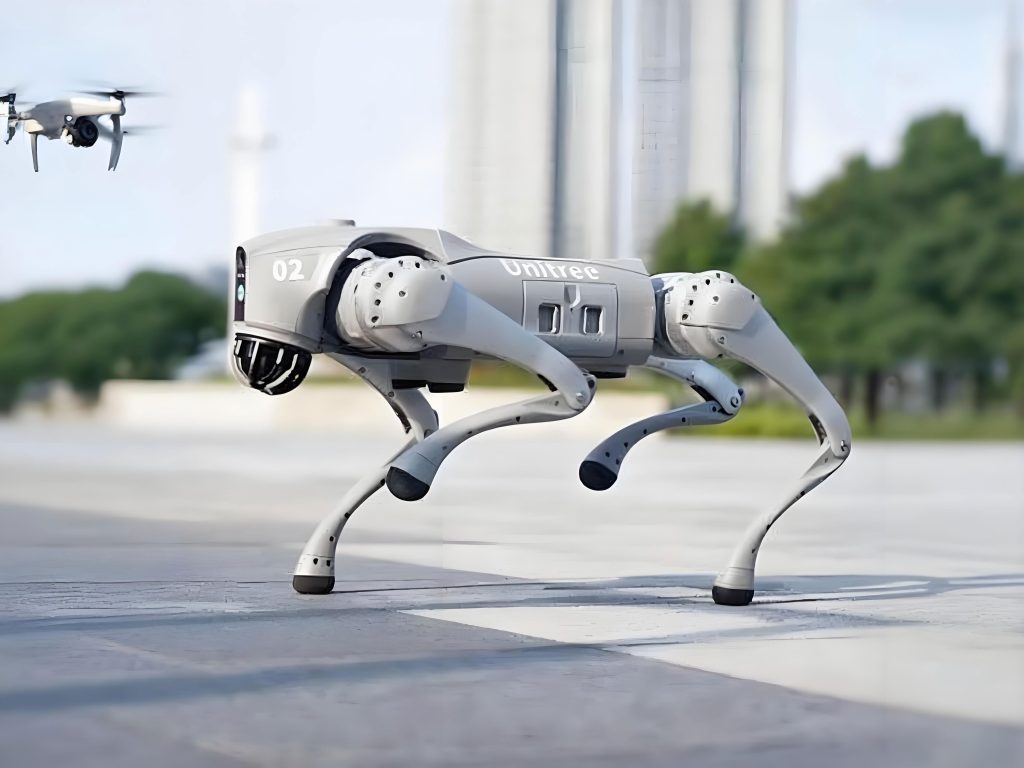
In developing these bionic robots, we focused on replicating the efficiency of biological systems. Each bionic robot acts as an autonomous agent, equipped with sensors, processors, and infrared emitters. The infrared signal serves as a virtual morphogen, carrying data about the robot’s state and environment. When multiple bionic robots are in proximity, they exchange these signals, creating a local communication network. This allows them to assess the collective needs and adjust their behavior accordingly. For instance, if a group of bionic robots detects a gap in a collapsed building, they can automatically converge and form a supportive structure. The beauty of this approach lies in its decentralization—no central controller is needed, making the system robust and scalable. As I reflect on our progress, the versatility of bionic robots continues to impress me, from their simple individual actions to emergent group intelligence.
To better understand the communication mechanism, let’s model the infrared signal propagation. The signal strength \( S \) decays with distance \( d \) according to the inverse square law, but for short ranges, we approximate it with a linear decay model. The effective range is around 10 cm, beyond which the signal becomes negligible. This ensures that bionic robots only influence nearby peers, promoting local interactions. The morphogen concentration \( M \) in a robot is represented as a virtual quantity that evolves based on received signals. We can express this with a differential equation:
$$ \frac{dM_i}{dt} = \alpha \sum_{j \in N_i} S_{ij} (M_j – M_i) – \beta M_i $$
where \( M_i \) is the morphogen level in robot \( i \), \( N_i \) is the set of neighboring bionic robots within range, \( S_{ij} \) is the signal strength from robot \( j \) to \( i \), \( \alpha \) is a coupling constant, and \( \beta \) is a decay rate. This equation captures how bionic robots adjust their morphogen levels through local exchanges, leading to coordinated behavior. In practice, we implement this in the robot’s code, allowing each bionic robot to compute its actions in real-time. The simplicity of this model belies its power—when thousands of bionic robots interact, they can form intricate patterns without any top-down commands.
The applications of bionic robots are vast, particularly in rescue scenarios. Imagine a disaster site where traditional robots struggle due to unstable terrain. Our bionic robots can be deployed en masse, each tiny and agile, to explore the environment. They can grow into structures that provide support or access, such as bridges or ramps. For example, after an earthquake, bionic robots could automatically assemble into a dynamic 3D scaffold that adapts to the rubble, enabling rescuers to reach survivors. In fire situations, bionic robots might form heat-resistant barriers or navigate through smoke using their collective intelligence. The key advantage is adaptability: these bionic robots can reshape themselves based on real-time feedback, much like biological organisms responding to stimuli. As I envision it, the future of rescue operations will heavily rely on such autonomous bionic robots, reducing human risk and increasing efficiency.
To summarize the technical specifications of our bionic robots, I have compiled a table below. This highlights the key parameters that enable their swarm behavior.
| Parameter | Value | Description |
|---|---|---|
| Signal Type | Infrared | Short-range communication for morphogen exchange |
| Signal Range | 10 cm | Maximum distance for effective interaction between bionic robots |
| Morphogen Types | Virtual (simulated) | Encoded as digital signals in the bionic robot’s software |
| Power Source | Rechargeable battery | Enables autonomous operation for extended periods |
| Size | Miniature (few cm) | Allows deployment in large swarms for complex tasks |
| Processing Unit | Embedded microcontroller | Handles local computations for decision-making in bionic robots |
Another critical aspect is the formation algorithm used by bionic robots. Inspired by biological morphogenesis, we designed a rule-based system where each bionic robot follows simple local rules to achieve global structures. These rules are encapsulated in the morphogen dynamics. For instance, if a bionic robot detects a high morphogen concentration in its vicinity, it may move toward that area, mimicking cell aggregation. The overall behavior can be described using a potential field model, where robots are attracted or repelled based on morphogen gradients. Let \( \vec{F}_i \) be the force on robot \( i \):
$$ \vec{F}_i = -k \nabla M_i + \sum_{j \neq i} \left( \frac{A}{r_{ij}^2} – \frac{B}{r_{ij}^4} \right) \hat{r}_{ij} $$
where \( k \) is a constant, \( \nabla M_i \) is the gradient of morphogen concentration, \( r_{ij} \) is the distance between bionic robots \( i \) and \( j \), and \( A \) and \( B \) are parameters for attraction and repulsion. This ensures that bionic robots maintain optimal spacing while clustering where needed. Through simulations, we have verified that this model allows bionic robots to form stable structures like bridges or walls. The elegance of this approach is that it requires minimal computation per bionic robot, making it scalable to thousands of units.
In rescue missions, the adaptability of bionic robots is paramount. They must respond to changing environments, such as shifting debris or varying temperatures. To address this, we incorporated adaptive algorithms that allow bionic robots to modify their morphogen profiles based on sensor inputs. For example, if a bionic robot senses an obstacle, it can increase its morphogen output to attract others for assistance. This emergent coordination is akin to how ants build trails or birds flock. The table below compares natural systems with our bionic robot swarms, highlighting the bio-inspired principles.
| Natural System | Bionic Robot Feature | Benefit in Rescue Operations |
|---|---|---|
| Cell signaling | Infrared morphogen exchange | Enables local communication without central control |
| Bee swarm formation | Self-organizing structures | Allows dynamic reshaping for bridges or barriers |
| Ant colony exploration | Distributed exploration algorithms | Facilitates efficient coverage of disaster sites by bionic robots |
| Embryonic development | Morphogen gradient-based growth | Supports adaptive 3D structure formation in bionic robots |
The development of bionic robots also involves challenges, such as ensuring robustness in noisy environments. Infrared signals can be interfered with by obstacles or other light sources. To mitigate this, we implemented error-correction codes in the signal transmission. Each bionic robot verifies received morphogen data against its neighbors, using consensus algorithms to maintain consistency. Mathematically, this can be represented as a consensus problem:
$$ M_i^{t+1} = M_i^t + \gamma \sum_{j \in N_i} (M_j^t – M_i^t) $$
where \( \gamma \) is a learning rate. Over time, all bionic robots in a connected network converge to a common morphogen value, ensuring coordinated action. This resilience is crucial for rescue missions where conditions are unpredictable. As I test these systems in simulated disasters, the bionic robots consistently demonstrate the ability to reorganize after disruptions, proving their potential for real-world applications.
Looking ahead, the scalability of bionic robot swarms is a key focus. We aim to deploy thousands of these miniature bionic robots in coordinated fleets. This requires efficient power management and collective decision-making. We are exploring hierarchical morphogen systems, where different types of morphogens represent various tasks, such as exploration or construction. For instance, one morphogen might guide bionic robots to form a base structure, while another directs them to reinforce weak points. The interaction can be modeled with coupled differential equations:
$$ \frac{dM_{1,i}}{dt} = f_1(M_{1,i}, M_{2,i}, S) $$
$$ \frac{dM_{2,i}}{dt} = f_2(M_{1,i}, M_{2,i}, S) $$
where \( M_{1,i} \) and \( M_{2,i} \) are two morphogen types in robot \( i \), and \( f_1, f_2 \) are functions capturing their interactions. This allows bionic robots to perform complex multi-task operations, akin to biological systems where multiple signals regulate development. In rescue scenarios, this could mean bionic robots simultaneously searching for survivors and building support structures, all autonomously.
To illustrate the potential impact, consider a case study where bionic robots are deployed after a building collapse. Initially, they scatter to map the area using their sensors. As they detect voids or survivors, they emit morphogens that attract other bionic robots. Gradually, they aggregate into a temporary bridge over a gap, adjusting its shape based on the terrain. The entire process is emergent, with no single bionic robot having a global plan. This decentralized approach reduces the risk of single-point failures—if one bionic robot malfunctions, others compensate. The table below outlines typical rescue tasks and how bionic robots address them.
| Rescue Task | Bionic Robot Action | Outcome |
|---|---|---|
| Exploration | Swarm disperses and relays data via morphogens | Comprehensive environmental mapping |
| Structure Formation | Robots converge based on morphogen gradients | Dynamic 3D structures like bridges or ramps |
| Adaptation | Morphogen levels adjust to sensor inputs | Structures reshape to fit changing conditions |
| Coordination | Local consensus algorithms ensure unity | Efficient collective behavior in bionic robots |
The bio-inspired nature of these bionic robots extends beyond mere imitation. We have engineered them to leverage principles from genetics and evolution. For example, the morphogen code can be viewed as a genetic program that dictates how bionic robots behave in response to stimuli. Over time, we can optimize this code using evolutionary algorithms, simulating generations of bionic robots to improve their performance. This involves a fitness function \( F \) that measures success in rescue tasks:
$$ F = \sum_{t} \left( \alpha C_t – \beta E_t \right) $$
where \( C_t \) is the coverage of explored area at time \( t \), \( E_t \) is energy consumption, and \( \alpha, \beta \) are weights. By iteratively refining the morphogen dynamics, we can evolve bionic robots that are more efficient and robust. This iterative design process mirrors natural selection, ensuring that our bionic robots are finely tuned for their intended roles.
In terms of hardware, each bionic robot is a marvel of miniaturization. They incorporate infrared LEDs for signaling, microcontrollers for processing, and small motors for movement. The power efficiency is critical, as bionic robots must operate for hours in disaster zones. We use low-power components and energy-harvesting techniques, such as solar cells, to extend battery life. The morphogen computation is optimized to minimize processor load, allowing real-time responses. As I assemble these bionic robots, I am constantly amazed by how much functionality we pack into such a small form factor. This miniaturization enables the deployment of massive swarms, each bionic robot contributing to the collective goal.
The communication protocol among bionic robots is another area of innovation. The infrared signal is modulated to carry morphogen data as packets. Each packet includes the robot’s ID, morphogen values, and timestamp. Bionic robots within range receive these packets and update their internal states. To avoid collisions, we implement a time-division multiplexing scheme, where bionic robots transmit in scheduled slots. This can be modeled as a queueing system:
$$ \lambda_i = \frac{1}{T} \sum_{j} S_{ij} $$
where \( \lambda_i \) is the average reception rate for robot \( i \), and \( T \) is the time slot duration. This ensures that bionic robots can communicate efficiently even in dense swarms. The protocol is designed to be scalable, so as more bionic robots are added, the system self-adjusts to maintain performance. This is essential for large-scale rescue operations where hundreds or thousands of bionic robots might be deployed simultaneously.
From a theoretical perspective, the behavior of bionic robot swarms can be analyzed using statistical mechanics. We can treat the swarm as a system of particles interacting via morphogen potentials. The overall density distribution \( \rho(\vec{r}, t) \) of bionic robots evolves according to a continuity equation:
$$ \frac{\partial \rho}{\partial t} + \nabla \cdot (\rho \vec{v}) = 0 $$
where \( \vec{v} \) is the velocity field derived from the force model earlier. This allows us to predict how bionic robots will spread or cluster over time. In rescue scenarios, this helps in planning deployments—for instance, ensuring that bionic robots evenly explore an area before concentrating on critical points. The mathematical framework provides a solid foundation for optimizing swarm strategies, making bionic robots more effective in real-world applications.
Ethical considerations also arise with autonomous bionic robots. In rescue missions, they must prioritize human safety and avoid unintended harm. We have embedded ethical guidelines into the morphogen logic, such as avoiding aggressive behaviors or respecting privacy. For example, if bionic robots encounter survivors, they can emit specific morphogens to signal for human assistance rather than autonomously intervening. This aligns with our vision of bionic robots as tools that augment human capabilities, not replace them. As I advocate for this technology, I emphasize the importance of responsible design, ensuring that bionic robots serve society beneficially.
Future developments in bionic robots will likely integrate advanced AI techniques. Machine learning algorithms could enable bionic robots to learn from experience, improving their morphogen responses over time. For instance, after multiple rescue drills, bionic robots might adapt their formation patterns to be more efficient. We are exploring reinforcement learning where each bionic robot receives rewards based on collective success. The update rule for a robot’s policy \( \pi \) can be expressed as:
$$ \pi_{i}^{new} = \pi_{i}^{old} + \eta \nabla J(\pi) $$
where \( \eta \) is a learning rate and \( J \) is the objective function. This could lead to bionic robots that self-optimize for specific environments, making them even more versatile. The integration of AI with bio-inspired principles represents the next frontier for bionic robots, promising unprecedented autonomy and adaptability.
In conclusion, the journey of developing bionic swarm robots has been both challenging and rewarding. These bionic robots, inspired by natural systems, demonstrate remarkable abilities to form structures without central instruction. Through infrared signals and virtual morphogens, they communicate locally and self-organize into dynamic shapes suitable for rescue missions. From exploring disaster sites to building adaptive bridges, the potential applications are vast. As I look to the future, I am confident that bionic robots will play a pivotal role in enhancing resilience and saving lives. The tables and formulas presented here summarize the technical essence, but the true impact lies in the real-world deployment of these autonomous bionic robots. I invite fellow engineers and researchers to join in advancing this exciting field, where biology and robotics converge to create intelligent, life-saving systems.