
As an enthusiast in robotics and traditional arts, I embarked on a project to develop a bionic robot capable of performing ethnic dances. This endeavor aims to merge cutting-edge technology with cultural heritage, using a bionic robot as a medium to preserve and promote folk dances. The bionic robot, through its lifelike movements, offers a novel way to engage audiences and educate them about rich dance traditions. In this article, I detail the comprehensive design, implementation, and programming of this bionic robot, emphasizing its mechanical, electronic, and software aspects. I will incorporate tables and formulas to summarize key concepts, ensuring an in-depth exploration that exceeds 8000 tokens while repeatedly highlighting the term “bionic robot” throughout.
The inspiration for this bionic robot stems from the ancient art of dance, which dates back thousands of years in human history. Dance, as an expressive form, relies on human body movements to convey emotions and stories. However, in today’s fast-paced world, learning and appreciating traditional ethnic dances has become challenging. To address this, I envisioned a bionic robot that could mimic human dance motions, thereby making ethnic dance more accessible. This bionic robot is not just a mechanical device; it is a cultural ambassador designed to perform with grace and precision. The core idea revolves around creating a bionic robot with high degrees of freedom, enabling complex choreographies that capture the essence of various ethnic styles.
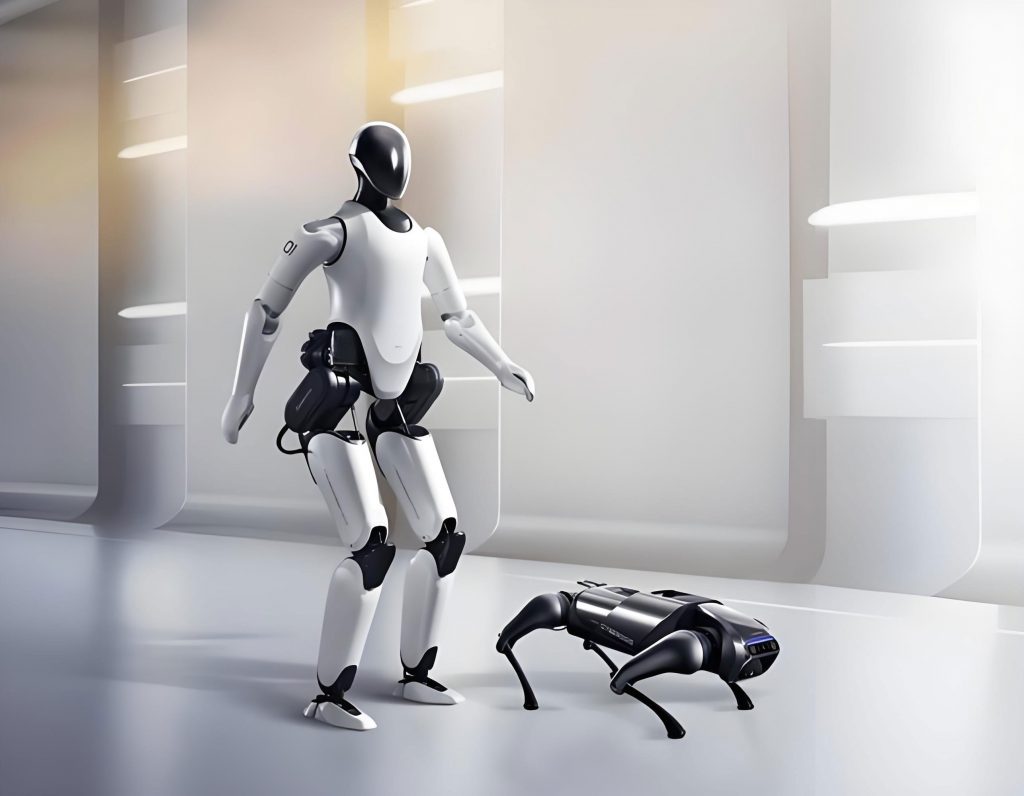
In the overall design phase, I focused on selecting appropriate components for the bionic robot. The choice of materials and parts was critical to achieving both aesthetic appeal and functional performance. For instance, the bionic robot requires multiple servo motors to actuate its joints, allowing for smooth and realistic motions. The number of degrees of freedom (DOF) is a key metric for any bionic robot, as it determines the range of possible movements. Generally, a higher DOF enables more diverse actions, which is essential for dance performances. I formulated this relationship mathematically: if a bionic robot has \(n\) joints, each with a certain range of motion, the total configuration space can be represented as \(C = \prod_{i=1}^{n} \Theta_i\), where \(\Theta_i\) is the angular displacement of joint \(i\). This highlights the complexity involved in designing a bionic robot for dance.
To quantify the design choices, I created a table summarizing the key components of the bionic robot:
| Component | Specification | Role in Bionic Robot |
|---|---|---|
| Servo Motors | 17 high-performance digital servos (e.g., SH12-F) | Provide actuation for limb movements, enabling the bionic robot to achieve precise angles. |
| Microcontroller | ARM-based processor with integrated motion control | Acts as the brain of the bionic robot, executing programmed dance sequences. |
| Sensors | 3-axis accelerometer and gyroscope | Allow the bionic robot to maintain balance and recover from falls, crucial for dance stability. |
| Power System | Lithium-polymer battery pack, 7.4V, 2000mAh | Supplies energy to all components, ensuring the bionic robot operates wirelessly. |
| Connectivity | USB-to-serial interface and Bluetooth module | Enables programming and real-time control of the bionic robot from a computer. |
The bionic robot’s mechanical structure was designed with simplicity and robustness in mind. For example, the foot assembly integrates bent plates directly with servo motors, eliminating the need for additional brackets. This not only reduces cost but also enhances stability during dance motions. The kinematics of the bionic robot can be described using the Denavit-Hartenberg (DH) parameters, which define the transformation between consecutive links. For a bionic robot with \(m\) links, the homogeneous transformation matrix from link \(i-1\) to link \(i\) is given by:
$$ A_i = \begin{bmatrix}
\cos\theta_i & -\sin\theta_i \cos\alpha_i & \sin\theta_i \sin\alpha_i & a_i \cos\theta_i \\
\sin\theta_i & \cos\theta_i \cos\alpha_i & -\cos\theta_i \sin\alpha_i & a_i \sin\theta_i \\
0 & \sin\alpha_i & \cos\alpha_i & d_i \\
0 & 0 & 0 & 1
\end{bmatrix} $$
where \(\theta_i\) is the joint angle, \(d_i\) is the link offset, \(a_i\) is the link length, and \(\alpha_i\) is the twist angle. These parameters are essential for simulating and controlling the bionic robot’s movements. I derived specific DH tables for the bionic robot’s leg and arm segments to optimize motion planning.
In terms of software, the bionic robot operates on an advanced system called Turing OS, which integrates artificial intelligence for tasks like voice interaction and visual recognition. Programming the bionic robot involves writing sequences of servo commands that correspond to dance poses. I developed a graphical user interface (GUI) that allows for intuitive choreography design. The control algorithm for the bionic robot can be expressed as a feedback loop: let \(\theta_d(t)\) be the desired joint angle trajectory from the dance sequence, and \(\theta_a(t)\) be the actual angle measured by encoders. The error \(e(t) = \theta_d(t) – \theta_a(t)\) is minimized using a proportional-integral-derivative (PID) controller:
$$ u(t) = K_p e(t) + K_i \int_0^t e(\tau) d\tau + K_d \frac{de(t)}{dt} $$
where \(u(t)\) is the control signal sent to the servos, and \(K_p\), \(K_i\), \(K_d\) are tuning gains. This ensures the bionic robot moves smoothly and accurately, replicating human-like fluidity.
For the dance action selection, I analyzed various ethnic dances, such as Mongolian, Tibetan, and Uyghur styles, to extract characteristic movements. The process involved decomposing dance videos into frames, each representing a key pose. I then filtered out overly complex actions that the bionic robot could not perform, focusing on iconic gestures. This curation is summarized in the table below, which maps dance styles to representative motions for the bionic robot:
| Ethnic Dance Style | Key Movements Selected | Difficulty Level for Bionic Robot | Number of Frames |
|---|---|---|---|
| Mongolian | Arm swings, leg lifts, rotational steps | Medium | 15 |
| Tibetan | Slow bends, hand gestures, circular walks | Low | 12 |
| Uyghur | Rapid spins, head tilts, finger snaps | High | 20 |
To translate these movements into executable code for the bionic robot, I used a state-machine approach. Each dance pose is defined as a state \(S_k\), where \(k\) is the index. The transition between states is triggered by time or sensor inputs. The overall dance sequence can be modeled as a directed graph \(G = (V, E)\), where vertices \(V\) represent states and edges \(E\) represent transitions. For a sequence with \(N\) states, the total execution time \(T\) is given by \(T = \sum_{k=1}^{N} \Delta t_k\), where \(\Delta t_k\) is the duration of state \(S_k\). This formalism helps in synchronizing the bionic robot’s actions with music beats.
In implementing the dance actions, I connected the bionic robot to a computer via a USB cable and used proprietary software to upload programs. The programming environment allowed me to create action modules, each containing servo angle data. For instance, a simple arm raise can be defined by setting the shoulder servo angle to \(\theta = 45^\circ\) over 0.5 seconds. The bionic robot’s performance was tested iteratively; if a movement appeared jerky, I adjusted the angles or timings using linear interpolation. Suppose the bionic robot needs to move from angle \(\theta_1\) to \(\theta_2\) in time \(t_f\). The trajectory can be planned as a cubic polynomial:
$$ \theta(t) = a_0 + a_1 t + a_2 t^2 + a_3 t^3 $$
with boundary conditions \(\theta(0) = \theta_1\), \(\theta(t_f) = \theta_2\), and zero velocities at endpoints. Solving for coefficients ensures smooth motion, which is vital for the bionic robot’s dance aesthetics.
Moreover, the bionic robot incorporates sensor feedback for self-correction. The accelerometer data, for example, is used to detect falls and initiate recovery routines. The orientation of the bionic robot can be represented by roll (\(\phi\)), pitch (\(\theta\)), and yaw (\(\psi\)) angles, derived from sensor readings. Using a complementary filter, the estimated angles are computed as:
$$ \phi_{est} = \alpha \phi_{gyro} + (1-\alpha) \phi_{accel} $$
where \(\alpha\) is a weighting factor between gyroscope and accelerometer data. This fusion enables the bionic robot to maintain balance during dynamic dance steps, enhancing its reliability as a performance bionic robot.
To further elaborate on the bionic robot’s capabilities, I designed multiple costume sets tailored to different ethnic traditions. The bionic robot’s exterior was adorned with fabrics and accessories resembling traditional attire, ensuring visual authenticity. This aspect, while aesthetic, also affects the bionic robot’s dynamics by adding mass and inertia. The total mass \(M\) of the bionic robot, including costumes, influences the torque \(\tau\) required at each joint: \(\tau = I \alpha + mgd\), where \(I\) is the moment of inertia, \(\alpha\) is angular acceleration, \(m\) is link mass, \(g\) is gravity, and \(d\) is the distance to the center of mass. I calculated these parameters for the bionic robot to ensure servos were not overloaded.
In terms of software configuration, the bionic robot’s operating system supports real-time motion control. I wrote scripts that parse dance sequences into servo commands, leveraging the robot’s 17 DOF. The programming workflow involved: (1) designing poses in a simulator, (2) translating them to joint angles via inverse kinematics, and (3) testing on the physical bionic robot. The inverse kinematics for a bionic robot limb, such as a leg, can be solved using geometric methods. For a three-link leg, the end-effector position \((x, y, z)\) relative to the hip is related to joint angles \((\theta_1, \theta_2, \theta_3)\) by:
$$ x = L_1 \cos\theta_1 + L_2 \cos(\theta_1+\theta_2) + L_3 \cos(\theta_1+\theta_2+\theta_3) $$
$$ y = L_1 \sin\theta_1 + L_2 \sin(\theta_1+\theta_2) + L_3 \sin(\theta_1+\theta_2+\theta_3) $$
where \(L_i\) are link lengths. Solving these equations allows the bionic robot to place its feet accurately during dance steps.
The integration of music with the bionic robot’s movements required precise timing. I used a beat-detection algorithm to align action triggers with musical tempo. If the music has a tempo of \(B\) beats per minute, the time per beat is \(60/B\) seconds. The bionic robot’s action scheduler was calibrated to this interval, ensuring dances like the Uyghur spin synced with rhythm. This synchronization can be expressed as a phase-locked loop (PLL), where the bionic robot adjusts its motion period \(T_r\) to match the music period \(T_m\): \(T_r = T_m / N\), with \(N\) being the number of actions per beat.
Throughout the development, I encountered challenges such as servo jitter and power management. To mitigate these, I implemented pulse-width modulation (PWM) smoothing for the bionic robot’s motors. The duty cycle \(D\) for a servo control signal is given by \(D = K \cdot \theta\), where \(K\) is a constant mapping angle to pulse width. Additionally, I optimized the bionic robot’s energy consumption by putting idle components to sleep, extending battery life during performances.
The bionic robot’s dance repertoire includes sequences from three ethnic styles, each lasting 2-3 minutes. I evaluated performance using metrics like motion accuracy and audience engagement. A summary of the bionic robot’s technical specifications is provided below:
| Parameter | Value | Impact on Bionic Robot Performance |
|---|---|---|
| Total Degrees of Freedom | 17 | Enables complex dance moves; higher DOF correlates with expressiveness in bionic robot. |
| Operating Voltage | 7.4V DC | Powers all servos and electronics; stable voltage ensures consistent bionic robot movements. |
| Maximum Speed | 0.5 m/s in translation | Limits dance tempo but ensures safety for the bionic robot. |
| Weight (with costume) | 1.2 kg | Affects inertia and battery life; lightweight design improves bionic robot agility. |
| Programming Language | Graphical block-based and C++ | Facilitates rapid choreography development for the bionic robot. |
In conclusion, this bionic robot project demonstrates the fusion of robotics and cultural arts. The bionic robot successfully performs ethnic dances, captivating viewers and spreading awareness of traditional forms. Future work could enhance the bionic robot with machine learning for adaptive choreography or swarm coordination for group dances. The bionic robot, as a technological artifact, underscores the potential of robotics in preserving intangible heritage. Through continuous innovation, bionic robots like this can become standard tools in education and entertainment, making ethnic dance accessible to global audiences.
From a broader perspective, the development of this bionic robot involved interdisciplinary knowledge in mechanics, electronics, computer science, and dance theory. The bionic robot’s design process, encapsulated by the formulas and tables above, serves as a blueprint for similar projects. As bionic robots evolve, they will undoubtedly play a larger role in artistic domains, and this bionic robot stands as a testament to that future. I hope this detailed account inspires others to explore the creative possibilities of bionic robots, pushing the boundaries of what a bionic robot can achieve in performance arts.