
As a researcher immersed in the field of robotics, I have witnessed firsthand the rapid evolution of machines that mimic biological systems. The concept of the bionic robot, a machine designed to emulate the form and function of living organisms, has captivated both the scientific community and the public imagination. In recent years, advancements in perception and cognition have been pivotal, yet one sensory modality has lagged behind: touch. The development of tactile perception technology has been relatively slow, creating a significant bottleneck in expanding the capabilities of bionic robots. Enabling robots to possess near-human levels of tactile ability in scenarios such as human-robot interaction, motion control, and dexterous manipulation has emerged as a critical research focus and a formidable technical challenge. This article delves into the latest breakthroughs, emphasizing the integration of tactile sensing, and explores how these innovations are propelling bionic robots toward unprecedented autonomy and functionality.
The foundation of any advanced bionic robot lies in its ability to perceive and interpret the environment. While computer vision has achieved remarkable feats, often rivaling human performance, the sense of touch remains underexplored. Tactile feedback is essential for safe, efficient, and autonomous operation, particularly in unstructured settings. I recall a recent demonstration where a wheel-legged bionic robot, an agile platform reminiscent of a rollerblader, showcased enhanced interaction capabilities. This evolution was made possible by integrating a novel tactile sensor, allowing the robot to detect minute pressure changes on its surface and respond to touch gestures. Such progress underscores a broader trend: the bionic robot is transitioning from a purely vision-driven entity to a multi-sensory being.
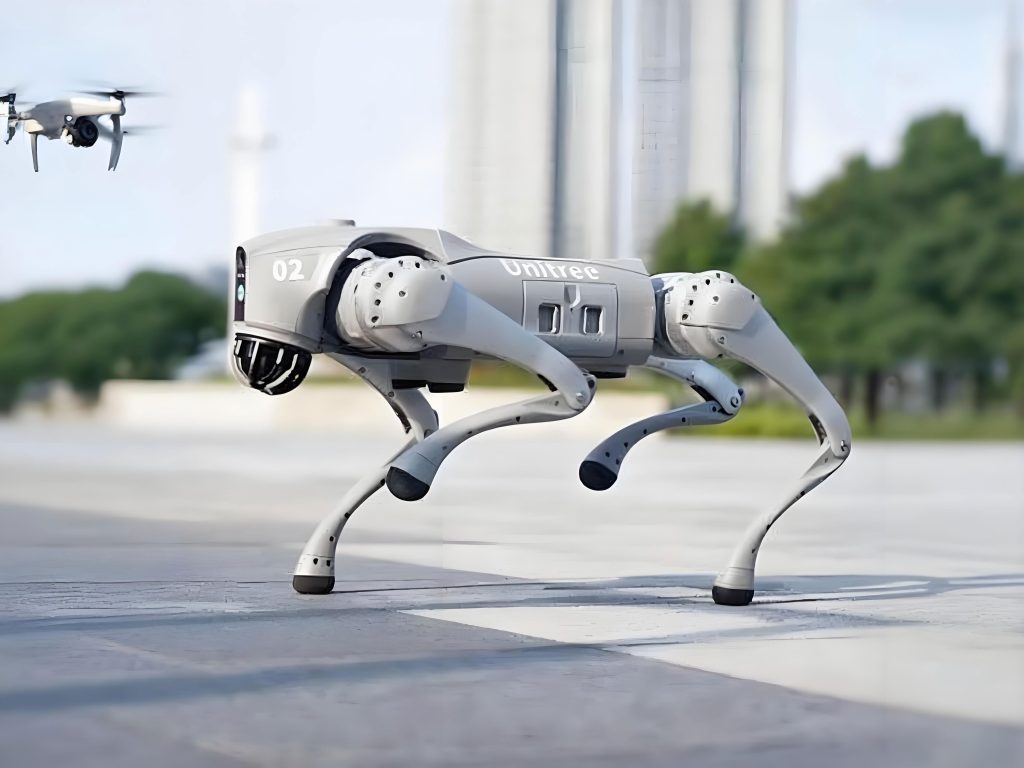
At the heart of this tactile revolution are advanced sensor arrays. The tactile sensor in question utilizes a new piezoresistive material characterized by ultra-high sensitivity, an extensive measurement range, rapid response times, and exceptional cyclic stability. When combined with customized electrode adaptation modules, high-speed signal acquisition hardware, and integrated software solutions, these sensors enable bionic robots to perceive contact with remarkable fidelity. The underlying principle can be modeled using a simplified piezoresistive equation:
$$ \Delta R = R_0 \cdot S \cdot \epsilon $$
where \( \Delta R \) is the change in resistance, \( R_0 \) is the baseline resistance, \( S \) is the gauge factor (sensitivity coefficient), and \( \epsilon \) represents strain induced by pressure. For a sensor array with \( n \times m \) elements, the spatial pressure distribution \( P(x,y) \) can be reconstructed from resistance mappings, enabling detailed tactile imaging. This technology represents a leap forward for bionic robots, allowing them to handle delicate tasks, such as balancing spherical objects on their heads, which require precise force modulation.
Parallel to developments in tactile sensing, the domain of humanoid bionic robots has seen significant strides. The unveiling of a full-scale humanoid bionic robot, designed with proportions akin to an average adult male, marks a milestone in mechanical complexity and system integration. This bionic robot incorporates auditory and visual spatial sensors, employs 3D reconstruction algorithms, and can recognize a wide array of human emotional semantics. Its motion control system coordinates numerous joint degrees of freedom with real-time responsiveness, leveraging custom whole-body control algorithms. The actuation system features multiple driving methods, with key joints generating high instantaneous torque to handle payloads. The integration of these systems exemplifies the holistic approach needed for advanced bionic robots.
To better illustrate the technological landscape, I have compiled key comparisons and metrics. The following table contrasts sensory modalities in modern bionic robots, highlighting the relative maturity and challenges of tactile perception.
| Sensory Modality | Primary Technology | Typical Accuracy/Resolution | Integration Challenge in Bionic Robots | Status in Bionic Robots |
|---|---|---|---|---|
| Vision | Cameras, LiDAR, Depth Sensors | Sub-millimeter to centimeter | Data processing, real-time 3D reconstruction | Mature, widely deployed |
| Audition | Microphone Arrays, Sound Localization | Frequency range: 20Hz-20kHz | Noise filtering, semantic understanding | Advanced, with emotion detection |
| Tactile (Skin-like) | Piezoresistive, Capacitive, Optical Arrays | Pressure sensitivity: <1 kPa, Spatial: <1 mm | Material durability, signal fusion, large-area coverage | Emerging, rapid progress |
| Proprioception | Encoders, IMUs, Force/Torque Sensors | Joint angle: <0.1°, Force: <0.1 N | Calibration, drift compensation | Well-established |
The control algorithms governing bionic robots are equally critical. For a bionic robot to maintain balance while performing dynamic maneuvers, such as the unique two-wheel stepping gait demonstrated by some platforms, it relies on sophisticated motion planning and stability controllers. Consider a simplified model for a wheel-legged bionic robot. Its dynamics can be expressed using the Euler-Lagrange formulation:
$$ M(q)\ddot{q} + C(q, \dot{q})\dot{q} + G(q) = \tau + J^T F $$
where \( q \) is the vector of generalized coordinates, \( M \) is the inertia matrix, \( C \) captures Coriolis and centrifugal terms, \( G \) is the gravitational vector, \( \tau \) represents actuator torques, \( J \) is the Jacobian matrix, and \( F \) denotes external forces (including tactile interactions). Integrating tactile feedback \( F_{\text{tactile}} \) allows for reactive control laws, such as:
$$ \tau_{\text{adjust}} = K_p \cdot F_{\text{tactile}} + K_d \cdot \dot{F}_{\text{tactile}} $$
where \( K_p \) and \( K_d \) are gain matrices. This enables the bionic robot to adapt its posture upon contact, enhancing stability during interactive tasks. The fusion of tactile data with proprioceptive and visual streams creates a robust perceptive loop, a hallmark of next-generation bionic robots.
Another fascinating aspect is the mechanical design and actuation of bionic robots. Humanoid bionic robots, in particular, demand a high degree of freedom and powerful, compact actuators. The following table summarizes key specifications for a hypothetical full-sized humanoid bionic robot, reflecting recent advancements.
| Parameter Category | Specification | Implication for Bionic Robot Performance |
|---|---|---|
| Height / Mass | ~1.8 m / ~55 kg | Anthropomorphic design for human-environment interaction |
| Degrees of Freedom (DoF) | 21+ joints | Enables complex, human-like motion trajectories |
| Actuation Types | 5 methods (e.g., servo, harmonic drive) | Optimizes torque, speed, and efficiency across joints |
| Peak Joint Torque (e.g., Hip) | ~300 Nm | Allows for lifting payloads, dynamic stability |
| Control Loop Response | <1 ms per DoF | Facilitates real-time adaptation and smooth motion |
| Sensory Suite | Tactile, vision, auditory, proprioceptive | Comprehensive perception for autonomous operation |
The integration of tactile sensing into a bionic robot is not merely an additive feature; it transforms the machine’s interaction paradigm. For instance, in human-robot collaboration, a bionic robot equipped with skin-like sensors can detect gentle taps or pushes, allowing for intuitive communication. This is governed by interaction dynamics that can be modeled using impedance control, where the robot adjusts its stiffness and damping based on tactile input. The desired impedance model is:
$$ M_d \ddot{x} + B_d \dot{x} + K_d x = F_{\text{ext}} $$
with \( M_d \), \( B_d \), and \( K_d \) as desired inertia, damping, and stiffness matrices, \( x \) as position error, and \( F_{\text{ext}} \) as external force from tactile sensing. By modulating these parameters, the bionic robot can switch between rigid precision tasks and compliant, safe interactions.
Looking at broader applications, the bionic robot stands to revolutionize fields from healthcare to logistics. In assisted living, a bionic robot with refined touch could help elderly individuals by providing physical support, detecting grip forces to avoid injury. In industrial settings, bionic robots could perform assembly tasks requiring delicate handling, such as inserting fragile components. The tactile sensor’s performance metrics are crucial here. Sensitivity \( S \) is often defined as:
$$ S = \frac{\Delta R / R_0}{\Delta P} $$
where \( \Delta P \) is pressure change. State-of-the-art sensors for bionic robots achieve \( S \) values exceeding 10 kPa⁻¹, with response times under 10 ms, enabling real-time feedback. Durability is another key factor, measured by cyclic tests where resistance drift \( \delta \) after \( N \) cycles should be minimal:
$$ \delta(N) = \left| \frac{R_N – R_0}{R_0} \right| \times 100\% < 5\% \quad \text{for } N > 10^5 $$
These specifications ensure that the bionic robot can operate reliably in prolonged interactions.
The path toward truly autonomous bionic robots involves converging multiple disciplines. Materials science yields flexible, durable sensor skins; mechanical engineering creates biomimetic structures; computer science develops algorithms for sensor fusion and control. A significant challenge is the computational load of processing high-density tactile data. For an array with \( k \) taxels (tactile pixels), each sampling at frequency \( f \), the data rate \( D \) is:
$$ D = k \cdot f \cdot b \quad \text{bits/s} $$
where \( b \) is bit depth per taxel. With \( k = 1000 \), \( f = 100 \, \text{Hz} \), and \( b = 12 \), \( D \approx 1.2 \, \text{Mbps} \). Efficient compression and edge processing are thus vital for a responsive bionic robot.
In my observation, the evolution of the bionic robot is accelerating through open research and cross-institutional collaboration. While specific corporate projects demonstrate rapid prototyping, the underlying technologies—like the tactile sensor arrays discussed—are often published in peer-reviewed journals, fostering community-wide progress. The bionic robot serves as a testbed for fundamental advancements in perception, cognition, and action. Future work will likely focus on enhancing the resolution and scalability of tactile skins, improving energy efficiency of actuators, and developing more intuitive human-robot interfaces. Moreover, as costs decrease through innovation, we may see broader deployment of bionic robots in daily life.
To summarize the core technologies enabling modern bionic robots, I present a comparative analysis of key hardware and software components in the table below.
| System Component | Current State-of-the-Art | Mathematical Model/Formula | Impact on Bionic Robot Capability |
|---|---|---|---|
| Tactile Sensor Array | Flexible, large-scale, high sensitivity piezoresistive | \( R(P) = R_0 e^{-\alpha P} \) (for some materials) | Enables fine manipulation, safe interaction |
| Motion Control Algorithm | Whole-body control, model predictive control (MPC) | \( \min_{\tau} \int (x_{\text{ref}} – x)^T Q (x_{\text{ref}} – x) + \tau^T R \tau \, dt \) | Achieves dynamic balance, agile locomotion |
| Multi-Sensory Fusion | Bayesian filtering, deep learning approaches | \( p(x_t | z_{1:t}) \propto p(z_t | x_t) \int p(x_t | x_{t-1}) p(x_{t-1} | z_{1:t-1}) dx_{t-1} \) | Creates unified environmental representation |
| Actuation System | High-torque density motors, compliant drives | \( \tau = K_t \cdot i \) (motor torque constant) | Provides strength, speed, and efficiency |
| Energy Management | High-density batteries, regenerative braking | \( E_{\text{total}} = \sum_i \int \tau_i \omega_i \, dt + E_{\text{aux}} \) | Extends operational duration for bionic robot |
In conclusion, the integration of advanced tactile perception marks a pivotal chapter in the saga of the bionic robot. By endowing machines with a sense of touch akin to biological systems, we unlock new realms of interaction, dexterity, and autonomy. The progress in sensor materials, control theory, and system integration is converging to create bionic robots that are not only mechanically adept but also perceptively rich. As a researcher, I am optimistic that continued innovation will address current limitations, such as cost and scalability, paving the way for bionic robots to become commonplace collaborators in our societies. The journey toward a truly touch-sensitive bionic robot is well underway, and each breakthrough brings us closer to machines that can feel, understand, and respond to the world with human-like grace.
Reflecting on the broader implications, the rise of the bionic robot challenges us to rethink the boundaries between machine and organism. With every sensor added and every algorithm refined, these entities become more capable of navigating complex environments, assisting in tasks ranging from mundane to critical. The bionic robot, especially when equipped with holistic sensory suites, represents a synthesis of engineering brilliance and biological inspiration. It is through persistent exploration in labs worldwide that the vision of a versatile, tactile-aware bionic robot will materialize, transforming industries and enriching human life. The future of robotics is unmistakably bionic, and touch is its newest frontier.