
In the realm of robotics, the emulation of biological systems has always fascinated researchers and engineers. My work focuses on the development and analysis of a bionic robot, specifically a quadrupedal machine inspired by mammalian locomotion. This bionic robot aims to replicate the stability, agility, and adaptability observed in nature, making it suitable for various terrains and tasks. The design and control of such a bionic robot involve intricate structural engineering and sophisticated gait planning. In this article, I will delve into the comprehensive analysis of the bionic robot’s architecture, kinematic modeling, gait strategies, and experimental validation. Throughout this discussion, the term “bionic robot” will be emphasized to underscore the biomimetic essence of this project. The integration of mechanical design with biological principles is central to advancing the capabilities of this bionic robot, paving the way for applications in search-and-rescue, exploration, and service robotics.
The inspiration for this bionic robot stems from the observation of quadrupedal animals, such as dogs or cats, which exhibit remarkable balance and mobility. By studying their limb structures and movement patterns, I have engineered a bionic robot that mimics these characteristics. The bionic robot’s design prioritizes lightweight construction, modularity, and efficient actuation to achieve dynamic locomotion. The core of this bionic robot lies in its leg mechanisms, which are designed with multiple degrees of freedom to enable complex maneuvers. This bionic robot represents a significant step towards creating autonomous machines that can navigate unstructured environments with ease. The following sections will detail the structural components, mathematical modeling, and gait analysis that define this bionic robot’s performance.
To visualize the physical embodiment of this bionic robot, consider the following image that captures its agile form and mechanical intricacies. This bionic robot showcases the integration of joints and linkages that replicate biological limbs, allowing for smooth and controlled motion. The design emphasizes robustness and precision, ensuring that the bionic robot can withstand operational stresses while maintaining flexibility.
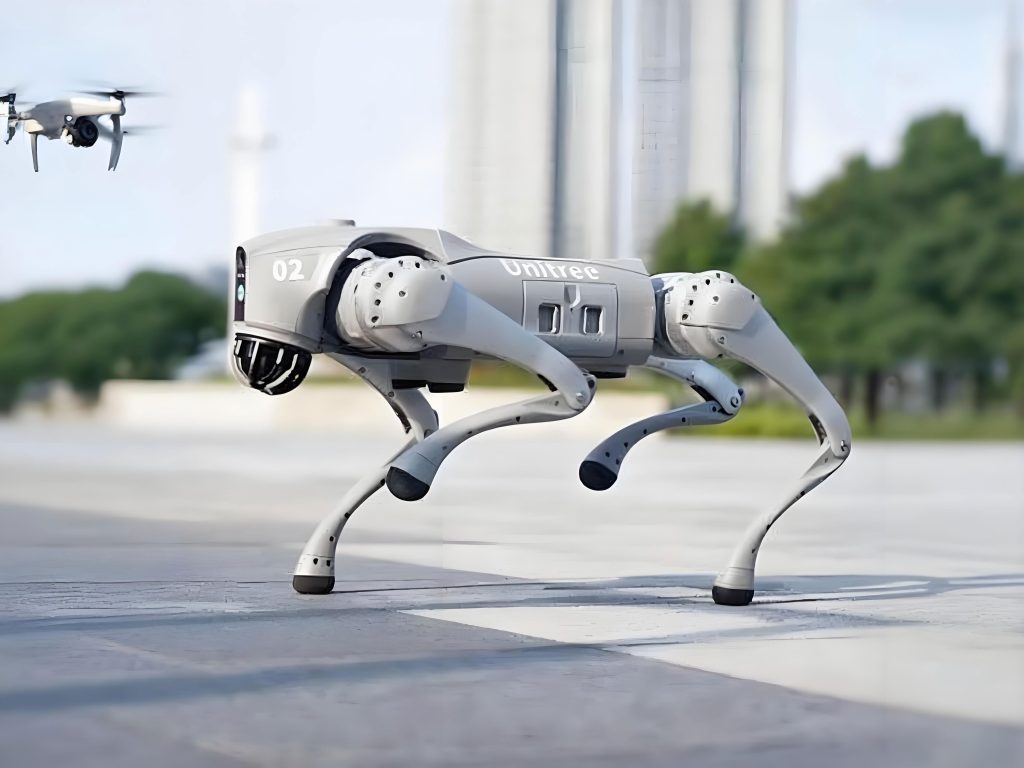
Overall Structure of the Bionic Robot
The bionic robot’s overall structure is compact and optimized for stability. With dimensions of 300 mm in length, 250 mm in width, and 263 mm in height, and a total mass of 2.5 kg, this bionic robot is designed for agility. The body frame is constructed from aluminum alloy, providing a balance between strength and weight reduction. The bionic robot features four identical legs symmetrically attached to the chassis, each equipped with three active joints. This configuration grants the bionic robot twelve degrees of freedom in total, enabling versatile movement capabilities. The leg distribution ensures even weight support and enhances the bionic robot’s balance during locomotion. The foot design incorporates a flat base to maximize ground contact, which is crucial for maintaining stability when the bionic robot is stationary or in motion. The actuation of each joint is achieved through servo motors, which serve as artificial muscles, driving the leg segments via linkages and brackets. This modular approach allows for easy maintenance and customization of the bionic robot, making it a versatile platform for research and development.
The bionic robot’s chassis houses the control electronics, power supply, and communication modules. The centralized control system coordinates the servo movements based on gait algorithms, ensuring synchronized leg actions. The bionic robot’s design also considers thermal management and durability, as the servo motors can generate heat during prolonged operation. By leveraging lightweight materials and efficient power distribution, this bionic robot achieves extended operational periods without compromising performance. The structural integrity of the bionic robot is validated through finite element analysis, confirming that it can handle dynamic loads during walking or turning. This bionic robot exemplifies how biomimicry can inform mechanical design, resulting in a machine that is both functional and resilient.
Single-Leg Structure of the Bionic Robot
Each leg of the bionic robot is a crucial subsystem that dictates the overall mobility. The single-leg structure comprises three main joints: the hip joint, knee joint, and ankle joint, each driven by a dedicated servo motor. These joints correspond to the biological analogs found in mammalian limbs, allowing the bionic robot to perform lifelike motions. The hip joint provides abduction and adduction, enabling lateral movements; the knee joint facilitates flexion and extension for forward propulsion; and the ankle joint offers fine-tuning of foot orientation. The linkages, such as servo mounts and joint brackets, act as skeletal elements, transmitting forces efficiently. The bionic robot’s leg design incorporates offset linkages to optimize torque transmission and reduce inertia, which is vital for rapid leg swings during gait cycles.
The servo motors are selected based on torque requirements and response speed, ensuring that the bionic robot can execute precise angle adjustments. The kinematic chain of each leg is modeled as a series of rigid links connected by revolute joints. This simplification allows for mathematical analysis of the bionic robot’s leg dynamics. The bionic robot’s foot is designed with a rubberized tip to enhance grip and absorb shocks, mimicking the paw pads of animals. This attention to detail in the bionic robot’s leg structure contributes to its ability to traverse uneven surfaces without slippage or instability. The modularity of the leg assembly means that individual components can be replaced or upgraded, making the bionic robot adaptable to different operational scenarios. The bionic robot’s leg mechanism is a testament to how biological principles can be translated into engineering solutions for enhanced robotic performance.
Kinematic Analysis of the Bionic Robot
To understand the bionic robot’s movement capabilities, a detailed kinematic analysis is essential. The Denavit-Hartenberg (DH) method is employed to model the leg’s coordinate systems. For the bionic robot’s right front leg, a base frame is established at the hip joint’s rotation axis, with the X-axis pointing opposite to the direction of motion, the Y-axis aligned with gravity, and the Z-axis determined by the right-hand rule. The joint angles are denoted as $\theta_1$, $\theta_2$, and $\theta_3$, corresponding to the hip, knee, and ankle rotations, respectively. The link lengths are defined as $L_1$, $L_2$, and $L_3$, representing the distances between joint origins. The foot-tip position and orientation in the base frame are described by the homogeneous transformation matrix.
The DH parameters for the bionic robot’s leg are summarized in Table 1. These parameters include the link lengths, twist angles, offsets, and joint variables, which are used to derive the transformation matrices between consecutive frames.
| Joint $i$ | Link Length $a_{i-1}$ | Twist Angle $\alpha_{i-1}$ | Offset $d_i$ | Joint Angle $\theta_i$ |
|---|---|---|---|---|
| 1 | 0 | 0° | 0 | $\theta_1$ |
| 2 | 0 | 90° | $L_1$ | $\theta_2$ |
| 3 | $L_2$ | 0° | 0 | $\theta_3$ |
| 4 | $L_3$ | 0° | 0 | 0 |
The transformation matrices from frame {0} to frame {4} are computed as follows. Let $c_i = \cos(\theta_i)$ and $s_i = \sin(\theta_i)$. The individual transformations are:
$${^0_1T} = \begin{bmatrix} c_1 & -s_1 & 0 & 0 \\ s_1 & c_1 & 0 & 0 \\ 0 & 0 & 1 & 0 \\ 0 & 0 & 0 & 1 \end{bmatrix}$$
$${^1_2T} = \begin{bmatrix} c_2 & -s_2 & 0 & 0 \\ 0 & 0 & -1 & L_1 \\ s_2 & c_2 & 0 & 0 \\ 0 & 0 & 0 & 1 \end{bmatrix}$$
$${^2_3T} = \begin{bmatrix} c_3 & -s_3 & 0 & L_2 \\ s_3 & c_3 & 0 & 0 \\ 0 & 0 & 1 & 0 \\ 0 & 0 & 0 & 1 \end{bmatrix}$$
$${^3_4T} = \begin{bmatrix} 1 & 0 & 0 & L_3 \\ 0 & 1 & 0 & 0 \\ 0 & 0 & 1 & 0 \\ 0 & 0 & 0 & 1 \end{bmatrix}$$
The overall transformation from the base to the foot-tip is obtained by multiplying these matrices:
$${^0_4T} = {^0_1T} \cdot {^1_2T} \cdot {^2_3T} \cdot {^3_4T} = \begin{bmatrix} c_1 c_{23} & -c_3 s_{12} & s_1 & L_3 c_1 c_{23} + L_1 s_1 + L_2 c_2 c_3 \\ s_1 c_{23} & -s_1 s_{23} & -c_1 & L_3 s_1 c_{23} – L_1 c_1 + L_2 s_1 c_2 \\ s_{23} & c_{23} & 0 & L_3 s_{23} + L_2 s_2 \\ 0 & 0 & 0 & 1 \end{bmatrix}$$
where $s_{ij} = \sin(\theta_i + \theta_j)$ and $c_{ij} = \cos(\theta_i + \theta_j)$. The foot-tip position vector $\mathbf{p} = [p_x, p_y, p_z]^T$ is extracted from the last column:
$$p_x = L_3 c_1 c_{23} + L_1 s_1 + L_2 c_2 c_3$$
$$p_y = L_3 s_1 c_{23} – L_1 c_1 + L_2 s_1 c_2$$
$$p_z = L_3 s_{23} + L_2 s_2$$
For inverse kinematics, given a desired foot-tip position, the joint angles can be solved. The solutions are derived through algebraic manipulation:
$$\theta_1 = \arctan\left(\frac{p_y}{p_x}\right)$$
$$\theta_2 = \arcsin\left(\frac{p_x}{A}\right) – \arccos\left(\frac{L_3 \cos(\theta_3) + L_2}{A}\right)$$
$$\theta_3 = \arccos\left(\frac{B – L_2^2 – L_3^2}{2 L_2 L_3}\right)$$
where $A = \sqrt{(p_x c_1 + p_y s_1)^2 + p_z^2}$ and $B = (L_3 \cos(\theta_3) + L_2)^2 + (L_3 \sin(\theta_3))^2$. These equations enable precise control of the bionic robot’s leg positioning, which is fundamental for gait execution. The kinematic model ensures that the bionic robot can place its feet accurately during support and swing phases, contributing to stable locomotion.
Gait Analysis for the Bionic Robot
The gait of a bionic robot refers to the coordinated pattern of leg movements that propels the body forward or facilitates turning. For this bionic robot, two primary gaits are analyzed: straight-line walking and point turning. These gaits are inspired by quadrupedal animals and are implemented through phased leg controls. The bionic robot’s gait planning involves defining support phases (when the leg is on the ground) and swing phases (when the leg is lifted). The timing and sequencing of these phases determine the bionic robot’s speed, stability, and energy efficiency.
Straight-Line Walking Gait
The bionic robot employs a trotting gait for straight-line motion, which is a diagonal gait where legs move in paired synchrony. In this bionic robot, the legs are grouped into two diagonal pairs: left front (LF) with right rear (RR) as Pair A, and right front (RF) with left rear (LR) as Pair B. The gait cycle is divided into phases where one pair is in swing while the other is in support. This diagonal sequencing mimics the efficient locomotion seen in many mammals, allowing the bionic robot to maintain dynamic balance.
Table 2 outlines the phase relationships for the bionic robot’s trotting gait over a cycle period $T$. The black cells indicate swing phases, and white cells indicate support phases.
| Time Phase | LF | RF | LR | RR |
|---|---|---|---|---|
| 0–0.25T | Swing | Support | Support | Swing |
| 0.25–0.5T | Support | Swing | Swing | Support |
| 0.5–0.75T | Swing | Support | Support | Swing |
| 0.75–1.0T | Support | Swing | Swing | Support |
The bionic robot can walk in both high-posture and low-posture modes. High-posture walking involves a taller body stance, which is useful for overcoming small obstacles. Low-posture walking lowers the center of mass, enhancing stability on rough terrain. For high-posture straight-line walking, the bionic robot completes a cycle in 3.5 seconds with seven distinct motion steps. Simulation data from ADAMS software shows that the bionic robot’s center of mass displaces approximately 115.55 mm forward per cycle, with an average speed of 33 mm/s. The lateral deviation is minimal (0.04915 mm), and vertical oscillations are within 12.5 mm, indicating stable progression.
For low-posture straight-line walking, the bionic robot takes 4 seconds per cycle due to an additional step to lower the body. The forward displacement increases to 128.25 mm per cycle, but the average speed slightly decreases to 32 mm/s. Lateral deviations are larger (up to 40 mm), suggesting more body sway, but the lower center of mass improves load-bearing stability. The bionic robot’s ability to switch between postures demonstrates its adaptability, a key feature of advanced bionic robots.
Point Turning Gait
Point turning allows the bionic robot to rotate in place, which is essential for navigation in confined spaces. This gait is executed in four stages: first, the LF leg swings inward and outward to shift the center of mass leftward; second, the LF hip swings left to rotate the body by 15°; third, the RF leg performs similar motions to achieve another 15° rotation; fourth, the leg angles are adjusted to recenter the mass. The entire point turn cycle lasts 2.5 seconds, with five motion steps.
The angular change of the bionic robot’s body during a point turn is plotted in Figure 1 (simulated). The initial angle is 91°, and the final angle is 79.07°, resulting in a net rotation of about 12° per cycle. The angular profile shows fluctuations due to ground contact and friction during leg lifts. This gait enables the bionic robot to reorient itself quickly without forward translation, enhancing its maneuverability. The bionic robot’s point turning capability is crucial for obstacle avoidance and path correction in complex environments.
Simulation and Prototype Testing of the Bionic Robot
To validate the design and gait algorithms, the bionic robot undergoes extensive simulation using ADAMS dynamics software. The simulation models the bionic robot’s mechanical structure, joint constraints, and ground interactions. For straight-line walking, the bionic robot’s center of mass trajectories are analyzed to assess stability and efficiency. The simulations confirm that the bionic robot maintains consistent forward motion with minimal lateral drift, as shown in the displacement curves. The bionic robot’s dynamic performance is evaluated under various payloads and surface conditions, ensuring robustness.
For point turning, the simulation tracks the body orientation over time, verifying that the bionic robot achieves the desired angular displacement. The torque requirements for each servo motor are also computed to prevent overheating and ensure longevity. The simulation results guide the optimization of gait parameters, such as step height and cycle duration, for the bionic robot. After simulation, a physical prototype of the bionic robot is built and tested. The prototype incorporates all design elements, including the aluminum chassis, servo-driven legs, and control system. The bionic robot’s gait tests involve straight-line walks, point turns, and obstacle avoidance sequences. In obstacle avoidance, the bionic robot uses sensors to detect barriers within 40 cm, triggering a point turn to change direction. After ten turn cycles, the bionic robot executes low-posture walking for three cycles before resuming high-posture walking. The tests demonstrate that the bionic robot operates smoothly, with gait transitions being seamless and stable.
The bionic robot’s performance metrics are summarized in Table 3, highlighting key outcomes from both simulation and physical testing.
| Metric | High-Posture Walk | Low-Posture Walk | Point Turn |
|---|---|---|---|
| Cycle Time (s) | 3.5 | 4.0 | 2.5 |
| Displacement per Cycle (mm) | 115.55 | 128.25 | N/A | Rotation per Cycle (°) | N/A | N/A | 12 |
| Average Speed (mm/s) | 33 | 32 | N/A |
| Lateral Deviation (mm) | 0.049 | 3.297 | N/A |
The successful testing of the bionic robot prototype confirms the efficacy of the structural and gait designs. The bionic robot exhibits reliable locomotion, making it a promising platform for further research into autonomous bionic robots.
Conclusion and Future Work
In this comprehensive study, I have presented the design, analysis, and testing of a bionic robot inspired by quadrupedal animals. The bionic robot’s structure features a lightweight chassis and multi-jointed legs, enabling dynamic movement. Kinematic modeling using DH parameters provides precise control over foot placement, which is essential for stable gaits. The bionic robot’s straight-line walking and point turning gaits are analyzed through simulation and physical experiments, demonstrating its ability to navigate diverse terrains. The bionic robot’s performance highlights the potential of biomimicry in robotics, offering insights into how biological principles can enhance mechanical systems.
Future work on this bionic robot will focus on integrating advanced sensors for environmental perception, such as LiDAR and cameras, to enable autonomous navigation. Additionally, machine learning algorithms could be employed to optimize gait parameters in real-time, allowing the bionic robot to adapt to unforeseen obstacles or surface changes. The bionic robot’s design could also be scaled or modified for specific applications, such as search-and-rescue or planetary exploration. Continued refinement of the bionic robot’s energy efficiency and payload capacity will broaden its utility. Ultimately, this bionic robot serves as a foundation for developing more sophisticated bionic robots that blur the line between machines and living organisms.
The journey of creating this bionic robot underscores the interdisciplinary nature of robotics, merging biology, mechanics, and control theory. As bionic robots evolve, they will play an increasingly vital role in addressing real-world challenges, from disaster response to industrial automation. The insights gained from this bionic robot project contribute to the growing body of knowledge in biomimetic robotics, paving the way for future innovations.