
The evolution of robotics in the 21st century is increasingly steering towards autonomy in unstructured and challenging environments, such as dense forests, disaster zones, and subterranean pipelines. Traditional wheeled or tracked vehicles often falter in such terrains due to limited adaptability. This challenge has naturally directed research focus towards the biological world, where legged locomotion has proven to be remarkably versatile and robust over millennia of evolution. Among legged creatures, multi-legged insects present a fascinating paradigm due to their inherent stability, agility, and ability to navigate highly complex obstacles. The development of multi-legged bionic robots has thus become a significant research frontier, aiming to translate biological principles into engineered systems capable of performing demanding tasks like reconnaissance, inspection, and payload transportation in wild landscapes.
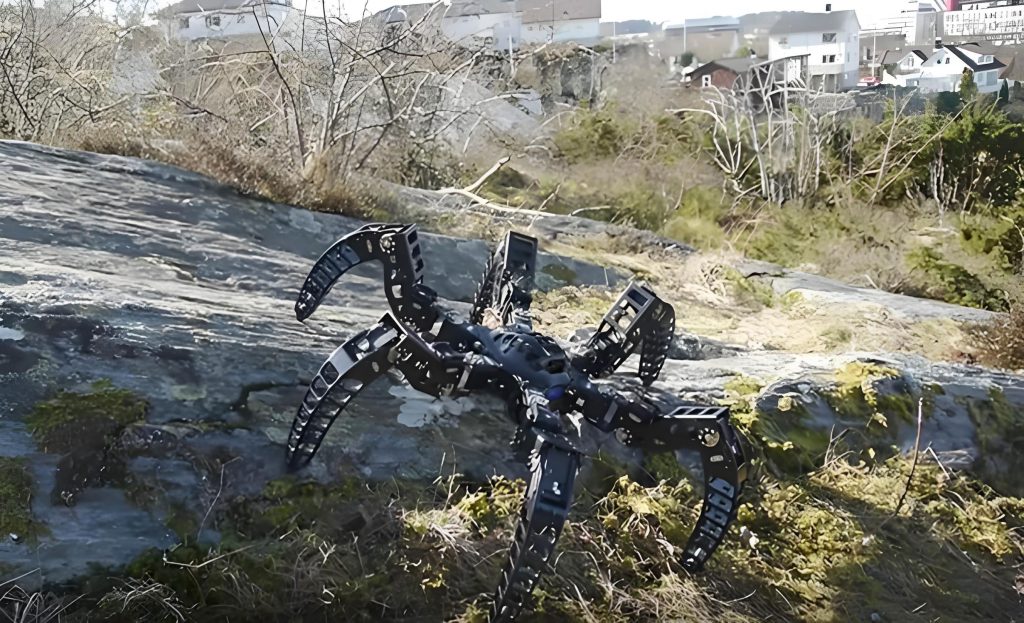
This work focuses on the design and analysis of a hexapod bionic robot inspired by the tiger beetle (Coleoptera: Cicindelinae). The tiger beetle is an exceptional biological model for several compelling reasons. First, it is renowned for its incredible relative speed; certain species can cover a distance 125 times their body length in a single second. This performance is intrinsically linked to the specialized design and kinematics of its legs. Second, the tiger beetle possesses a remarkably lightweight leg structure, with the mass of all six legs constituting less than one-tenth of its total body mass. This is a stark contrast to many engineered legged robots, where the leg actuators and structure often constitute a significant portion of the total weight, limiting efficiency and payload capacity. By studying and emulating the tiger beetle’s morphology, we aim to develop a bionic robot that combines high mobility, good stability, and structural efficiency for operation in forested and uneven terrains.
Biomimetic Analysis of the Tiger Beetle Prototype
The tiger beetle’s body is elongated and dorsoventrally flattened, typically divided into the head, thorax, and abdomen. Its six legs are attached to the lateral-ventral surfaces of the thoracic segments: the forelegs to the prothorax, mid-legs to the mesothorax, and hind legs to the metathorax. A key morphological feature is the non-uniform length of its legs; the hind legs are generally the longest and most robust, followed by the mid-legs and forelegs. This gradation in leg size likely optimizes the working envelope and force distribution during locomotion and obstacle negotiation. For the purpose of designing a modular and manufacturable bionic robot, we select the hind leg as the primary biomimetic template due to its dominant role in propulsion and stride.
Anatomically, an insect leg, including that of the tiger beetle, consists of several segments from proximal to distal: coxa, trochanter, femur, tibia, tarsus, and pretarsus. For mechanical simplification and focused design, our analysis concentrates on the femur and tibia segments, which are the primary long lever arms responsible for major leg motion. The coxa is short and provides articulation with the body. The femur is typically robust and slightly curved, housing strong muscles. The tibia is generally straight and comparable in length to the femur, connecting to the femur via a joint and terminating at the multi-segmented tarsus (foot).
To derive a quantitative basis for our bionic robot leg proportions, we analyzed the hind leg morphology of four distinct tiger beetle species. The femur length (fl) and tibia length (tl) were measured from available entomological data. The ratio of tibia length to femur length (tl/fl) provides a key scaling parameter. The data is summarized in the table below.
| Tiger Beetle Species | Femur Length, fl (mm) | Tibia Length, tl (mm) | Tibia/Femur Ratio (tl/fl) |
|---|---|---|---|
| Cicindela campestris | 2.8 | 3.0 | 1.07 |
| Cicindela hybrida | 3.9 | 4.2 | 1.07 |
| Socotrana labroturrita | 4.4 | 5.4 | 1.23 |
| Cicindela pulchra | 3.3 | 4.3 | 1.30 |
The data indicates a strong correlation between tibia and femur length. The average ratio from these species is approximately 1.18. This ratio serves as a foundational guideline for the kinematic design of our bionic robot’s leg segments. Furthermore, the elongated body form of the tiger beetle, with a typical body length-to-width ratio around 3, informs the overall chassis geometry of our hexapod bionic robot.
Structural Design of the Hexapod Bionic Robot
The primary design objectives for this bionic robot are high terrain adaptability, stability, and sufficient payload capacity for potential applications like forest monitoring or payload carriage. Unlike mammalian-inspired robots with legs positioned directly under the body, an insect-inspired configuration places the legs laterally. This lowers the overall center of gravity relative to the ground, inherently enhancing static and dynamic stability. It also provides a larger potential workspace for each leg, improving flexibility for maneuvers such as side-stepping or turning in confined spaces.
The overall design of the hexapod bionic robot is symmetric. Its chassis mimics the elongated, flat profile of the tiger beetle, with the six leg attachment points arranged approximately on a long elliptical footprint. The key design parameters for the robot’s main body and legs are consolidated below.
| Component | Parameter | Designed Value | Biomimetic Basis / Notes |
|---|---|---|---|
| Chassis/Body | Length | 1.8 m | Inspired by the elongated form (Length/Width ≈ 3) |
| Width | 0.6 m | ||
| Height | 0.5 m | ||
| Leg Segment Lengths | Coxa (Base) | 0.145 m | Determined by actuator/drive train packaging |
| Femur | 0.510 m | Based on average tl/fl ratio of ~1.18 | |
| Tibia | 0.602 m | ||
| Leg Configuration | Degrees of Freedom (DoF) | 3 per leg | Serial mechanism: Root (yaw), Hip (pitch), Knee (pitch) joints |
Each leg of this advanced bionic robot is a 3-DoF serial mechanism, comprising the following key parts from proximal to distal:
Coxa & Root Joint: The coxa acts as the structural base connecting the leg to the body. The root joint, located here, provides yaw motion (forward/backward swing) primarily for steering and forward/backward locomotion. It is driven by a brushless DC servo motor with a geared reducer.
Hip Joint & Femur: The hip joint provides the first pitch motion, lifting or lowering the entire leg. The femur is an assembly of two curved connecting plates and three linking rods. One plate connects the hip drive to the knee drive, while the other provides structural linkage to the root joint, creating a parallel linkage for enhanced rigidity.
Knee Joint & Tibia: The knee joint provides the second pitch motion, controlling the extension of the leg. The tibia is a two-part telescopic assembly consisting of an outer and an inner tube. A unique dual-spring buffer system is incorporated within the tibia. A long spring inside the outer tube and a short spring above a linear bearing at the top work in tandem to absorb shock loads from ground impact and dampen force reflections from the knee joint, ensuring stable and smooth footfall.
Foot (Tarsus Analog): The terminal component is a hemispherical foot made with a flexible element like natural rubber. This design promotes adaptive surface contact (as opposed to point contact) and provides additional damping. A force sensor is integrated at the base of the foot to measure ground reaction forces in real-time, enabling reflexive posture adjustments.
The chassis is designed as a sealed, box-type structure to protect internal electronics (controllers, computing unit) and payloads (e.g., fire extinguisher units, sensors) from environmental hazards like dust and moisture. The streamlined, arched top reduces aerodynamic drag. The front is equipped with stereo vision for navigation, while multiple proximity sensors around the perimeter enable obstacle detection.
Static Analysis of the Leg Mechanism
To validate the structural integrity of the designed bionic robot leg under load, a static analysis is performed. The most demanding common gait for a hexapod is the tripod gait, where three legs (one front and hind on one side with the middle leg on the opposite side) are in the support phase while the other three swing. This gait offers speed and assumes the highest joint torques among periodic gaits. For simplification, we assume the robot’s total weight M is distributed equally among the three support legs under static conditions. The vertical ground reaction force N on a single support foot is:
$$ N = \frac{Mg}{3} $$
where g is the acceleration due to gravity. For this bionic robot design, the total mass M is estimated from the CAD model to be approximately 154 kg. Therefore, $$ N = \frac{154 \times 9.81}{3} \approx 503.6 \, \text{N} $$.
In the insect-inspired configuration, the axis of the root joint (yaw) is vertical and parallel to the plane of the ground reaction force. Therefore, the force N does not create a significant torque about this axis; the primary load on the root joint is axial. The critical torque loads are on the hip (pitch) and knee (pitch) joints. A free-body diagram of a support leg is analyzed, leading to the following equilibrium equations for the hip joint torque (M2) and knee joint torque (M3):
$$ M_2 + \frac{1}{2} m_2 g l_2 \cos\theta_2 + m_3 g \left[ l_2 \cos\theta_2 + \frac{1}{2} l_3 \cos(\theta_3 – \theta_2) \right] – N \left[ l_2 \cos\theta_2 + l_3 \cos(\theta_3 – \theta_2) \right] = 0 $$
$$ M_3 + \frac{1}{2} m_3 g l_3 \cos(\theta_3 – \theta_2) – N l_3 \cos(\theta_3 – \theta_2) = 0 $$
where:
l2, m2 = Length (0.502 m) and mass (4.40 kg) of the femur.
l3, m3 = Length (0.628 m) and mass (3.53 kg) of the tibia.
θ2 = Angle of the femur relative to the horizontal (coxa axis). Range: -90° to 85°.
θ3 – θ2 = Relative angle between the tibia and femur. Range: 0° to 135°.
By evaluating these equations across the allowable joint angles, the maximum required joint torques for the most stressed static posture are found:
| Joint | Maximum Required Static Torque |
|---|---|
| Hip Joint (M2) | 529 N·m |
| Knee Joint (M3) | 305 N·m |
These torque values guide the selection of appropriate servo motors and gear reducers for the bionic robot. To ensure the mechanical parts can withstand the associated stresses, Finite Element Analysis (FEA) is conducted on key load-bearing components using ANSYS Workbench software. The material for primary structural parts is Aluminum Alloy (Elastic Modulus, E = 71 GPa; Poisson’s ratio, ν = 0.33; Yield Strength, σy = 280 MPa; Ultimate Strength, σu = 310 MPa).
1. Femur Connecting Plate (Left Plate) Analysis: This component transmits torque from both the hip and knee actuators and is highly stressed. Under the worst-case load derived from the static torque analysis, the FEA results show:
Maximum Von Mises Stress: 67.6 MPa
Maximum Elastic Strain: 3.61 × 10⁻⁴ mm/mm
Minimum Safety Factor: 4.59 (based on yield strength)
The maximum stress is well below the material’s yield strength, and the safety factor exceeds the typical engineering minimum of 3.0, confirming the part’s safety under design loads.
2. Tibia Outer Tube Analysis: This component experiences primarily axial compression and bending. The FEA results under the corresponding loading condition show:
Maximum Von Mises Stress: 7.05 MPa
Maximum Elastic Strain: 1.04 × 10⁻⁴ mm/mm
Minimum Safety Factor: 43.98
The very low stress and high safety factor indicate that the tibia outer tube is not a critical failure point under static conditions and possesses significant stiffness, which is beneficial for protecting the internal buffering mechanism and maintaining precise leg kinematics.
Gait Planning and Mobility Considerations for the Bionic Robot
The structural design forms the mechanical skeleton of the bionic robot, but its mobility intelligence comes from gait planning and control. The hexapod configuration offers great redundancy and stability. The standard gaits for such a bionic robot include:
Wave Gait: The slowest and most stable gait, where only one leg is lifted at a time. This provides a static, stable posture at all times and is useful for precise movement or traversing extremely fragile terrain.
Tripod Gait: As analyzed, this is a dynamic gait where the robot moves three legs simultaneously (forming a stable tripod) while the other three swing forward. It is the fastest symmetrical gait and is commonly used for efficient traversal on relatively flat or moderately uneven ground.
Adaptive/Free Gaits: For highly complex terrain, the bionic robot must depart from fixed patterns. Using data from the foot force sensors and the vision system, an adaptive controller can decide the sequence and placement of each footstep independently to overcome obstacles, climb slopes, or navigate around holes. This requires sophisticated real-time path planning and body posture adjustment algorithms.
The kinematics of each 3-DoF leg must be solved for both forward kinematics (calculating foot position from joint angles) and inverse kinematics (calculating required joint angles for a desired foot position). For a leg with the described configuration, the position of the foot tip relative to the root joint in its leg frame can be expressed as:
$$ \begin{aligned} x_f &= l_2 \cos\theta_2 + l_3 \cos(\theta_2 + \theta_3) \\ y_f &= 0 \quad \text{(for planar pitch motion analysis)} \\ z_f &= l_2 \sin\theta_2 + l_3 \sin(\theta_2 + \theta_3) \end{aligned} $$
where θ3 here is defined as the knee joint angle relative to the femur extension. Solving the inverse kinematics involves trigonometric solutions to place the foot at coordinates (xf, zf).
Stability is paramount for a walking bionic robot. The static stability margin (SSM) is a key metric, defined as the shortest distance from the vertical projection of the center of gravity (CoG) to the boundaries of the support polygon formed by the feet in contact with the ground. A positive SSM indicates static stability. The lateral leg placement and low CoG of our insect-inspired design inherently promote a large support polygon and thus a favorable stability margin. The control system must constantly monitor and, if necessary, adjust the body posture (via leg extensions) to keep the CoG projection well within the support polygon during slow movements or when stopped.
Conclusion and Future Perspectives for Bionic Robot Development
This work presented the comprehensive structural design and static analysis of a hexapod bionic robot inspired by the biomechanics of the tiger beetle. By analyzing the biological prototype, a key dimensional ratio (tibia/femur ≈ 1.18) was extracted and implemented. The resulting bionic robot features an elongated, low-profile chassis with three-degree-of-freedom legs incorporating a unique dual-spring shock absorption system in the tibia. Static analysis determined the maximum joint torques required during a tripod gait, and subsequent Finite Element Analysis confirmed that critical components like the femur connecting plate and tibia tube operate within safe stress limits with adequate safety factors.
The design of this bionic robot lays a solid mechanical foundation for a platform capable of operating in unstructured environments like forests. The inherent stability from the insectiform posture, coupled with the planned sensing suite (force sensing, vision, proximity detection), positions this bionic robot for advanced autonomous behaviors.
Future work on this bionic robot platform will progress in several directions:
1. Dynamic Analysis and Optimization: While static analysis is crucial, a full dynamic simulation incorporating inertia, acceleration, and ground impact forces is necessary to refine actuator specifications, spring constants in the buffer system, and control parameters.
2. Material and Weight Optimization: Further weight reduction can be pursued through topology optimization of structural parts and the use of advanced composite materials, moving closer to the tiger beetle’s exemplary low leg-to-body mass ratio.
3. Integration and Testing: Building a physical prototype is the essential next step. This involves integrating the mechanical structure, actuators, sensors, and embedded control hardware. Extensive testing on various terrains will validate the gait algorithms, stability controllers, and obstacle negotiation capabilities.
4. Enhanced Autonomy: Developing sophisticated algorithms that fuse data from all sensors to create a real-time terrain map and autonomously plan optimal footstep locations and body trajectories will be the key to unlocking the full potential of this bionic robot in truly complex, unknown environments.
The journey from biological inspiration to a functional engineered machine is intricate. This study on the tiger beetle-inspired hexapod bionic robot contributes a detailed mechanical design and analysis framework, underscoring the power of biomimicry in advancing robotic technology for challenging real-world applications. The continuous refinement of such bionic robots promises to yield increasingly capable machines that can extend human reach into hazardous and inaccessible domains.