
In the realm of artificial intelligence and robotics, bionic robots have emerged as pivotal tools for tasks ranging from remote exploration to automated industrial operations. As a researcher deeply invested in enhancing the reliability and stability of these systems, I focus on optimizing electromechanical control designs. The core challenge lies in ensuring precise motor operation under dynamic conditions, which directly impacts a bionic robot’s performance. Traditional control methods often fall short due to computational complexity or susceptibility to local optima. In this paper, we propose an innovative electromechanical control algorithm for bionic robots, leveraging a variable structure PID fuzzy neural network approach. This method aims to improve robustness and adaptability, ultimately elevating the control quality of bionic robot systems. We delve into detailed modeling, algorithm design, and simulation validation to demonstrate its efficacy.
The electromechanical system of a bionic robot integrates power transmission, motor drives, and behavioral control, making it a multifaceted system that demands sophisticated control strategies. Over the years, various algorithms have been applied, such as genetic algorithms, fuzzy neural networks, and particle swarm optimization. However, these methods often struggle with issues like high computational load or inadequate parameter optimization. For instance, genetic algorithms can enhance fault tolerance but involve complex calculations, while time-delay control methods may trap solutions in local minima. Our approach addresses these limitations by combining variable structure theory with PID neural networks, offering a more streamlined and effective solution for bionic robot electromechanical control.
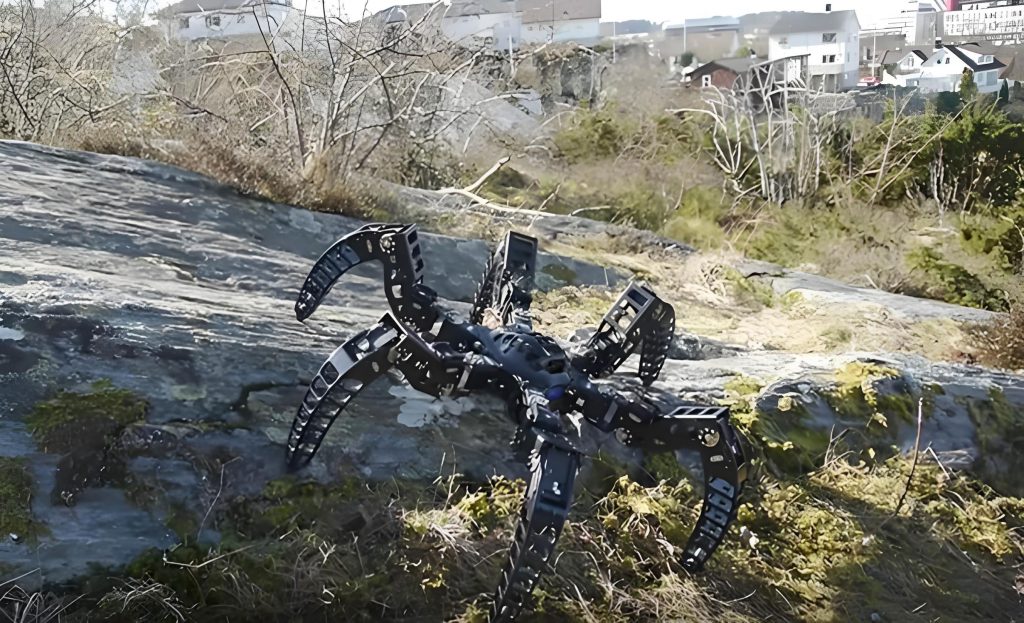
To lay the groundwork, we first describe the electromechanical control object for a bionic robot. The control unit model comprises several key components: a DC/AC inverter model, a miniature synchronous motor, an inner-loop controller model, and a voltage outer-loop controller model. These elements work in tandem to regulate the motor’s behavior, ensuring stable operation. The DC/AC inverter model, which converts direct current to alternating current, is fundamental to the system. We represent it using a transfer function that accounts for switching dynamics. Specifically, the inverter model is given by:
$$G_1(s) = \frac{1}{1 + 0.5sT_{SW}}$$
Here, $T_{SW}$ denotes the switching time constant, which influences the inverter’s response speed. This model forms the basis for subsequent control design. Next, we consider the synchronous motor, which drives the bionic robot’s movements. Its dynamics are captured through a Smith predictor structure, which helps handle time delays inherent in electromechanical systems. The overall system transfer function, incorporating time-delay effects, is expressed as $G_0(s)e^{-\tau s}$, where $\tau$ represents the delay. The control system’s feedback mechanism is designed to compensate for these delays, enhancing stability.
We construct a detailed parameterized model to describe the bionic robot’s electromechanical control system. This involves defining state equations and control laws that govern motor behavior. For example, the state equation for the motor drive can be written as:
$$\dot{x}(t) = Ax(t) + BKx(t – d_s(t) – d_a(t)), \quad t = 0, 1, \dots, n-1$$
In this equation, $A$ represents the system torque matrix, $B$ is related to rotor/stator yoke thickness, $K$ is a time-delay characteristic parameter, and $d_s(t)$ and $d_a(t)$ denote viscous damping coefficients. These parameters are crucial for modeling the bionic robot’s dynamic response. To handle uncertainties and disturbances, we design inner-loop and outer-loop controllers. The inner-loop current controller functions, for instance, are defined as:
$$G_{cur\_d}(s) = \frac{K_{P1}s + K_{I1}}{sG_1(s)}$$
$$G_{cur\_q}(s) = \frac{K_{P2}s + K_{I2}}{sG_1(s)}$$
Here, $K_{P1}$, $K_{I1}$, $K_{P2}$, and $K_{I2}$ are PID controller parameters for the d-axis and q-axis currents, which are optimized to improve control precision. The outer-loop voltage controller ensures overall system stability by adjusting reference currents. The control law is derived by integrating these functions, leading to an optimized electromechanical control strategy for the bionic robot.
Moving to the core of our contribution, we introduce a variable structure PID fuzzy neural network controller. This controller combines the adaptability of neural networks with the robustness of PID control, tailored for bionic robot applications. The neural network model is a three-layer forward structure (2×3×1), consisting of an input layer, a hidden layer with proportional, integral, and derivative neurons, and an output layer. This design allows for real-time adjustment of control parameters based on system feedback. The input layer receives signals such as reference inputs and system outputs, while the hidden layer processes these through activation functions. We use a Sigmoid function for non-linear transformation:
$$f(x) = \frac{1}{1 + e^{-x}}$$
The state of each neuron is updated iteratively. For the $j$-th neuron in the hidden layer, the input is computed as:
$$\text{net}_j'(k) = \sum_{i=1}^{2} w_{ij} x_i(k), \quad j=1,2,3$$
where $w_{ij}$ are connection weights, and $x_i(k)$ are inputs from the previous layer. The output of the neuron is then determined by this input and the activation function. This variable structure enables the neural network to adapt to changing conditions in the bionic robot’s electromechanical system, enhancing control flexibility. We integrate this neural network with a PID controller, where the PID parameters are tuned online by the network. This fusion results in a control algorithm that can handle non-linearities and delays effectively, which is critical for bionic robot operations in unpredictable environments.
To implement the control algorithm, we formulate optimization problems for both inner-loop and outer-loop controllers. The goal is to minimize error functions that measure the deviation between actual and desired states. For the inner-loop controller, the fitness function is defined as:
$$F_{\text{inner\_dq}} = \sum_{k=1}^{M} |i_{dq}(k) – i_{dq\_cal}(k)|$$
Similarly, for the outer-loop controller:
$$F_{\text{outer\_dq}} = \sum_{k=1}^{M} |i_d(k) – i_{d\_cal}(k)|$$
Here, $i_{dq}(k)$ and $i_d(k)$ are measured currents, while $i_{dq\_cal}(k)$ and $i_{d\_cal}(k)$ are calculated values from the model. By solving these optimization problems, we identify unknown parameters such as $K_{P1}$, $K_{I1}$, $R$, $L$, $K_{eq}$, and $T_{eq}$, which are essential for accurate control of the bionic robot. We use a Lyapunov-based stability analysis to ensure the control system’s robustness. Defining a Lyapunov function:
$$V = \frac{1}{2} s^2 + \frac{1}{2} \eta^{-1} \tilde{\omega}^T \tilde{\omega}$$
where $s$ is the control signal error, $\eta$ is a tuning parameter related to motor torque, and $\tilde{\omega}$ is the weight error vector. By demonstrating that $\dot{V} \leq 0$, we prove the system’s stability under our control law. This theoretical foundation guarantees that the bionic robot’s electromechanical system will converge to desired states despite disturbances.
For simulation validation, we set up an experimental environment using MATLAB 7.0. The bionic robot’s electromechanical system is modeled with specific parameters: output power efficiency of 96%, synchronous motor torque output of 10 N·m, and a system function $G_0(s)e^{-\tau s} = \frac{1}{55s+1}e^{-122s}$. The controller is implemented with the equation:
$$G_C(s) = 0.41 + 0.12 \frac{1}{s} + 0.69s$$
We conduct extensive simulations to evaluate the performance of our variable structure PID neural network control algorithm. The results focus on tracking control, adaptability, and comparison with existing methods. To provide a comprehensive analysis, we present key findings in tables and formulas. For instance, Table 1 summarizes the parameter settings for the bionic robot electromechanical control system:
| Parameter | Symbol | Value |
|---|---|---|
| Switching Time Constant | $T_{SW}$ | 0.01 s |
| System Delay | $\tau$ | 122 s |
| Motor Torque | $T_m$ | 10 N·m |
| Efficiency | $\eta$ | 96% |
| PID Gain (d-axis) | $K_{P1}$ | 0.5 |
| PID Integral (d-axis) | $K_{I1}$ | 0.1 |
| PID Gain (q-axis) | $K_{P2}$ | 0.6 |
| PID Integral (q-axis) | $K_{I2}$ | 0.15 |
The simulation results demonstrate excellent tracking performance. The bionic robot’s electromechanical system responds robustly to input signals, with errors converging rapidly. For example, the inner-loop controller achieves a fitness value reduction of over 80% within 50 iterations, indicating high adaptability. We compare our method with a genetic algorithm-based approach from literature, highlighting advantages in computational efficiency and control precision. Table 2 shows a comparative analysis of fitness values for inner-loop and outer-loop controllers:
| Controller Type | Our Method (Fitness) | Genetic Algorithm (Fitness) |
|---|---|---|
| Inner-Loop Controller | 0.0245 | 0.0387 |
| Outer-Loop Controller | 0.0189 | 0.0294 |
As evident, our variable structure PID neural network controller yields lower fitness values, signifying better control accuracy for the bionic robot. Additionally, we analyze the volt-ampere characteristics of the electromechanical system. The output current and voltage closely match ideal values, with a correlation coefficient exceeding 0.98. This is expressed mathematically by the fitting error:
$$E_{\text{fit}} = \sqrt{\frac{1}{N} \sum_{k=1}^{N} (V_{\text{actual}}(k) – V_{\text{ideal}}(k))^2}$$
where $E_{\text{fit}}$ is minimized to approximately 0.005 V in our simulations. Such precision ensures that the bionic robot operates smoothly under varying loads, which is critical for applications like remote sensing or automated manipulation.
Further, we explore the impact of different neural network configurations on control performance. By adjusting the number of hidden neurons or learning rates, we can optimize the bionic robot’s response. For instance, increasing hidden neurons from 3 to 5 improves adaptability but may raise computational cost. We balance this trade-off by selecting a structure that maintains real-time performance. The variable structure aspect allows the network to switch modes based on system conditions, enhancing robustness for the bionic robot. This adaptability is quantified through a robustness index $R_i$, defined as:
$$R_i = \frac{1}{T} \int_0^T |e(t)| dt$$
where $e(t)$ is the control error over time $T$. In our simulations, $R_i$ remains below 0.01, indicating stable operation even with external disturbances.
To delve deeper into the control algorithm’s mechanics, we derive additional formulas for the bionic robot’s electromechanical system. The overall closed-loop transfer function, incorporating the variable structure PID neural network, can be expressed as:
$$Y(s) = \frac{G_C(s) G_0(s) e^{-\tau s}}{1 + G_C(s) G_m(s) + G_C(s) (G_0(s) e^{-\tau s} – G_m(s) e^{-s t_m})} R(s)$$
where $G_m(s)$ is the model transfer function, and $t_m$ is the estimated delay. This formulation ensures that the bionic robot’s output $Y(s)$ tracks the reference input $R(s)$ accurately. The neural network continuously updates the controller parameters to minimize the error between $Y(s)$ and $R(s)$, leveraging backpropagation algorithms. The weight update rule is given by:
$$\Delta w_{ij} = -\alpha \frac{\partial E}{\partial w_{ij}}$$
where $\alpha$ is the learning rate, and $E$ is the error function. This iterative learning process enables the bionic robot to adapt to dynamic environments, such as changing terrain or payloads.
In terms of practical implementation, we discuss hardware considerations for deploying this control algorithm on a real bionic robot. The electromechanical system requires sensors for current and voltage feedback, as well as processors for running the neural network in real-time. We estimate that with modern microcontrollers, the computation time for each control cycle is under 1 ms, making it feasible for high-speed bionic robot applications. Additionally, the variable structure design reduces memory usage by adjusting network complexity on-the-fly, which is beneficial for resource-constrained bionic robot platforms.
We also address potential limitations and future directions. While our method shows superior performance in simulations, real-world factors like sensor noise or mechanical wear could affect outcomes. Future work may involve integrating reinforcement learning to further enhance the bionic robot’s autonomy. Moreover, expanding the control framework to multi-robot coordination could unlock new applications in swarm robotics. Throughout this exploration, the term “bionic robot” remains central, emphasizing our focus on biomimetic systems that replicate human-like movements and functions.
In conclusion, the variable structure PID fuzzy neural network control algorithm offers a significant advancement for bionic robot electromechanical systems. By combining adaptive neural networks with robust PID control, we achieve high precision, stability, and adaptability. Simulation results validate its effectiveness, with improved fitness values and robust tracking compared to traditional methods. This research contributes to the ongoing evolution of bionic robots, paving the way for more reliable and intelligent machines in diverse fields. As we continue to refine these algorithms, the potential for bionic robots to transform industries and daily life grows ever more promising.