
As a fundamental energy source and critical industrial raw material, coal has long dominated China’s primary energy consumption structure. While ensuring energy security, the coal mining industry faces significant safety challenges due to its inherently hazardous operating environment, characterized by threats from water, fire, gas, dust, and roof collapse. The industry’s reliance on human labor in these unstructured and dangerous conditions necessitates a paradigm shift. The future of coal mining lies in the intelligent and unmanned operation of core production processes, where robotics represents the most promising solution.
The concept of “smart mines” underpins the high-quality development of the coal industry. Robotics serves as the crucial enabler for achieving truly intelligent mining operations. Current developments focus on five broad categories of mine robots: tunneling, mining, transportation, safety inspection and control, and disaster rescue. Despite progress, the adoption of advanced robotics, particularly bionic robots, in underground coal mines remains limited. The harsh and highly variable underground environment demands a level of adaptability and resilience that conventional robotic designs often struggle to provide.
In contrast, after eons of natural selection, biological organisms exhibit highly optimized and efficient mechanisms, functionalities, information processing, and environmental adaptation strategies. Bionic robotics, a vibrant subfield, seeks to draw inspiration from these biological principles to create machines with superior performance. The application of bionics offers a compelling new pathway to overcome the limitations of current mining robotics. This article examines the current state of mine robots, explores key bionic technologies, and analyzes the immense potential of bionic robots in revolutionizing unmanned mining operations.
I. Current Landscape and Limitations of Mining Robotics
The push towards unmanned operations has driven significant advancements in mining robotics. Robotic systems are now being deployed or developed for various critical tasks.
1. Robotic Tunneling Systems
Tunneling (or roadway development) is fundamental for creating access to coal seams. The automation of this process is a major focus. Boom-type roadheaders are commonly used, integrating cutting, loading, and traveling functions. The development trend is towards intelligent, robotized systems capable of autonomous walking, profile cutting control, coal-rock identification, and remote monitoring.
2. Intelligent Mining Equipment
Longwall mining, representing the most advanced technique, utilizes a fully integrated system of shearers, hydraulic roof supports, and armored face conveyors. The cutting-edge development is the “smart longwall face,” where these components form an intelligent entity with perception, memory, learning, and decision-making capabilities. Remote control centers monitor and operate the entire face, drastically reducing personnel in the most hazardous production zone.
3. Robotic Transportation and Handling
This category includes robots for material handling, sorting, and hoisting. Intelligent conveyor systems with permanent magnet motor drives and coal-gangue sorting robots using machine vision for identification and robotic grasping are under active development. The focus is on creating closed-loop, intelligent logistics chains within the mine.
4. Safety and Inspection Robots
Deployed to patrol and monitor underground areas, these robots face challenging conditions like narrow spaces, complex equipment layouts, and poor visibility. They include face inspection robots, pipeline inspection robots, and tunnel patrol robots. Equipped with sensors for gas, temperature, and visual data, they provide real-time situational awareness, replacing human inspectors in dangerous or tedious patrol routes.
5. Mine Rescue Robots
Perhaps the most critical application, rescue robots are designed to enter post-disaster environments (after collapses, explosions, or flooding) that are impassable or lethal for humans. Their primary role is reconnaissance—mapping the area, locating survivors, and assessing hazards—to guide rescue efforts. Tracked designs are prevalent due to their good terrain adaptability.
While these robotic solutions represent significant progress, they often struggle with the extreme non-structural complexity of a mine, especially after a disaster. Their mobility is typically limited to specific terrains, their form factors may be too bulky for collapsed spaces, and their adaptability to unforeseen obstacles is low. This gap in capability is where bionic robots hold transformative potential.
II. Core Technologies of Bionic Robots and Their Mining Relevance
The field of bionic robotics draws inspiration from nature across multiple dimensions: mechanism, perception, control, actuation, and materials. Each area offers novel solutions to the constraints of conventional mining robots.
1. Bionic Mechanism: Mimicking Efficient Motion
The study of biological locomotion has led to robots with exceptional mobility.
- Bionic Underwater Propulsion: Inspired by fish and marine mammals, these robots use body/caudal fin (BCF) or median/paired fin (MPF) propulsion. They achieve high efficiency and maneuverability with minimal noise and disturbance, outperforming traditional rotary propellers in certain conditions. A relevant application in mining could be for inspecting flooded sections, sumps, or conducting surveys after water intrusion incidents.
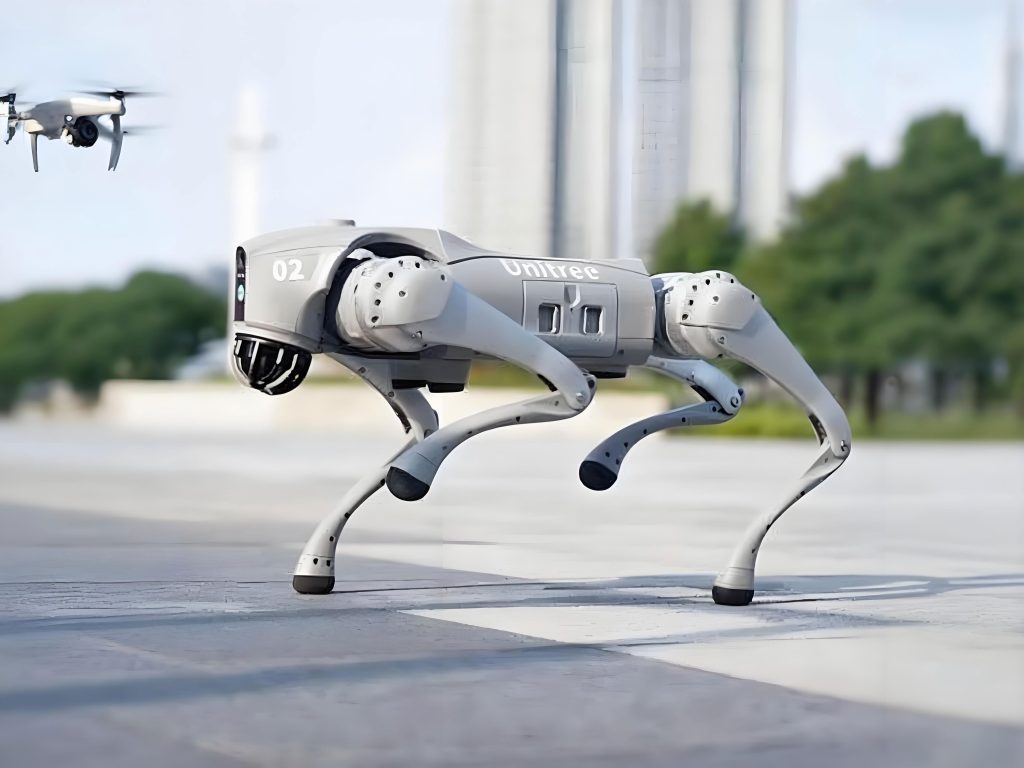
- Bionic Terrestrial Locomotion: Legged robots, inspired by mammals and insects, offer unparalleled adaptability to rough, uneven, and obstacle-strewn terrain—precisely the conditions found in damaged mine roadways. Their ability to step over debris, climb onto platforms, and maintain stability on slippery surfaces is far superior to wheels or tracks in highly unstructured environments. Furthermore, limb-like structures can be adapted into dexterous manipulators for handling tasks in confined spaces.
- Bionic Creeping and Slithering: Snakes, worms, and caterpillars inspire robots that can navigate through extremely narrow cracks, pipes, and rubble. These serpentine or soft-bodied robots can infiltrate areas completely inaccessible to any other machine, making them ideal for post-disaster search and reconnaissance within collapsed structures.
- Bionic Flight: Flapping-wing micro air vehicles (MAVs), inspired by birds and insects, are highly agile and can operate in confined vertical shafts or cavities where rotary drones might collide with walls. Their ability to hover and perch could be valuable for detailed inspection of high walls, roof conditions, or equipment in large caverns.
2. Bionic Perception: Sensing Like Living Organisms
Biological sensory systems are often more robust, efficient, and multi-functional than their engineering counterparts.
| Bionic Sense | Biological Inspiration | Technical Approach / Advantage | Potential Mining Application |
|---|---|---|---|
| Vision | Insect compound eyes, mammalian retina | Event-based vision sensors (dynamic vision sensors), wide-field optics, neural processing models for SLAM (e.g., inspired by hippocampal place & grid cells). | Robust navigation in low-light, high-dust environments; efficient 3D mapping of complex tunnels. |
| Tactile | Human skin, insect antennae | Flexible electronic skins (e-skins) with distributed pressure, temperature, and vibration sensors. | Safe physical interaction in tight spaces; detection of structural vibrations (precursors to rockburst); “feeling” the terrain for secure footing. |
| Olfactory | Mammalian nose, insect antennae | Electronic nose (E-nose) using arrays of cross-selective chemical sensors and pattern recognition algorithms. | Early, sensitive, and discriminative detection of mixed hazardous gases (CH4, CO, H2S, etc.), enabling predictive safety monitoring. |
3. Bionic Control: Emulating Natural Intelligence and Coordination
Control strategies inspired by biological nervous systems offer robustness and adaptability.
- Central Pattern Generators (CPGs): These are neural circuits that generate rhythmic motor patterns (like walking, swimming) without needing detailed sensory feedback at every cycle. Implementing CPG models in robots allows for stable, self-sustaining locomotion gaits that can be smoothly modulated by simple higher-level commands or sensory inputs (e.g., adjusting gait frequency based on slope). The dynamics can be modeled with coupled nonlinear oscillators:
$$ \tau_i \dot{u}_i = -u_i – \sum_{j} w_{ij} v_j + u_0 + feed_i, $$
$$ \tau’_i \dot{v}_i = -v_i + u_i, $$
$$ y_i = max(0, u_i) $$
where $u_i$ and $v_i$ represent the membrane potential and self-inhibition of neuron $i$, $w_{ij}$ are coupling weights, and $y_i$ is the rhythmic output driving a joint. - Bio-Inspired Learning Algorithms: Reinforcement learning, inspired by trial-and-error learning in animals, allows robots to autonomously develop optimal control policies for complex tasks in simulation, which can then be transferred to the real machine. This is key for adapting to the unique “terrain” of a specific mine.
- Swarm Intelligence: Algorithms inspired by ant colonies, bird flocks, or fish schools enable the coordination of multiple simple robots to accomplish complex tasks (e.g., distributed sensing, cooperative transport). This is highly relevant for deploying teams of inspection or light-duty robots across a large mine.
4. Bionic Actuation: The Quest for Artificial Muscle
Traditional electric motors and hydraulic cylinders are powerful but lack the compliance, power-to-weight ratio, and distributed nature of biological muscle. New actuation technologies are crucial for creating life-like movement.
| Actuator Type | Principle | Advantages for Bionic Robots |
|---|---|---|
| Pneumatic Artificial Muscles (PAMs) | Braided sleeve contracts when inflated. | High power/weight, inherent compliance, simple structure. |
| Shape Memory Alloys (SMAs) | Metal alloy contracts when heated (via current). | Silent, high force density, can be used as fine “muscle wires.” |
| Dielectric Elastomer Actuators (DEAs) | Elastic polymer film deforms under high voltage. | Large strain, fast response, can mimic muscle groups. |
| Hydraulic/Pneumatic Soft Fluidic Actuators | Pressurized fluid causes deformation of soft chambers. | Extremely compliant, safe human-robot interaction, enables continuum manipulators (like an elephant trunk or octopus arm). |
A soft continuum manipulator inspired by an octopus arm could navigate through complex rubble piles for search and rescue, while a gripper based on soft actuation could handle irregularly shaped objects (like rocks or tools) without complex control.
5. Bionic Materials: Beyond Steel and Plastic
Advanced materials can impart biological properties to robots.
- Functional Surface Materials: Gecko-inspired dry adhesives for climbing vertical surfaces in mine shafts; shark-skin-inspired riblet surfaces to reduce drag on underwater inspection robots.
- Self-Healing Materials: Polymers that can autonomously repair cuts or punctures, greatly enhancing the durability and maintenance interval of robots working in abrasive and sharp-edged environments.
- Stimuli-Responsive Materials: Materials that change color, stiffness, or shape in response to temperature, light, or magnetic fields, enabling adaptive camouflage or morphing structures.
III. Evolutionary Trends in Bionic Robotics
The field is moving beyond simple mimicry towards a deeper integration of biological principles, driven by several clear trends:
- From Rigid to Soft and Hybrid Structures: The future lies in soft robots or rigid-soft hybrid systems that combine the strength of a skeleton with the adaptability and safety of soft tissues, much like vertebrates.
- From Conventional to Muscle-Like Actuation: Research focuses on developing artificial muscles with performance metrics (energy density, efficiency, bandwidth) that begin to rival biological muscle, using materials like electroactive polymers and advanced fluidic systems.
- From Single-Mode to Multi-Habitat High Mobility: Future bionic robots will seamlessly transition between environments—walking, swimming, climbing, and perhaps even flying—to handle all the varied terrains within and around a mine.
- From Traditional Control to Embodied Biological Intelligence: Control will move further towards brain-inspired neuromorphic computing and tightly coupled sensorimotor loops, enabling real-time adaptation and true autonomous decision-making in dynamic environments.
- From Single Robots to Collaborative Swarms: Inspired by social insects, systems will leverage large numbers of relatively simple, low-cost bionic robots that collaborate to achieve complex goals, offering robustness through redundancy.
- From Electromechanical Systems to Bio-Hybrid Systems: The frontier involves integrating living biological components (e.g., engineered tissues, neurons) with mechanical systems to create robots with biological energy efficiency, growth, and self-repair capabilities.
IV. Application Prospects in Unmanned Mining Operations
Integrating these bionic trends addresses the core challenges facing mine robotics today.
1. Application of New Functional Materials
Challenge: Explosion-proof requirements add immense weight and bulk, crippling mobility.
Bionic Solution: Develop lightweight, high-strength protective materials inspired by biological armor (e.g., mollusk shells, fish scales). Use intrinsically safe bionic actuators (artificial muscles) to eliminate spark hazards from traditional motors. Explore bio-inspired energy systems for higher efficiency.
2. Application of Efficient Locomotion Modes
Challenge: Current robots (tracks, wheels) cannot “walk” over severe debris or through highly collapsed areas.
Bionic Solution: Legged bionic robots, potentially with hybrid wheel-leg mechanisms, will be the mobile platform for the future mine. Their terrain adaptability is unmatched. Snake-like robots will be specialized tools for penetrating the tightest spaces after a disaster.
3. Application of Intelligent Environmental Perception
Challenge: Harsh conditions (dust, darkness, electromagnetic interference) degrade conventional sensors, limiting autonomy.
Bionic Solution: Fuse bio-inspired vision (event cameras), tactile e-skins, and advanced E-noses into a multi-modal perceptual system. Implement neural processing models for robust state estimation and hazard (gas, strata pressure) prediction, creating a true “situational awareness” for the robotic system.
4. Application of Intelligent Autonomous Operation
Challenge: Low levels of autonomy require constant human supervision, negating the benefit of unmanned operations.
Bionic Solution: Integrate bionic intelligence—through CPG-based locomotion, reinforcement-learned skills, and swarm coordination protocols. This will enable robots to perform complex tasks like autonomous cutting parameter adjustment, adaptive equipment inspection, and collaborative transport and assembly underground, forming the core of a “cognitive” mining ecosystem.
V. Conclusion
The acceleration of mine intelligence and the construction of unmanned mines are inextricably linked to the widespread application of robotics. While still in its infancy, the integration of bionic principles into mine robotics represents a profound and necessary evolution. The limitations of current robotic systems in terms of adaptability, resilience, and efficiency in the face of the mine’s extreme non-structural environment are significant. Bionic technology, drawing from billions of years of evolutionary optimization, provides a rich repository of solutions. From novel materials and actuators to intelligent control and perception architectures, bionics paves the way for a new generation of mining robots. These bionic robots will not merely replace human labor but will possess capabilities—to navigate, sense, decide, and collaborate—that surpass current mechanical systems. The future of safe, efficient, and truly intelligent mining will be built, in no small part, upon the foundational advancements in bionic robot technology.