
In the field of disaster response, traditional rescue equipment often faces significant limitations in navigating complex, unstable rubble and confined spaces, directly impacting the timeliness and safety of operations. To address these critical challenges, this project proposes the development of a novel, highly redundant modular bionic robot. The core aim is to bridge the gap between theoretical biomimetic principles and practical rescue applications, leveraging bionic mechanics to penetrate disaster zones, reduce rescuer risk, minimize casualties, and consequently lower national losses from catastrophic events. This research tackles the problem from both technological and biomimetic perspectives, aiming to enrich the variety of China’s rescue apparatus. Our focus is on the kinematic study of this robot, encompassing innovative joint design, terrain-adaptive locomotion, and intelligent motion control algorithms tailored for search and rescue (SAR) missions.
The primary design philosophy centers on creating a slender, agile, and reconfigurable bionic robot capable of serpentine locomotion. Key performance targets include high single-joint degrees of freedom (DOF), exceptional terrain adaptability, and the ability to carry and deliver essential life-support supplies to trapped victims. The following table summarizes the core design advantages derived from our integrated approach.
| Design Feature | Advantage | Impact on Rescue Operations |
|---|---|---|
| Modular Architecture | Enables flexible assembly and reconfiguration based on specific mission profiles (e.g., length, sensor payload). | Adaptability to diverse and unpredictable disaster scenarios. |
| Novel Orthogonal Joint & Bionic Skin | Provides high DOF in a compact form factor; anisotropic friction enables efficient forward propulsion. | Superior mobility in tight, complex terrains compared to wheeled or tracked robots. |
| Integrated Life-Support Conduit | Can carry and deliver water and high-energy food to trapped individuals. | Extends survival window, increasing chances of successful extrication. |
| Advanced Motion Control & Vision | Algorithmic control for navigating deep into rubble; composite vision for low-light, beyond-line-of-sight search. | Enables access to unreachable areas and protects both victims and rescue personnel. |
| Lightweight Construction | Single module mass of only 650g. | Enhances portability and reduces the energy required for locomotion. |
Mechanical Design and Kinematic Foundation
The agility of a serpentine bionic robot is fundamentally governed by its joint design. Our analysis of existing technologies identified two key inspirations: the universal joint for its flexibility and the orthogonal cross structure for its high load-bearing capacity. Synthesizing these advantages, we conceived a novel connection method that approximates a universal joint’s functionality using an orthogonal structure, realized through SolidWorks modeling and simulation.
The core principle involves two connected orthogonal axes designed to intersect at a point. In an ideal theoretical model, this configuration allows motion equivalent to a universal joint. However, assembly and interference analysis revealed a practical angular constraint, defining a conical workspace. The kinematic relationship is defined as follows, where $A$ is the link length between joints, and the actual conical half-angle is $\theta$:
$$ \theta = 2 \cdot \arctan\left(\frac{r}{A}\right) $$
Within this conical volume ( $\pm \theta$ ), the joint can perform arbitrary 3D spatial motions. Motions exceeding this range are primarily dominated by rotation about one axis, with the other acting as an auxiliary, allowing for smaller-amplitude 3D adjustments. Motion simulation confirmed the consistency between this theoretical design and practical kinematic behavior. This design significantly optimizes the ratio of diameter to single-joint length, approaching an ideal value of approximately 0.67, which is crucial for a slender profile.
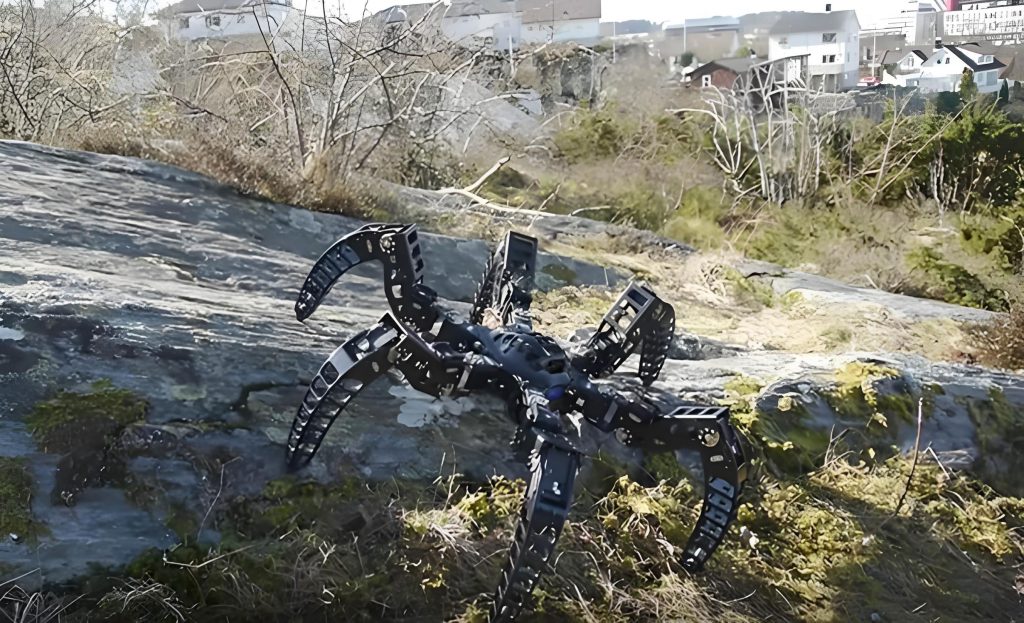
Complementing the joint, terrain adaptability is achieved through a biomimetic friction shell. Biological studies of snakes reveal that their scales exhibit anisotropic friction coefficients, with a lower coefficient in the forward direction than in the backward direction. Emulating this principle, we designed a specialized surface texture with grooves set at an optimal angle of $40^\circ$ to $45^\circ$ relative to the body axis. This engineered anisotropy is critical for effective rectilinear (inching) locomotion, allowing the bionic robot to grip the terrain during propulsion phases.
Structural Optimization and Module Design
Based on feedback from rescue professionals, a critical functional requirement was integrated: the ability to transport life-sustaining supplies. We optimized the central chassis to incorporate a dedicated cavity for a water bladder and solid food (e.g., energy bars), with a maximum payload capacity of 250g per module. The closure mechanism features a simple, intuitive latch that can be easily operated by a trapped person.
To enhance versatility and maintainability, a full modular design philosophy was adopted. This encompasses:
- Inter-Module Connection Interface: Standardized mechanical and electrical ports allow for rapid assembly and disassembly of robot segments.
- Detachable Supply Module: The life-support conduit is designed as a sealed, plug-and-play cartridge that can be installed or omitted based on mission needs.
- Internal Support Structure: Lightweight ABS plastic frames securely house electronic components (controllers, sensors, communication modules) within each segment.
This modularity allows the bionic robot platform to be swiftly reconfigured for diverse applications beyond SAR, such as pipeline inspection, hazardous gas detection in mines, or reconnaissance.
Motion Algorithm Optimization and Kinematic Control
The locomotion of our bionic robot is governed by bio-inspired gait algorithms, primarily focusing on serpentine (undulatory) and rectilinear (inching) modes. Kinematic control is achieved by coordinating the angular positions of each joint servo motor via Pulse-Width Modulation (PWM) signals.
1. Serpentine (Undulatory) Gait: This is the primary mode for efficient forward movement over surfaces. The body follows a sinusoidal wave propagating from head to tail. The desired joint angle $\phi_i$ for the $i$-th segment at time $t$ can be modeled as:
$$ \phi_i(t) = \alpha \cdot \sin(\kappa \cdot i + \omega t + \delta) $$
Where:
- $\alpha$ is the amplitude of the wave.
- $\kappa$ is the spatial frequency (related to the wavelength).
- $\omega$ is the temporal frequency.
- $\delta$ is a phase offset.
The interaction between this body wave and the anisotropic friction of the shell generates forward thrust. The mapping from these body wave parameters to individual servo commands is handled by a central microcontroller.
2. Rectilinear (Inching) Gait: Used for stability in confined spaces or when precise, linear advancement is needed. Unlike serpentine motion, this gait involves the sequential lifting, advancing, and settling of body sections. The control is more discrete. For a joint to “lift” and form an arch, its PWM signal is generated by a dedicated timer interrupt. A key insight from algorithm simulation and debugging was ensuring dynamic stability: when one joint arches, the adjacent joints provide a counterbalancing support base due to their larger frictional contact with the ground. This is managed by coordinating two timer interrupts (e.g., Timer 3 and Timer 5) to generate precisely phased PWM waves for adjacent servos.
| Gait Mode | Control Principle | Mathematical Basis | Primary Use Case |
|---|---|---|---|
| Serpentine | Propagating body sine wave | $\phi_i(t) = \alpha \sin(\kappa i + \omega t)$ | General forward locomotion on surfaces |
| Rectilinear | Sequential joint lifting & anchoring | Discrete state machine control via timer interrupts | Stable movement in tight, constrained spaces |
3. Kinematic Optimization: Initial simulations revealed slight “jerkiness” or hesitation in gait transitions. This was addressed by:
- Smoothing the parameter interpolation between joint angle setpoints.
- Optimizing the timer interrupt service routines (ISRs) for minimal latency and precise synchronization.
- Implementing a feedback loop where onboard inertial measurement unit (IMU) data can be used to adjust gait parameters in real-time for stability on uneven terrain.
The forward kinematics of the entire robot, describing the position and orientation of its head relative to the base, can be derived through the sequential application of homogeneous transformation matrices for each joint. For an $n$-segment robot, the transformation is:
$$ T_{total} = T_{base} \cdot \prod_{i=1}^{n} T_{i}(\phi_i) $$
Where $T_{i}(\phi_i)$ represents the transformation from joint $i-1$ to joint $i$, incorporating both the fixed link length/offset and the variable joint angle $\phi_i$. This model is essential for path planning and determining the robot’s reachable workspace within rubble.
Research Outcomes and Broader Value
This project has yielded significant outcomes in the development of advanced bionic robot technology for rescue operations:
- Novel Joint Mechanism: The orthogonal approximation joint provides a compact, high-DOF solution that is mechanically robust and suitable for miniaturization.
- Engineered Biomimetic Skin: The anisotropic friction shell design translates biological principles into a functional engineering advantage, enabling effective locomotion.
- Integrated Functional Design: The modular life-support delivery system represents a tangible step towards multi-functional rescue robots.
- Robust Kinematic Control: Optimized serpentine and rectilinear gait algorithms allow for flexible and adaptive movement strategies.
- IoT-Enabled Framework: The design incorporates a communication backbone for real-time data (video, sensor readings) transmission and remote control, enabling beyond-line-of-sight operations.
The modular nature of this bionic robot platform makes it a foundational technology with high potential for cross-disciplinary application. By swapping sensor payloads, the same robotic platform can be adapted for:
- Industrial Inspection: Navigating pipelines, ventilation ducts, and complex machinery.
- Environmental Monitoring: Detecting hazardous gases or radiological contamination in inaccessible areas.
- Military & Security: Reconnaissance and surveillance in denied environments.
- Archaeological Exploration: Investigating unstable or very small cavities.
In conclusion, the kinematic research presented here provides a comprehensive framework for the design and control of a highly redundant bionic robot. By solving core challenges in joint design, terrain interaction, and motion planning, this work advances the practical deployment of biomimetic machines in critical, life-saving scenarios. The fusion of mechanical innovation, bio-inspired principles, and intelligent control algorithms marks a significant step towards more capable, versatile, and resilient rescue robotics. Future work will focus on enhancing autonomy through more sophisticated perception algorithms, improving power efficiency, and conducting extensive field trials in simulated disaster environments to refine all system parameters.