
As I delve into the fascinating world of bionic robotics, I am constantly amazed by the rapid advancements that blur the lines between biological organisms and mechanical systems. The development of bionic robots, which mimic human or animal movements and functions, represents a pinnacle of engineering innovation. These machines are not merely tools; they are becoming integral partners in various fields, from military applications to healthcare and industrial automation. In this article, I will explore how cutting-edge technologies, particularly sensorless motor control, are propelling the capabilities of bionic robots to new heights. The integration of such control mechanisms is crucial for enhancing the agility, efficiency, and autonomy of these systems, making them more lifelike and functional in real-world scenarios.
The concept of a bionic robot has evolved significantly over the years. Initially, these robots were rudimentary, with limited mobility and reliance on external controls. However, recent breakthroughs have led to the creation of highly sophisticated bionic robots that can perform complex tasks with remarkable precision. A prime example is the PETMAN robot developed by a leading engineering firm. This bionic robot is designed to simulate human soldiers for testing protective gear and equipment in hazardous environments. PETMAN showcases advanced capabilities such as walking, balancing, and even simulating physiological responses like sweating and temperature regulation. These features make it an invaluable asset for military testing, as it can replicate human reactions to toxic substances like sarin or mustard gas. The progress in bionic robot technology underscores the importance of robust and efficient actuation systems, where motor control plays a pivotal role.
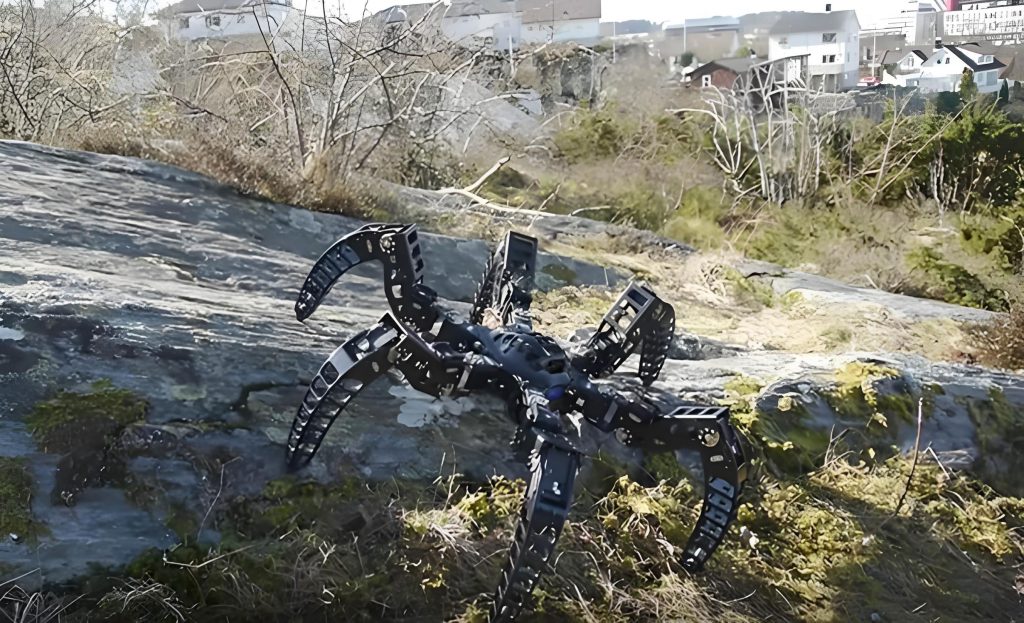
In my analysis of bionic robot design, I have found that one of the most critical components is the motor system used for actuation. Permanent magnet motors, often referred to as brushless DC motors, are preferred in many bionic robot applications due to their high efficiency and power density. However, a longstanding challenge has been the need for position sensors to detect rotor angle, especially during startup and low-speed operation. These sensors add complexity, increase size, and reduce reliability, which can be detrimental in the compact and dynamic environments where bionic robots operate. To address this, researchers have developed sensorless control techniques that eliminate the need for physical position sensors, thereby streamlining the motor design and enhancing performance. This advancement is particularly relevant for bionic robots, as it allows for more natural and fluid movements without the bulk of additional hardware.
The core of sensorless control lies in accurately inferring the rotor position without direct measurement. Traditional methods rely on back electromotive force (EMF), which is generated as the rotor spins. The back EMF voltage, denoted as \( E_b \), is proportional to the rotational speed \( \omega \) and the motor constant \( K_e \):
$$ E_b = K_e \cdot \omega $$
At low speeds or when the motor is stationary, \( \omega \) approaches zero, making \( E_b \) too small to measure reliably. This limitation has restricted sensorless motors to applications like air conditioners or industrial fans, where continuous operation is the norm. For a bionic robot, which requires frequent starts, stops, and precise torque control at various speeds, such methods are inadequate. They often necessitate high inrush currents to initiate motion, leading to energy waste and potential overheating—issues that are unacceptable in the delicate balance of a bionic robot’s system.
To overcome these hurdles, a novel approach has been developed that exploits the subtle variations in coil inductance caused by the permanent magnets. Inductance \( L \) is defined as the ratio of magnetic flux linkage \( \lambda \) to current \( i \):
$$ L = \frac{\lambda}{i} $$
In a permanent magnet motor, the presence of the rotor’s magnets affects the magnetic circuit, causing \( L \) to change slightly with rotor position. This variation can be observed as a modulation in the motor’s voltage or current signals, even at standstill. By injecting high-frequency signals or analyzing current responses, the rotor angle \( \theta \) can be estimated. The relationship can be expressed as:
$$ \Delta L(\theta) = L_0 + \Delta L_m \cdot \cos(2\theta + \phi) $$
where \( L_0 \) is the base inductance, \( \Delta L_m \) is the amplitude of inductance variation, and \( \phi \) is a phase offset. Through advanced algorithms, such as observer models or signal processing techniques, this allows for precise position detection without sensors. I have summarized the comparison between traditional and new sensorless methods in the table below, highlighting their impact on bionic robot performance.
| Control Method | Position Sensing Mechanism | Applicable Speed Range | Energy Efficiency | Suitability for Bionic Robot |
|---|---|---|---|---|
| Traditional Sensor-Based | Hall sensors or encoders | Full range, but adds bulk | Moderate due to sensor power | Limited due to size and reliability issues |
| Back EMF-Based Sensorless | Inference from back EMF voltage | Medium to high speeds only | Low at startup (high current surge) | Poor for low-speed agility in bionic robots |
| Inductance Variation-Based Sensorless | Detection of coil inductance changes | Zero to high speeds | High, with smooth torque generation | Excellent for dynamic movements in bionic robots |
This sensorless control technology is a game-changer for bionic robots. By enabling stable low-speed operation and rapid startup with high torque, it allows bionic robots to perform intricate maneuvers that closely mimic biological beings. For instance, in a walking bionic robot like PETMAN, the legs require motors that can deliver precise torque adjustments during each step, from heel strike to toe-off. With sensorless control, these motors can respond swiftly without the latency or inaccuracy introduced by position sensors. The elimination of sensors also reduces maintenance needs and enhances durability, which is crucial for bionic robots deployed in rugged or hazardous environments. As I reflect on this, it becomes clear that the evolution of bionic robots is deeply intertwined with advancements in motor control systems.
To further illustrate the principles, let’s delve into the mathematical modeling of the sensorless control technique. The motor’s electrical dynamics can be described by the voltage equation in the rotor reference frame:
$$ V_d = R i_d + L_d \frac{di_d}{dt} – \omega L_q i_q $$
$$ V_q = R i_q + L_q \frac{di_q}{dt} + \omega L_d i_d + \omega \psi_f $$
where \( V_d \) and \( V_q \) are the d- and q-axis voltages, \( i_d \) and \( i_q \) are the currents, \( R \) is the stator resistance, \( L_d \) and \( L_q \) are the inductances, \( \omega \) is the electrical speed, and \( \psi_f \) is the permanent magnet flux linkage. In sensorless control, the goal is to estimate \( \theta \) (and thus \( \omega \)) from these equations without direct measurement. By exploiting the inductance variations, we can formulate an observer that updates position estimates based on current deviations. For example, a common approach uses the high-frequency signal injection method, where a carrier voltage \( V_c \) is superimposed on the fundamental excitation. The resulting current response \( i_c \) contains position-dependent information:
$$ i_c \approx \frac{V_c}{j\omega_c L(\theta)} $$
where \( \omega_c \) is the carrier frequency. Through demodulation, the rotor position can be extracted as:
$$ \hat{\theta} = \frac{1}{2} \arg\left( \mathcal{F}\{ i_c \} \right) $$
with \( \mathcal{F} \) denoting a signal processing function like a Fourier transform. This enables accurate control even at zero speed, making it ideal for bionic robots that need to hold positions or start moving smoothly from rest.
The application of this technology in bionic robots extends beyond locomotion. Consider a bionic robot designed for delicate tasks, such as surgical assistance or object manipulation. These robots require actuators that provide fine motor control with minimal vibration and noise. Sensorless motors, with their ability to deliver high torque at low speeds, are perfectly suited for such applications. They allow the bionic robot to mimic the dexterity of human hands, enabling precise movements like grasping, rotating, or aligning objects. Moreover, the reduced size from eliminating sensors means that the bionic robot can have a more compact and lightweight design, enhancing its mobility and energy efficiency. As I explore these possibilities, I am convinced that sensorless motor control is a cornerstone for the next generation of bionic robots.
In terms of implementation, the integration of sensorless control into bionic robots involves several key steps. First, the motor parameters must be characterized through testing or simulation. This includes measuring the inductance variations as a function of rotor position, which can be tabulated for reference. Below is a sample table showing hypothetical inductance values for different angles in a permanent magnet motor used in a bionic robot joint.
| Rotor Angle \( \theta \) (degrees) | d-axis Inductance \( L_d \) (mH) | q-axis Inductance \( L_q \) (mH) | Inductance Variation \( \Delta L \) (mH) |
|---|---|---|---|
| 0 | 5.2 | 3.8 | 1.4 |
| 45 | 5.0 | 4.0 | 1.0 |
| 90 | 4.8 | 4.2 | 0.6 |
| 135 | 5.0 | 4.0 | 1.0 |
| 180 | 5.2 | 3.8 | 1.4 |
These values are critical for tuning the control algorithms. Next, a microcontroller or digital signal processor implements the position estimation algorithm in real-time. The control loop typically follows these steps: measure phase currents, compute estimated position using the inductance model, generate appropriate voltage commands via pulse-width modulation (PWM), and drive the motor. The torque output \( T_e \) in a permanent magnet motor is given by:
$$ T_e = \frac{3}{2} p \left[ \psi_f i_q + (L_d – L_q) i_d i_q \right] $$
where \( p \) is the number of pole pairs. With accurate position estimation, the controller can optimize \( i_d \) and \( i_q \) to produce the desired torque smoothly, even during transient states. This is essential for a bionic robot performing dynamic actions like jumping or running, where torque demands change rapidly.
Looking ahead, the future of bionic robots is incredibly promising with these advancements. I envision bionic robots becoming more autonomous and adaptable, capable of operating in diverse environments without human intervention. The sensorless motor control technology will play a vital role in this evolution, as it enables more efficient and reliable actuation. For example, in search-and-rescue missions, a bionic robot could navigate through debris or rough terrain using legs with sensorless motors that adjust grip and balance in real-time. Similarly, in healthcare, bionic robots could assist with rehabilitation, providing tailored support based on patient movements. The key is to continue refining these control systems to handle the complexities of real-world interactions.
Moreover, the synergy between bionic robot design and sensorless control opens up new research avenues. One area is the development of adaptive algorithms that learn from environmental feedback, much like biological nervous systems. By incorporating machine learning techniques, the control system could predict and compensate for disturbances, further enhancing the bionic robot’s stability. Another direction is miniaturization; as motors become smaller and more powerful, bionic robots could be designed for micro-scale tasks, such as internal body monitoring or precision manufacturing. The potential applications are vast, and I am excited to see how this technology will transform industries.
In conclusion, the progress in sensorless motor control represents a significant leap forward for bionic robotics. By eliminating position sensors, we can create more compact, efficient, and robust actuation systems that mirror the elegance of biological movement. From military testing with robots like PETMAN to civilian applications in automation and medicine, bionic robots are poised to become integral parts of our society. As I reflect on these developments, I am reminded that the journey of innovation is continuous, and the fusion of mechanics, electronics, and control theory will keep pushing the boundaries of what bionic robots can achieve. The future is bright for these machines, and I look forward to contributing to their evolution through ongoing research and collaboration.