
In the rapidly evolving field of robotics education, the teaching of parallel robots, such as Delta-type manipulators, presents significant challenges due to their complex structural principles and abstract kinematic theories. Traditional pedagogical approaches often struggle to make these concepts tangible, leading to suboptimal learning outcomes and hindered student engagement. As a researcher and educator in intelligent robotics, I have observed these limitations firsthand and recognized the urgent need for innovative solutions that leverage advanced technologies. The advent of large language models (LLMs) offers a promising avenue for transforming robotics education by enabling natural language interactions and intelligent knowledge reasoning. However, generic LLMs frequently fall short in specialized domains like intelligent robot systems, as they lack deep integration with hardware data and vertical domain expertise. This gap inspired our team to design and implement an intelligent experimental teaching platform that seamlessly fuses a customized domestic LLM with parallel robot hardware, creating a dynamic, interactive learning environment. Our platform addresses core issues such as data interpretation from sensors, precise instructional guidance, and domain-specific knowledge enhancement, ultimately aiming to elevate the quality of intelligent robot education and foster innovative capabilities in students. By bridging the gap between abstract theory and hands-on practice, we envision this platform as a cornerstone for the next generation of robotics engineering training.
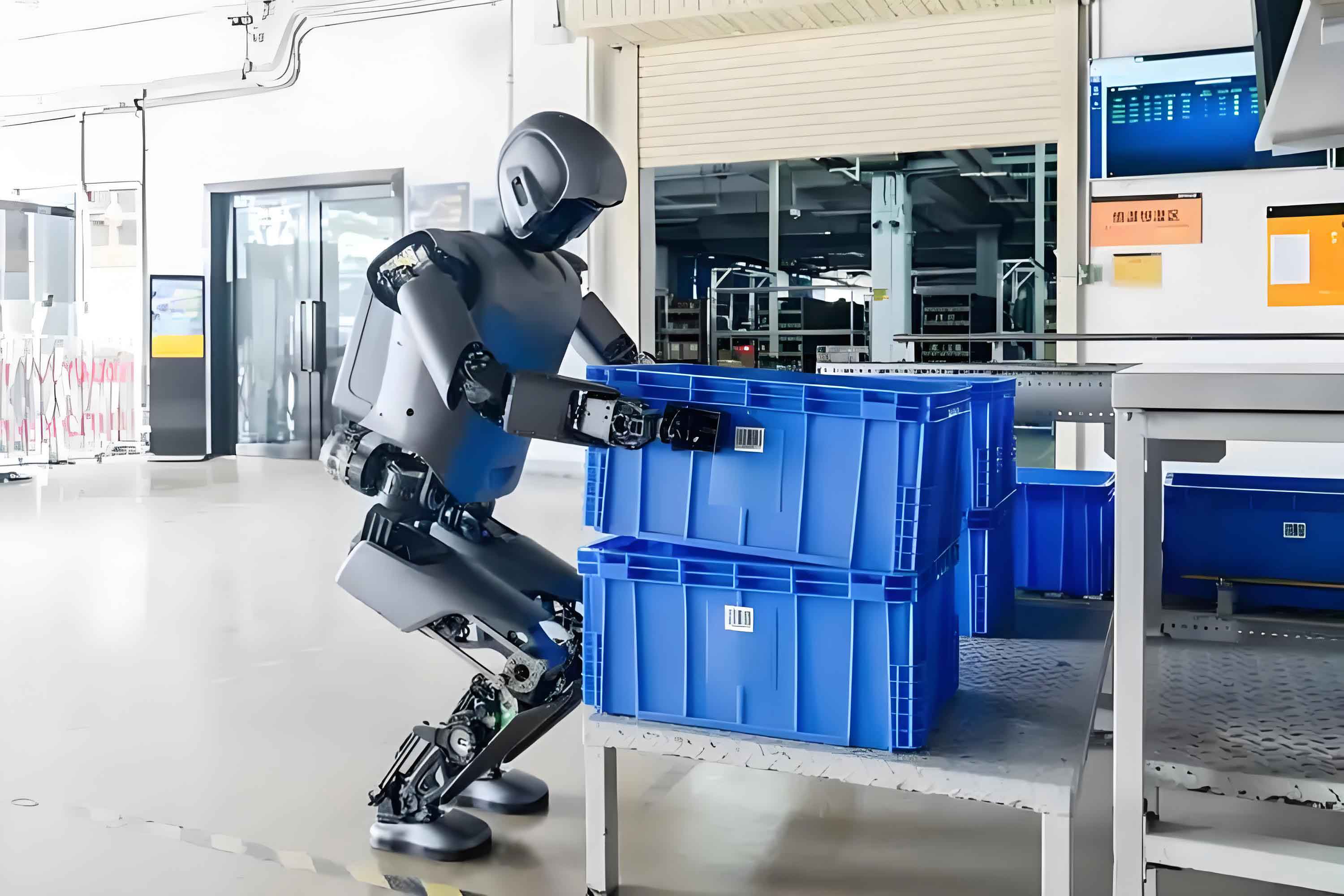
The intelligent robot teaching platform is built around a Delta parallel robot, a quintessential intelligent robot in manufacturing due to its high speed, precision, and versatility. Our holistic design integrates hardware components, software architecture, and a customized LLM to form a cohesive system that supports experiential learning. The hardware setup includes the Delta parallel robot as the primary manipulator, an industrial computer for processing, a CANopen communication network with a master station card, motor drivers and actuators, and an industrial camera system for vision-based tasks. This configuration mimics real-world intelligent robot applications, such as object sorting and assembly, providing students with a practical context to explore robot control, path planning, and sensor integration. The software layer is structured into four tiers: an interaction layer with a user-friendly interface, a communication layer supporting protocols like CANopen and Ethernet, a service layer centered on the domestic LLM API, and a data layer for storing experiment records and knowledge bases. This architecture ensures robust data flow and intelligent feedback, enabling the platform to function not just as a simulator but as an adaptive tutor that responds to student queries and performance. The core innovation lies in the customization of the LLM, which we tailored specifically for intelligent robot education through hardware data transcoding, prompt engineering, and domain knowledge fusion. This approach allows the platform to interpret raw sensor data, generate context-aware explanations, and provide personalized guidance, thereby transforming the learning experience for complex intelligent robot systems.
| Hardware Component | Function in Intelligent Robot Platform | Educational Relevance |
|---|---|---|
| Delta Parallel Robot | Primary manipulator for executing tasks like picking and placing | Illustrates kinematic principles and structural design of intelligent robots |
| Industrial Computer | Central processor for vision, control, and communication tasks | Teaches multi-tasking programming and system integration in intelligent robots |
| CANopen Master Station Card | Facilitates USB to CANopen protocol conversion for sensor and actuator networks | Demonstrates real-time communication protocols in intelligent robot systems |
| Motor Drivers and Actuators | Control joint movements via networked drivers | Provides hands-on experience with motor tuning and control logic for intelligent robots |
| Industrial Camera and Vision System | Captures workpiece features for automated sorting | Introduces computer vision applications in intelligent robot operations |
To enable the LLM to effectively assist in intelligent robot education, we developed a customized design methodology focusing on three key aspects: hardware data transcoding, prompt construction, and domain knowledge base integration. First, the hardware data transcoding design solves the inherent limitation of LLMs in parsing raw sensor data. Through the CANopen protocol, we map Process Data Objects (PDOs) to transmit and receive data from the intelligent robot’s components, such as motor status and joint positions. For instance, a Typical PDO (TPDO) carrying binary status words is decoded into a JSON format that the LLM can semantically understand. This transcoding process allows the LLM to analyze real-time data from the intelligent robot, such as detecting anomalies in acceleration or position errors, and generate actionable feedback for students. The mapping and transcoding are summarized in the table below, showcasing how hardware signals are transformed into LLM-interpretable data.
| PDO Type | COB-ID | Mapped Object | Transcoded Data Example (JSON) |
|---|---|---|---|
| RPDO1 | 200h + NodeID | Control Word (Index 6040-00h) | {“ControlWord”: “0x0F”, “Description”: “Motor enable command for intelligent robot operation”} |
| TPDO1 | 180h + NodeID | Status Word (Index 6041-00h) | {“StatusWord”: “0x0237”, “Description”: “Intelligent robot motor running without faults”} |
| TPDO2 | 280h + NodeID | Actual Position (Index 6064-00h) | {“ActualPosition”: {“X”: 99.5, “Y”: 199.8, “Z”: 299.7}, “Unit”: “mm”} |
Second, we constructed a prompt engineering framework to enhance the precision and depth of interactions between students and the LLM. Recognizing that vague or poorly structured queries often lead to generic responses, we designed a set of prompt templates categorized by common intelligent robot teaching tasks, such as concept explanation, principle elaboration, code generation, and experimental guidance. These templates provide a structured format that guides students in formulating clear questions, while also enabling the LLM to generate focused and accurate answers. For example, a prompt template for trajectory planning might be: “Design a smooth trajectory for an intelligent robot performing a pick-and-place task, considering constraints like acceleration limits and obstacle avoidance.” To automate this process, we employed lexical and syntactic analysis using tools like HanLP for word segmentation and Stanford CoreNLP for parsing, which extract keywords and classify query types to fill the templates dynamically. This method significantly improves the relevance of LLM outputs, ensuring that students receive tailored guidance on intelligent robot concepts. The table below illustrates sample prompt templates for various educational scenarios in intelligent robot training.
| Task Category | Prompt Template Structure | Example for Intelligent Robot Context | |
|---|---|---|---|
| Concept Explanation | Explain [concept] including [aspects] in [style] | Explain “degrees of freedom in parallel intelligent robots,” including definition and calculation, in simple terms. | |
| Principle Elaboration | Elaborate on [principle] covering [elements] with examples in [application] | Elaborate on inverse kinematics of Delta intelligent robots, covering formulas and parameters, with examples in sorting tasks. | |
| Code Generation | Provide code in [language] for [function] meeting [requirements] with comments | Provide Python code for CANopen communication in an intelligent robot, ensuring real-time data accuracy, with detailed comments. | |
| Experimental Guidance | Outline steps for [experiment] including preparation, operation, and troubleshooting | Outline steps for kinematic calibration of an intelligent robot, including sensor setup and error handling. |
Third, we built a comprehensive knowledge base dedicated to parallel intelligent robots, addressing the lack of vertical domain expertise in general LLMs. This knowledge base aggregates curated resources such as academic papers, technical manuals, and internal teaching materials on intelligent robot systems. We organized the content into categories like mechanical design, control algorithms, and application case studies, and integrated it into the LLM through retrieval-augmented techniques. This fusion allows the LLM to access specialized knowledge on-demand, enhancing its ability to answer complex questions about intelligent robot dynamics or optimization strategies. For instance, when a student inquires about vibration suppression in Delta intelligent robots, the LLM can draw from the knowledge base to recommend techniques like modified trapezoidal acceleration profiles, supported by relevant equations and references. This domain-specific enrichment ensures that the platform serves as a reliable expert in intelligent robot education, far surpassing generic AI tools in accuracy and depth.
In practice, the intelligent robot teaching platform was applied to a trajectory planning task for a Delta parallel robot, demonstrating its efficacy in a real-world educational scenario. Students were tasked with designing a smooth, door-shaped trajectory for a pick-and-place operation, requiring considerations of acceleration continuity, joint angle limits, and vibration minimization—a common challenge in intelligent robot programming. Using the platform, students could input natural language queries, such as “Generate a trajectory for an intelligent robot to move from a pickup to a drop-off point without vibrations.” The customized LLM, leveraging the hardware data transcoding and knowledge base, would then propose an optimized trajectory based on a modified trapezoidal acceleration function. We enhanced the standard function from literature to improve smoothness, represented by the following LaTeX formula:
$$ a(t) = \begin{cases}
\frac{a_{\text{max}}}{2} \left[1 – \cos\left(\frac{8\pi}{T} t\right)\right], & 0 \leq t < \frac{T}{8} \\
a_{\text{max}}, & \frac{T}{8} \leq t < \frac{3T}{8} \\
a_{\text{max}} \cos\left[\frac{4\pi}{T} \left(t – \frac{3T}{8}\right)\right], & \frac{3T}{8} \leq t < \frac{5T}{8} \\
-a_{\text{max}}, & \frac{5T}{8} \leq t < \frac{7T}{8} \\
-\frac{a_{\text{max}}}{2} \left[1 + \cos\left(\frac{8\pi}{T} \left(t – \frac{7T}{8}\right)\right)\right], & \frac{7T}{8} \leq t \leq T
\end{cases} $$
Here, \( a(t) \) denotes the acceleration over time \( t \), \( a_{\text{max}} \) is the maximum acceleration (e.g., 100 mm/s²), and \( T \) is the motion period (e.g., 8 seconds). This function ensures that acceleration derivatives are continuous at start and end points, reducing jerks and vibrations in the intelligent robot’s motion. The LLM would guide students through parameter selection, such as setting \( a_{\text{max}} = 100 \, \text{mm/s}^2 \) and \( T = 6 \, \text{s} \) for a typical task, and validate these against the intelligent robot’s joint constraints (e.g., arm angles between -10° and 90°). Through the CANopen interface, real-time data from the intelligent robot’s sensors could be monitored, allowing the LLM to provide feedback on performance metrics like position accuracy or oscillation levels. This iterative process—where students refine trajectories based on LLM suggestions—mirrors real engineering workflows, deepening their understanding of intelligent robot control principles.
The platform’s impact was evaluated through a comparative study involving students engaged in the trajectory planning task. We divided participants into an experimental group using the LLM-assisted intelligent robot platform and a control group relying on traditional manual methods. The results, summarized in the table below, highlight significant improvements in efficiency and output quality for the experimental group, underscoring the value of customized LLMs in intelligent robot education.
| Performance Metric | Experimental Group (LLM-Assisted) | Control Group (Traditional) | Improvement Percentage |
|---|---|---|---|
| Average Task Completion Time (minutes) | 25 | 45 | 44.4% faster |
| Code Debugging Error Rate (%) | 5 | 18.92 | 73.6% reduction |
| Vibration Suppression Success Rate (%) | 92.5 | 64.86 | 42.6% increase |
| Trajectory Smoothness Compliance Rate (%) | 85 | 56.76 | 49.8% increase |
These outcomes demonstrate that the intelligent robot platform, powered by the customized LLM, not only accelerates learning but also enhances the precision of student work. In the experimental group, participants were able to generate trajectories with smoother acceleration profiles and fewer errors, leading to better overall performance of the intelligent robot in tasks. Moreover, qualitative feedback from students indicated a deeper grasp of kinematic concepts, such as the relationship between acceleration continuity and vibration reduction in intelligent robots. Many students went beyond basic requirements, experimenting with advanced techniques like fifth-order polynomial interpolation for trajectory optimization—a testament to the platform’s role in fostering innovation. This aligns with our goal of creating an intelligent robot teaching environment that bridges theory and practice, making abstract principles tangible through interactive, AI-driven guidance.
Looking ahead, the intelligent robot teaching platform presents several avenues for expansion and refinement. One direction is the integration of more diverse sensor modalities, such as force-torque sensors or lidar, to enrich the data streams available for LLM analysis. This would allow the platform to support a wider range of intelligent robot applications, from assembly to human-robot collaboration. Additionally, we plan to enhance the LLM’s capabilities through continuous learning from student interactions, enabling it to adapt to individual learning styles and common misconceptions in intelligent robot education. Another promising area is the scalability of the platform to other robot types, such as collaborative robots or mobile manipulators, by generalizing the hardware data transcoding and knowledge base frameworks. This could establish a standardized approach for intelligent robot training across institutions, promoting consistency and quality in robotics engineering programs. Furthermore, as AI technology evolves, incorporating multimodal LLMs that process both text and visual data could provide even more immersive experiences, such as real-time feedback on intelligent robot movements via augmented reality interfaces.
In conclusion, the development of this intelligent robot teaching platform marks a significant step forward in addressing the pedagogical challenges associated with parallel robots and complex mechatronic systems. By fusing a customized large language model with robust hardware and software architectures, we have created a system that not only interprets sensor data and provides personalized instruction but also deepens students’ conceptual understanding through hands-on experimentation. The platform’s success in trajectory planning tasks underscores its potential to transform intelligent robot education, making it more accessible, engaging, and effective. As intelligent robots continue to play a pivotal role in industries like manufacturing and logistics, equipping future engineers with such advanced tools is essential for driving innovation and competitiveness. We believe that this platform serves as a scalable model for integrating AI into technical education, paving the way for a new era of intelligent, adaptive learning environments in robotics and beyond.