
As I reflect on the rapid advancements in technology, it is clear that we have entered an age where intelligent robots are becoming indispensable. The journey of robotics, tracing back to ancient innovations like the south-pointing chariot in China, has evolved dramatically, especially with the industrial application of robots in electronics and automotive production lines since 1978. Today, intelligent robots are at the heart of high-end equipment and smart manufacturing, serving as critical tools in major infrastructure projects and maintenance. The drive to develop intelligent robots is fueled by pressing global challenges: the转型升级 of manufacturing sectors and the deepening老龄化 of societies. With labor shortages and the need for industrial modernization, the demand for intelligent robots has never been more urgent. Governments worldwide are prioritizing robotics, with strategic initiatives from the United States, Germany, Japan, the European Union, and China leading the charge. In my view, intelligent robots represent the most dynamic and promising industry, poised to be the engine for future digital economic growth.
| Country/Region | Focus of Robotics Strategy | Key Objectives for Intelligent Robots |
|---|---|---|
| United States | National Robotics Initiative | Promote multi-robot collaboration and human-robot integration into society. |
| Germany | Industry 4.0 and Smart Manufacturing | Enhance industrial competitiveness through smart factories, production, and logistics robots. |
| Japan | Service and Medical Robotics | Leverage mature robotics to develop assistive and healthcare intelligent robots. |
| European Union | Agricultural Robotics | Drive farming advancements with precision agricultural intelligent robots. |
| China | Manufacturing转型升级 Policies | Use intelligent robots to upgrade industries and fuel digital economy growth. |
Defining an intelligent robot, I consider it a mechanical automation device endowed with perception, planning, decision-making, and control capabilities, designed to assist or replace humans in tasks. The classification of intelligent robots is multifaceted, as summarized below. Regardless of type, mastering four core technologies is essential: the本体机构, perception systems, decision-planning-scheduling systems, and execution systems. Thus, an intelligent robot operates as a closed-loop feedback automation control system, integrating disciplines like artificial intelligence, mechanical engineering, control theory, computer science, electronics, and materials science. Through platforms such as industrial robots, flying robots, mobile robots, medical robots, ocean robots, and space robots, intelligent robots are deployed across diverse fields, most notably in smart manufacturing, intelligent logistics, and precision agriculture. Specialized applications, like disaster relief and pandemic response, further highlight the versatility of intelligent robots, such as the防疫 robots that reduced healthcare burdens during COVID-19.
| Classification Criteria | Types of Intelligent Robots | Example Applications |
|---|---|---|
| By Application | Industrial, Agricultural, Medical, Service | Assembly lines, crop monitoring, surgical assistance, customer support |
| By Structure | Humanoid, Modular, Serial, Parallel | 仿人 robots for interaction, reconfigurable systems for flexibility |
| By Spatial Domain | Ground-based, Aerial, Underwater, Space | Autonomous vehicles, drones, submersibles, planetary explorers |
The development of an intelligent robot hinges on five functional modules: perception, motion, planning, learning, and decision-control. Three key technologies支撑 these modules: environment perception, planning decision, and协同 control. First, robot perception technology, especially visual perception, involves high-speed, high-precision sensors and imaging systems. Adaptive optical imaging enables high-real-time, reliable performance; high-resolution perception captures微小物体 in complex scenes; and 3D visual recognition定位 facilitates handling of irregular workpieces. Mathematically, visual processing can be modeled using convolutional neural networks (CNNs), where for an input image $x$, the feature map $y$ is computed as:
$$y = f(W * x + b)$$
Here, $W$ represents the filter weights, $*$ denotes convolution, $b$ is the bias, and $f$ is an activation function like ReLU. This allows intelligent robots to perceive environments accurately.
Second, robot control technology leverages perceived information to execute operations. Control systems include compliant control, visual servo control, learning-based intelligent control, and multi-robot协同控制. For learning control, reinforcement learning is prominent, where an intelligent robot learns through trial and error. The Q-learning update rule is:
$$Q(s, a) \leftarrow Q(s, a) + \alpha [r + \gamma \max_{a’} Q(s’, a’) – Q(s, a)]$$
In this formula, $Q(s, a)$ is the value of action $a$ in state $s$, $\alpha$ is the learning rate, $r$ is the reward, and $\gamma$ is the discount factor. This enables intelligent robots to develop感知决策 abilities over iterations. For precise tasks, such as grasping杂乱无序 parts, a learning controller integrates 3D deep perception with visual servo control, optimizing performance through反馈控制. Additionally, traditional control methods like PID are used:
$$u(t) = K_p e(t) + K_i \int_0^t e(\tau) d\tau + K_d \frac{de(t)}{dt}$$
where $u(t)$ is the control output, $e(t)$ is the error, and $K_p$, $K_i$, $K_d$ are gains. This ensures stable and accurate operations for intelligent robots.
Third, multi-robot协同控制 addresses challenges in multi-sensor information fusion,协同感知, and协同规划 and control. In networked systems, security is critical; distributed resilient control involves detecting cyber-attacks, isolating threats, and重组 networks. The end-effector control requires dexterous manipulation, integrating opto-mechatronics for tasks like precise surgery. Integration innovation, as a fifth technology, enables application across domains. In our research, we have developed intelligent robots for various scenarios: high-speed beverage line inspection robots,医药 and vaccine制造 robots for无菌化 production, tire assembly robots via visual guidance, and激光 welding systems for超大型构件. These intelligent robots demonstrate the power of融合 technologies.
| Core Technology for Intelligent Robots | Key Components | Mathematical Models or Algorithms |
|---|---|---|
| Perception Technology | Visual sensors,成像 systems,信息处理 | CNN: $y = \sigma(Wx + b)$; 3D reconstruction using stereo vision. |
| Control Technology | Compliant control, visual servo, learning control | PID: $u(t) = K_p e(t) + K_i \int e dt + K_d \frac{de}{dt}$; Reinforcement learning with Bellman equation. |
| 协同 Control | Multi-sensor fusion,协同 planning, network resilience | Consensus algorithms: $\dot{x}_i = \sum_{j \in N_i} (x_j – x_i)$; Attack detection via anomaly scoring. |
| Integration Innovation | Cross-domain application, system optimization | Multi-objective optimization: $\min f(x) = [f_1(x), f_2(x), …]$ subject to constraints. |
The evolution of intelligent robots can be segmented into eras, each marked by technological leaps. Robot 1.0 featured basic automation with controllers, reducers, servos, and human-machine interfaces. Robot 2.0 introduced数字化 elements like visual perception and trajectory planning. Today, Robot 3.0 emphasizes协作 robots with cognitive learning, human-robot interaction, and semantic analysis. Looking ahead, Robot 4.0 will demand stronger autonomy, driven by AI breakthroughs such as联想记忆, environment perception, action planning, and machine深度学习. Future intelligent factories will rely on network化协同制造 for flexible, customized production, necessitating even smarter intelligent robots. In military contexts, intelligent robots like unmanned vehicles and drones will require协同感控 algorithms, brain-like chips, and autonomous cluster systems, all empowered by AI. The progression toward network化, autonomy,协同化, dexterity, and intelligence defines the trajectory of intelligent robots.
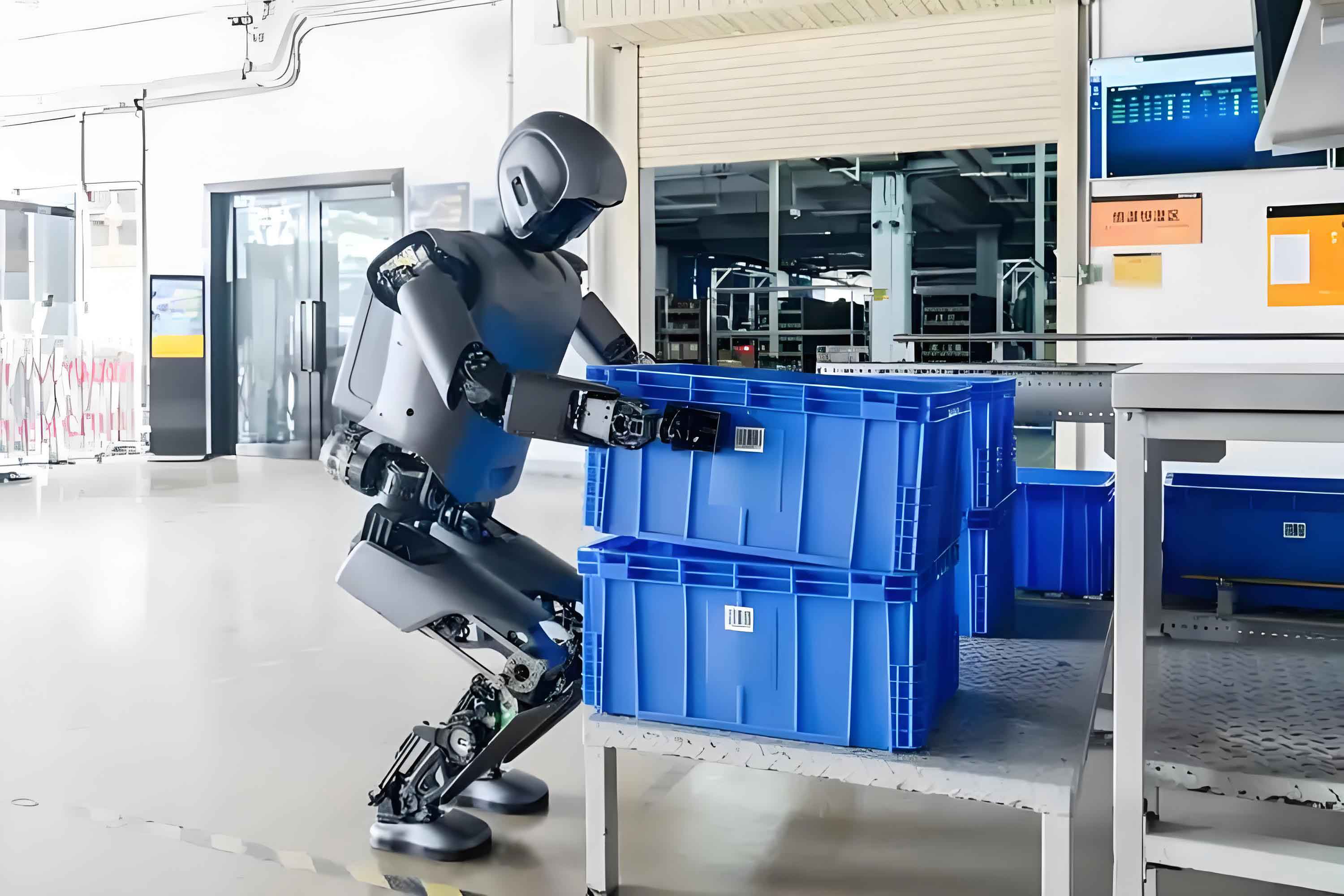
As I envision the future, intelligent robots must achieve cognitive leaps, such as interpreting manuals for automatic assembly. This requires transitioning from感知智能 to认知智能 and行为智能, enabled by AI. For instance, natural language processing models can parse instructions, while computer vision guides动作. The loss function in deep learning for such tasks might be:
$$L = -\sum_{i=1}^{N} y_i \log(\hat{y}_i) + \lambda \|\theta\|^2$$
where $y_i$ is the true label, $\hat{y}_i$ is the predicted probability, $\theta$ are model parameters, and $\lambda$ controls regularization. This fosters robust learning in intelligent robots. Challenges outlined in Science Robotics, including新材料,仿生,能源动力,脑机接口,医疗机器人, and伦理安全, will shape research. For example, energy efficiency can be modeled as:
$$E_{\text{total}} = \int P(t) dt$$
where $P(t)$ is power consumption, urging designs for longer-lasting intelligent robots. Ethical frameworks must address autonomy and safety, ensuring intelligent robots benefit humanity.
| Robot Evolution Era | Characteristics | AI Technologies for Intelligent Robots |
|---|---|---|
| Robot 1.0 | Basic automation, standalone operation | Simple control algorithms, no perception |
| Robot 2.0 | Digital integration, visual感知,示教 | Computer vision, trajectory planning |
| Robot 3.0 | Collaborative, cognitive, interactive | Machine learning, semantic analysis,人机交互 |
| Robot 4.0 | Autonomous, self-learning, multi-robot协作 | Deep reinforcement learning,类脑 computing, swarm intelligence |
To propel the intelligent robot industry, strategic planning is essential. We must establish协同创新 environments, develop technical standards for next-gen研发, and nurture innovative talents. The potential of intelligent robots extends beyond industry to societal transformation, from healthcare to environmental monitoring. In our work, we have applied intelligent robots in特种服务, such as power grid maintenance during ice disasters and pandemic response, showcasing their adaptability. The mathematical foundation for multi-robot协作 can involve graph theory, where robots are nodes in a network $G = (V, E)$, and协同 is achieved through distributed optimization:
$$\min \sum_{i \in V} f_i(x_i) \text{ subject to } g(x) \leq 0$$
This enables efficient task allocation among intelligent robots. As we advance, the融合 of AI with robotics will unlock unprecedented capabilities, making intelligent robots more resilient and intelligent. I believe that through continuous innovation, intelligent robots will redefine productivity and quality of life, steering us toward a smarter, more connected world where intelligent robots are ubiquitous partners in progress.